After my sister died, my niece found a large box of papers relating to my mother. She promised to keep it aside for me. I decided to drive to Melbourne during the school holidays and collect the box. I thought I was ready for whatever awaited me.
When I opened my Pandora’s Box containing documents and photos relating to my mother’s life, I felt the equilibrium I had guarded so carefully begin to falter. Feelings of confusion and unease came at me like a dust devil. My first reaction was to shut the lid quickly and contain the storm. Even imagining what might be inside began to wreak havoc with my mind. Without realising, my mother’s curse from when I was sixteen made me not want to touch the contents. Her words flooded back, ‘remember this for as long as you live. I curse every single object I have ever touched.’ Yet I knew I had to face whatever the box contained and I would do so in my own time. What I knew for certain was that I would not be taking the box home with me. If I did, I might never find the courage to open it again.
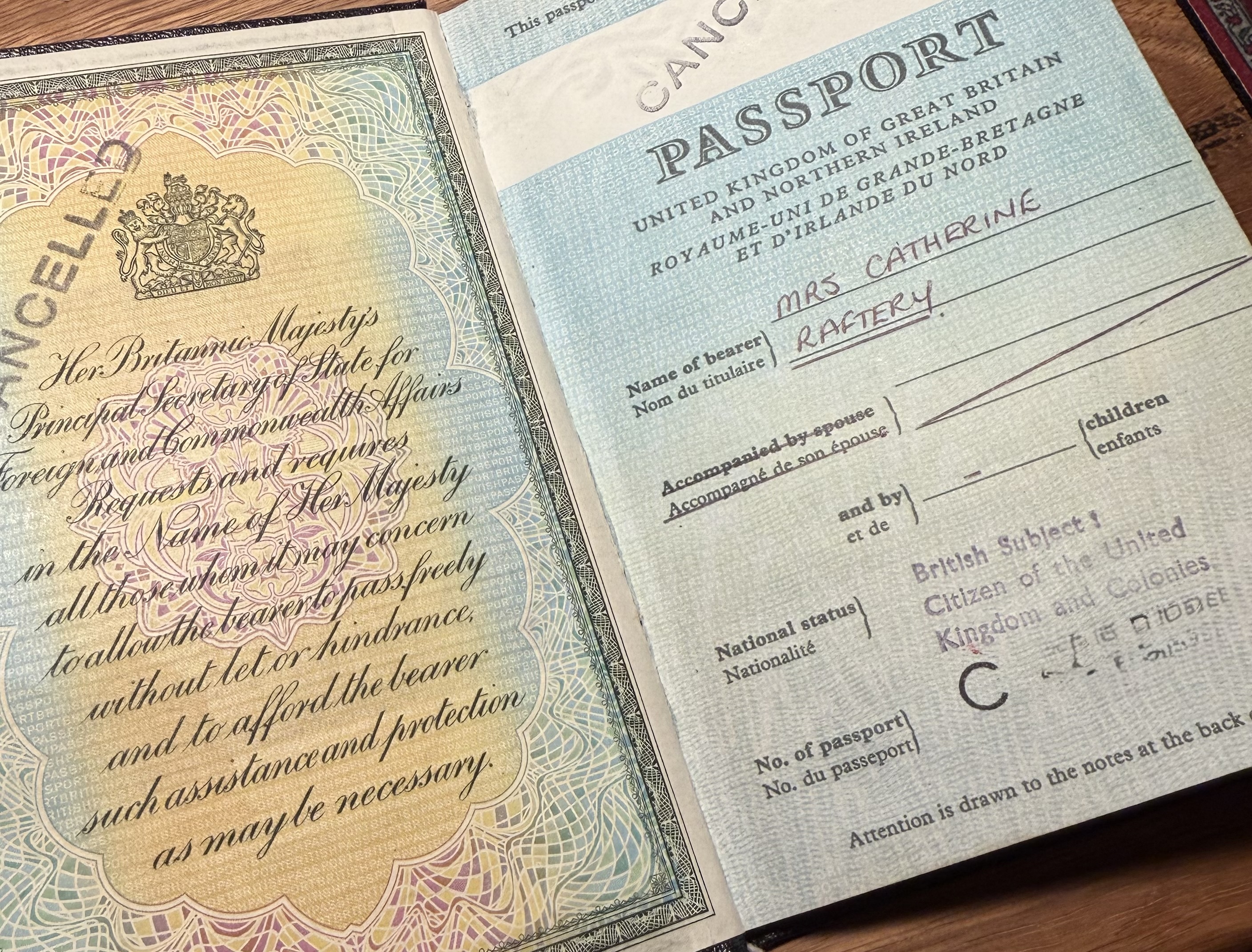
The square, floral box contained the paltry remnants of her life. Expired British passports in the name of Catherine Raftery, dozens of letters from a friend called Edith who lived in Austria but wrote in Hungarian, psychiatric reports that contributed to the State Trustees taking charge of her affairs as her guardian, and a photo album in which the only person I recognised was my mother growing older as I turned the pages. None of it made sense to me. What was I expecting? A photo album with pictures of myself, my sister and my father? She had remarried, travelled the world, lived on a farm for a while until her husband died. Then she spent the last eight or so years living with my sister, where she is remembered for often being drunk and argumentative. She died when she was 89 years old. I had been in her life for no more than ten or eleven years.
The psychiatric reports make for some interesting reading. My mother gave different versions of her life prior to meeting Patrick Raftery. In 2005 in a psychiatric report my mother stated that ‘her husband [my father] became involved in drug use and committed suicide in 1975. She was distressed by his death.’ Then, ‘she remained in contact with her daughters by letter.’ Neither statement is true, and the date my mother gave for my father’s death was wrong too.
In 2007, a psychiatrist stated that ‘Mrs Raftery’s account of her background was at times difficult to follow.’ This time, my mother claimed that she moved to Austria and then to Australia in 1971 with her daughter Palma. She then married again in 1977. In this version, there is no mention of my father or me. The psychiatrist also stated that ‘Mrs Raftery denies symptoms of depression, anxiety, elevated mood and psychosis.’
Marrying Patrick Raftery not only gave my mother a new name but also gave her access to the European Union through her British passport before Brexit. She could travel back to Hungary and stay for as long as she pleased. She may have lived in Australia but her identity remained firmly Hungarian.
My roots have always been more complex. My parents were refugees from Hungary, a place they called their homeland, but I was a refugee in my birth place and every place I have lived since. I became an Australian citizen when I was 18, but it took many more years to grow into myself and find my own way of being in the world. A passport could make me a citizen, but by itself it wasn’t enough to bridge that no man’s land in my heart. Perhaps that is why I think so often about what it means to belong.
Today, at the Canberra Writers’ Festival, I heard a striking answer to that question from Ian Hamm, an eminent Yorta Yorta man from Shepparton. When asked, ‘What is one good thing about being Aboriginal?’ he answered, ‘I know where I belong,’ or maybe he said, ‘I know I belong.’ He uttered these words with unshakable confidence, even though he is a survivor of the Stolen Generation. Belonging to his Country and his People is an ancestral inheritance that no one can take away from him. There is a profound beauty in that surety of belonging. His answer took my breath away. It filled me with a deep reverence and quiet longing.