
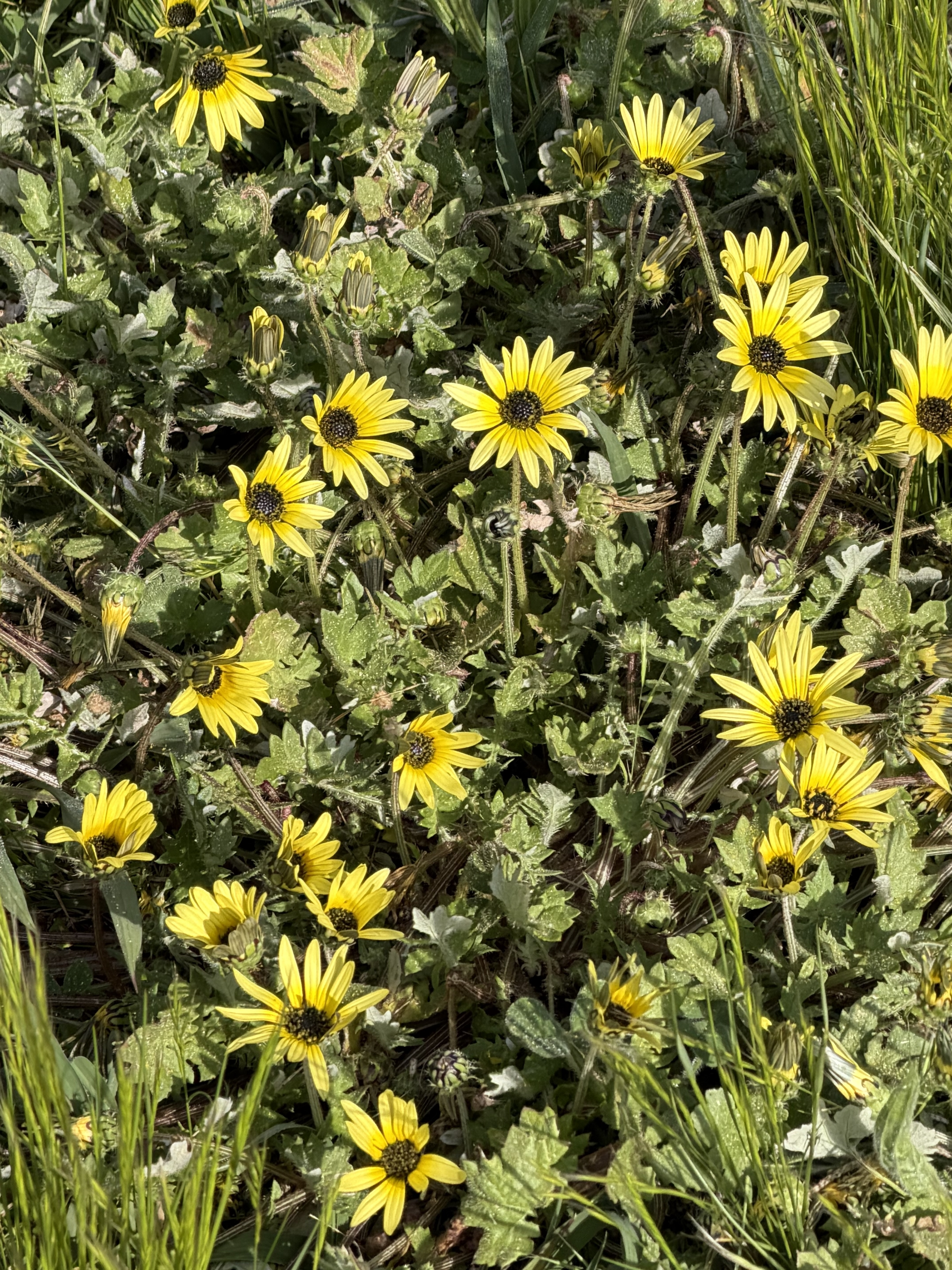
I’ve been away for the best part of a week. On my return, I was greeted by a blanket of yellow daisy-like flowers in the reserve across the road. My first reaction was that they looked quite pretty, but of course a plant springing up in such numbers points to a weed infestation. A quick Google search informed me that I was looking at Capeweed. While we consider it a weed here in Australia in South African, it is a pretty little native wild flower by the name of Arctotheca calendula. The name Capeweed alludes the Cape of Good Hope.
A weed is simply an unwanted plant growing in the wrong place. Some weeds, of course, are much worse for the environment than others, especially those that take moisture and nutrients away from neighbouring plants or displace natives. However, even weeds have their place. Capeweed often grows where the soil has been disturbed, quite possibly by the foot traffic of us dog owners in the area. For now, it covers patches of bare ground and where grass used to be, though it will die back in summer. Our four-footed friends may also carry its seeds further afield. Yes, it indicates an imbalance in that particular ecosystem, but that is hardly surprising in a built-up urban area.
Some weeds have useful functions, such as dandelions, which can be used in salads or made into tea or a caffeine-free coffee substitute. Mint is another example of a plant that can be useful in cooking but can take over a garden in no time, becoming a pesky weed. I have spent many a day pulling unwanted mint from my garden even though I love mint tea.
I am lucky that I don’t have to deal with Capeweed in my garden. It can be difficult to pull out because of its deep taproot. If the root breaks, the plant soon returns. But across the road, I can admire the yellow flowers and be happy for the bees and the young girls who sit and make daisy chains. Perhaps, like beauty, a weed is in the eye of the beholder.

