The No-Man’s-Land in My Heart

After my sister died, my niece found a large box of papers relating to my mother. She promised to keep it aside for me. I decided to drive to Melbourne during the school holidays and collect the box. I thought I was ready for whatever awaited me.

When I opened my Pandora’s Box containing documents and photos relating to my mother’s life, I felt the equilibrium I had guarded so carefully begin to falter. Feelings of confusion and unease came at me like a dust devil. My first reaction was to shut the lid quickly and contain the storm. Even imagining what might be inside began to wreak havoc with my mind. Without realising, my mother’s curse from when I was sixteen made me not want to touch the contents. Her words flooded back, ‘remember this for as long as you live. I curse every single object I have ever touched.’ Yet I knew I had to face whatever the box contained and I would do so in my own time. What I knew for certain was that I would not be taking the box home with me. If I did, I might never find the courage to open it again.

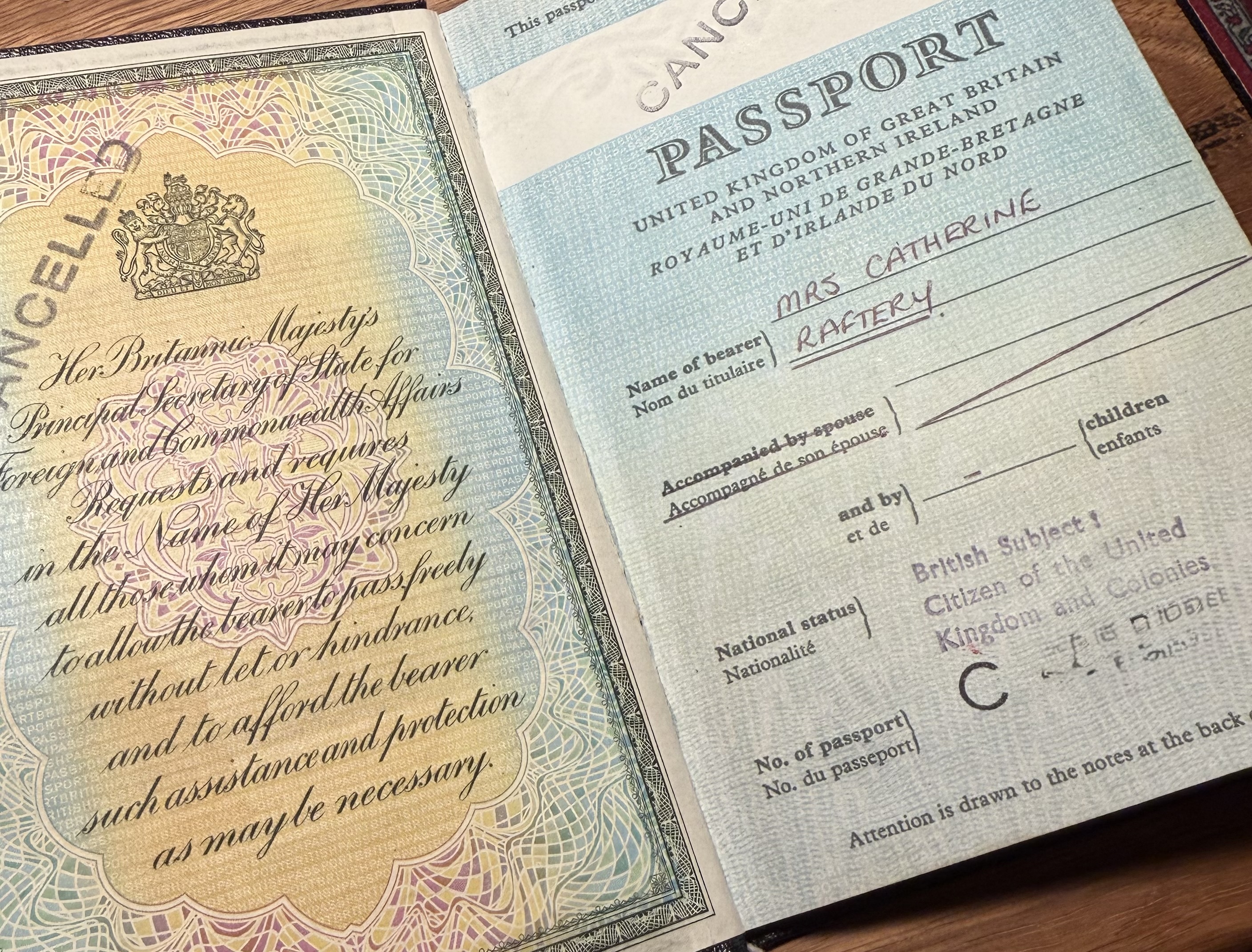
The square, floral box contained the paltry remnants of her life. Expired British passports in the name of Catherine Raftery, dozens of letters from a friend called Edith who lived in Austria but wrote in Hungarian, psychiatric reports that contributed to the State Trustees taking charge of her affairs as her guardian, and a photo album in which the only person I recognised was my mother growing older as I turned the pages. None of it made sense to me. What was I expecting? A photo album with pictures of myself, my sister and my father? She had remarried, travelled the world, lived on a farm for a while until her husband died. Then she spent the last eight or so years living with my sister, where she is remembered for often being drunk and argumentative. She died when she was 89 years old. I had been in her life for no more than ten or eleven years.

The psychiatric reports make for some interesting reading. My mother gave different versions of her life prior to meeting Patrick Raftery. In 2005 in a psychiatric report my mother stated that ‘her husband [my father] became involved in drug use and committed suicide in 1975. She was distressed by his death.’ Then, ‘she remained in contact with her daughters by letter.’ Neither statement is true, and the date my mother gave for my father’s death was wrong too.

In 2007, a psychiatrist stated that ‘Mrs Raftery’s account of her background was at times difficult to follow.’ This time, my mother claimed that she moved to Austria and then to Australia in 1971 with her daughter Palma. She then married again in 1977. In this version, there is no mention of my father or me. The psychiatrist also stated that ‘Mrs Raftery denies symptoms of depression, anxiety, elevated mood and psychosis.’

Marrying Patrick Raftery not only gave my mother a new name but also gave her access to the European Union through her British passport before Brexit. She could travel back to Hungary and stay for as long as she pleased. She may have lived in Australia but her identity remained firmly Hungarian.

My roots have always been more complex. My parents were refugees from Hungary, a place they called their homeland, but I was a refugee in my birth place and every place I have lived since. I became an Australian citizen when I was 18, but it took many more years to grow into myself and find my own way of being in the world. A passport could make me a citizen, but by itself it wasn’t enough to bridge that no man’s land in my heart. Perhaps that is why I think so often about what it means to belong.

Today, at the Canberra Writers’ Festival, I heard a striking answer to that question from Ian Hamm, an eminent Yorta Yorta man from Shepparton. When asked, ‘What is one good thing about being Aboriginal?’ he answered, ‘I know where I belong,’ or maybe he said, ‘I know I belong.’ He uttered these words with unshakable confidence, even though he is a survivor of the Stolen Generation. Belonging to his Country and his People is an ancestral inheritance that no one can take away from him. There is a profound beauty in that surety of belonging. His answer took my breath away. It filled me with a deep reverence and quiet longing.

When a Stranger Calls Your Name

Photograph by John Harding originally posted on Friends of Watson Greenspace Facebook page

It takes about a year for me to feel that I have arrived in a new place. I have moved cities often enough to recognise this pattern. Sometimes waiting for that moment feels like an eternity, as it did when I first moved to Sydney while other times, it feels as if it has taken no time at all. Canberra falls in the latter category.

While I have felt at home in my new place very quickly, I didn’t know anyone besides my daughter and her friends when I moved. Then, a couple of months later I met my first friend at the dog park. She lives on the same street as I do, and we meet up for drinks or dinner every now and again.

I am known at the local shop but not by name. People are more likely to say hello to my dog Zoë who wears her name on her harness than they are to say hello to me. Of course this is very common. Even Markus Zusak says that when he is out without his dogs, he becomes invisible to people on the street.

Can you imagine my surprise when a man with a camera hanging from his neck called out to me, ‘Are you Viktoria?’ It turned out, he was the local wildlife photographer who posts the most stunning photos of birds, dogs and kangaroos that visit the nature reserve across the road from me. I have been liking his posts for months and occasionally writing a comment, especially when he posts shots of tawny frogmouths. He must have looked at my name and found a picture of me. Now, he kindly showed me the tree where they were roosting, and I saw the three babies with their parents with my own eyes. It was a truly awe-inspiring sight, and I was grateful that he shared his knowledge of birds freely.

I thanked him and continued on my way. Zoë was getting impatient for her walk. However, after about 200m we were stopped again. This time, an older woman called out, ‘excuse me but do you have a friend in Sydney who lives in Dulwich Hill?’ Once more, I was flummoxed. Turns out she had moved to Watson recently, was given my number, but hadn’t made the call as yet. She recognised me because of Zoë. I guess there aren’t many black standard poodles who walk in this park. We had a chat and decided to catch up for a cuppa later in the month.

Ten months have gone by since I first moved here. So many joyful things have happened, but it wasn’t until I was recognised by strangers that I felt I had truly set down roots. It feels like I am part of the suburb and part of this community. I feel calm in the familiarity of the trees, the pond and the paths that I take daily. But hearing my name said out loud carried a particular weight, as though the world had suddenly recognised me within it. It was a fleeting moment of quiet significance, a moment when I felt connected to the place and the person who has called me into being out of my own thoughts and into the time and space we both inhabited.

And so, I have finally arrived.

The Blue Mountains Writers’ Festival

I have wanted to attend the Blue Mountains Writers’ Festival for many years. Each year as the dates approached, I found a ‘reason’ why I couldn’t go.

What about the animals while I am away?

I can’t justify spending the money this year.

I should have gone when I was living in the mountains, now it’s too late.

It will take me at least two and a half hours to get there.

I don’t belong to a writerly crowd.

Who am I to think I can go to an event like this?

When I examined each of these thoughts in turn, I realised that I was shying away from the real reason I never went. I felt awkward attending an event on my own and I didn’t want to face discomfort. It was never about the event per se, but the intervals where people stand with their friends, chatting, laughing and having a good time.

I am not someone who can walk into a room and start a conversation. I usually stand on my own like a shag on a rock staring into a drink or trying to focus on some detail on the wall. I could distract myself with my mobile, and sometimes I do, but I am so appalled by such behaviour in others that I can’t bear resorting to it.

Yet if I have a role, I can be gregarious and helpful. I don’t even mind talking to a crowd of people over a microphone. Speaking to a group of two hundred doesn’t faze me at all, it is small groups that I find terrifying. Give me something to do and I will do it. Consequently, you often find me either at the food table or taking plates around, which legitimately allows me to approach people.

This year I decided to become savvy. The moment I saw a request for volunteers, I put up my hand. I was thrilled to be accepted. It meant I could spend some time wearing an official T-shirt and lanyard which would give me a role and I would also have time to attend events. It’s what Stephen Covey calls a Win/Win.

It turned out to be much better than that. I met wonderful volunteers with whom I could converse easily, I chatted to speakers informally in the Green Room and I contributed to an event that was an important and enriching experience for everyone. The volunteer role enabled me to start conversations and, as my confidence grew, I continued to seek out more opportunities.

The more I let my vulnerabilities show, the more others disclosed their own sensitivities. Our conversations moved from the superficial to the deeply personal and established connections which I hope will continue well past the festival weekend. It made me realise how important it is to find my own ‘tribe.’

Then there were the writers. The ones I heard spoke with honesty, often self-deprecating humour, and they were generous with their time. There were many sessions running concurrently, which meant I inevitably missed some brilliant speakers. It was a sentiment I heard echoed in the hallways wherever I went. So, although I had some trepidation about attending, by the end of the weekend, I felt energised, inspired and comfortable in my own skin.

I am grateful to Varuna for organising such an eminent event and for their staunch support of Australian writers.