The Secret Language of Feathers

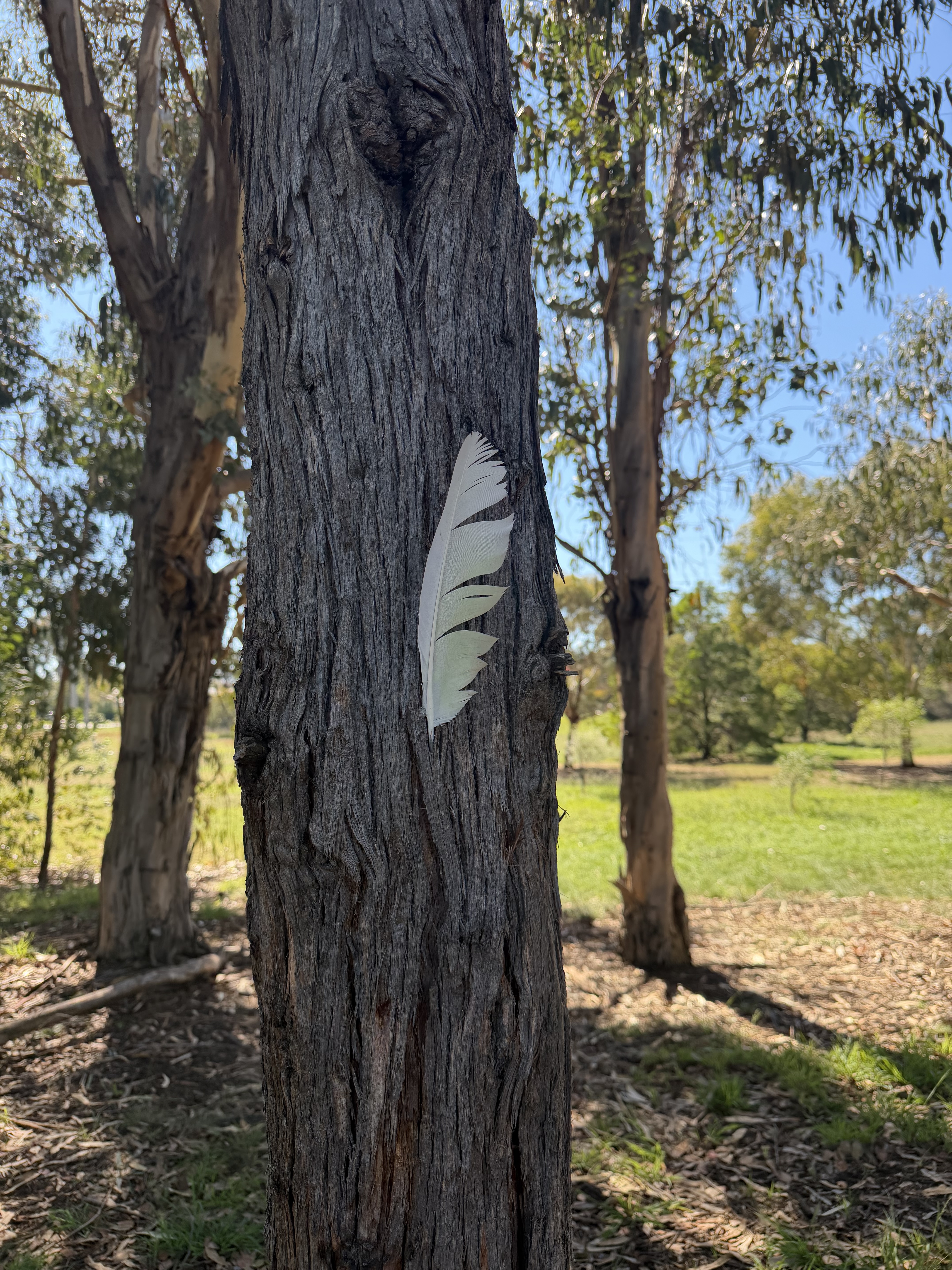
White cockatoo feathers adorn a row of trees on my daily walk. They sit slightly below shoulder height, which makes me think they were placed there by children, perhaps eight years old or older. They have intrigued me for a while now, appearing along the path and then closer to some fences, as though marking something only a few people can see.

I have asked several adults with children whether they knew anything about the feathers, but none of them had even noticed them, despite their prominence. Once I point them out, they too begin to see them everywhere, though they seem less curious about them than I am. Most agree they are probably part of a game some children are playing in the park.

I remember playing cowboys and Indians as a child. No doubt, if there had been cockatoo feathers to be found, I would have made them part of an Indian war path. Of course, I had no understanding then of cultural misappropriation or the colonial stories I was absorbing. I simply liked running around with my pop pistol, shooting into the air and pretending to be a cowboy. I even had cigarette shaped lollies that I pretended to smoke. Dear Lord!

I wonder what these children are playing. Are they marking the way to a clubhouse? Do the feathers carry meaning, like a white flag for peace? I doubt it. That feels like a very adult reading of the symbol. It is more likely to be something enchanting, a secret pathway leading somewhere only they know and understand. Perhaps the feathers are signs left for other players to follow, guiding them towards a place that looks ordinary to the rest of us but has been transformed entirely by imagination.

I like the idea that they are not only playing with other children but also with adults who cannot decipher the code. Could the feathers be territorial markers? This is our place. Do not trespass. Or perhaps they protect the magical world the children are about to enter, charms that keep adults and other dangerous creatures away. Then again, maybe it is simply a treasure hunt. Follow the feathers and you will find the prize.

For me, the real treasure lies in the imagination of the children who created the game. They are outside amongst trees and dirt and wind, inventing meaning from feathers and pathways. They are transforming an ordinary suburban park into another world entirely. There is something deeply hopeful in that in an age dominated by screens.

Getting children (and adults) outside allows for exploration of the natural world, which has a calming and centring influence. It improves fitness through walking, running and jumping, movements often missing from our sedentary lives. I believe it also feeds the imagination. Watching birds, finding feathers, collecting interesting sticks and leaves, all invite children to invent stories and find possibilities through play. Adults don’t do this often enough, even though research tells us imaginative play is crucial for cognitive and social development. And let’s not forget, imaginative play can bring immeasurable joy.

The Power of Small Conversations

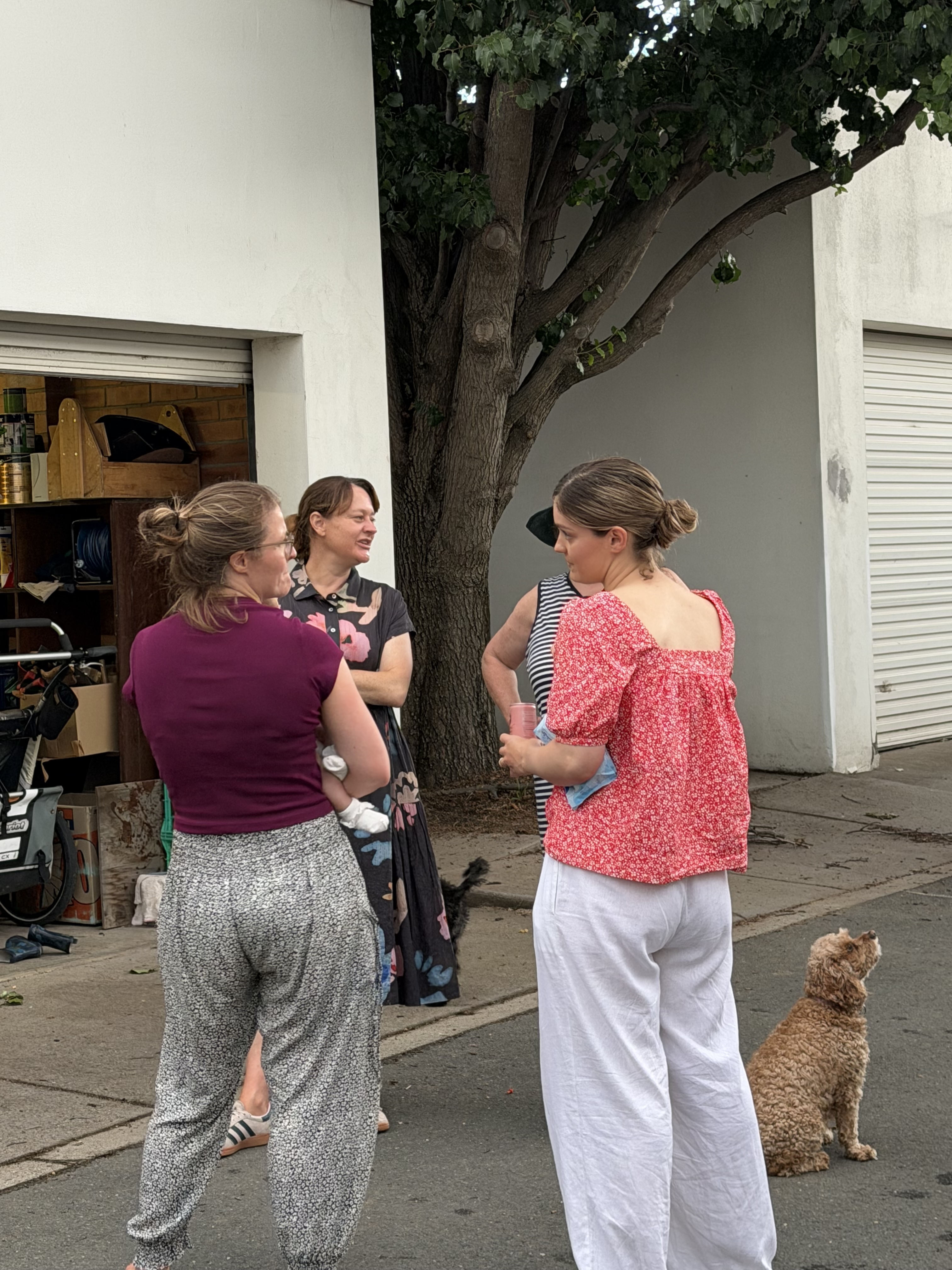
A deliberate effort to engage in conversations with strangers has enriched the past week in ways I would never have predicted. Each encounter, however small, stayed with me and made me think more deeply about the inner lives of people we rarely come to know.

Lining up at the chemist, I heard the woman say, ‘I’m such a luddite.’ I couldn’t help myself. ‘Do you know the history of the Luddites?’ I asked. She did, and we had a slightly conspiratorial conversation about the Industrial Revolution and the loom weavers who sabotaged machinery, some by throwing wooden clogs into the works. We walked away with a hint of mischief between us.

While walking the dog, a woman I vaguely knew said hello. ‘I haven’t seen you for a while,’ I said. ‘I’ve had some surgery and I can’t do much exercise until it heals,’ she replied. She then told me about her nightmare of having to remove breast implants and how she wishes she could warn young women about the very real dangers that can follow. It was a completely honest conversation that allowed her to be vulnerable with someone she didn’t know. She acknowledged her insecurities had led her down the path of cosmetic surgery and recognised that the only person who benefitted was the surgeon. It takes guts to be this brutally honest, and I don’t even know her name.

Later in the week I braved the city mall to replace my phone’s screen protector. It had been shattered for months. At the Apple Store I was greeted by a woman in her thirties who asked about my granddaughter and then started to tell me about her own family. She spoke about the complexity of the feelings she experienced leaving her two-year-old after returning to work. She seemed to recognise in me an older woman who would understand the inner conflict she was navigating. We chatted while she fixed my phone and by the time I left, we had established a real human connection that is rare to come across.

Today I went to explore an upmarket second-hand clothing store at an Anglican church. They were having a 50% off sale I had read about in Region Canberra. I found three items and when I went to pay, I struck up a conversation with one of the volunteers. They were making room for winter stock and needed to clear the leftover summer items. She explained that the summer clothes would be sent to Maningrida, in West Arnhem Land. ‘I’ve been there!’ I exclaimed. This was all that was needed for her to tell me about hosting a young Aboriginal woman from Maningrida for a week. Years later, she still remembered her with great fondness.

Each of these encounters reinforced our shared humanity. We participated in telling authentic stories that made our experiences feel valuable. As people, we make sense of the world through our stories. We create empathy by sharing what matters to us. When used in this way, stories serve to unite us.

Perhaps this is our superpower.