The microclimates of different suburbs are most recognisable at this time of year. In some places, the trees are only just moving from budding to flowering, while in others the open blossoms are already wind-blown and slowly moving to the next part of their cycle. Blink and you are likely to miss it.
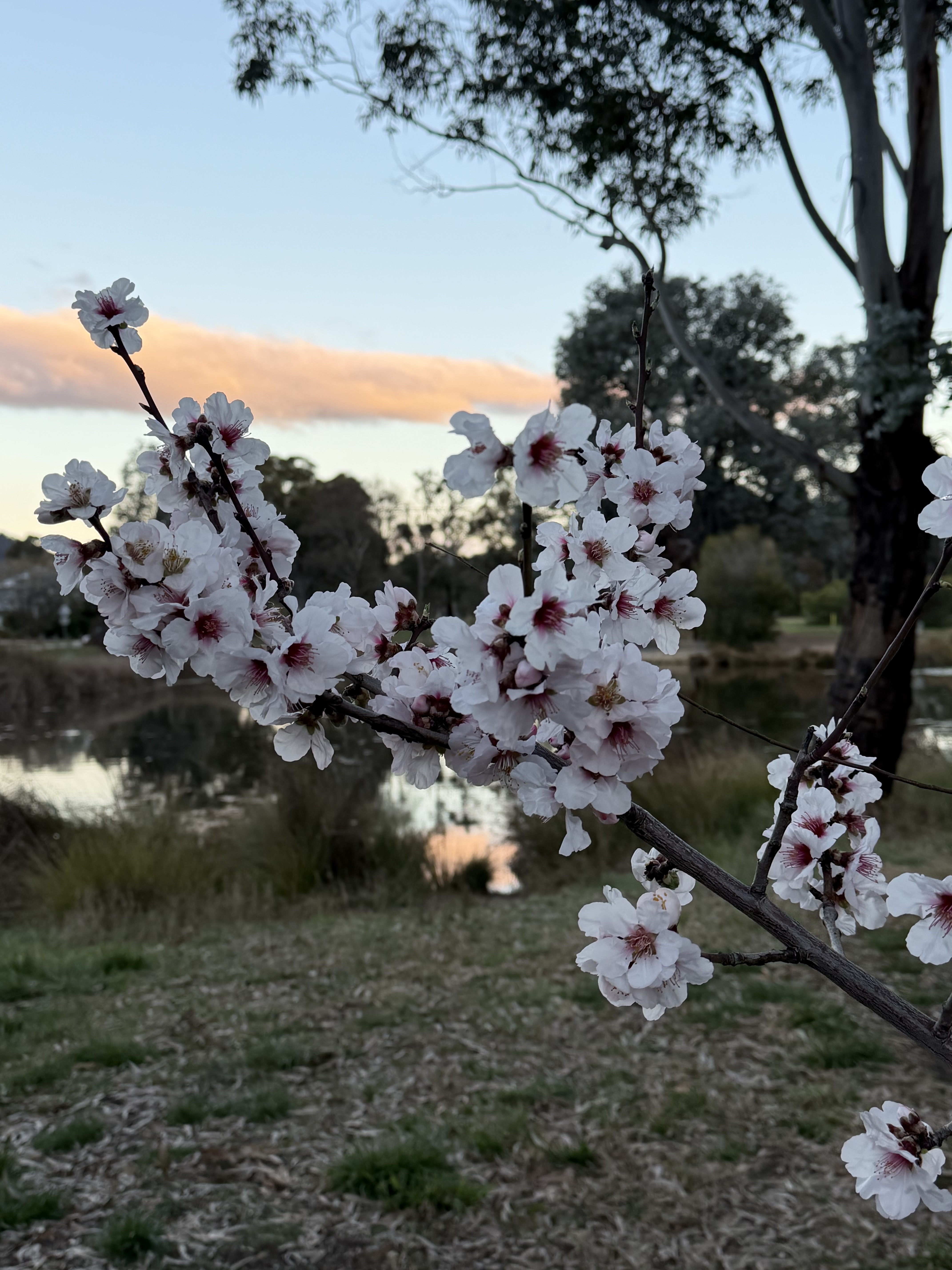
One morning a fortnight ago, I was delighted to come across a naturalised fruit tree on my dog-walking path. From its pale blossoms and distinctive magenta centres, it is most likely an almond tree. In the few years that I have been here, the tree has not grown much. Yet every spring, it puts on a magnificent show for all who walk past it. On a whim, I took a photo of the blossoms and sent it to my cousin, for whom the season is also changing. His world is moving towards the cool of autumn.
This morning, as I walked the dog, I stopped at the tree to have another look. I was surprised to see that many of the flowers had dropped and the tree no longer looked as glorious as it had. All in the space of two weeks. It made me think of the changes we all go through, hardly noticeable from day to day until we look in the mirror and realise how much the person looking back has changed. Viewed through the lens of the seasons, this makes perfect sense. Why should we be surprised when we, too, are part of nature’s great cycle? Perhaps the scraggly little tree had not lost its glory at all. It was simply moving into its next season, as we all are.
Whenever I return from Europe, it is the daily punctuation of bells that I miss. From churches and town halls, they mark the passing hours and quarter hours. For centuries, their sound helped people keep track of time, long before clocks and watches became common.
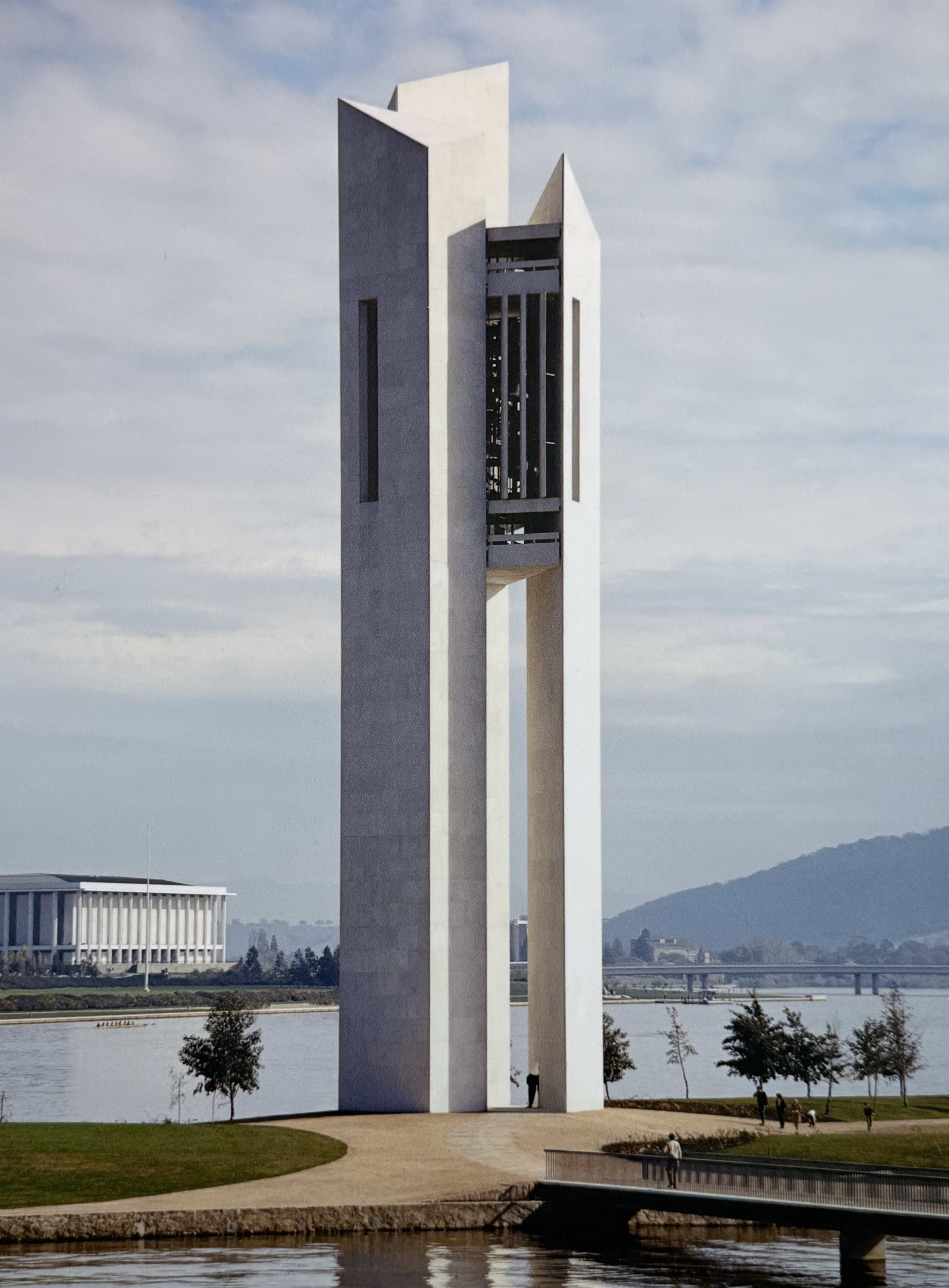
When I saw an advertisement to tour the National Carillon here in Canberra, I immediately signed up. I had no idea that traditional carillons were so rare as I have worked at Sydney University where I heard the Carillon played daily and I also worked at Bathurst where one of my friends is a carillonist. I never realised how privileged I was to have heard all three of the traditional carillons in Australia.
To be classed as a carillon, the instrument must have at least 23 bronze bells and be played by hand using a baton keyboard. The carillonist strikes the baton with the bottom of a loose fist and may also play some notes with foot pedals. The National Carillon has 57 bells and today I had the pleasure of playing some random notes that reverberated across a couple of nearby suburbs. The highlight of the tour was taking the lift into the belltower and seeing the largest bells that ring out majestically over Lake Burley Griffin. The biggest bell weighs six tonnes, and I felt its rich resonance with my whole body.
I savour their varied voices, some high pitched and almost tinny, others with tones so low that they feel like pure vibration. To stop and listen until the last reverberation dissipates is a habit I have learned to nurture. I first came across it in Buddhist meditation, where the bell is a reminder to return to the present. And so, for a moment, I allow myself to be enveloped in pure sound and simply be.
We were a group of strangers walking silently through the Banksia garden at the Canberra Botanical Gardens. Tasked with following our hearts to the plants that drew us in, we spent half an hour exploring the area. We took photographs and made notes which would later lead into a nature journaling and painting session.
Our instructions were to be curious, examine our plant in detail and make notes about our observations. We were to include the date, time and weather information as well as any other data we could gather. While I loved the idea, my brain took a different turn and I began to think in metaphors and ponder the questions that came to mind.
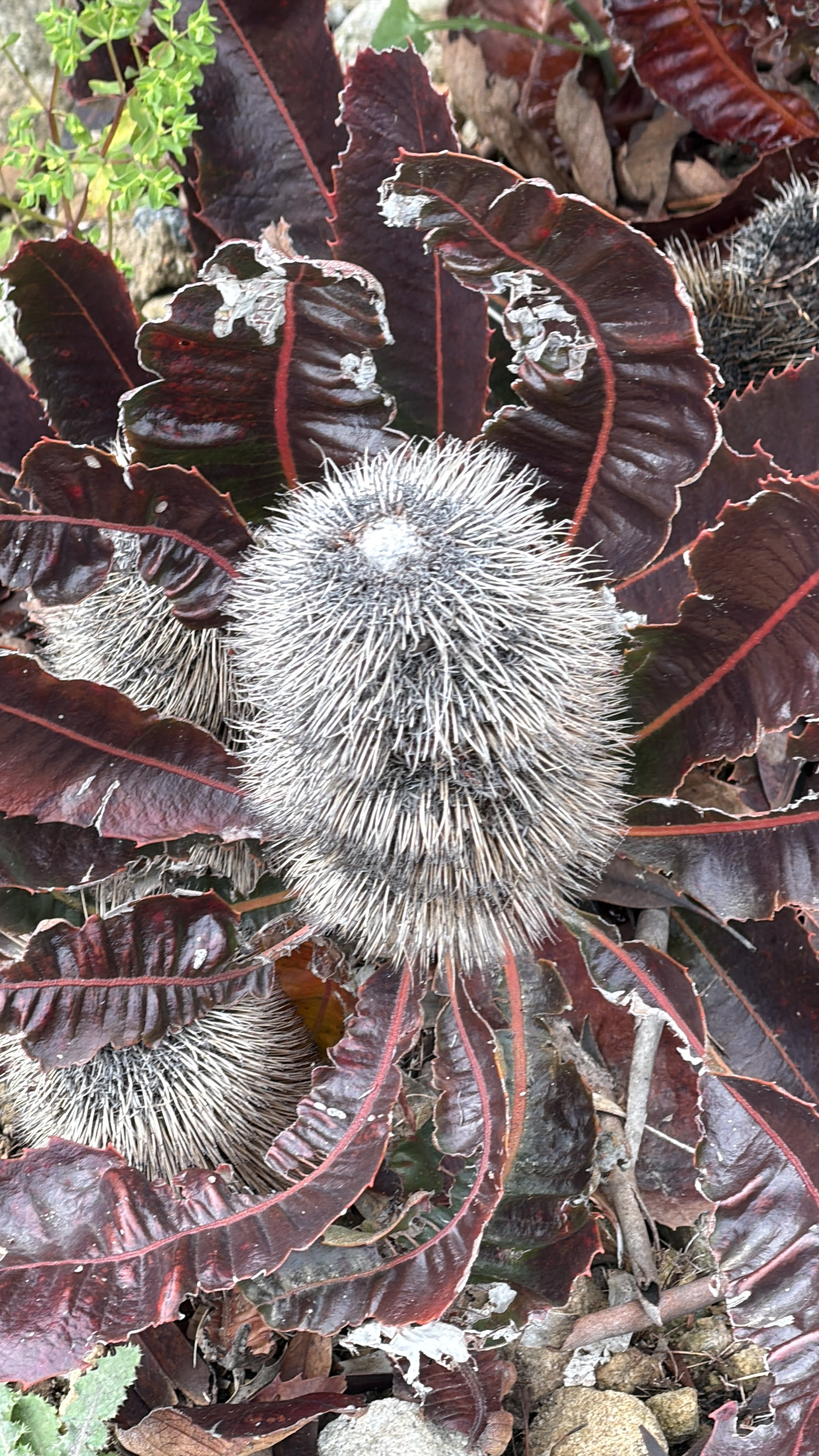
The plant that chose to reveal itself to me was a Banksia robur. This plant can tolerate a wide range of growing conditions, including swamps and sandy environments. I was drawn to the rhubarb coloured leaves at the bottom of the plant as well as the bright flowers at the top. As the flowers fade, the inflorescence, or cluster of hundreds of individual small flowers, turns grey before becoming the woody seed pods that we associate with banksias. It struck me that every stage of the flowering was not only beautiful in its own right but also contained within it the lifecycle of the plant.
What drew me in was the greying flower at the bottom of the plant with the brighter flowers above it. It reminded me of an upside down family tree. I identified strongly with this greying flower, nurturing the youthful generations above it. I called the flower Grandmother Banksia, in recognition of my recent transition to this stage of life. This greying flower exuded a beauty of its own; no longer radiant in its vivid colouring, yet soft and solid. There at the base of the shrub, it would eventually transform into a pod that held within it the possibility of rebirth after a future fire event released the seeds to germinate.
Looking at Grandmother Banksia, I felt at peace with the process of ageing. There is so much that I can still offer to the generations that come after me, as well as to my own generation. I may no longer attract bees with my sweet honey, but there is a strength and solidity that only age can reliably offer. This is my gift.
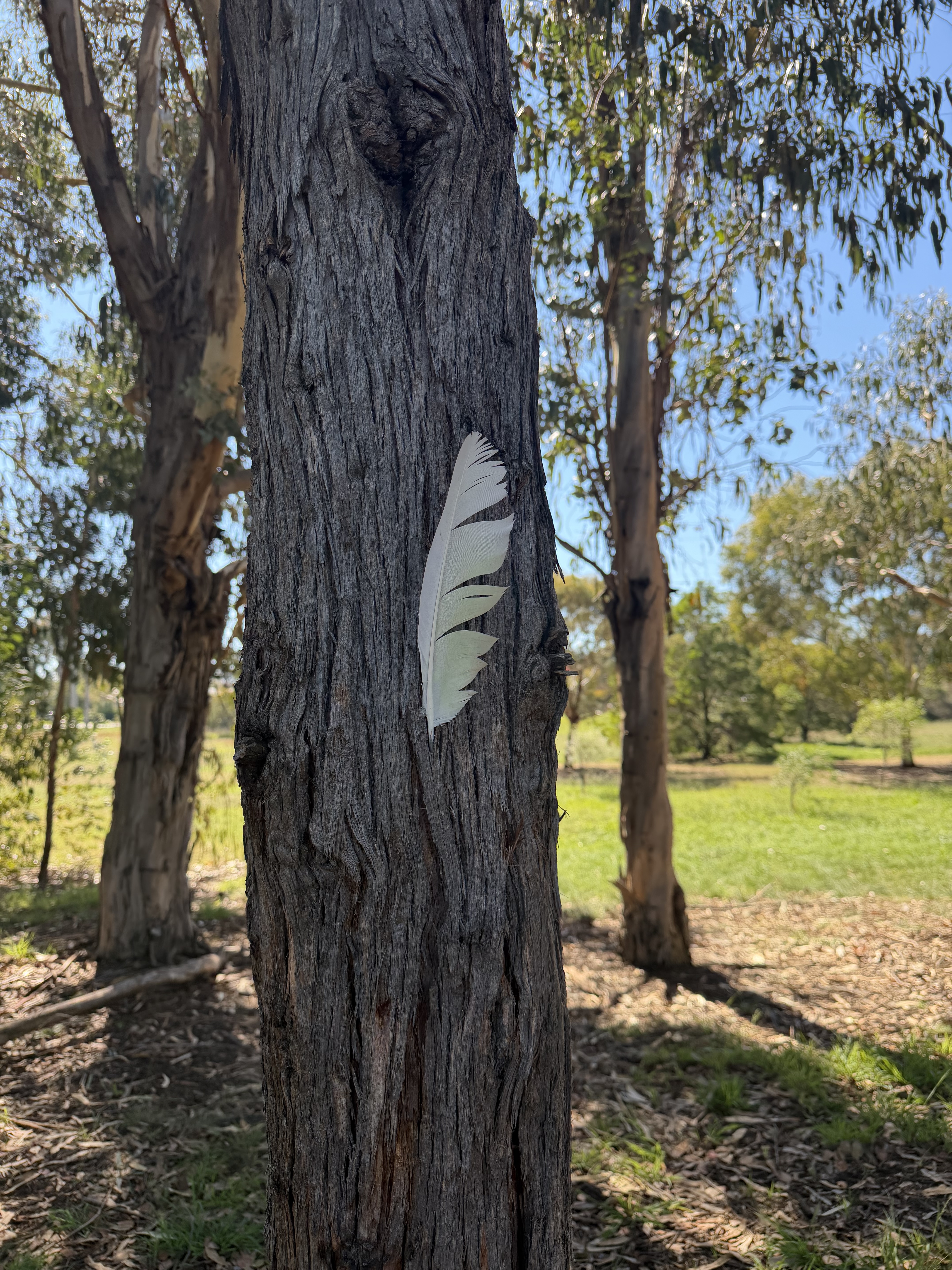
White cockatoo feathers adorn a row of trees on my daily walk. They sit slightly below shoulder height, which makes me think they were placed there by children, perhaps eight years old or older. They have intrigued me for a while now, appearing along the path and then closer to some fences, as though marking something only a few people can see.
I have asked several adults with children whether they knew anything about the feathers, but none of them had even noticed them, despite their prominence. Once I point them out, they too begin to see them everywhere, though they seem less curious about them than I am. Most agree they are probably part of a game some children are playing in the park.
I remember playing cowboys and Indians as a child. No doubt, if there had been cockatoo feathers to be found, I would have made them part of an Indian war path. Of course, I had no understanding then of cultural misappropriation or the colonial stories I was absorbing. I simply liked running around with my pop pistol, shooting into the air and pretending to be a cowboy. I even had cigarette shaped lollies that I pretended to smoke. Dear Lord!
I wonder what these children are playing. Are they marking the way to a clubhouse? Do the feathers carry meaning, like a white flag for peace? I doubt it. That feels like a very adult reading of the symbol. It is more likely to be something enchanting, a secret pathway leading somewhere only they know and understand. Perhaps the feathers are signs left for other players to follow, guiding them towards a place that looks ordinary to the rest of us but has been transformed entirely by imagination.
I like the idea that they are not only playing with other children but also with adults who cannot decipher the code. Could the feathers be territorial markers? This is our place. Do not trespass. Or perhaps they protect the magical world the children are about to enter, charms that keep adults and other dangerous creatures away. Then again, maybe it is simply a treasure hunt. Follow the feathers and you will find the prize.
For me, the real treasure lies in the imagination of the children who created the game. They are outside amongst trees and dirt and wind, inventing meaning from feathers and pathways. They are transforming an ordinary suburban park into another world entirely. There is something deeply hopeful in that in an age dominated by screens.
Getting children (and adults) outside allows for exploration of the natural world, which has a calming and centring influence. It improves fitness through walking, running and jumping, movements often missing from our sedentary lives. I believe it also feeds the imagination. Watching birds, finding feathers, collecting interesting sticks and leaves, all invite children to invent stories and find possibilities through play. Adults don’t do this often enough, even though research tells us imaginative play is crucial for cognitive and social development. And let’s not forget, imaginative play can bring immeasurable joy.
A deliberate effort to engage in conversations with strangers has enriched the past week in ways I would never have predicted. Each encounter, however small, stayed with me and made me think more deeply about the inner lives of people we rarely come to know.
Lining up at the chemist, I heard the woman say, ‘I’m such a luddite.’ I couldn’t help myself. ‘Do you know the history of the Luddites?’ I asked. She did, and we had a slightly conspiratorial conversation about the Industrial Revolution and the loom weavers who sabotaged machinery, some by throwing wooden clogs into the works. We walked away with a hint of mischief between us.
While walking the dog, a woman I vaguely knew said hello. ‘I haven’t seen you for a while,’ I said. ‘I’ve had some surgery and I can’t do much exercise until it heals,’ she replied. She then told me about her nightmare of having to remove breast implants and how she wishes she could warn young women about the very real dangers that can follow. It was a completely honest conversation that allowed her to be vulnerable with someone she didn’t know. She acknowledged her insecurities had led her down the path of cosmetic surgery and recognised that the only person who benefitted was the surgeon. It takes guts to be this brutally honest, and I don’t even know her name.
Later in the week I braved the city mall to replace my phone’s screen protector. It had been shattered for months. At the Apple Store I was greeted by a woman in her thirties who asked about my granddaughter and then started to tell me about her own family. She spoke about the complexity of the feelings she experienced leaving her two-year-old after returning to work. She seemed to recognise in me an older woman who would understand the inner conflict she was navigating. We chatted while she fixed my phone and by the time I left, we had established a real human connection that is rare to come across.
Today I went to explore an upmarket second-hand clothing store at an Anglican church. They were having a 50% off sale I had read about in Region Canberra. I found three items and when I went to pay, I struck up a conversation with one of the volunteers. They were making room for winter stock and needed to clear the leftover summer items. She explained that the summer clothes would be sent to Maningrida, in West Arnhem Land. ‘I’ve been there!’ I exclaimed. This was all that was needed for her to tell me about hosting a young Aboriginal woman from Maningrida for a week. Years later, she still remembered her with great fondness.
Each of these encounters reinforced our shared humanity. We participated in telling authentic stories that made our experiences feel valuable. As people, we make sense of the world through our stories. We create empathy by sharing what matters to us. When used in this way, stories serve to unite us.
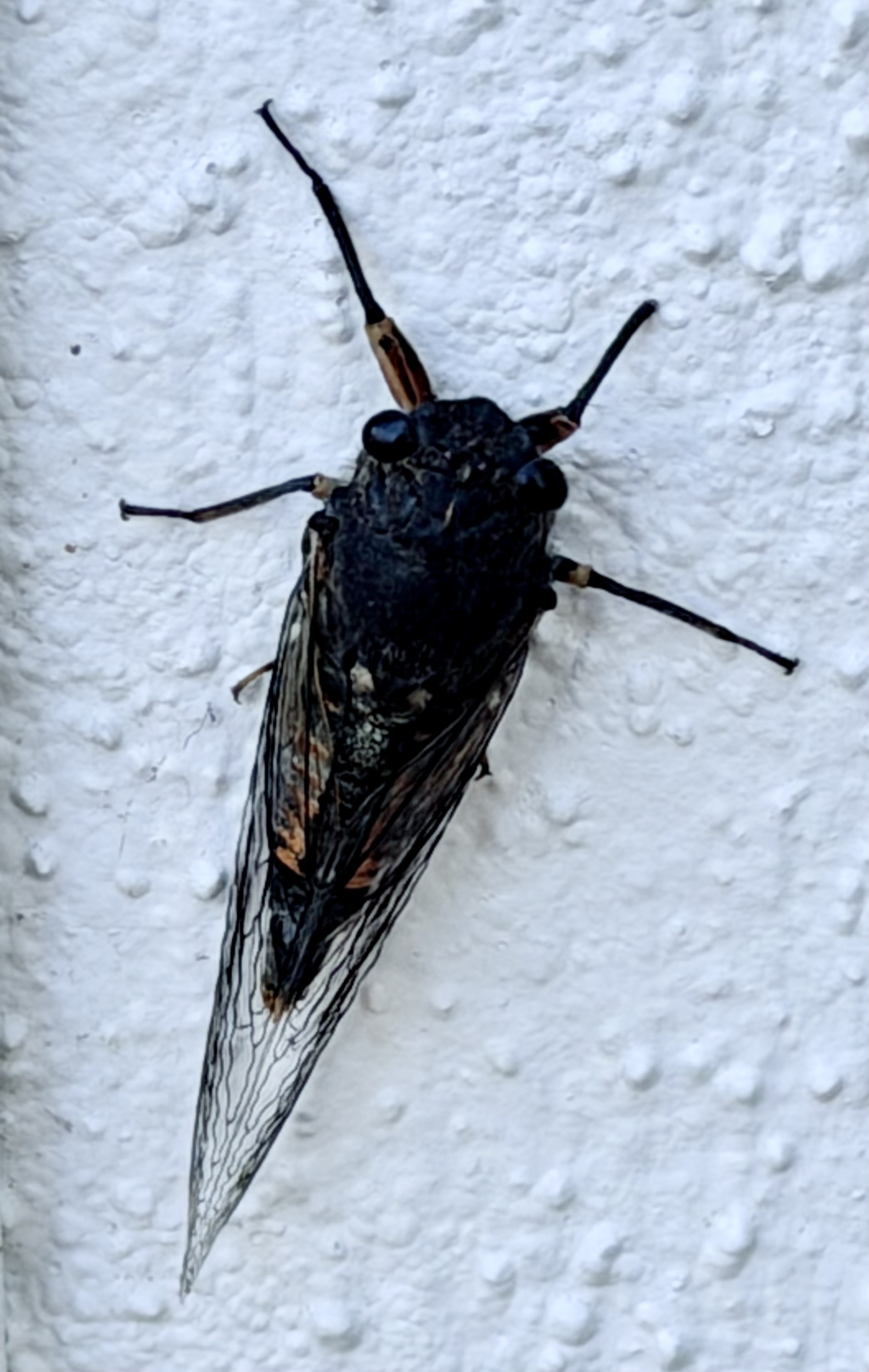
The sound of summer in Australia is the ear-splitting drone of cicadas. On a hot day, different species may be heard, each with their unique song. The sound they make with their tymbals creates the characteristic rhythmic drone. On my walk the other morning, the sound reminded me of a hurdy gurdy used in medieval music.
The closer I listened, the more sounds I heard, including a lower rhythmic quack that punctuated the drone. Intrigued, I recorded the sound and headed home to do some research. The quack quack sound belongs to Red Eyed Cicada and the high pitched deafening drone comes from the cicada affectionately known as the Greengrocer.
The common names of cicadas in Australia are often comical. Here are some of the ones I have come across: Double Drummer, Yellow Monday, Floury Baker and Razor Grinder… They sound like nicknames acquired down the pub after a few beers.
Some years ago, I worked at a school where classes were named after a theme. One year, the whole school was named after insects and I chose for our class to be the cicadas. We collected their shells from trees and learnt about their life cycle. Children often brought in cicadas they had found and after studying them, released them in the playground. At the end of the year, each child was to receive an award which I read out aloud at an assembly. I found 25 different cicada names which I assigned to each child with a sentence or two about their personality. Parents laughter echoed in the hall as I read amusing anecdotes I had collected throughout the year. The kid who liked to tap his pencil on his desk became the Double Drummer, the Black Prince was our Star Wars aficionado. I haven’t thought about that for years.
This year we have had a strange summer. It arrived somewhat late and while there are stinking hot days, the temperatures have also plunged into the teens. It is pretty unpredictable at present. I am not a fan of the hot weather and much prefer autumn and winter, especially in Canberra where temperatures plummet to negative numbers. Yet the sound of cicadas cutting through the summer heat, loud and insistent, brings a measure of joy to even the hottest days.
The first time I saw Lake George was almost 30 years ago. We were travelling to Canberra along the Federal Highway when the lake appeared to our left. It looked like an enormous expanse of water that accompanied us for what seemed like a long time. Later I would learn that the lake is 20 km long and 10 km wide. I thought all of Canberra’s drinking water must come from this enormous lake.
A few years later, we travelled the same route and I was looking out for the large lake. It wasn’t there. All I could see were cattle and sheep grazing where the lake should have been. There were even fences. It struck me that I couldn’t see any creeks that should have fed into a lake. Could I have imagined the expanse of water?
In time, I learnt that the lake regularly empties and fills. There are no creeks that feed into it, which makes it an unusual type of lake, a closed basin. What feeds it is rain and what drains it is evaporation. When it does have water, it is rarely deeper than 1.5 to 2 metres. This was not always the case. I have seen photos from the early 1960s when the Canberra sailing club held regattas on the lake. And in prehistoric times, the lake is estimated to have been 37 metres deep. With the current rate of climate change, Lake George will experience more severe fluctuations, and it may become a dry bed with only occasional filling episodes. So much for my fanciful idea that it could supply drinking water.
I have now lived in Canberra for close to two years. In that time, I have seen the lake fill and begin to drain again. There are cattle at the northern end now and I can see the fences appear again. Looking across the lake, I see a wind farm that one of our ex-politicians, Joe Hockey, described as ‘a blight on the landscape’. It makes me wonder whether he has ever seen an open cut mine. I quite like the look of the wind turbines in the distance.
Last winter, my boss and I had to drive to Sydney a couple of times. When we left Canberra it was still dark, and the sun had just begun to peep over the horizon as we came down towards Lake George. I was mesmerised. The black expanse of water slowly changed to navy, then cerulean. Golden threads shimmered where the sun’s rays bounced off the water. I was glad not to be the driver, so I could immerse myself in the liquid light of the lake.
Lachlan Macquarie named this expanse of water Lake George after King George III in 1820, as if it didn’t already have a name. To the Aboriginal tribes of the area, the lake was known as Weereewa or Ngungara. It has deep significance to the custodians of the land and waters as both a meeting place and a place for ceremonies. There is also strong evidence that there was a massacre at the site sometime in the early 1820s. King George III never set foot on Australian soil. It is time to recognise the custodians of this land and the lake, allowing them to reclaim it with their own language and rightful name. The lake is waiting for us to remember its true name.
When I jump into the deep end of a pool, I can always dog paddle until I find my stroke. This is what life has taught me. I always get to the other side. I may not be a great swimmer but I am buoyant. Knowing this has served me well.
In 2008 I spent a year in Switzerland with my family. It was a crazy opportunity that came out of nowhere and I was willing to take the chance. Arriving in Zurich was like jumping off a diving board. The first week felt like a massive belly flop and I wondered whether I had made the right decision, not only for myself but for my family.
It didn’t take us long to learn some of the idiosyncrasies of our new home. School starts before 8 a.m., shops close for lunch, trains and buses run on time. There were other quite annoying things such as having to do your washing on a Friday (everyone has a designated day), no flushing toilets after 10 p.m. (house rules) and no paracetamol available except at chemists which are closed on Sundays.
I was quite cocky before we left. Why would I have trouble understanding the Swiss, when I understand Swabian and Austrian dialects? What could be so difficult? Well, maybe vocabulary, grammar and pronunciation as a start! It took me much longer than I expected to follow simple conversations. Nor did I expect the Swiss to frown upon my high German. After all, it is meant to be the official language in the German cantons.
As we became increasingly familiar with how things operated, we began to appreciate the small things of life. Wherever we were in the countryside, we’d find a cat in a field, ears pricked up, ready to pounce. We could even spot them from the train! Why do Swiss cats do this and not other cats? It remained a charming mystery.
If land didn’t have a dwelling on it, there were cows grazing there, kept in place by movable electric fences. Behind our nearest bus shelter were three cows and behind them were rows of multi-storey flats. If it wasn’t cows grazing, it was goats. These animals could be found in any of the suburbs of large towns. I grew to love this proximity to farm animals. It made for a slower and much calmer pace.
In 2024, I jumped off the diving board once more, this time to move to Canberra. It wasn’t anywhere near as disorientating as moving to Switzerland but it did feel much more permanent. I had bought a townhouse, changed jobs and began the process of acclimatising. At least I can speak the language here and know how society operates but it still takes time to adjust.
At first, I was confused by the wide streets and wanted to turn into the oncoming traffic not realising that the lanes were one way. Then there were all the roundabouts and roads that go around in circles. I have been caught out more than once with the all-day 40 km school zones with no flashing lights. In fact, I have never had as many fines as I have since moving here. The rules can be quite perplexing!
In Canberra, I can buy a bottle of wine at the supermarket, just as I could in Switzerland. However, when I go to work across the border, this is no longer possible. Lately, I have begun to see other similarities with where we lived in Switzerland. Every morning I drive past ducks that may waddle across the street, only 100 m from a main arterial road. Near the first roundabout as you enter Canberra coming from Sydney, there is a small herd of Angus cows grazing in a paddock that will eventually be turned into medium density housing. I had to laugh when I first saw them.
My drive to work takes me along a stretch of a freeway that has paddocks on both sides. There are agisted horses, cows and small farms all within a ten-minute drive from the centre of the city. I hope this doesn’t change in my lifetime. Next to one of these farms there is a small ‘shop’ that works on an honesty system. Here, I can buy eggs, cheese and honey on my way home. It reminds me of a place in Switzerland which was a ten-minute walk up the hill from our place. We could buy seasonal fruit from the farmer who had a wooden box on the side of the road where we would leave money. Honesty boxes could be found all over Switzerland including deep in forests where 2 Franks could be exchanged for a swig of Absinthe!
Canberra has retained the feel of a large country town with plenty of green space. No wonder it prides itself on being the Bush Capital. Maybe I recognised some of its similarities to Switzerland which I grew to love. I think about this more often as I approach my second anniversary living in Canberra. The longer I spend here, the more I appreciate its beauty, surrounded by farms, nature reserves and the stunning Brindabellas in the distance. I’ve found my rhythm once more; steady, buoyant and much more at home.
The other day I listened to Dr Ellen Langer speak about mindfulness as a way of being rather than a practice. She described the art of seeing the ordinary with fresh eyes, of really looking, really noticing. It struck me how easily the rhythm of daily life can lull us into living on autopilot.
Her talk reminded me of the Buddhist Monk, Thich Nhat Hanh’s definition of mindfulness, doing the ordinary things in life with a sense of purpose and attention, whether that be opening a door or turning on a tap. Each of these little acts can be done either mindlessly or mindfully. Doing it one way we are absent from our life while doing it mindfully we become alive to the present moment. And the present moment, as we know, is the only moment. Whatever happened 5 minutes ago is in past and whatever is coming is in the future. Life can only be lived in the small moments of now.
I have known this for many years but I am not very good at being grounded. My mind takes me hither and dither and I can be quite the scatterbrain. Where’s my phone? My wallet? Did I turn off the lights? Did I just lock myself out? These are daily micro-moments of panic I experience on repeat. My daughter just laughs and says she never gets past counting to 17 before my problem-of-the-moment is resolved!
This morning has been a scattered start. I’m still in my PJs deciding on shower, getting dressed, making to do lists, going to the shop and walking the dog. It really shouldn’t be this hard. Just start with the first logical step (have a shower) and keep going. It hasn’t helped that I am unwell and brain fog has settled in for the day. That’s when I stopped and looked out the window. No, not just looked out the window but really looked out the window. I saw the usual scene before me with fresh eyes. Trees swaying in the wind, leaves like windchimes. Thousands of hushed, eucalypt windchimes trembling on trees only a few metres from the glass pane. I was mesmerised by the bounty of their beauty and then looked further afield towards the horizon.
Erupting in a belly-laugh, I couldn’t believe my eyes! I have lived here for 20 months and have never seen it. Yet there it was, clear as the day before me. The largest structure in Canberra, a 195metre telecommunications tower known as Telstra Tower and it can be seen from my window! How often have I mindlessly looked out and never seen it? How can I miss an obscenely large structure like this? I shook my head in disbelief and couldn’t help but laugh at my selective blindness. Sadly, this is nothing new, many people know this about me but it still catches me completely unawares.
I now have a new landmark to celebrate when I look out the window and I wonder what other delights await me as I learn to look once more with fresh eyes. It’s both humbling and heartening to realise that wonder was there all along. As Thich Nhat Hanh says, “We all have the ability to look at things with fresh eyes and see them as if seeing them for the first time. If we have lost our freshness, all we have to do is practice breathing in and out to restore it.” (From A Handful of Quiet, Happiness in Four Pebbles.)
And so I breathe in and out and learn an old lesson anew. I laugh at how life patiently keeps offering me reminders and I resolve to open my eyes and look deeply as if for the very first or very last time.
Many a weekend is spent on housework and chores. That’s a fact of life for those of us who work full-time. But there’s more to life than dishes and socks. Weekends also need to include recreational activities to recharge us.
This week my dear friend Heidi announced she would come to visit. We live about 110 km from each other but even with this relatively short distance in Australian terms, we don’t see each other often. I suggested going to Floriade, a Canberran institution which is held every year in September. She readily agreed.
Floriade is a celebration of spring held at Commonwealth Park each year. An overall theme is selected for the various garden bed designs. This year Floriade features 12 large garden beds highlighting Australian Scientists through the contribution they made to a scientific field. The garden bed themes have names such as Molecular Structure, Spectrum and Petri Dish. By carefully observing the design of each bed, the theme presents itself. My favourites were the double helix for DNA and the Atom.
While massed tulips are the main attraction, there are many varieties of flowers in an assortment of colours. There are Pansies, Chrysanthemums, Hyacinths and Violas to name but a few. Each display is painstakingly planted to represent the facets of science it celebrates. It can be difficult to discern the images portrayed from ground level but when viewed from above, the images become clear.
I suggested going on the Ferris Wheel to get a better view. After a long wait, we clambered into a swinging carriage that was to take us up for a better view. From above, it was much easier to discern the themes. It was very windy at the top and we rocked from side to side which made taking pictures difficult. Our best photos came from when we stopped half way up.
Heidi and I had a wonderful time exploring the gardens. We were mesmerised by the variety of colours of the flowers we encountered. Black Pansies and deep purple hyacinths! We had never seen either of these. We marvelled at the ingenuity of the of the garden bed designers.
While the flowers occupied the centre of attention, we still had time to catch up with each other’s lives. We are empty nesters; our children flapping their fledgling wings. We talked about our plans for retirement, the joys of having a dog, our fears for future generations.
There is immense comfort in a friendship that has lasted forty years. Surprisingly, in all that time, we have only lived in the same town for roughly two years. Yet like tulips at the Floriade, our friendship has returned season after season, surprising us with vivid palettes of colour and the patina that the years provide.