I’m back at work after two glorious months off. While I was still working diligently on my own projects, the days and weeks had a different rhythm. Often, it was difficult to tell which day was which, as the weeks rolled into each other. There’s a deliciousness about feeling that we are outside of time, but it also has its downsides. Like forgetting about business hours for example and realising that others work on a different set of assumptions about working hours.
Now that I am back in the Monday to Friday world of work, weekends have a special quality to them. I can sleep in, read a book, go to the market and walk my dog at a more leisurely pace than during the week. This morning, I took my dog Zoë to the local café, wrote in my journal, drank my latté and shared a freshly baked croissant with her. Bliss.
Walking back, I took my time and noticed the small things that go unnoticed when on a deadline. Like the slight breeze that caressed my bare arms ever so gently. Entering a copse of trees, I saw the shadow of the leaves dancing on the path beneath my feet. I stopped to watch this shimmer of shadow and light – a performance dedicated to the spectator who chose to notice its exquisite beauty.
Back home I performed all the mundane duties that accumulated during the week. I didn’t grumble or delay, I completed them with a sense of joy that comes from being truly present to miracle of life and all it has to offer. Or as Eckhart Tolle put it,’Always say ‘yes’ to the present moment… Surrender to what is.’
Every six weeks, I get my hair cut. There’s nothing out of the ordinary about that. Hair grows and if you like it short, it needs to be cut regularly. Nor is it unusual for women to travel across town to visit their hairdresser. Once you have established a good relationship, it is difficult to start over with someone else. It’s a bit like an old relationship where you are comfortable bearing all to each other.
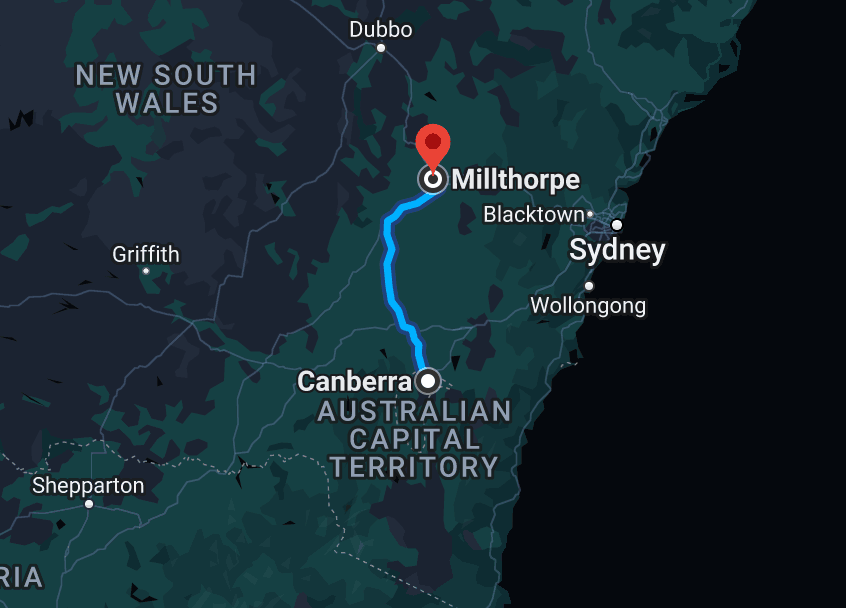
I probably take this further than most. Visiting my hairdresser involves a ritual of driving 270km each way and staying overnight with friends in Millthorpe where I used to live. That’s the equivalent of driving from Milan to Venice or further than Vienna to Budapest. In Europe this would be insane, in Australia just slightly bonkers. We readily acknowledge that we have a different relationship to distances. In my misspent youth, I dated guys who used six packs (beer) as their preferred unit of measure between cities. (Not condoned!) That was before drink driving was taken seriously. I have a tendency to measure distances by increments of towns. Canberra to Millthorpe is three hours; one hour to Boorowa, one hour to Cowra and then one hour to Millthorpe. It’s a rough estimate, but it works for me.
My hairdresser is good but there’s probably 50 equally good ones within a 10km radius from where I live. She knows me well by now and doesn’t bother with social niceties. If we talk, there’s a point to it. She’s a no-nonsense woman who has no need to pretend to be anything else. I like her. But that’s not the only reason I make the trip.
Over the seven years I lived in Millthorpe, I have made some good friends and rekindled some old friendships from a different part of my life. Funny how that works out. When I moved to Canberra, I left some very good friends behind, and it seems a shame to keep losing friends as we age. So, I decided not to let that happen. My hairdresser appointment is a good excuse to visit friends regularly. For I know when we say, ‘let’s keep in touch,’ it rarely eventuates. Our lives become busy, other priorities take over and before we know it, we have lost contact. Getting my haircut is my way of ensuring that I keep up with friends. I now need to come up with a similar strategy to see my friends in Sydney!
Photograph by John Harding originally posted on Friends of Watson Greenspace Facebook page
It takes about a year for me to feel that I have arrived in a new place. I have moved cities often enough to recognise this pattern. Sometimes waiting for that moment feels like an eternity, as it did when I first moved to Sydney while other times, it feels as if it has taken no time at all. Canberra falls in the latter category.
While I have felt at home in my new place very quickly, I didn’t know anyone besides my daughter and her friends when I moved. Then, a couple of months later I met my first friend at the dog park. She lives on the same street as I do, and we meet up for drinks or dinner every now and again.
I am known at the local shop but not by name. People are more likely to say hello to my dog Zoë who wears her name on her harness than they are to say hello to me. Of course this is very common. Even Markus Zusak says that when he is out without his dogs, he becomes invisible to people on the street.
Can you imagine my surprise when a man with a camera hanging from his neck called out to me, ‘Are you Viktoria?’ It turned out, he was the local wildlife photographer who posts the most stunning photos of birds, dogs and kangaroos that visit the nature reserve across the road from me. I have been liking his posts for months and occasionally writing a comment, especially when he posts shots of tawny frogmouths. He must have looked at my name and found a picture of me. Now, he kindly showed me the tree where they were roosting, and I saw the three babies with their parents with my own eyes. It was a truly awe-inspiring sight, and I was grateful that he shared his knowledge of birds freely.
I thanked him and continued on my way. Zoë was getting impatient for her walk. However, after about 200m we were stopped again. This time, an older woman called out, ‘excuse me but do you have a friend in Sydney who lives in Dulwich Hill?’ Once more, I was flummoxed. Turns out she had moved to Watson recently, was given my number, but hadn’t made the call as yet. She recognised me because of Zoë. I guess there aren’t many black standard poodles who walk in this park. We had a chat and decided to catch up for a cuppa later in the month.
Ten months have gone by since I first moved here. So many joyful things have happened, but it wasn’t until I was recognised by strangers that I felt I had truly set down roots. It feels like I am part of the suburb and part of this community. I feel calm in the familiarity of the trees, the pond and the paths that I take daily. But hearing my name said out loud carried a particular weight, as though the world had suddenly recognised me within it. It was a fleeting moment of quiet significance, a moment when I felt connected to the place and the person who has called me into being out of my own thoughts and into the time and space we both inhabited.
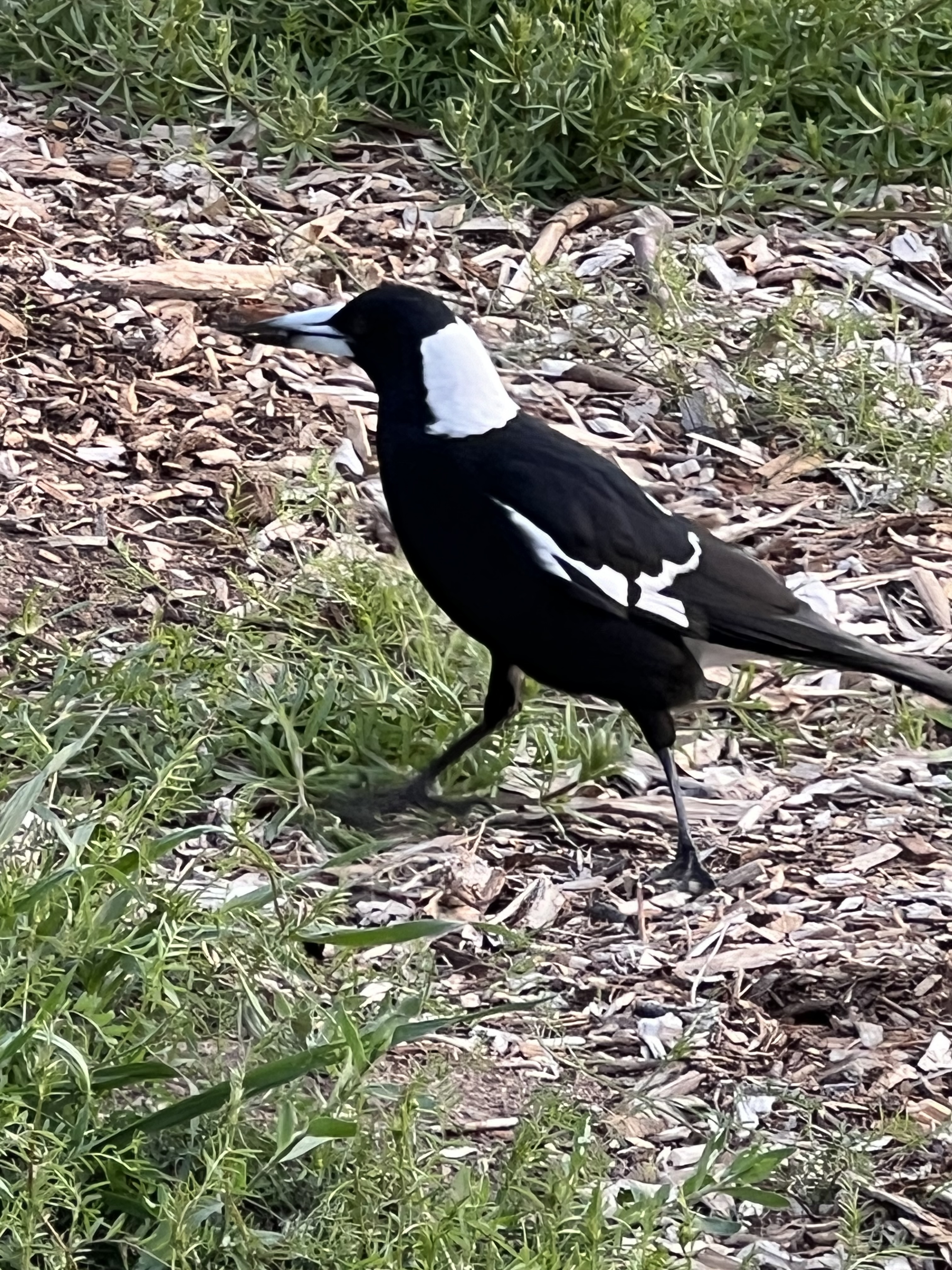
It’s magpie swooping season. In the past two weeks, I’ve been pecked on my head three times and my dog has had Northrop B-2 Spirit magpies stealth-bombing her from behind. Always from behind. She doesn’t move from my side now when we go near trees, and she looks up nervously at her sworn mortal enemies.
For nine months of the year, magpies are a joy in the neighbourhood. They warble in groups of two or three every morning and know us all by sight. They have excellent facial recognition, and recognise everyone in their patch, which is roughly the size of 30 suburban blocks. Magpies know exactly who is naughty or nice, and they pass on this information to other birds.
I always imagined their warble as a joyous expression of welcoming a new day or singing because they are happy. It turns out I was completely deluded. It takes a lot of energy to sing and warble, which is why most songbirds only do it when they are trying to attract a mate. Magpies, however, continue to sing each and every day and it turns out that it is purely to protect their territory. That lovely warble is hurtling expletives at other magpies within earshot. ‘Stay away or else!’
When I lived in the country, three magpies came to the bird feeder most mornings. They’d eat seeds I had put out for parrots, then throw their heads back in what I thought was appreciation and warbled. I referred to them as the three tenors. I must have watched too many Disney movies where all animals are anthropomorphised and given cutesy human traits, for it never occurred to me they were warding off other birds from their find.
Many years ago, I heard an ornithologist interviewed on ABC radio. He explained that 90% of magpies show no aggression at all and that it is only 10% of males who cause all the trouble during mating season. Tongue in cheek, he claimed Australia would be uninhabitable if all magpies swooped. After my last attack, I can only concur. Still, 10% of magpies are a sizable number. Of these aggressive males, half will attack only pedestrians and/or dogs, approximately 16% will attack only cyclists, 16% will go for posties and 18% will randomly attack anyone they come across. These figures are not made up; attacks have been extensively researched and quantified.
Magpies only ever swoop from behind and only if you are in the vicinity of a nest that has chicks in it. All attacks happen within 50 to 100m of a nest, so the sensible thing to do is to avoid the area once you’ve been swooped. When the chicks finally leave the nest, the male returns to being a placid bird until the following year. The best thing you can do in the meantime is to look at your attacker; a magpie won’t ever attack if it can see your face. The worst thing you can do is to run for your life, because then it will surely come after you. If you are on a bike, get off and walk the next 100m until you are in the clear. And yes, the cable ties on helmets work, not that it will stop the swooping, but at least it stops the frightening experience of a beak making repeated contact with the helmet.
For the next two months, I am avoiding the beautiful gums in my neighbourhood. Still, I walk the dog, greet any magpies I meet in a friendly tone and stay out of their territory. There will be time enough to enjoy a shady walk under the spotted gums once spring has passed. In the meantime, I remind myself that I am the intruder here.
One of the delights of living in the capital city is access to the National Library. While I can’t borrow items to take home, I can request anything from their collection which has more than 7 000 000 items. It also houses a delightful café and a bookshop that I can never resist. As a Friend of the National Library, I receive a 10% discount at both the bookshop and the café which makes it a desirable place to visit.
The National Library and I share a birth year. However, time has been kinder to the grand lady on the lake. She has grown into stately resplendence and made her mark on the landscape. Her wide steps invite us to enter a modernist cathedral built to venerate history and knowledge. This is echoed within the building by the tall stained-glass windows on either side of the foyer, which functions like a church narthex.
Once the foyer is traversed, a sentinel verifies the visitor is fit to enter the hallowed halls. From there on, a hush descends. It is one of the few libraries that still has rules about eating and drinking, remaining quiet and using mobile phones. No-one complains.
Today, I spent two hours in the library reading. I observed students, researchers, members of the public accessing the latest issues of magazines. I love that in a world of user pays, this facility is free to use and available to anyone in Australia. You don’t need to be an academic or a writer, just someone who is curious to follow a line of enquiry.
The National Library is a cultural treasure, a gift to the country. There are always interesting exhibitions; currently there is one about migration. In August there is a webinar on family history for beginners, a lecture on Aboriginal perspectives on landscape and a book launch of Australian flora, to name a few. There are collections focusing on maps, oral histories, performing arts, Australiana and Australian writers, and many more. You can access many resources through Trove, a library database owned by the National Library at https://trove.nla.gov.au/.
Canberra is located at the foothills of the Snowy Mountains, within the Great Dividing Range. Its altitude is 577m above sea level, which may not seem like much by South American standards where cities often sit above 1000m, but it is quite high compared to other cities in Australia and Europe. In fact, Canberra’s elevation is 168m above that of Zürich.
The elevation and the fact that it is a relatively sheltered valley near mountains, allows cooler air to sink and the warmer air to form a blanket above it, especially when there is little or no wind. These are perfect conditions for thick fog to occur. On average, there are around 20 heavily foggy days in winter.
I relish these foggy days which give the city a magical air. I love walking in it, not knowing what is in front or behind me, just focusing on one step at a time. I don’t even mind driving in it, although I admit that I prefer driving in fog when I know a route well. But then I have had years of experience driving in the Blue Mountains, where fog can envelop a valley even in summer.
Canberra airport was built on one of the lowest lying areas in the city. The result is that many flights are delayed and cancelled, especially after 10am when incoming flights can’t land due to the lack of visibility. It does seem like a huge oversight to have located an international airport in one of the worst affected areas in town.
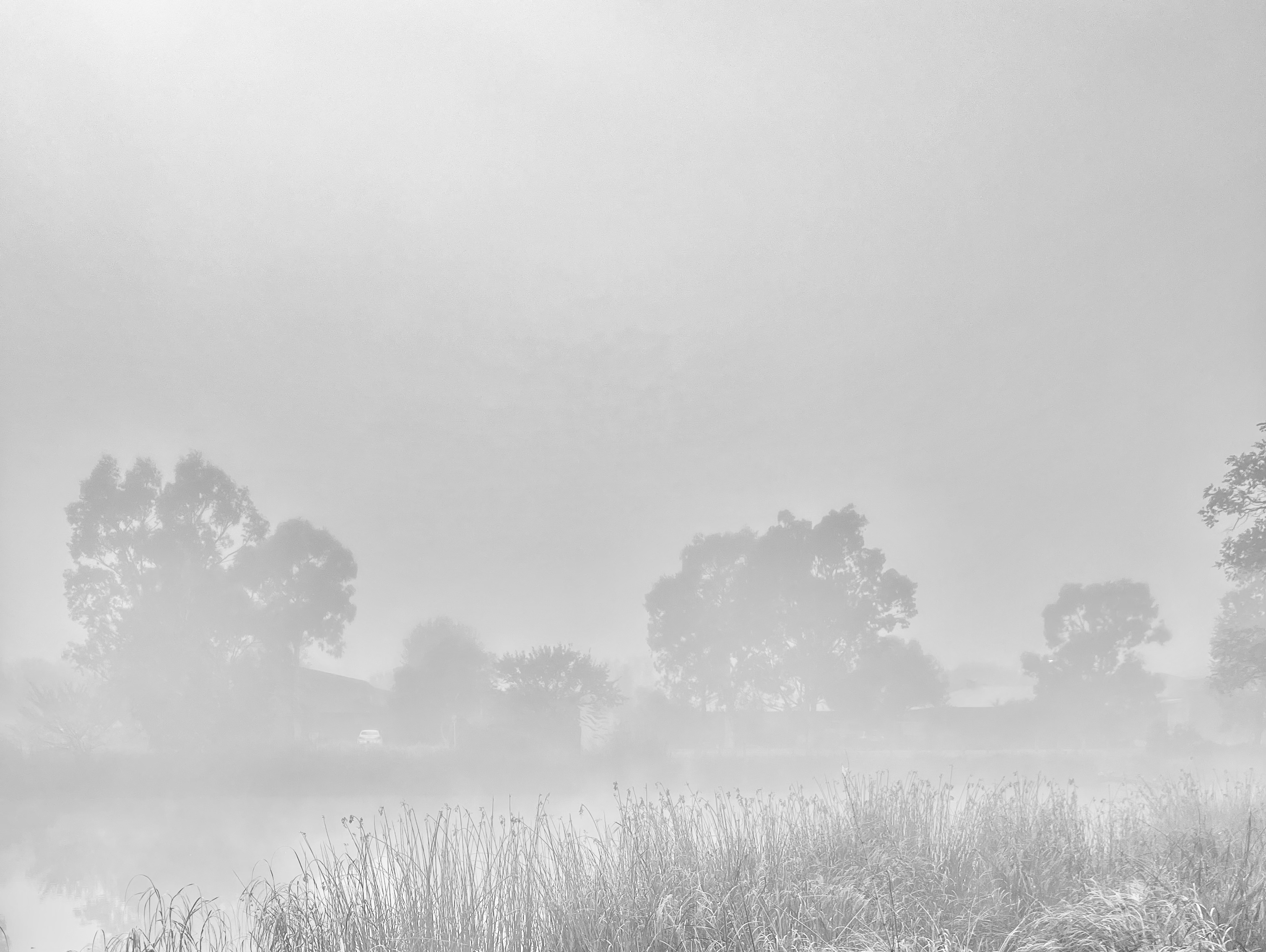
Where I live is only 9km from the airport and it shares its propensity to fog. There are mornings when I can only see shadowy outlines of the trees across the road. When I walk the dog, she disappears ahead of me, and I can confuse markers ahead for people coming towards me. It is a strange, fairy-tale landscape where both time and space seem to conflate. It is muffled and eerie, yet stunningly beautiful and comforting at the same time.
When I worked at Blackheath in the Blue Mountains, I often watched the fog roll in like hay bales on a farm. One would roll up the main street and gather moisture and momentum as it shrouded everything in its path, white as a freshly washed sheet. I’d look out onto the playground and play a game of ‘now you see me and now you don’t’; 350 children there one moment and gone the next.
Fog is an enormous doona spread over the city to make all of us more aware of our senses, to hone our navigation skills and to remind us of the things we can’t control.
It is also a lesson in awe and wonder inviting us to pay close attention to our surroundings. Fog is the winter coat I wear gladly. Wrapped around me, I feel peaceful and lovingly enveloped.
Costa Georgiadis argues that no space is too small for a garden. On Gardening Australia, he has presented stories of magnificent indoor gardens and balcony gardens. I never took much notice as I neither had a balcony nor much light inside my house to grow indoor plants. The truth is, while I enjoy visiting beautiful gardens, I am not a gardener. I’m impatient, get frustrated with weeds and find the whole never-ending process akin to cleaning. A boring chore.
One feature I like about my townhouse is its miniature courtyard. I also like the balcony upstairs, but I immediately bequeathed it to the cat, so she had a place to escape from the dog. There was only one problem with that. It looked so desolate with only a cat litter tray and her little trampoline, and I don’t cope well with desolation. It lacked what Germans identify as Gemütlichkeit or what Danes call hygge. No-one bar the cat would want to spend any time there.
I may not enjoy the work that goes into making a patch of green space, but I do value the benefits it brings. Sure, the nature reserve is only across the road, but it turns out I needed something closer than that. I knew there were health benefits that come from spending time in nature and that cities that have more parks score higher on measures of well-being. Maybe that is why Canberra ranked second in the world for a city with the best quality of life. While that is reassuring, I still felt I needed to transform my barren balcony into something more pleasing. As Danielle Shanahan from the University of Queensland said, ‘There is plenty of evidence that you will get a range of benefits even if all you can manage is putting a plant in your room or looking at trees through your window at home.’
Plants don’t have to be sourced from expensive nurseries. I kept a look out for second-hand plants and nice pots and spent a day last weekend driving to people’s houses. I met a woman who propagates proteas, someone else who is moving house and then migrating to Spain and a suspicious person who left me standing in the cold, locking the screen door, while she retrieved the plant from inside. It was an interesting study in human behaviour.
This weekend, I purchased some shoe racks which I am using as plant stands. I cleared the area and began my arrangement. It is still a work in progress, but I am pleased with the results. Now when I look out onto the balcony from my desk, I see freshly planted pots in the foreground and the trees across the road in the nature reserve. It is a perfect place to write.
Frosty mornings have arrived, covering the grass in icy, white droplets. The dog’s breath turns to vapour as we make our way across the road to the park. I too can see my breath ahead of me and plunge my hands deep into my pockets. The cold nibbles at my ears and nose, but a down coat keeps the rest of my body warm.
The dog doesn’t seem to feel the cold. She happily lies on this carpet of frost, frolicking and licking the icy dew. There’s a wild look in her eye and I know she is about to run in ever-widening circles, stretching her body fully with each stride. I watch as she performs her exercise routine with unashamed, abundant joy, and I can’t help but feel a vicarious sense of being fully alive. I admire her ability to be so present that nothing else matters to her at all.
These morning walks before work are now as important to me as they are to the dog. Some mornings, the park is shrouded in fog, and we venture into unfamiliar terrain, uncertain of what we may come across along the way. The trees become mysterious creatures with outstretched arms, ready to catch me should I stumble too close. These mornings I am transported into a fairy tale where inanimate objects take on human form in the distance, only to turn back into posts or small bushes when I come near. It never feels menacing, but laden with the promise of some adventure.
The black swan that had appeared one day on the billabong has continued its journey. I wonder where they fly for winter. Only the ducks are left and a cormorant or two. Even the magpies seem quieter in the morning now, or am I imagining this? In any case, the park has taken on a different feel; it is quieter, and the colours are muted. The park is now in calm repose.
My day continues with work hours, obligations, and errands. By late afternoon, I feel the urge to visit again before the light fades completely. I take the dog for her second walk of the day, this time with greater urgency and less time to reflect. Despite my desire to be there, the walk becomes perfunctory. I’m thinking about cooking dinner and jobs that still need to be done before the day is out. Other people in the park seem harried too. Everyone wants a bit more time outside before the light fades completely.
Back home, I can just make out the outline of the canopies. Soon, the inky black sky will blanket the city. The day, with all its cares, is over. A brand-new walk awaits us in the morning.
One of the enjoyable aspects of moving to a new city is discovering what others take for granted. Since moving into my daughter’s unit in Braddon while my place undergoes a facelift, I’m seeing this suburb with fresh eyes.
As a visitor, I had been to Haig Park several times, usually to visit the Sunday morning markets. Now that I live across the road, I have quite a different relationship with it. As I need to take my dog down several times a day to do her business, the park is perfect for a quick comfort stop or a longer run off leash. We have met several dogs and their owners, some chatty, others rather off-hand. Humans that is, never the dogs.
The park has a rather curious design. It runs the length of two suburbs and is 1780m long. It has 14 rows of trees, planted equidistant from each other, giving it more of a feel of a state forest. The plantings of pine trees reinforce this, although on closer inspection, there are four different species of trees which all have their own dedicated rows. Where I am, I can see Italian Cypress, Pin Oaks, and Deodar Cedars, but there are also Argyle apple trees and Radiata Pines. The row upon row of trees gives it a rather eerie feel at night, especially as the lighting is virtually non-existent. I certainly wouldn’t venture across it in the dark.
During the day, it is a much friendlier place, although it still feels odd to be walking up and down in straight lines between trees. This made me wonder about the history of the park, as many of the trees are quite old. A little research yielded the answer to its odd design. It was originally planted as a windbreak in 1921 when Braddon and Turner were fledgling suburbs and needed to be protected from the dust and wind battering it from the north. I can’t imagine Braddon being a fledgling suburb as it is now as close as you can get to the centre of the city.
I haven’t explored the Turner side of the park yet. But I have discovered a couple of interesting things at the Braddon end. The first thing I came across were two metal cabinets that are attached to a pole. The cabinets aren’t locked and unfortunately, this means that possums and crows regularly raid the contents and leave them strewn. A notice attached to the top of one of the cabinets describes their purpose. They are there for food donations for anyone in need. Despite the clear instructions to only use it for non-perishable items, people still leave bread that gets eaten by local wildlife. It also makes a mess around the cabinets. It is a shame that great initiatives often have unwanted consequences.
A little further across the park, I came across a labyrinth. This was an unexpected delight. Unlike other labyrinths I have walked, this one is in the shape of a hand. It is called the Ngala labyrinth. Ngala is the Ngunnawal word for tree. At first, I thought it looked a little too simple compared to the Chartres design. However, walking the labyrinth, I discovered its own beauty. The centre is within the palm, which of course has echoes Proverbs 30.4 ‘God holds us in the palm of his hand.’ But there are also reverberations within Buddhism, Taoism and Yoga where the palm is associated with subtle energy or chakras. Then there is also the connection to fortune telling and palmistry. Clearly, there is a long spiritual tradition which treats the hands as a metaphor. Walking this labyrinth, I felt at peace and grounded upon the land I was on, a stark contrast to the hustle and bustle of Lonsdale Street just a few hundred metres away.
To see the world with fresh eyes is a gift that moving to a new place offers. It is my sincere wish that this stage has longevity so that I may continue to be observant and approach my surroundings with childlike curiosity.
I have been planning this move for over two years. Thank goodness I had the foresight to buy this townhouse. At the time I really didn’t think I could afford it. Luck was on my side, and I purchased just before prices in Canberra skyrocketed. I certainly wouldn’t be able to afford it now.
I am enjoying the city after seven years in the country. Mind you, it feels more like a large country town which has made it easier to acclimatise. I love that there are trees everywhere and from my study window, I can just see the roof of a solitary building.
A friend of my daughter calls my place the treehouse. I like that. The mosaic I made depicting a large tree will be affixed to the wall at the front door. It all seems so befitting now as l look over the canopies and listen to the warbling magpies. I am glad the Maggies have followed me here as have the Sulphur Crested Cockies. I do miss my Blackbirds though. Although they wouldn’t quite fit into the deliberately native landscape. There are no Silver Birches, Magnolias, Crab Apples, or Fruit trees. Instead, I look out over Eucalypts, Kurajongs, She-oaks, and Crepe Myrtles.
This makes me think about the possibilities for a garden. My courtyard out the back is presently filled with weeds. It has but a tiny patch of soil and I will have to think long and hard about what to plant there. It won’t be the roses of Millthorpe, nor brightly coloured flowering exotic species. I want to pay respect to the landscape around me so I will find out about endemic plants before I make my choice. There is much to learn.
I have been here less than a week, but it already feels like a lifetime. Maybe it is because I have spent so much time in this city over the past ten years. I may not know where everything is yet, but it feels very familiar. Familiar enough to feel a little like home.