
Following Her North

My daughter loves Norway. She visits whenever she can. For a while now, she has asked me join her on a trip as she wanted me to understand her deep longing for this country. The opportunity finally came this year when I started thinking of visiting friends and family in Europe. With the efficiency of a seasoned traveller, she booked the accommodation, organised the car hire and presented me with a two-week itinerary. All I had to do was get on a plane to Bergen.

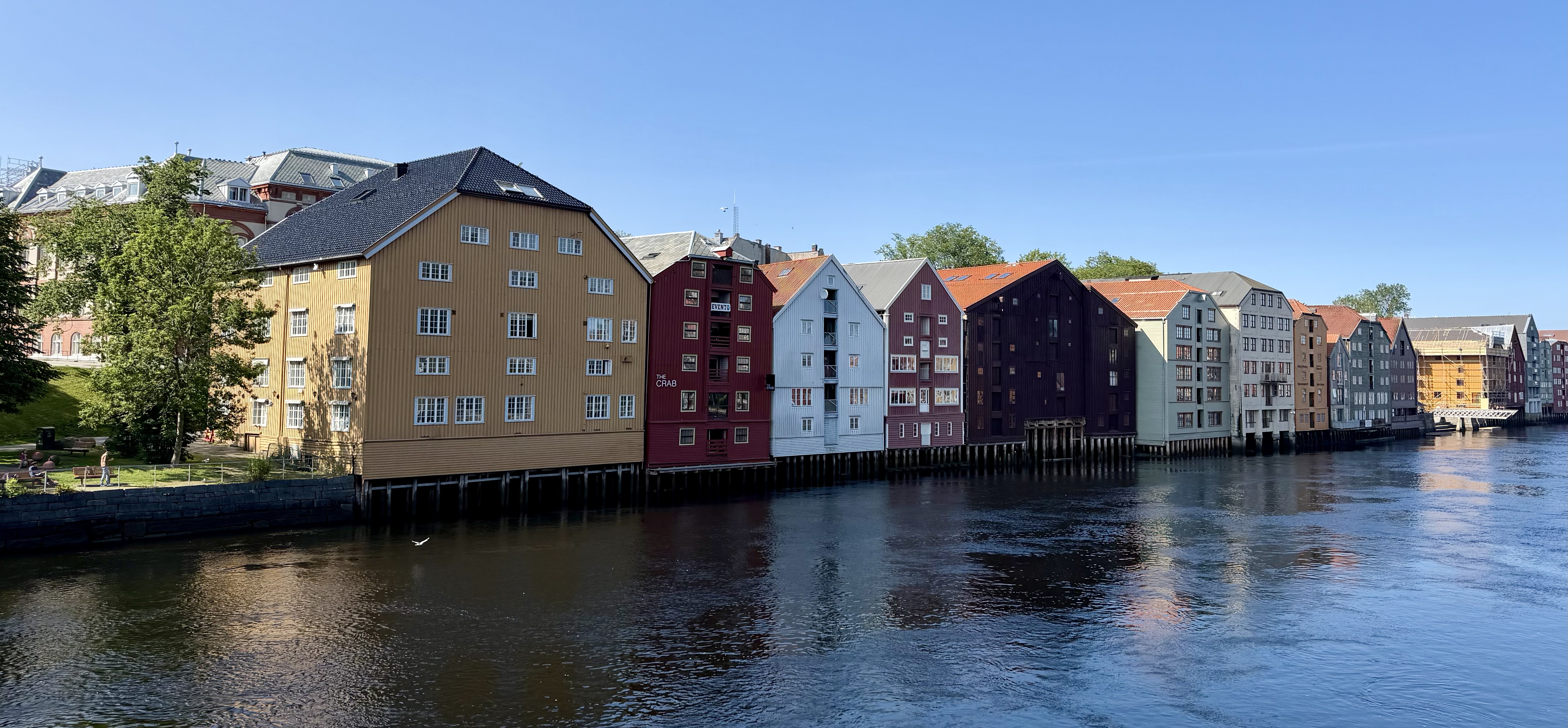
My first impressions of Bergen were of charming timber houses painted red, yellow, blue and green but mostly an ochre red. Much later, I discovered that the prevalence of red had an economic reason; it was the cheapest house paint to produce. Now of course, it has become a tourist drawcard as people from all over the world admire the brightly coloured houses.

We began our trip in earnest following fjords along the coast, going through mountains or under waterways using the extensive arrangement of tunnels along the way. We began to count them and after a while we rated each one from 1-5. My favourite was tunnel number 14, which had an elegant entrance and a stunning view at the exit. It was a fun activity discussing the merits of each tunnel as we drove north through spectacular countryside.

Norway is exactly as you expect it to be from the photos you see. Majestic mountains, fjords and off shore islands wherever you look, dear little timber houses dotted on grassy slopes, virtually 24 hours of sunlight in summer. What you don’t expect, even when you have been warned, is the high cost of living as virtually all consumables are imported. Unlike in the rest of Europe where you can save money by going to supermarkets and cooking your own food, in Norway, even supermarket items are ludicrously expensive. Pretty soon our mantra became, ‘oh, it cost $100’, for it seemed impossible to buy anything below that price.

We stayed at a variety of Airbnbs, some of which will stay with me for the hospitality and kindness of the host. Two farm stays were the most memorable in part because of the surrounding countryside. We did small hikes, went up 1000 metres in one of the steepest skylifts at Loen, where the incline at times was 60 degrees. From there we marvelled at the mountain vistas with glaciers in the distance.

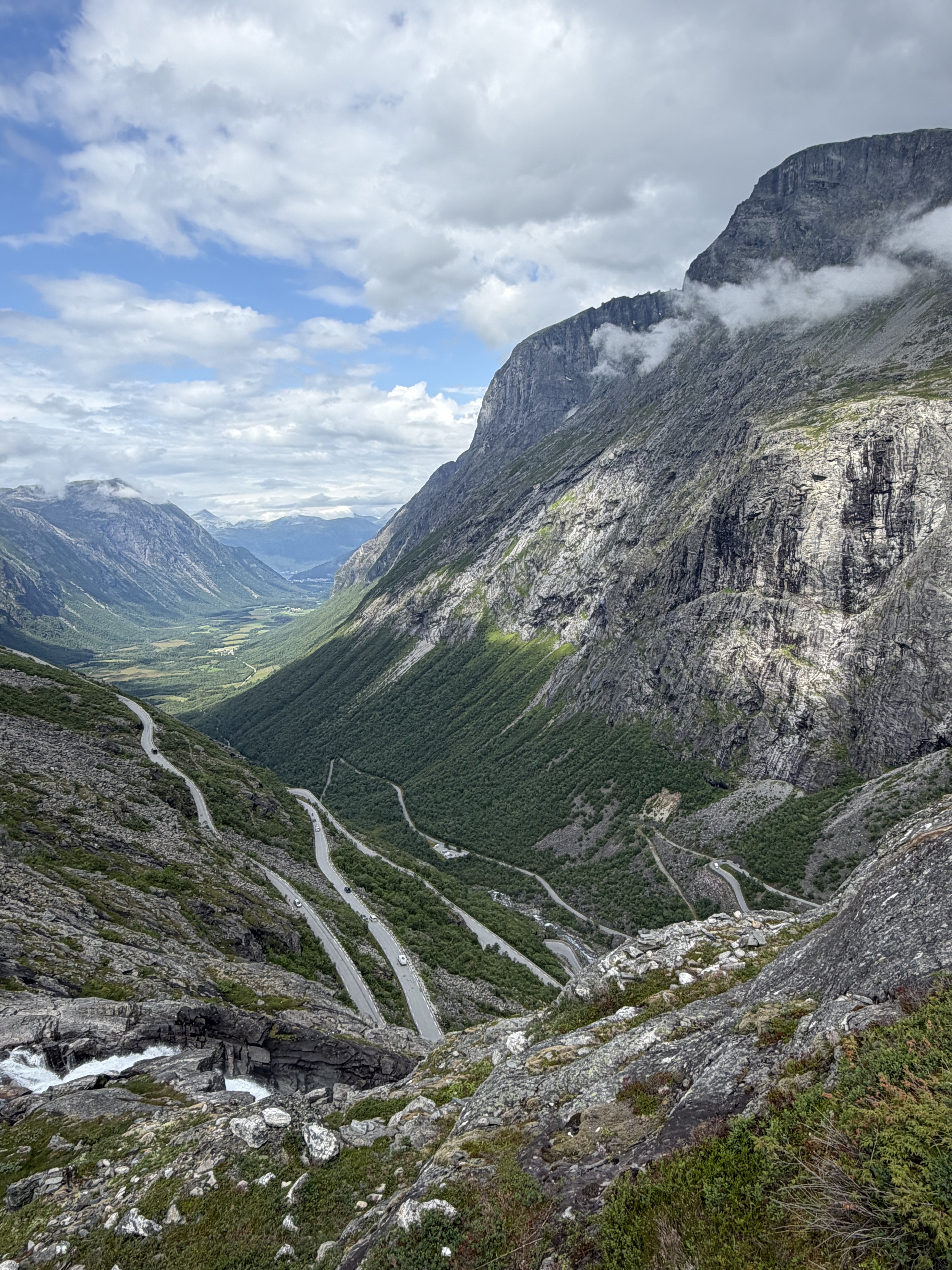
We followed the road to the mountain plateau at Stigrøra, from which the descent was along the famous Trollstigen or Troll’s pass. While it looked hair-raising from atop the mountain, the actual trip down was quite enjoyable, but then I wasn’t driving down the hair-pin bends. Surprisingly, it wasn’t at all terrifying as I had feared.

Our trip ended in Trondheim, where we stayed for a few days. After spending time in the countryside, it was refreshing to get to a city with some cultural places to explore. I visited museums, churches, a synagogue and took a lovely walk through the old part of the city with my daughter and family before returning to a patisserie and treating everyone to a kanelsnurr, a delicious, twisted cinnamon scroll which I am determined to learn to make.

I am glad my daughter convinced me to go as I would never have gone on my own. There is definitely more to write about this trip but for the time being, this is enough. This holiday has brought me closer to my daughter as I have a deeper appreciation of her love of Norway now that I have walked along some of her favourite places.
From Zurich to the Bush Capital

When I jump into the deep end of a pool, I can always dog paddle until I find my stroke. This is what life has taught me. I always get to the other side. I may not be a great swimmer but I am buoyant. Knowing this has served me well.

In 2008 I spent a year in Switzerland with my family. It was a crazy opportunity that came out of nowhere and I was willing to take the chance. Arriving in Zurich was like jumping off a diving board. The first week felt like a massive belly flop and I wondered whether I had made the right decision, not only for myself but for my family.  

It didn’t take us long to learn some of the idiosyncrasies of our new home. School starts before 8 a.m., shops close for lunch, trains and buses run on time. There were other quite annoying things such as having to do your washing on a Friday (everyone has a designated day), no flushing toilets after 10 p.m. (house rules) and no paracetamol available except at chemists which are closed on Sundays.

I was quite cocky before we left. Why would I have trouble understanding the Swiss, when I understand Swabian and Austrian dialects?  What could be so difficult? Well, maybe vocabulary, grammar and pronunciation as a start! It took me much longer than I expected to follow simple conversations. Nor did I expect the Swiss to frown upon my high German. After all, it is meant to be the official language in the German cantons.

As we became increasingly familiar with how things operated, we began to appreciate the small things of life. Wherever we were in the countryside, we’d find a cat in a field, ears pricked up, ready to pounce. We could even spot them from the train! Why do Swiss cats do this and not other cats? It remained a charming mystery.

If land didn’t have a dwelling on it, there were cows grazing there, kept in place by movable electric fences. Behind our nearest bus shelter were three cows and behind them were rows of multi-storey flats. If it wasn’t cows grazing, it was goats. These animals could be found in any of the suburbs of large towns. I grew to love this proximity to farm animals. It made for a slower and much calmer pace.

In 2024, I jumped off the diving board once more, this time to move to Canberra. It wasn’t anywhere near as disorientating as moving to Switzerland but it did feel much more permanent. I had bought a townhouse, changed jobs and began the process of acclimatising. At least I can speak the language here and know how society operates but it still takes time to adjust.

At first, I was confused by the wide streets and wanted to turn into the oncoming traffic not realising that the lanes were one way. Then there were all the roundabouts and roads that go around in circles. I have been caught out more than once with the all-day 40 km school zones with no flashing lights. In fact, I have never had as many fines as I have since moving here. The rules can be quite perplexing!

In Canberra, I can buy a bottle of wine at the supermarket, just as I could in Switzerland. However, when I go to work across the border, this is no longer possible. Lately, I have begun to see other similarities with where we lived in Switzerland. Every morning I drive past ducks that may waddle across the street, only 100 m from a main arterial road. Near the first roundabout as you enter Canberra coming from Sydney, there is a small herd of Angus cows grazing in a paddock that will eventually be turned into medium density housing. I had to laugh when I first saw them.

My drive to work takes me along a stretch of a freeway that has paddocks on both sides. There are agisted horses, cows and small farms all within a ten-minute drive from the centre of the city. I hope this doesn’t change in my lifetime. Next to one of these farms there is a small ‘shop’ that works on an honesty system. Here, I can buy eggs, cheese and honey on my way home. It reminds me of a place in Switzerland which was a ten-minute walk up the hill from our place. We could buy seasonal fruit from the farmer who had a wooden box on the side of the road where we would leave money. Honesty boxes could be found all over Switzerland including deep in forests where 2 Franks could be exchanged for a swig of Absinthe!

Canberra has retained the feel of a large country town with plenty of green space. No wonder it prides itself on being the Bush Capital. Maybe I recognised some of its similarities to Switzerland which I grew to love. I think about this more often as I approach my second anniversary living in Canberra. The longer I spend here, the more I appreciate its beauty, surrounded by farms, nature reserves and the stunning Brindabellas in the distance. I’ve found my rhythm once more; steady, buoyant and much more at home.

From Asters to Astoria

Asters are star shaped flowers with tube like petals that come in a variety of dazzling colours. I was given a bright pink bunch a couple of weeks ago and I delighted in their cheery presence, especially in this bleak and wintery weather. Sadly, their stems soon began to droop, but the flowers retained their sunny disposition. That’s when I decided to cut off their stems and float the flowers in a bowl of water. They have continued to bring joy for two weeks and still look fresh.

Their flower heads remind me of daisies, so I wondered whether they were related. It turns out they are. Like a daisy, the disk florets in the centre of the flower are bright yellow, which is why we think of them as being sunny. Asters bloom late autumn and provide an important food source for bees and when there is little nectar to be found. My pink asters are native to Australia but as a species, there are more than 250 varieties in the world.

While researching the humble aster, I learnt that the Hungarian revolution of October 1918 was also called the ‘Aster Revolution’. The name was derived from soldiers removing the Austro-Hungarian symbols from their caps and replacing these with asters.

The ‘headquarters’ for the revolutionaries was at the Astoria Hotel in Pest, on the eastern side of the Danube of the dual city of Budapest. This stunning seven storey hotel, featuring fin-de-siècle architecture is still one of the best loved hotels in the heart of the city. However, at the time of the revolution, it was only four years old and without a doubt one of the most elegant places in Budapest. It was from one of its balconies that the leader of the First Hungarian People’s Republic, Mihály Károlyi, announced the end of the Hapsburg empire and the foundation of the republic to jubilant supporters below. This was the only revolution that Hungarians have ever won.

Reading about the significance of the Astoria took me back to the 1980s, when during a particularly cold winter, I arrived in Budapest to find the transport in the city had ground to a halt. Metre high snow lay frozen on the side of roads; there were abandoned cars and trams everywhere, and the occasional taxi or bus that was still operational wouldn’t stop.

I stood at a bus stop with dozens of commuters needing to get out of the cold. They were locals, while I was a tourist with a 30kg backpack that I could barely carry. When a bus finally stopped, they roughly pushed past me to get on board. I slipped on the ice, fell on my back and was transformed into a giant beetle, like Gregor Samsa in Kafka’s Metamorphosis. By now the bus had left, and I lay on the ground, legs in the air, crying, asking for my father’s intercession to get me out of this mess. After all, I was in his hometown, chasing ghosts.

Getting up seemed to take an eternity. I was cold, miserable and lonely. My only contact was my aunt who lived in a Soviet style high-rise in Buda. It was miles away. That’s when I spotted the Hotel Astoria on the other side of the road. Surely, someone could help me there.

I trudged across the road, entered the building and was greeted by a friendly face. I wiped away my tears. The woman behind the counter took pity on me and called my aunt who immediately took charge of the situation. All I had to do was to wait outside until she bribed a taxi driver to drive back into the city to collect me. Within half an hour the taxi arrived, and I arrived safely at my aunt’s place fifteen minutes later.

The weather improved the next day. I took the bus into town, found a florist and bought a pot of chrysanthemums. These I delivered to my saviour at the Astoria. At the time I had no idea of the hotel’s history. Nor would I have known that chrysanthemums are closely related to asters.