Grandmother Banksia

We were a group of strangers walking silently through the Banksia garden at the Canberra Botanical Gardens. Tasked with following our hearts to the plants that drew us in, we spent half an hour exploring the area. We took photographs and made notes which would later lead into a nature journaling and painting session.

Our instructions were to be curious, examine our plant in detail and make notes about our observations. We were to include the date, time and weather information as well as any other data we could gather. While I loved the idea, my brain took a different turn and I began to think in metaphors and ponder the questions that came to mind.

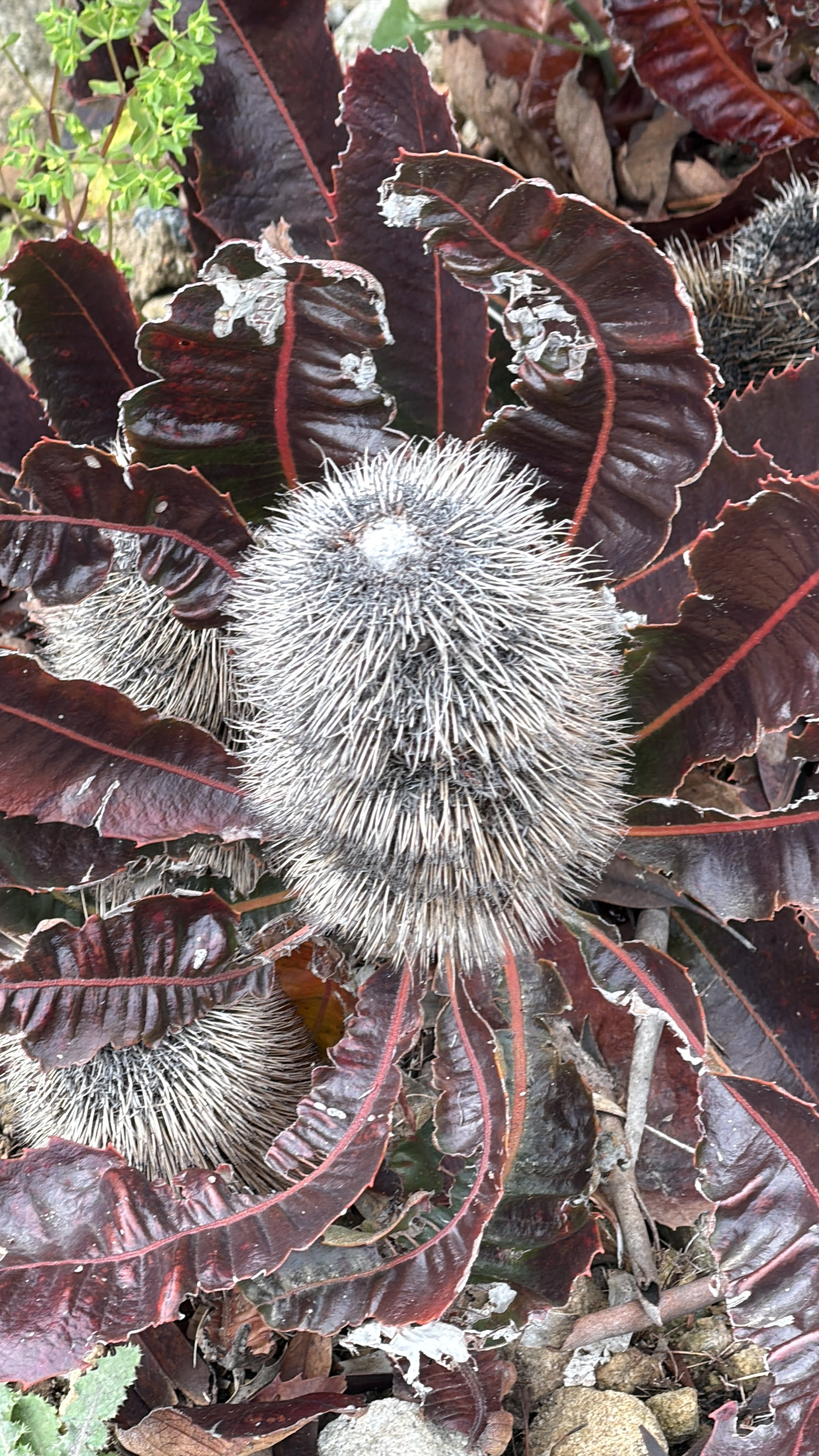
The plant that chose to reveal itself to me was a Banksia robur. This plant can tolerate a wide range of growing conditions, including swamps and sandy environments. I was drawn to the rhubarb coloured leaves at the bottom of the plant as well as the bright flowers at the top. As the flowers fade, the inflorescence, or cluster of hundreds of individual small flowers, turns grey before becoming the woody seed pods that we associate with banksias. It struck me that every stage of the flowering was not only beautiful in its own right but also contained within it the lifecycle of the plant.

What drew me in was the greying flower at the bottom of the plant with the brighter flowers above it. It reminded me of an upside down family tree. I identified strongly with this greying flower, nurturing the youthful generations above it. I called the flower Grandmother Banksia, in recognition of my recent transition to this stage of life. This greying flower exuded a beauty of its own; no longer radiant in its vivid colouring, yet soft and solid. There at the base of the shrub, it would eventually transform into a pod that held within it the possibility of rebirth after a future fire event released the seeds to germinate.

Looking at Grandmother Banksia, I felt at peace with the process of ageing. There is so much that I can still offer to the generations that come after me, as well as to my own generation. I may no longer attract bees with my sweet honey, but there is a strength and solidity that only age can reliably offer. This is my gift.

From barren to blooming

Costa Georgiadis argues that no space is too small for a garden. On Gardening Australia, he has presented stories of magnificent indoor gardens and balcony gardens. I never took much notice as I neither had a balcony nor much light inside my house to grow indoor plants. The truth is, while I enjoy visiting beautiful gardens, I am not a gardener. I’m impatient, get frustrated with weeds and find the whole never-ending process akin to cleaning. A boring chore.

One feature I like about my townhouse is its miniature courtyard. I also like the balcony upstairs, but I immediately bequeathed it to the cat, so she had a place to escape from the dog. There was only one problem with that. It looked so desolate with only a cat litter tray and her little trampoline, and I don’t cope well with desolation. It lacked what Germans identify as Gemütlichkeit or what Danes call hygge. No-one bar the cat would want to spend any time there.

I may not enjoy the work that goes into making a patch of green space, but I do value the benefits it brings. Sure, the nature reserve is only across the road, but it turns out I needed something closer than that. I knew there were health benefits that come from spending time in nature and that cities that have more parks score higher on measures of well-being. Maybe that is why Canberra ranked second in the world for a city with the best quality of life. While that is reassuring, I still felt I needed to transform my barren balcony into something more pleasing. As Danielle Shanahan from the University of Queensland said, ‘There is plenty of evidence that you will get a range of benefits even if all you can manage is putting a plant in your room or looking at trees through your window at home.’

Plants don’t have to be sourced from expensive nurseries. I kept a look out for second-hand plants and nice pots and spent a day last weekend driving to people’s houses. I met a woman who propagates proteas, someone else who is moving house and then migrating to Spain and a suspicious person who left me standing in the cold, locking the screen door, while she retrieved the plant from inside. It was an interesting study in human behaviour.

This weekend, I purchased some shoe racks which I am using as plant stands. I cleared the area and began my arrangement. It is still a work in progress, but I am pleased with the results. Now when I look out onto the balcony from my desk, I see freshly planted pots in the foreground and the trees across the road in the nature reserve. It is a perfect place to write.