Grandmother Banksia

We were a group of strangers walking silently through the Banksia garden at the Canberra Botanical Gardens. Tasked with following our hearts to the plants that drew us in, we spent half an hour exploring the area. We took photographs and made notes which would later lead into a nature journaling and painting session.

Our instructions were to be curious, examine our plant in detail and make notes about our observations. We were to include the date, time and weather information as well as any other data we could gather. While I loved the idea, my brain took a different turn and I began to think in metaphors and ponder the questions that came to mind.

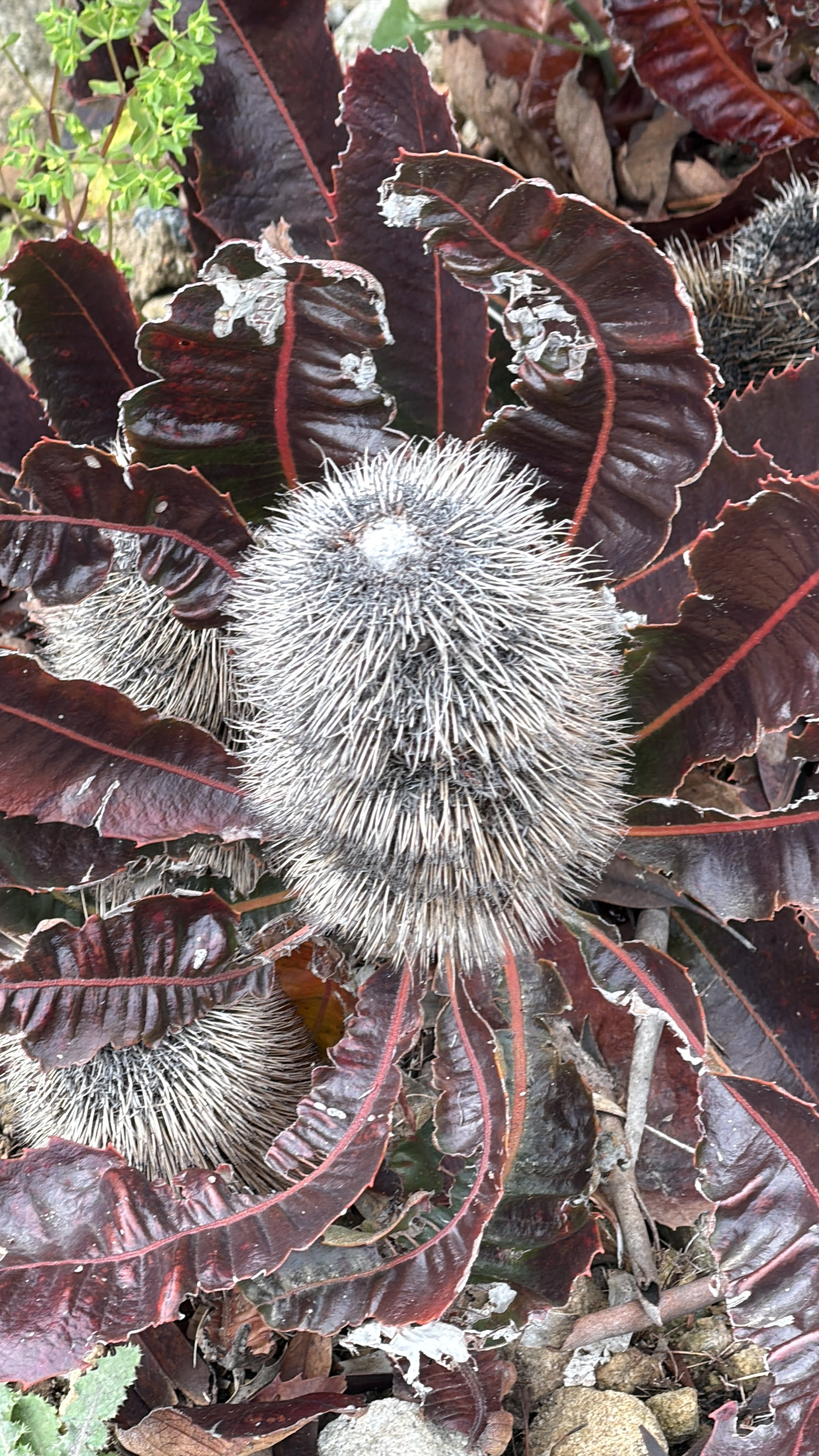
The plant that chose to reveal itself to me was a Banksia robur. This plant can tolerate a wide range of growing conditions, including swamps and sandy environments. I was drawn to the rhubarb coloured leaves at the bottom of the plant as well as the bright flowers at the top. As the flowers fade, the inflorescence, or cluster of hundreds of individual small flowers, turns grey before becoming the woody seed pods that we associate with banksias. It struck me that every stage of the flowering was not only beautiful in its own right but also contained within it the lifecycle of the plant.

What drew me in was the greying flower at the bottom of the plant with the brighter flowers above it. It reminded me of an upside down family tree. I identified strongly with this greying flower, nurturing the youthful generations above it. I called the flower Grandmother Banksia, in recognition of my recent transition to this stage of life. This greying flower exuded a beauty of its own; no longer radiant in its vivid colouring, yet soft and solid. There at the base of the shrub, it would eventually transform into a pod that held within it the possibility of rebirth after a future fire event released the seeds to germinate.

Looking at Grandmother Banksia, I felt at peace with the process of ageing. There is so much that I can still offer to the generations that come after me, as well as to my own generation. I may no longer attract bees with my sweet honey, but there is a strength and solidity that only age can reliably offer. This is my gift.

Floriade and Friendship

Many a weekend is spent on housework and chores. That’s a fact of life for those of us who work full-time. But there’s more to life than dishes and socks. Weekends also need to include recreational activities to recharge us.

This week my dear friend Heidi announced she would come to visit. We live about 110 km from each other but even with this relatively short distance in Australian terms, we don’t see each other often. I suggested going to Floriade, a Canberran institution which is held every year in September. She readily agreed.

Floriade is a celebration of spring held at Commonwealth Park each year. An overall theme is selected for the various garden bed designs. This year Floriade features 12 large garden beds highlighting Australian Scientists through the contribution they made to a scientific field. The garden bed themes have names such as Molecular Structure, Spectrum and Petri Dish. By carefully observing the design of each bed, the theme presents itself. My favourites were the double helix for DNA and the Atom.

While massed tulips are the main attraction, there are many varieties of flowers in an assortment of colours. There are Pansies, Chrysanthemums, Hyacinths and Violas to name but a few. Each display is painstakingly planted to represent the facets of science it celebrates. It can be difficult to discern the images portrayed from ground level but when viewed from above, the images become clear.

I suggested going on the Ferris Wheel to get a better view. After a long wait, we clambered into a swinging carriage that was to take us up for a better view. From above, it was much easier to discern the themes. It was very windy at the top and we rocked from side to side which made taking pictures difficult. Our best photos came from when we stopped half way up.

Heidi and I had a wonderful time exploring the gardens. We were mesmerised by the variety of colours of the flowers we encountered. Black Pansies and deep purple hyacinths! We had never seen either of these. We marvelled at the ingenuity of the of the garden bed designers.

While the flowers occupied the centre of attention, we still had time to catch up with each other’s lives. We are empty nesters; our children flapping their fledgling wings. We talked about our plans for retirement, the joys of having a dog, our fears for future generations.

There is immense comfort in a friendship that has lasted forty years. Surprisingly, in all that time, we have only lived in the same town for roughly two years. Yet like tulips at the Floriade, our friendship has returned season after season, surprising us with vivid palettes of colour and the patina that the years provide.

Jonquils in July

I make a last-minute dash to the markets for some Batlow apples. Most stallholders are busy sweeping the concrete, packing their unsold wares onto trucks. Everyone is looking forward to getting home and for some, there is a long drive ahead. They have been here since five in the morning, setting up and waiting for the first customers to arrive. I hastily look for my favourite stall and I’m lucky, the girl selling apples is still serving customers.

I take a walk around what’s left of the markets, buy some mushrooms and am given an extra bag of woodland browns to take home. These late saunters on a Saturday morning, when the place empties, are my idea of bliss and there’s always a bargain to be had.

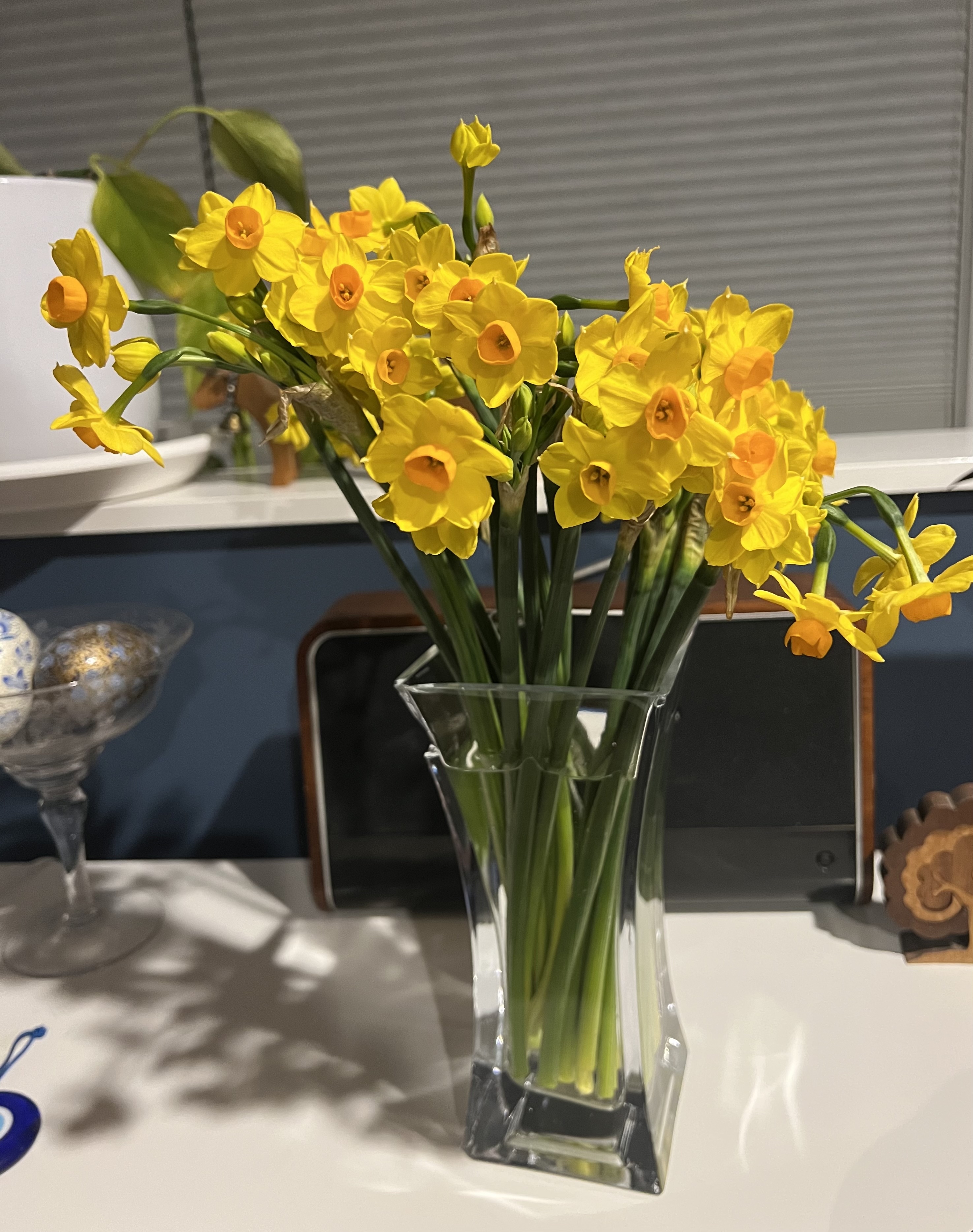
As I come around the last isle, bright yellow jonquils catch my eye. It is mid-winter, yet here they are, heralding spring. Massed in large plastic buckets, their sweet fragrance borders on pungent. I can’t resist. Two bunches are rolled into tissue paper while I hand over a ten dollar note.

Flowers always brighten my day. I’m drawn to their beauty and fragrance. It turns out there is a reason for this feeling. Flowers can spark the release of dopamine and serotonin in our brain by their bright colours and pleasant smell. There are studies that show that having flowers in the house can lower cortisol levels. They create a relaxed and aesthetically pleasing environment which makes us feel more relaxed. 

Before I knew any of these benefits, I instinctively bought flowers when I felt downhearted. Back in 1987, I spent a rather miserable winter in Berlin. The cloud cover arrived in October and never left for six months. The short days felt like eternal dawn or dusk; it was impossible to tell which. It was during these months that I began the habit of buying flowers every Friday afternoon as I returned from university. The florist around the corner wasn’t cheap but made the most exquisite flower arrangements. They reminded me of the Japanese art of Ikebana. The designs were always minimalist, and they took my breath away. I had very little money left for luxuries, but my Friday ritual never felt like an extravagance.

This memory came flooding back as I purchased my jonquils. While I don’t possess the patience to artistically place flowers in a vase, it doesn’t much matter. A dull winter’s day has been transformed into delight by their smiling yellow faces. And for the next week, there will be guaranteed sunshine every morning.