Markets, Maple Syrup and a Wide Open Mouth

Saturday mornings are for going to the market. Even when I don’t need much, I go because I enjoy the ritual. Many people need to change things up to find their vitality. I need repetition and ritual to feel grounded and truly present. It is the simple acts such as putting the harness on the dog, getting the bags ready and choosing to walk through the park that make the trip joyful. I pause to say hello to strangers and listen to snippets of conversation as people pass me with their bags or trolleys, all heading to the same place. Passing us on the other side of the narrow track are the early birds returning with their bounty.

Today, my aim is to buy fruit and transform it into delicious baby food for my granddaughter. She has become a voracious eater. Rather than buy processed food with additives, I have taken it upon myself to cook and bottle food that contains only fresh ingredients and an extra large dollop of love.

The dog is used to the routine. I tie her up to one of the posts as she looks across at all the other dogs, patiently waiting, tied up along the fence. Then I disappear into the fray. I already know where I will buy the apples and pears but, as they will be heavy, I leave that purchase until last. Before I buy anything, I walk down every aisle, getting acquainted with what is on offer and which of my favourite stallholders has come this week. Among the many bread stalls, I find my favourite sourdough halfway down on the left. Tempting as they are, I only look at the native plants. Maybe next time, if I manage to get on top of the weeding in the meantime.

After succumbing to Greek ricotta donuts, I head to my favourite fruit stall. It is run by an elderly, weathered woman with long grey plaits, who comes every week from Batlow on the south west slopes of NSW. Unlike supermarkets, she sells a wide variety of apples, some that haven’t been seen on shelves for years. She also sells cheap, misshapen fruit that tastes just fine and is perfect for stewing. She drives two and a half hours to get to Canberra, starting her journey at about 4am to arrive in time for the market. I am in awe of her stamina and her commitment to come each week.

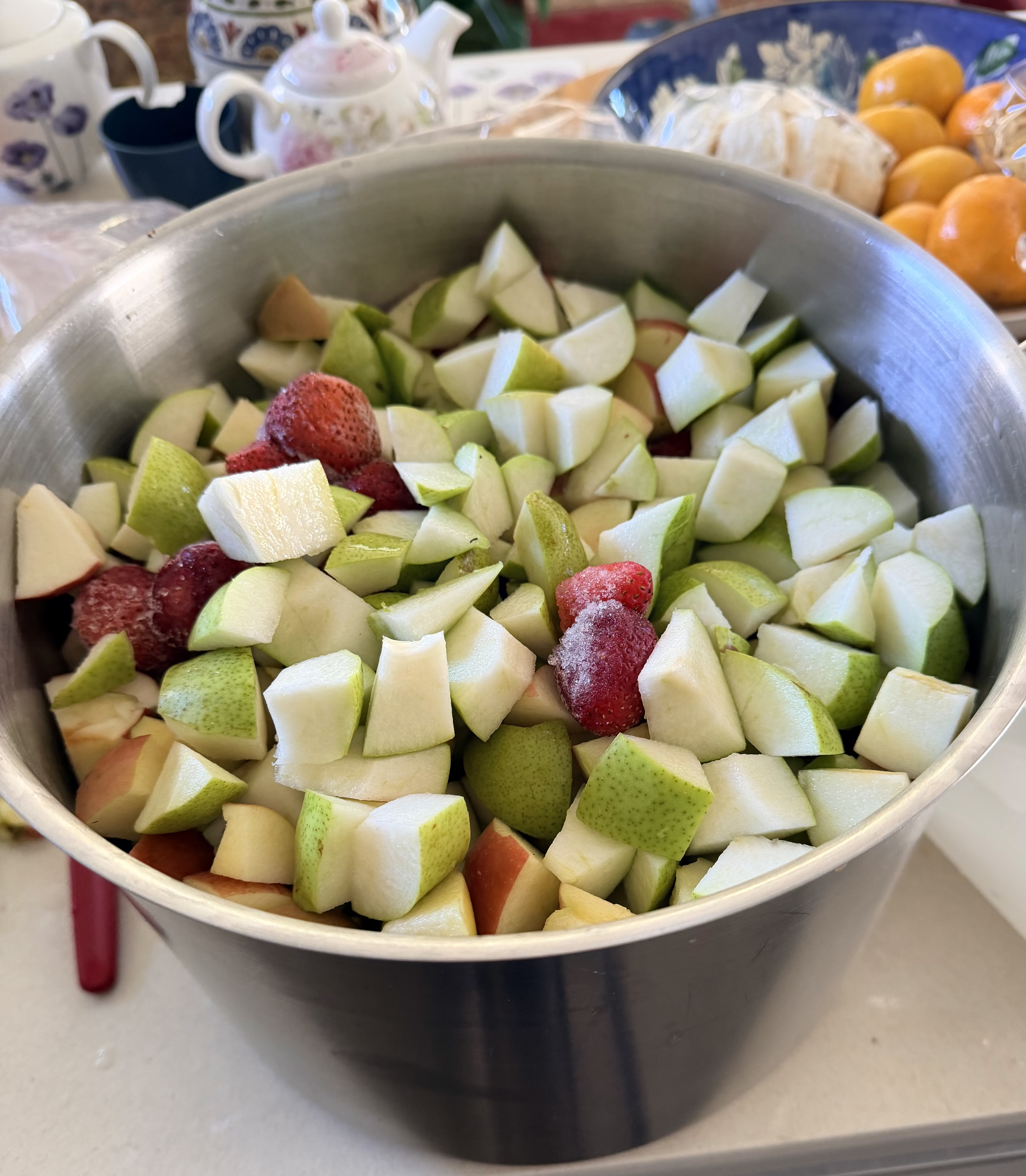
The dog is on the lookout, searching for me as I come out of the hall. The rucksack is heavy and I feel my centre of gravity shift as I bend down to untie her. Our walk back is slower, but it still only takes ten minutes to get home. After a cuppa and two of the delicious ricotta donuts, I am ready to wash, core and slice the fruit. To give it a little zing, I add a generous amount of cinnamon, strawberries and some maple syrup. Once soft, the mixture is blended and poured into sterilised jars. It is delicious.

Later in the afternoon, I deliver the goods. The hungry little possum is rapturous. Her mouth opens wide as the loaded spoon approaches. She repeats the wide gape again and again until the contents of a large bowl disappear. Her delight is all mine.

Through the simple act of preparing freshly sourced food, I am strengthening the connection between myself and my daughter’s family. These meals provide sustenance for the body, but also carry care, intention and love. Making and sharing nutritious meals has always been my love language.
Jonquils in July

I make a last-minute dash to the markets for some Batlow apples. Most stallholders are busy sweeping the concrete, packing their unsold wares onto trucks. Everyone is looking forward to getting home and for some, there is a long drive ahead. They have been here since five in the morning, setting up and waiting for the first customers to arrive. I hastily look for my favourite stall and I’m lucky, the girl selling apples is still serving customers.

I take a walk around what’s left of the markets, buy some mushrooms and am given an extra bag of woodland browns to take home. These late saunters on a Saturday morning, when the place empties, are my idea of bliss and there’s always a bargain to be had.

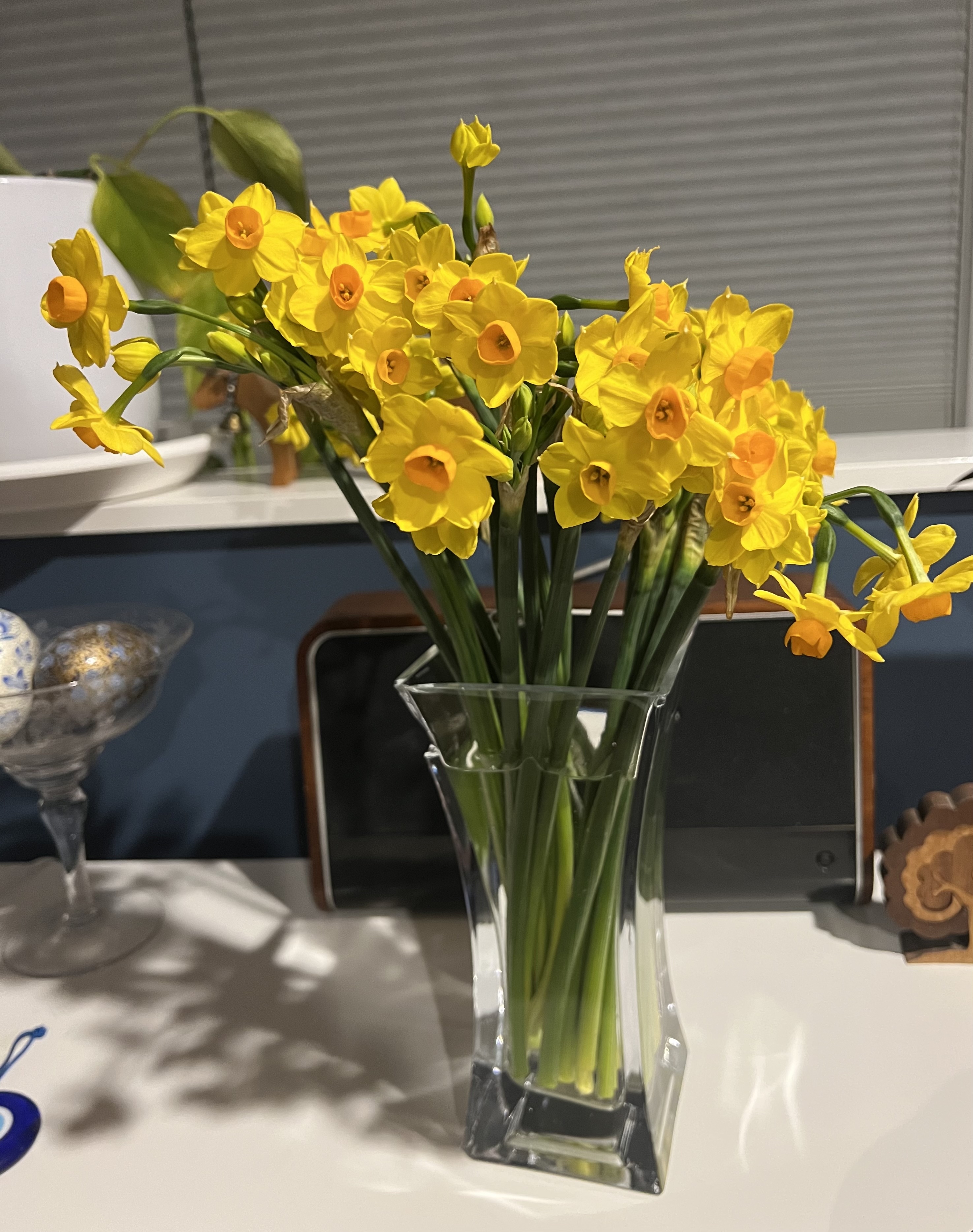
As I come around the last isle, bright yellow jonquils catch my eye. It is mid-winter, yet here they are, heralding spring. Massed in large plastic buckets, their sweet fragrance borders on pungent. I can’t resist. Two bunches are rolled into tissue paper while I hand over a ten dollar note.

Flowers always brighten my day. I’m drawn to their beauty and fragrance. It turns out there is a reason for this feeling. Flowers can spark the release of dopamine and serotonin in our brain by their bright colours and pleasant smell. There are studies that show that having flowers in the house can lower cortisol levels. They create a relaxed and aesthetically pleasing environment which makes us feel more relaxed. 

Before I knew any of these benefits, I instinctively bought flowers when I felt downhearted. Back in 1987, I spent a rather miserable winter in Berlin. The cloud cover arrived in October and never left for six months. The short days felt like eternal dawn or dusk; it was impossible to tell which. It was during these months that I began the habit of buying flowers every Friday afternoon as I returned from university. The florist around the corner wasn’t cheap but made the most exquisite flower arrangements. They reminded me of the Japanese art of Ikebana. The designs were always minimalist, and they took my breath away. I had very little money left for luxuries, but my Friday ritual never felt like an extravagance.

This memory came flooding back as I purchased my jonquils. While I don’t possess the patience to artistically place flowers in a vase, it doesn’t much matter. A dull winter’s day has been transformed into delight by their smiling yellow faces. And for the next week, there will be guaranteed sunshine every morning.

Adelaide Markets

In my late teens, I spent most Saturday mornings at the Adelaide markets. It was where we did our weekly shopping for fruit and vegetables and met friends from other share houses. The markets were a grid of trestle tables laden with fresh produce and boxes underneath containing cauliflower leaves and silver beat stalks. The stall holders were loud middle-aged, leather faced men jostling with each other for customers.

There were only a few shops along the side, mainly delicatessens. One of my favourites was Greek and it had dozens of dried Yevani bunches of basil hanging on ceiling hooks. The shop sold vine leaves and other delicacies and I loved the smell of herbs that infused every corner of this tightly packed store.

After our weekly shopping trip, we headed to Victoria square. Most demonstrations started from this vantage point. We often took leisurely strolls through the city streets calling out slogans against uranium mining, for Aboriginal Land rights or made a general plea for peace. There was never any trouble; we marched with our vegetables, stood up for what we believed in and headed home.

I haven’t been back to Adelaide since the halcyon days of my youth when everything seemed possible, and change was in the air. It just turned out that the change that was coming was not what we had bargained for.

I felt disoriented when I walked into the markets this morning. My memory was playing tricks with me. I seemed to remember Victoria Square to my right but it is to my left. Then there is the market itself. It looks nothing like it did back then. I walked all the way around the perimeter looking for the Greek deli, but it has been replaced with trendy coffee shops ubiquitous in every Australian city.

Even the fruit and vegetable stalls look neater and have permanent signage above them. There are rows of cheese shops, coffee roasters and specialty stores selling everything from body lotions to boutique distillery gin. The rhubarb gin was delicious, although it felt very wrong to try it at 9:30 in the morning.  However, the charming salesman reminded me with a wink that it was 5pm somewhere in the world. This certainly wasn’t the markets I remembered from my youth.

I feel an odd unreciprocated nostalgia when I visit places where I have lived. It is as if the place has moved on, but I haven’t. At least not when it comes to my expectations of the familiar. I know the streets and can find my way around, yet I am disoriented. I search for a familiar building to find it has been replaced by a concrete box with offices. As I walk, I recognise that this is undisputedly Adelaide just not the way I know it. My Adelaide will always be locked away in my untrustworthy memory, made tender with age.