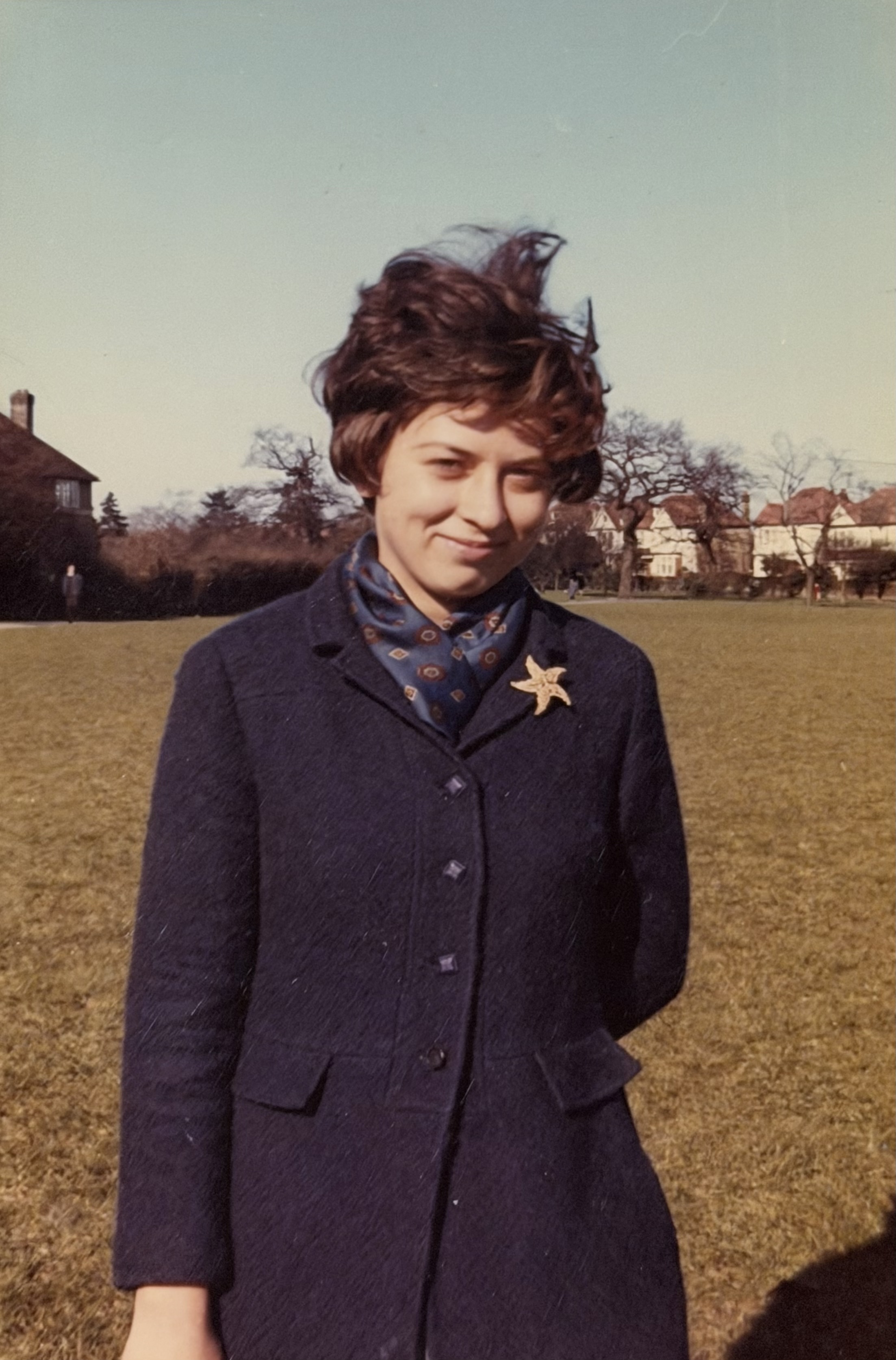
My sister died suddenly but it was not unexpected. She had a series of health issues that plagued her but none of them were necessarily fatal. It was both the combination of these ailments, and her stubborn refusal to do anything about them, that led to her passing. It is easy to say that she chose the path to self-destruction but of course it was much more complicated than that.
Born in Hungary in 1950, she was a post-war baby in a ravaged country where everything was still scarce. Her father had left while our mother was pregnant and by the time she was born two months premature, my mother did not want her either. ‘Throw it against the wall,’ she’d say, then throw her head back and laugh. This was how she always recounted the birth of my sister. Her aunt Vicki, who acted as her midwife, did no such thing. Instead she stoked up the fire and kept the room hot so that the little girl would survive.
True to her word, my mother did not want anything to do with her daughter. She left her in her aunt’s care, where the young child was loved and treated as if she were one of her own. I don’t know whether my mother visited often or at all but in the meantime, she met my father who had lost his wife to tuberculosis in the late 40s. The chemistry sparked between them and during the 1956 revolution they decided to risk their lives and flee the country. It was at this point that my mother returned to Aunt Vicki and took the child from her.
My sister was christened Palma Anastasia. Nobody really knows why. Both are unusual names in Hungary. She was always known by a shortened version of her middle name, Naszti, which later caused her to change her name to Palma and eventually to Pam because she was tired of people getting her name wrong. This was yet another layer of her identity that was stripped from her.
Little Naszti went from a stable loving home to running across mountains with a people smuggler, gunshots echoing behind her. Once ‘safe’ in Austria, she waited in a refugee camp with her mother whom she barely knew and a man she had hardly met. Eventually they were resettled in Luxembourg where she had to learn the three official languages, French, German and Letzeburgisch. Then, when she was ten years old, I was born.
Unfortunately for her, the chemistry that sparked between my parents soon became explosive and my mother often used her to create division between them.
‘He doesn’t love you the way he loves your sister. You’re not of his blood.’
I am surprised she was able to love me as much as she did, considering all the things she was told. My sister, however, was a gentle soul then and wanted to protect me above all else. In fact, as a ten-year-old, she took on much of the mothering responsibilities while my mother worked.
Her world was once again turned upside down when she was fourteen. After a disastrous business venture, my parents fled to Spain to escape bankruptcy. Another language to learn, new school, new friends to make. She was also watching my parents’ marriage implode. When my father and I disappeared one day, she was left with my grieving mother. She searched everywhere for her second daughter and when she found me a year later, my sister was left behind in Madrid to fend for herself at sixteen.
After another ill-fated reunion, this time in Austria, she left for London to work as an au pair at age seventeen. There was another language to learn and she couldn’t keep her name which sounded too much like ‘nasty’ to the English. She began using Palma and eventually Pam to fit in. At eighteen, she met her husband, a Sicilian chef nine years her senior. They married and within a year, I was sent to them for a year so I could learn English. They paid for my private school costs, all other expenses and put up with a miserable homesick child who really didn’t want to be there. My sister wasn’t equipped to look after my emotional needs, but then she was barely more than a child herself. At nineteen, I didn’t do any better looking after the younger siblings of my friends. It wasn’t my sister’s fault; my parents should have known better.
We migrated to Australia in 1971 and she followed within a year with her husband and baby son. While my family life unravelled amid my parents’ ongoing fights and eventual separation, hers seemed to flourish. They moved to the outskirts of Melbourne and life seemed to be going well for her. They built a house, had another child, bought a business and began to establish wealth. I didn’t see her for about six years during this period as I chose to stay with my father. We didn’t have a phone or car and I am not even sure that I had her address.
When we finally re-established contact, she was a mother of two living in suburbia. We didn’t have much in common but we loved each other. I became more involved with her daughter whom I regularly took to my place for sleepovers and ballet lessons. My sister took on more and more of the Italian traits of her husband’s heritage. They spoke Italian at home, she saw herself as the matriarch but was never really accepted by the broader Italian family. No matter how much she tried, she could never become one of their tribe.
I didn’t see everything that happened behind closed doors. My brother-in-law was loud and demanding. He always got what he wanted. I know he didn’t treat his wife kindly. He worked hard and she was expected to do whatever had to be done behind the scenes for his businesses. If anything was not to his liking, she would know about it. I never saw him hit her but his children did. I think she just got tired of a transactional marriage and saw no way out for herself.
When our mother became old and disoriented, my sister took her in. She looked after her for years with the patience of a saint. Our mother had never been easy but in her old age she became ever more demanding, nasty and often drunk. No matter where the alcohol was hidden, she would sniff it out. It became a constant source of friction between my sister and her family yet she could never find the heart to put her in a home.
Food became a source of comfort and over the years she gained a great deal of weight. She always loved fried food, bread, pasta and sweets. About three years ago, she was diagnosed with diabetes. She struggled to manage her diabetes and often forgot to check her levels.
Like her husband, she was a chain smoker which eventually led to emphysema. Smoking helped her regulate her mood. She continued to smoke even after her husband died of lung cancer. She probably had a smoke in bed the night before she died. ‘What else do I have left?’ she would say to herself.
I’m not sure when she discovered poker machines. She certainly kept it a secret from us all. I used to get frustrated with her stories of break-ins, cleaning ladies stealing jewellery, people stealing her bag or wallet out of the car, often with the weekly takings of the shop in her possession. How could anyone have such bad luck, I would think. At times she would ring in a panic and ask for a loan for something she couldn’t tell her husband about. Whenever I could, I obliged, never thinking that there was another reason behind her constant bad luck with money.
Once the truth came out, her relationship with her children was damaged and her husband was furious. She had lost well over a million dollars and suddenly they went from being well off to having to work to keep the roof over their heads. The last time I saw her she told me that gambling blocked everything out of her mind and for the hours she was there, she did not think about how miserable she felt. In the end, it left her asset rich in a large house without the money she needed for its upkeep. She relied on foodbanks to get her through to her next pension cheque.
She discovered love about four years ago when she met a much older man. He is in his 90s and has outlived her. While they seemed happy in each other’s company, her daughter had concerns about the relationship and did not approve. As it turned out, he was too frail to look after my sister or to live on his own so he moved to Gippsland to live with his daughter. He kept in touch over the phone and occasionally would visit her. My sister confided in me that he was the first gentle man she had encountered.
It is painful to admit that she was never truly happy. Our phone calls were always about the latest aches and pains, the terrible state of affairs in … (insert the latest hot spot), and how ungrateful her children were. I dreaded these conversations. Her hearing aid never worked well, the TV was always on high volume in the background and I had no chance of getting a word in. She stopped going out and her world shrunk to her four walls.
I tried to talk to her about our family but she steered clear of painful memories. As with so many members of my family, whatever she knew is now forever lost. I have come back from Hungary with photographs I have never seen before, and I was looking forward to asking my sister who these people were. I was hoping to drive to Melbourne in late September to talk to her about my recent trip. Now there is no one left to ask. The people in those photographs will remain unnamed, another missing piece in the puzzle that is my family.


Gosh Vicki, you have captured the tragedy of your sister’s life so well. Obviously there is a great deal for you to process too. Thank goodness you are able write about it.
LikeLike
Ohhh Viktoria, big big hugs. We will chat soon xox
LikeLike
a lovely description of Palma’s sad, tragi-comic struggles with life..
LikeLike
I learned so much about your sister here. What a challenging life she had. I wish she could have known greater happiness. Lizzie xxx
LikeLike
Very sorry for your loss Viktoria. Thank you again for telling us your story, a wonderful piece of humanity. Best Francoise
LikeLike
I was soo affected by this amazing piece of writing. And so sad for you Vicki. Rima xxOn 15 Aug 2026,
LikeLike
Hello Viktoria, I hope that your sister died peacefully, may she rest in peace. What a very, very difficult life she had. I wonder why your mother decided to take her away from Hungary, her life might have been easier if she had stayed. Your beautiful writing tells her story with truth and love. A privilege to read.
LikeLike
I’m so sorry for your loss, I have only just caught up with your blog. Sending you lots of love and hugs. xx
LikeLike
💔
LikeLike