Softening the edges

I am drawn to the fog the way some people are to the sun. I revel in it, rejoice in its arrival and gladly slip into its cloak. It is a snug garment to wear that allows me to blend and fade, removing my sharp edges and those of the world around me.

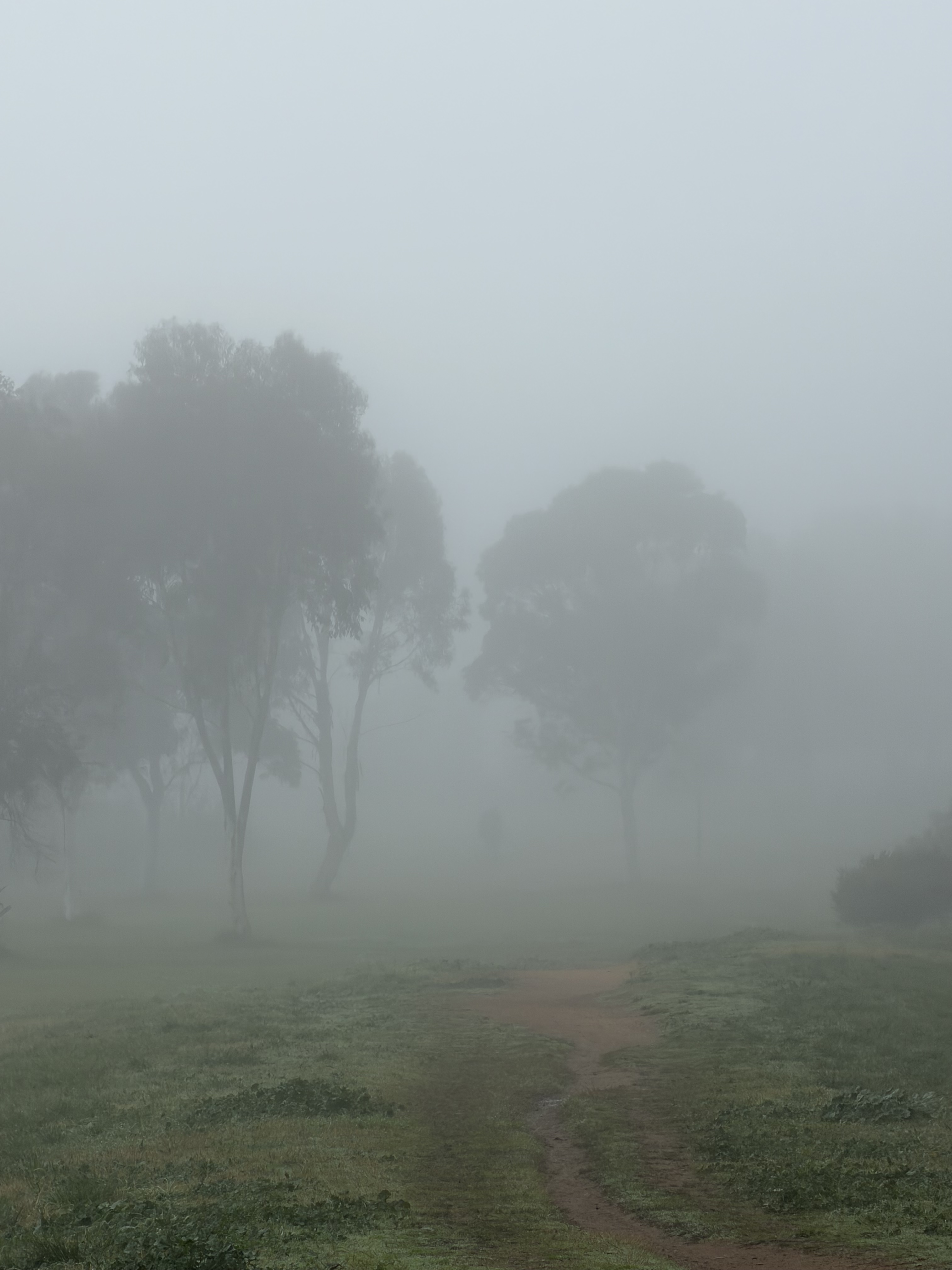
When I walk in fog, I feel I am the subject of a drawing where a skilled artist using only black and white pastels renders the scene. My figure in the distance is finger smudged and blends with the light grey surrounds. It is hard to make out the shapes but they are there. Look and you will find them.

A copse of trees takes on a mystique, sensual and unattainable. Their beauty can only be captured from the distance, come too close and the fog dissipates leaving only a group of ordinary trees. Move back into the distance and the intrigue returns.

For some years I worked at Blackheath, a village atop the Blue Mountains. Fog accompanied our days in both summer and winter. You never knew when it would appear. Many a time I stood in the fog shrouded playground knowing that somewhere beyond the white sheet that enveloped me, were over 300 children. I reasoned they would find me should they need me.

It was at Blackheath that I saw a phenomenon that I could only describe as poetry come alive. I watched the fog roll in from the valley, slowly making its way up the main street. It rolled like a haybale, gathering up people, cars, buildings until I too was swallowed up in this rolling ball. It reminded me of the line in T.S. Elliot’s poem The Love Song of J. Alfred Prufrock where he describes The yellow fog that rubs its back upon the window-panes. The fog curled and settled on every object in its way.

While I know that this is a very romantic view of fog, I acknowledge the hazards it brings. Generally, I don’t mind driving in fog but once, when driving in Canada on the other side of the road in mid-winter, I lost my nerve and had pull over. Logging trucks rattled past on that purblind night and fear clouded my judgement just as the fog had clouded the alpine road ahead. My daughter took over and steered us safely to our destination, a picturesque log cabin blanketed in snow.

Back in Australia, fog is a friendly companion on winter mornings. I enjoy getting lost within it, the anonymity it brings and the delight in discovering a dog on the path that was invisible only a few seconds ago. I enjoy the softness it brings to an otherwise bleak morning. Like those trees in the distance, some things are at their most beautiful when not fully revealed.
A capital fog

Canberra is located at the foothills of the Snowy Mountains, within the Great Dividing Range. Its altitude is 577m above sea level, which may not seem like much by South American standards where cities often sit above 1000m, but it is quite high compared to other cities in Australia and Europe. In fact, Canberra’s elevation is 168m above that of Zürich.

The elevation and the fact that it is a relatively sheltered valley near mountains, allows cooler air to sink and the warmer air to form a blanket above it, especially when there is little or no wind. These are perfect conditions for thick fog to occur. On average, there are around 20 heavily foggy days in winter.

I relish these foggy days which give the city a magical air. I love walking in it, not knowing what is in front or behind me, just focusing on one step at a time. I don’t even mind driving in it, although I admit that I prefer driving in fog when I know a route well. But then I have had years of experience driving in the Blue Mountains, where fog can envelop a valley even in summer.

Canberra airport was built on one of the lowest lying areas in the city. The result is that many flights are delayed and cancelled, especially after 10am when incoming flights can’t land due to the lack of visibility. It does seem like a huge oversight to have located an international airport in one of the worst affected areas in town.

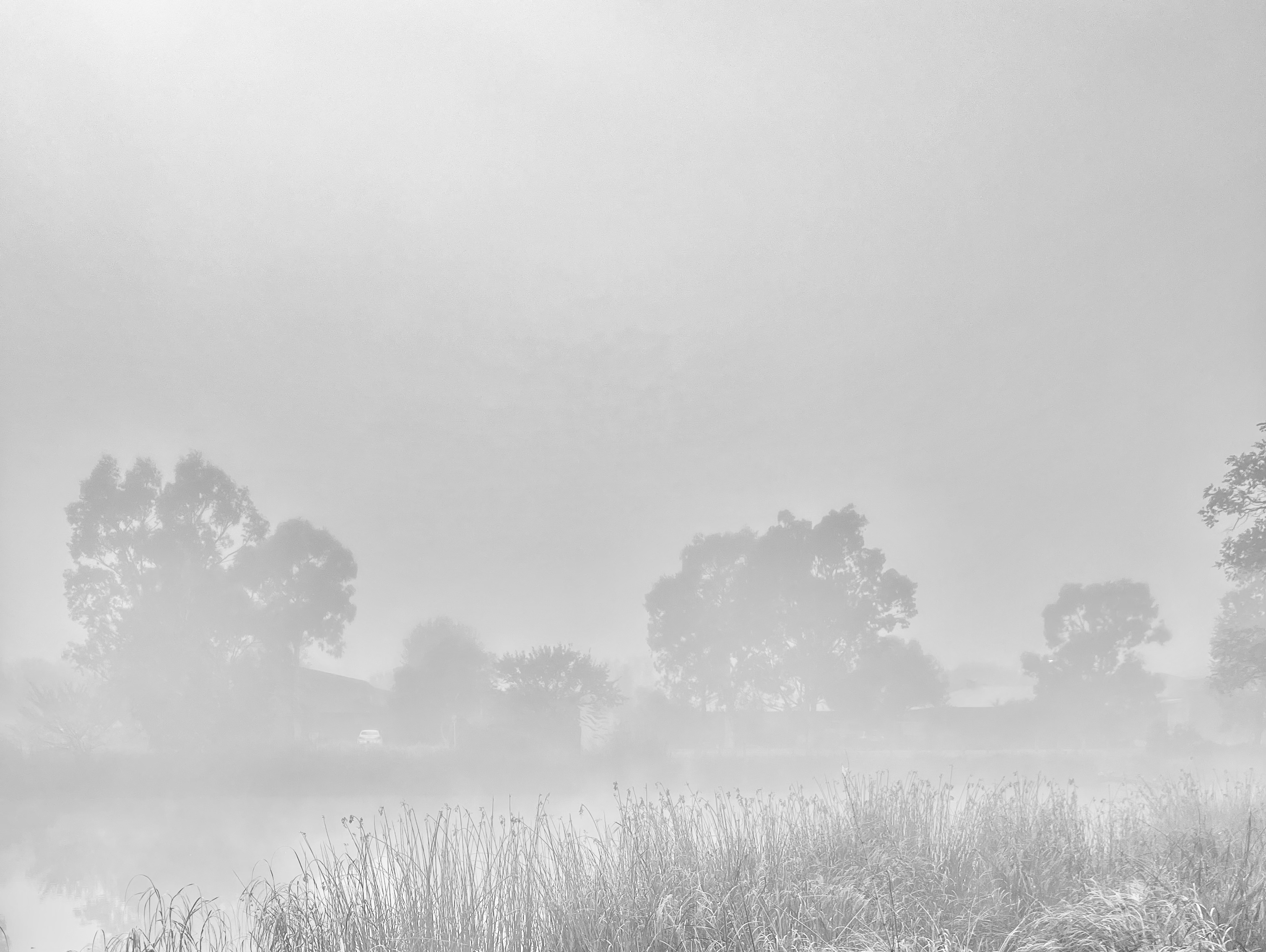
Where I live is only 9km from the airport and it shares its propensity to fog. There are mornings when I can only see shadowy outlines of the trees across the road. When I walk the dog, she disappears ahead of me, and I can confuse markers ahead for people coming towards me. It is a strange, fairy-tale landscape where both time and space seem to conflate. It is muffled and eerie, yet stunningly beautiful and comforting at the same time.

When I worked at Blackheath in the Blue Mountains, I often watched the fog roll in like hay bales on a farm. One would roll up the main street and gather moisture and momentum as it shrouded everything in its path, white as a freshly washed sheet. I’d look out onto the playground and play a game of ‘now you see me and now you don’t’; 350 children there one moment and gone the next.

Fog is an enormous doona spread over the city to make all of us more aware of our senses, to hone our navigation skills and to remind us of the things we can’t control.

It is also a lesson in awe and wonder inviting us to pay close attention to our surroundings. Fog is the winter coat I wear gladly. Wrapped around me, I feel peaceful and lovingly enveloped.