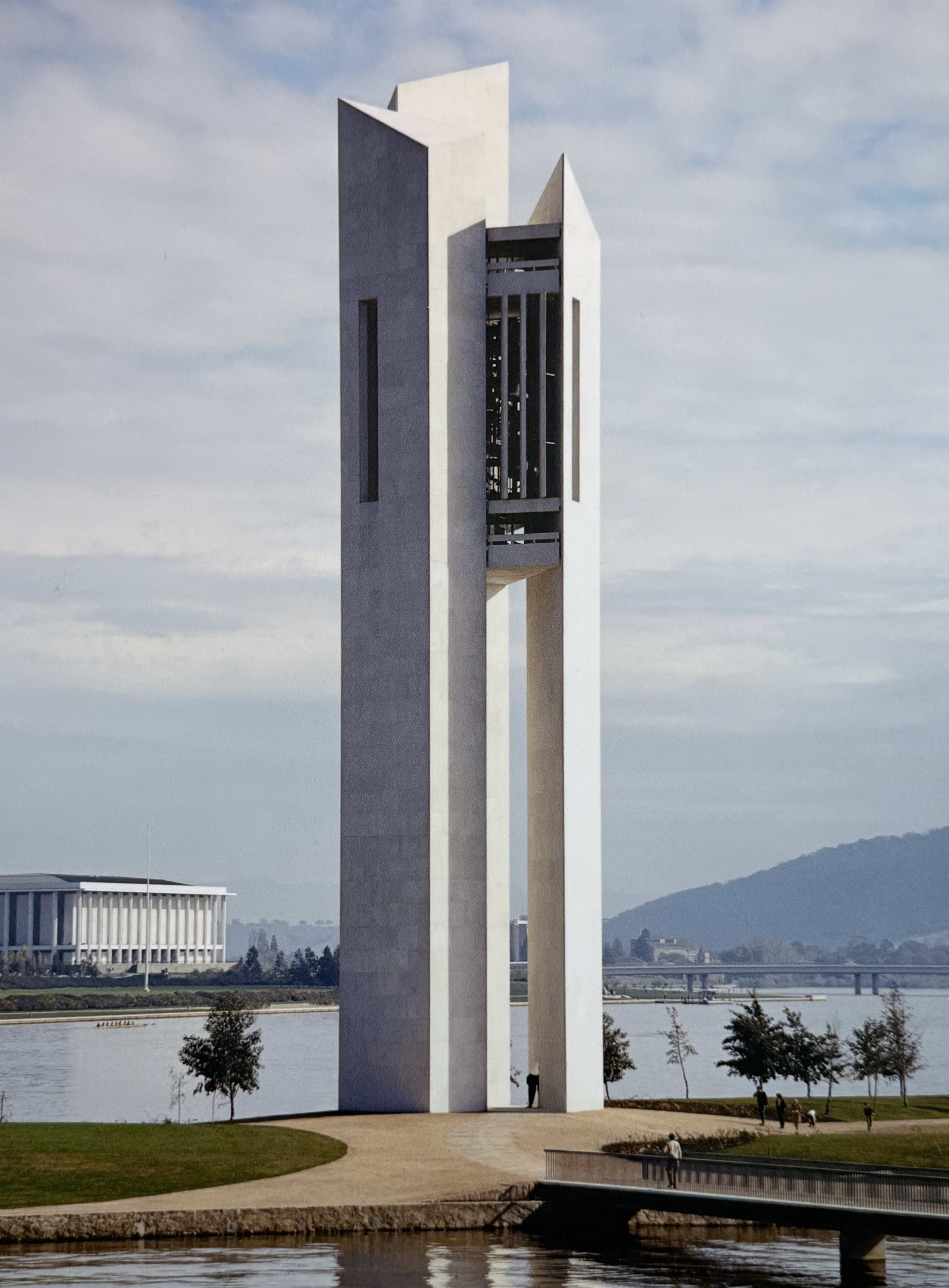
National Carillon 1970
Whenever I return from Europe, it is the daily punctuation of bells that I miss. From churches and town halls, they mark the passing hours and quarter hours. For centuries, their sound helped people keep track of time, long before clocks and watches became common.
When I saw an advertisement to tour the National Carillon here in Canberra, I immediately signed up. I had no idea that traditional carillons were so rare as I have worked at Sydney University where I heard the Carillon played daily and I also worked at Bathurst where one of my friends is a carillonist. I never realised how privileged I was to have heard all three of the traditional carillons in Australia.
To be classed as a carillon, the instrument must have at least 23 bronze bells and be played by hand using a baton keyboard. The carillonist strikes the baton with the bottom of a loose fist and may also play some notes with foot pedals. The National Carillon has 57 bells and today I had the pleasure of playing some random notes that reverberated across a couple of nearby suburbs. The highlight of the tour was taking the lift into the belltower and seeing the largest bells that ring out majestically over Lake Burley Griffin. The biggest bell weighs six tonnes, and I felt its rich resonance with my whole body.
I savour their varied voices, some high pitched and almost tinny, others with tones so low that they feel like pure vibration. To stop and listen until the last reverberation dissipates is a habit I have learned to nurture. I first came across it in Buddhist meditation, where the bell is a reminder to return to the present. And so, for a moment, I allow myself to be enveloped in pure sound and simply be.

