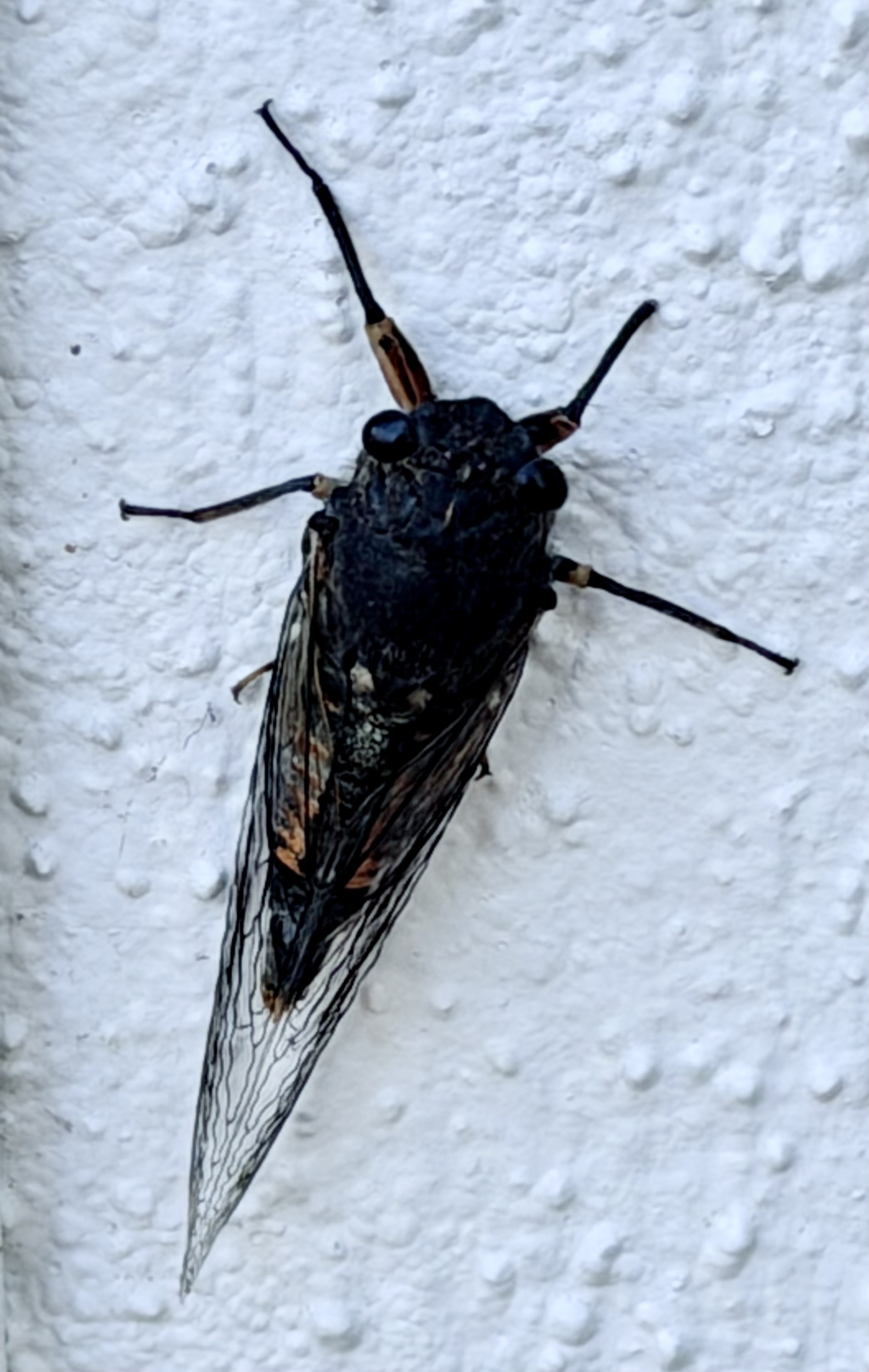
The sound of summer in Australia is the ear-splitting drone of cicadas. On a hot day, different species may be heard, each with their unique song. The sound they make with their tymbals creates the characteristic rhythmic drone. On my walk the other morning, the sound reminded me of a hurdy gurdy used in medieval music.
The closer I listened, the more sounds I heard, including a lower rhythmic quack that punctuated the drone. Intrigued, I recorded the sound and headed home to do some research. The quack quack sound belongs to Red Eyed Cicada and the high pitched deafening drone comes from the cicada affectionately known as the Greengrocer.
The common names of cicadas in Australia are often comical. Here are some of the ones I have come across: Double Drummer, Yellow Monday, Floury Baker and Razor Grinder… They sound like nicknames acquired down the pub after a few beers.
Some years ago, I worked at a school where classes were named after a theme. One year, the whole school was named after insects and I chose for our class to be the cicadas. We collected their shells from trees and learnt about their life cycle. Children often brought in cicadas they had found and after studying them, released them in the playground. At the end of the year, each child was to receive an award which I read out aloud at an assembly. I found 25 different cicada names which I assigned to each child with a sentence or two about their personality. Parents laughter echoed in the hall as I read amusing anecdotes I had collected throughout the year. The kid who liked to tap his pencil on his desk became the Double Drummer, the Black Prince was our Star Wars aficionado. I haven’t thought about that for years.
This year we have had a strange summer. It arrived somewhat late and while there are stinking hot days, the temperatures have also plunged into the teens. It is pretty unpredictable at present. I am not a fan of the hot weather and much prefer autumn and winter, especially in Canberra where temperatures plummet to negative numbers. Yet the sound of cicadas cutting through the summer heat, loud and insistent, brings a measure of joy to even the hottest days.
The first time I saw Lake George was almost 30 years ago. We were travelling to Canberra along the Federal Highway when the lake appeared to our left. It looked like an enormous expanse of water that accompanied us for what seemed like a long time. Later I would learn that the lake is 20 km long and 10 km wide. I thought all of Canberra’s drinking water must come from this enormous lake.
A few years later, we travelled the same route and I was looking out for the large lake. It wasn’t there. All I could see were cattle and sheep grazing where the lake should have been. There were even fences. It struck me that I couldn’t see any creeks that should have fed into a lake. Could I have imagined the expanse of water?
In time, I learnt that the lake regularly empties and fills. There are no creeks that feed into it, which makes it an unusual type of lake, a closed basin. What feeds it is rain and what drains it is evaporation. When it does have water, it is rarely deeper than 1.5 to 2 metres. This was not always the case. I have seen photos from the early 1960s when the Canberra sailing club held regattas on the lake. And in prehistoric times, the lake is estimated to have been 37 metres deep. With the current rate of climate change, Lake George will experience more severe fluctuations, and it may become a dry bed with only occasional filling episodes. So much for my fanciful idea that it could supply drinking water.
I have now lived in Canberra for close to two years. In that time, I have seen the lake fill and begin to drain again. There are cattle at the northern end now and I can see the fences appear again. Looking across the lake, I see a wind farm that one of our ex-politicians, Joe Hockey, described as ‘a blight on the landscape’. It makes me wonder whether he has ever seen an open cut mine. I quite like the look of the wind turbines in the distance.
Last winter, my boss and I had to drive to Sydney a couple of times. When we left Canberra it was still dark, and the sun had just begun to peep over the horizon as we came down towards Lake George. I was mesmerised. The black expanse of water slowly changed to navy, then cerulean. Golden threads shimmered where the sun’s rays bounced off the water. I was glad not to be the driver, so I could immerse myself in the liquid light of the lake.
Lachlan Macquarie named this expanse of water Lake George after King George III in 1820, as if it didn’t already have a name. To the Aboriginal tribes of the area, the lake was known as Weereewa or Ngungara. It has deep significance to the custodians of the land and waters as both a meeting place and a place for ceremonies. There is also strong evidence that there was a massacre at the site sometime in the early 1820s. King George III never set foot on Australian soil. It is time to recognise the custodians of this land and the lake, allowing them to reclaim it with their own language and rightful name. The lake is waiting for us to remember its true name.
When I jump into the deep end of a pool, I can always dog paddle until I find my stroke. This is what life has taught me. I always get to the other side. I may not be a great swimmer but I am buoyant. Knowing this has served me well.
In 2008 I spent a year in Switzerland with my family. It was a crazy opportunity that came out of nowhere and I was willing to take the chance. Arriving in Zurich was like jumping off a diving board. The first week felt like a massive belly flop and I wondered whether I had made the right decision, not only for myself but for my family.
It didn’t take us long to learn some of the idiosyncrasies of our new home. School starts before 8 a.m., shops close for lunch, trains and buses run on time. There were other quite annoying things such as having to do your washing on a Friday (everyone has a designated day), no flushing toilets after 10 p.m. (house rules) and no paracetamol available except at chemists which are closed on Sundays.
I was quite cocky before we left. Why would I have trouble understanding the Swiss, when I understand Swabian and Austrian dialects? What could be so difficult? Well, maybe vocabulary, grammar and pronunciation as a start! It took me much longer than I expected to follow simple conversations. Nor did I expect the Swiss to frown upon my high German. After all, it is meant to be the official language in the German cantons.
As we became increasingly familiar with how things operated, we began to appreciate the small things of life. Wherever we were in the countryside, we’d find a cat in a field, ears pricked up, ready to pounce. We could even spot them from the train! Why do Swiss cats do this and not other cats? It remained a charming mystery.
If land didn’t have a dwelling on it, there were cows grazing there, kept in place by movable electric fences. Behind our nearest bus shelter were three cows and behind them were rows of multi-storey flats. If it wasn’t cows grazing, it was goats. These animals could be found in any of the suburbs of large towns. I grew to love this proximity to farm animals. It made for a slower and much calmer pace.
In 2024, I jumped off the diving board once more, this time to move to Canberra. It wasn’t anywhere near as disorientating as moving to Switzerland but it did feel much more permanent. I had bought a townhouse, changed jobs and began the process of acclimatising. At least I can speak the language here and know how society operates but it still takes time to adjust.
At first, I was confused by the wide streets and wanted to turn into the oncoming traffic not realising that the lanes were one way. Then there were all the roundabouts and roads that go around in circles. I have been caught out more than once with the all-day 40 km school zones with no flashing lights. In fact, I have never had as many fines as I have since moving here. The rules can be quite perplexing!
In Canberra, I can buy a bottle of wine at the supermarket, just as I could in Switzerland. However, when I go to work across the border, this is no longer possible. Lately, I have begun to see other similarities with where we lived in Switzerland. Every morning I drive past ducks that may waddle across the street, only 100 m from a main arterial road. Near the first roundabout as you enter Canberra coming from Sydney, there is a small herd of Angus cows grazing in a paddock that will eventually be turned into medium density housing. I had to laugh when I first saw them.
My drive to work takes me along a stretch of a freeway that has paddocks on both sides. There are agisted horses, cows and small farms all within a ten-minute drive from the centre of the city. I hope this doesn’t change in my lifetime. Next to one of these farms there is a small ‘shop’ that works on an honesty system. Here, I can buy eggs, cheese and honey on my way home. It reminds me of a place in Switzerland which was a ten-minute walk up the hill from our place. We could buy seasonal fruit from the farmer who had a wooden box on the side of the road where we would leave money. Honesty boxes could be found all over Switzerland including deep in forests where 2 Franks could be exchanged for a swig of Absinthe!
Canberra has retained the feel of a large country town with plenty of green space. No wonder it prides itself on being the Bush Capital. Maybe I recognised some of its similarities to Switzerland which I grew to love. I think about this more often as I approach my second anniversary living in Canberra. The longer I spend here, the more I appreciate its beauty, surrounded by farms, nature reserves and the stunning Brindabellas in the distance. I’ve found my rhythm once more; steady, buoyant and much more at home.
The other day I listened to Dr Ellen Langer speak about mindfulness as a way of being rather than a practice. She described the art of seeing the ordinary with fresh eyes, of really looking, really noticing. It struck me how easily the rhythm of daily life can lull us into living on autopilot.
Her talk reminded me of the Buddhist Monk, Thich Nhat Hanh’s definition of mindfulness, doing the ordinary things in life with a sense of purpose and attention, whether that be opening a door or turning on a tap. Each of these little acts can be done either mindlessly or mindfully. Doing it one way we are absent from our life while doing it mindfully we become alive to the present moment. And the present moment, as we know, is the only moment. Whatever happened 5 minutes ago is in past and whatever is coming is in the future. Life can only be lived in the small moments of now.
I have known this for many years but I am not very good at being grounded. My mind takes me hither and dither and I can be quite the scatterbrain. Where’s my phone? My wallet? Did I turn off the lights? Did I just lock myself out? These are daily micro-moments of panic I experience on repeat. My daughter just laughs and says she never gets past counting to 17 before my problem-of-the-moment is resolved!
This morning has been a scattered start. I’m still in my PJs deciding on shower, getting dressed, making to do lists, going to the shop and walking the dog. It really shouldn’t be this hard. Just start with the first logical step (have a shower) and keep going. It hasn’t helped that I am unwell and brain fog has settled in for the day. That’s when I stopped and looked out the window. No, not just looked out the window but really looked out the window. I saw the usual scene before me with fresh eyes. Trees swaying in the wind, leaves like windchimes. Thousands of hushed, eucalypt windchimes trembling on trees only a few metres from the glass pane. I was mesmerised by the bounty of their beauty and then looked further afield towards the horizon.
Erupting in a belly-laugh, I couldn’t believe my eyes! I have lived here for 20 months and have never seen it. Yet there it was, clear as the day before me. The largest structure in Canberra, a 195metre telecommunications tower known as Telstra Tower and it can be seen from my window! How often have I mindlessly looked out and never seen it? How can I miss an obscenely large structure like this? I shook my head in disbelief and couldn’t help but laugh at my selective blindness. Sadly, this is nothing new, many people know this about me but it still catches me completely unawares.
I now have a new landmark to celebrate when I look out the window and I wonder what other delights await me as I learn to look once more with fresh eyes. It’s both humbling and heartening to realise that wonder was there all along. As Thich Nhat Hanh says, “We all have the ability to look at things with fresh eyes and see them as if seeing them for the first time. If we have lost our freshness, all we have to do is practice breathing in and out to restore it.” (From A Handful of Quiet, Happiness in Four Pebbles.)
And so I breathe in and out and learn an old lesson anew. I laugh at how life patiently keeps offering me reminders and I resolve to open my eyes and look deeply as if for the very first or very last time.
Many a weekend is spent on housework and chores. That’s a fact of life for those of us who work full-time. But there’s more to life than dishes and socks. Weekends also need to include recreational activities to recharge us.
This week my dear friend Heidi announced she would come to visit. We live about 110 km from each other but even with this relatively short distance in Australian terms, we don’t see each other often. I suggested going to Floriade, a Canberran institution which is held every year in September. She readily agreed.
Floriade is a celebration of spring held at Commonwealth Park each year. An overall theme is selected for the various garden bed designs. This year Floriade features 12 large garden beds highlighting Australian Scientists through the contribution they made to a scientific field. The garden bed themes have names such as Molecular Structure, Spectrum and Petri Dish. By carefully observing the design of each bed, the theme presents itself. My favourites were the double helix for DNA and the Atom.
While massed tulips are the main attraction, there are many varieties of flowers in an assortment of colours. There are Pansies, Chrysanthemums, Hyacinths and Violas to name but a few. Each display is painstakingly planted to represent the facets of science it celebrates. It can be difficult to discern the images portrayed from ground level but when viewed from above, the images become clear.
I suggested going on the Ferris Wheel to get a better view. After a long wait, we clambered into a swinging carriage that was to take us up for a better view. From above, it was much easier to discern the themes. It was very windy at the top and we rocked from side to side which made taking pictures difficult. Our best photos came from when we stopped half way up.
Heidi and I had a wonderful time exploring the gardens. We were mesmerised by the variety of colours of the flowers we encountered. Black Pansies and deep purple hyacinths! We had never seen either of these. We marvelled at the ingenuity of the of the garden bed designers.
While the flowers occupied the centre of attention, we still had time to catch up with each other’s lives. We are empty nesters; our children flapping their fledgling wings. We talked about our plans for retirement, the joys of having a dog, our fears for future generations.
There is immense comfort in a friendship that has lasted forty years. Surprisingly, in all that time, we have only lived in the same town for roughly two years. Yet like tulips at the Floriade, our friendship has returned season after season, surprising us with vivid palettes of colour and the patina that the years provide.
Dickson is an inner-north suburb of Canberra, well known for Asian restaurants and specialty grocers. The shopping precinct is also known for people sleeping rough, alcohol and drug problems as well as boarded up shop fronts. Coles and Woolworths are two retail giants competing against each other, but small shops struggle to make ends meet. It is a mixed bag.
In the centre of the shopping precinct is a plaza with a public library servicing the surrounding areas. At night, the covered entrance way provides shelter for the homeless. Vinnies does a night patrol in the area, providing food, jackets, sleeping bags, and offering non-judgmental social interaction. There are many who would like to clear out the poor and ‘improve’ the suburb. They speak of a clean-up as if it were a matter of getting some mops and brooms, sweeping away unwanted people.
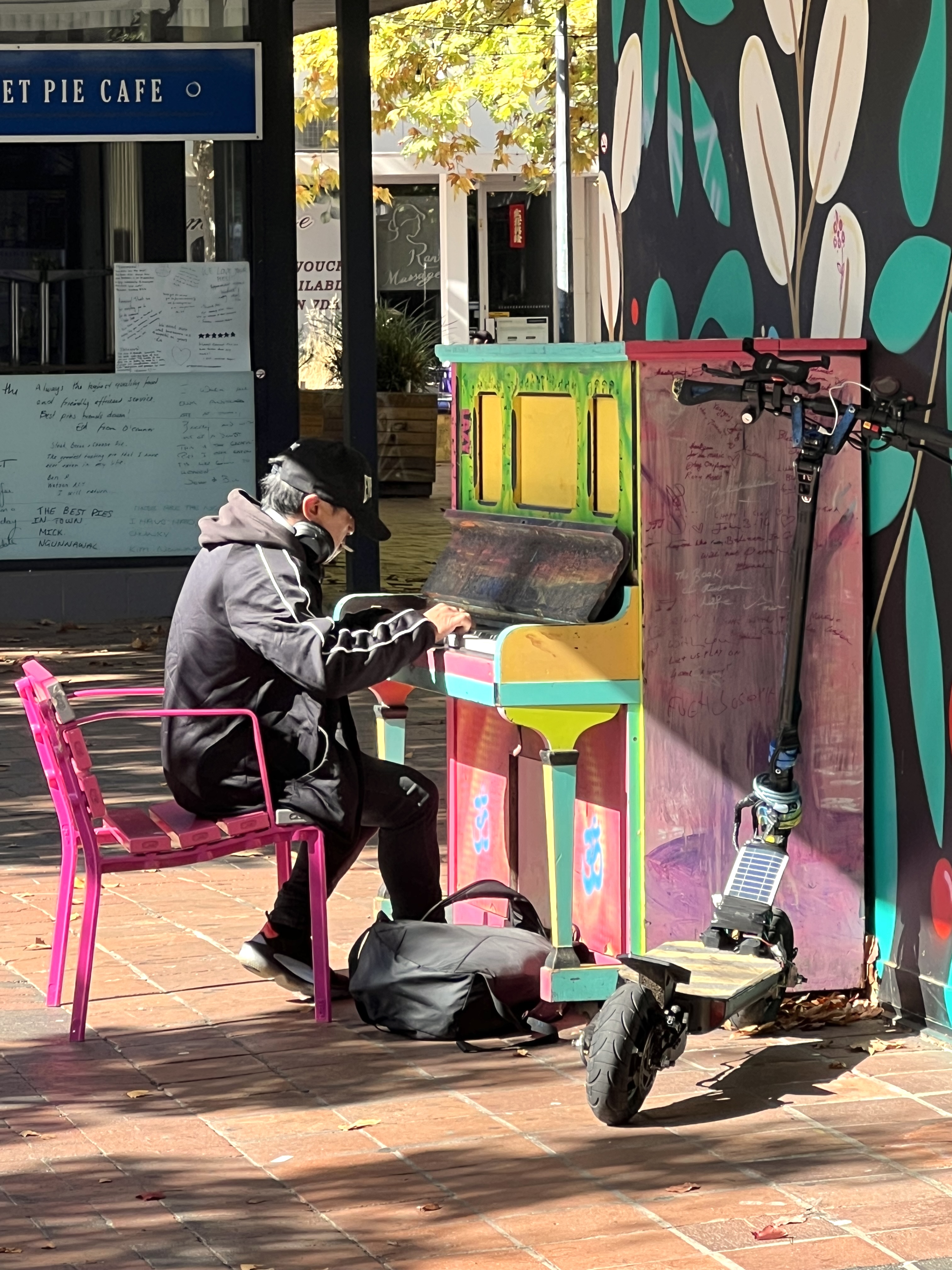
Yes, I can attest to the problems in the area, but I also see a richness and community spirit. While waiting for a prescription to be filled, I sat on a bench opposite a muralled wall where an upright piano stands under the eaves of a building. It is old and weather-beaten, but its keys are intact. Playable, even if most likely out of tune.
A man in his 40s, wearing a black backpack, sat down, rolled a cigarette and began to play. The music that flowed from his hands was enchanting. As it was a public holiday, there were very few people about. Yet those who were about to walk past, stopped, took videos or simply listened before continuing on their way. I stood up and commented on the soaring melodies to a woman with a pram. Her toddler was transfixed. Soon, someone else joined us and we were strangers no more. The pianist had brought us together to enjoy the moment, doing what he loved best, awakening within us the power of music.
At the end of a song, I approached to say thank you. He was rather bashful, telling me he was self-taught and had only been playing for two years. He could only play by ear, and as he hadn’t worked out how to use the black keys, he could only play in C major or A minor, the two scales that can be played solely on the white keys. He probably wasn’t aware of that. Nevertheless, he sounded accomplished, and his repertoire was extensive.
This man, rich in spirit but poor, had transformed my trip to the chemist into deep appreciation for the gifts that people can offer each other. He touched the hearts of everyone who walked past and allowed people to connect who would otherwise not strike up a conversation. All because someone had leaned an old piano against a wall in the mall.
I have seen the architect’s impression of a precinct, a master plan of hundreds of new apartments and clean, green public spaces. The language of conservation (zero waste) and Connecting with Country (green corridors) are present, appealing to our middle-class conscience. No doubt the suburb will enjoy a process of gentrification and it will be prices rather than the broom that will eventually sweep the suburb clean of people like the piano man.
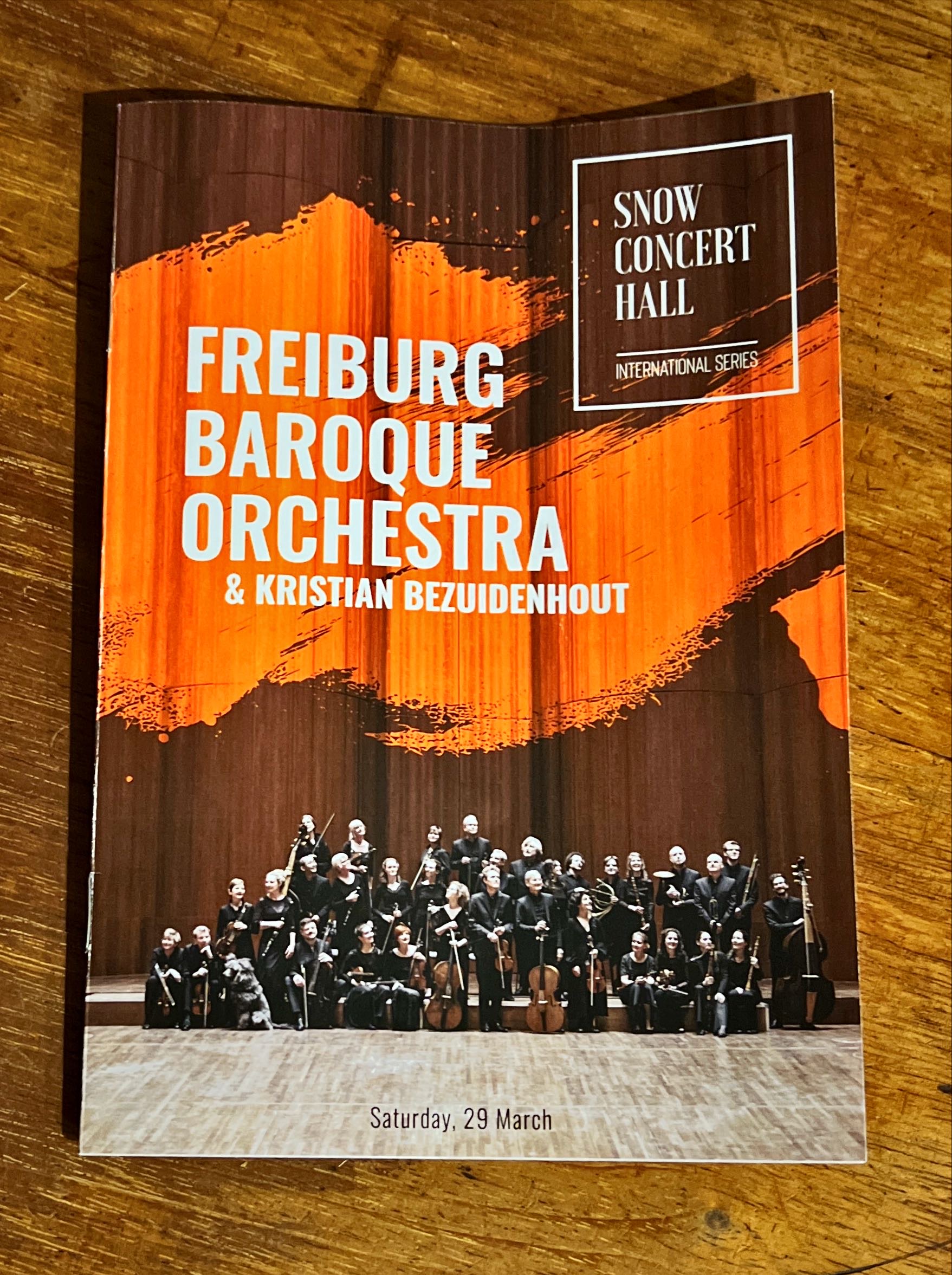
On the spur of the moment, I bought myself a ticket the Freiburg Baroque Orchestra. I have been in Canberra for just over a year and so far, have attended four concerts. Having access to more cultural events was one of my reasons for moving to the city. So why wasn’t I getting out more?
I am happy with my own company, but when it comes to going out, I still subscribe to the outdated notion that I need to go with a friend. What a ridiculous idea! Sure, it would be nice to talk about the concert, but during the recital we’d be sitting next to each other in silence. Would I enjoy the music more because I know the person sitting next to me? Of course not! So, I decided to drop this limiting belief and go anyway.
The concert consisted of a Bach symphony in G minor followed by the Mozart piano concerto ‘Jeunehomme’, with Kristian Bezuidenhout on Fortepiano. In Baroque music, I’m much more used to the sound of a Harpsichord, so it was interesting to listen to the Fortepiano which is more like the piano we know today but with a much softer, less sustained tone. Bezuidenhout’s playing was magical. Unfortunately, the man in front of me was tall and bobbed his head this way and that, making it hard for me to watch the action on stage. I felt sorry for the people behind me who must have watched his head go one way, mine the other, to get a glimpse.
There were two children behind me with their mother. I am guessing they were between 8 and 11 years old. Neither could wait for the interval to get some food. Poor kids! Afterwards, the boy, bored with the event, was hoping the concert would end after each piece. His sister was much quieter. It reminded me of taking my daughter to concerts when she was little, but she was much more engaged. Maybe that was because we started taking her from about the age of three and she was a compliant child. At that age, she sat on one of our laps, listened to the music for the first half and fell asleep after intermission. I wasn’t concerned about the children behind me – they only spoke between the pieces when people were clapping.
After the interval, the orchestra played the Violin Concerto No.5 in A major, ‘Turkish’. Gottfried von der Goltz was truly mesmerising on violin. I thought about my daughter, who also learned to play violin. I would have loved her to become a violinist but while she had the aptitude, she didn’t have the application. She pursued it for a couple of years at university but never quite seriously. At the time, I was a little disappointed. Now, I see that her interests have evolved and what she does pursue, she does with passion and full-hearted commitment. All these thoughts went through my mind as I listened. I also considered how lucky I am to have my daughter nearby. Had she become a violinist, she would most likely be overseas by now.
It is hard for a casual connoisseur to concentrate on only the music for over two hours. My mind went to many places during the evening. One place I wished my mind hadn’t turned to, was feeling annoyed with a man two rows in front of me. He not only arrived late but scrolled on his phone for the entire performance. No matter how much I told myself that I had no control over the situation, it kept annoying me. I tried to tilt my head so I couldn’t see the screen, but the phone kept lighting up. I felt sorry for the people sitting either side of him. I couldn’t understand why they didn’t ask him to put it away. It made me wonder why we seem to have traded manners, which are about the way we behave towards others, for the right of the individual to do as they please. Dear Lord, I’m beginning to sound self-righteous!
The end of the concert caught me by surprise. I must have drifted off a little. It had all been quite pleasant except for the mobile phone man. We streamed out of the concert hall, most people well past their sixties, judging by the number of grey heads. I felt like a youngster in comparison. Walking to the car I thought how easy and enjoyable the evening had been. From now on, I am fully embracing my independence.
I’m back at work after two glorious months off. While I was still working diligently on my own projects, the days and weeks had a different rhythm. Often, it was difficult to tell which day was which, as the weeks rolled into each other. There’s a deliciousness about feeling that we are outside of time, but it also has its downsides. Like forgetting about business hours for example and realising that others work on a different set of assumptions about working hours.
Now that I am back in the Monday to Friday world of work, weekends have a special quality to them. I can sleep in, read a book, go to the market and walk my dog at a more leisurely pace than during the week. This morning, I took my dog Zoë to the local café, wrote in my journal, drank my latté and shared a freshly baked croissant with her. Bliss.
Walking back, I took my time and noticed the small things that go unnoticed when on a deadline. Like the slight breeze that caressed my bare arms ever so gently. Entering a copse of trees, I saw the shadow of the leaves dancing on the path beneath my feet. I stopped to watch this shimmer of shadow and light – a performance dedicated to the spectator who chose to notice its exquisite beauty.
Back home I performed all the mundane duties that accumulated during the week. I didn’t grumble or delay, I completed them with a sense of joy that comes from being truly present to miracle of life and all it has to offer. Or as Eckhart Tolle put it,’Always say ‘yes’ to the present moment… Surrender to what is.’
Every six weeks, I get my hair cut. There’s nothing out of the ordinary about that. Hair grows and if you like it short, it needs to be cut regularly. Nor is it unusual for women to travel across town to visit their hairdresser. Once you have established a good relationship, it is difficult to start over with someone else. It’s a bit like an old relationship where you are comfortable bearing all to each other.
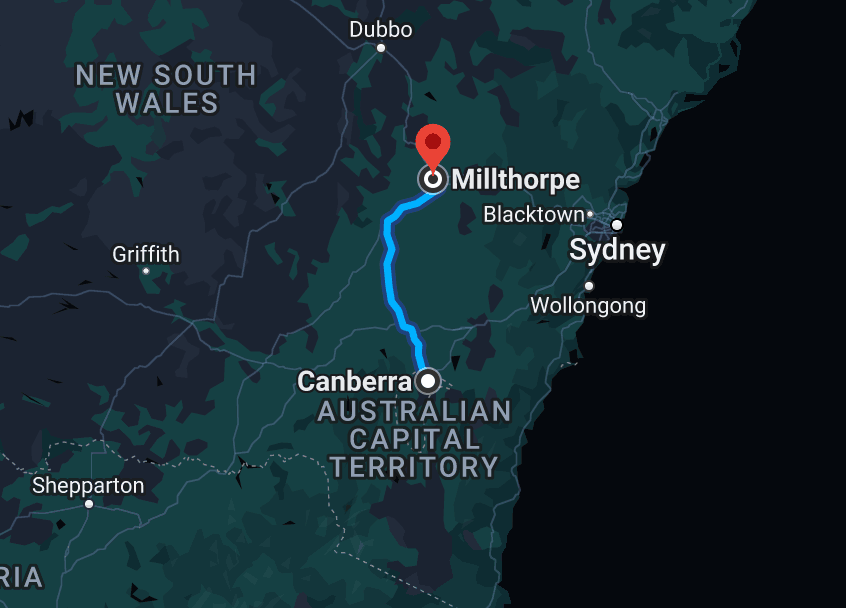
I probably take this further than most. Visiting my hairdresser involves a ritual of driving 270km each way and staying overnight with friends in Millthorpe where I used to live. That’s the equivalent of driving from Milan to Venice or further than Vienna to Budapest. In Europe this would be insane, in Australia just slightly bonkers. We readily acknowledge that we have a different relationship to distances. In my misspent youth, I dated guys who used six packs (beer) as their preferred unit of measure between cities. (Not condoned!) That was before drink driving was taken seriously. I have a tendency to measure distances by increments of towns. Canberra to Millthorpe is three hours; one hour to Boorowa, one hour to Cowra and then one hour to Millthorpe. It’s a rough estimate, but it works for me.
My hairdresser is good but there’s probably 50 equally good ones within a 10km radius from where I live. She knows me well by now and doesn’t bother with social niceties. If we talk, there’s a point to it. She’s a no-nonsense woman who has no need to pretend to be anything else. I like her. But that’s not the only reason I make the trip.
Over the seven years I lived in Millthorpe, I have made some good friends and rekindled some old friendships from a different part of my life. Funny how that works out. When I moved to Canberra, I left some very good friends behind, and it seems a shame to keep losing friends as we age. So, I decided not to let that happen. My hairdresser appointment is a good excuse to visit friends regularly. For I know when we say, ‘let’s keep in touch,’ it rarely eventuates. Our lives become busy, other priorities take over and before we know it, we have lost contact. Getting my haircut is my way of ensuring that I keep up with friends. I now need to come up with a similar strategy to see my friends in Sydney!
Photograph by John Harding originally posted on Friends of Watson Greenspace Facebook page
It takes about a year for me to feel that I have arrived in a new place. I have moved cities often enough to recognise this pattern. Sometimes waiting for that moment feels like an eternity, as it did when I first moved to Sydney while other times, it feels as if it has taken no time at all. Canberra falls in the latter category.
While I have felt at home in my new place very quickly, I didn’t know anyone besides my daughter and her friends when I moved. Then, a couple of months later I met my first friend at the dog park. She lives on the same street as I do, and we meet up for drinks or dinner every now and again.
I am known at the local shop but not by name. People are more likely to say hello to my dog Zoë who wears her name on her harness than they are to say hello to me. Of course this is very common. Even Markus Zusak says that when he is out without his dogs, he becomes invisible to people on the street.
Can you imagine my surprise when a man with a camera hanging from his neck called out to me, ‘Are you Viktoria?’ It turned out, he was the local wildlife photographer who posts the most stunning photos of birds, dogs and kangaroos that visit the nature reserve across the road from me. I have been liking his posts for months and occasionally writing a comment, especially when he posts shots of tawny frogmouths. He must have looked at my name and found a picture of me. Now, he kindly showed me the tree where they were roosting, and I saw the three babies with their parents with my own eyes. It was a truly awe-inspiring sight, and I was grateful that he shared his knowledge of birds freely.
I thanked him and continued on my way. Zoë was getting impatient for her walk. However, after about 200m we were stopped again. This time, an older woman called out, ‘excuse me but do you have a friend in Sydney who lives in Dulwich Hill?’ Once more, I was flummoxed. Turns out she had moved to Watson recently, was given my number, but hadn’t made the call as yet. She recognised me because of Zoë. I guess there aren’t many black standard poodles who walk in this park. We had a chat and decided to catch up for a cuppa later in the month.
Ten months have gone by since I first moved here. So many joyful things have happened, but it wasn’t until I was recognised by strangers that I felt I had truly set down roots. It feels like I am part of the suburb and part of this community. I feel calm in the familiarity of the trees, the pond and the paths that I take daily. But hearing my name said out loud carried a particular weight, as though the world had suddenly recognised me within it. It was a fleeting moment of quiet significance, a moment when I felt connected to the place and the person who has called me into being out of my own thoughts and into the time and space we both inhabited.





 From Quill to Quote