Jonquils in July

I make a last-minute dash to the markets for some Batlow apples. Most stallholders are busy sweeping the concrete, packing their unsold wares onto trucks. Everyone is looking forward to getting home and for some, there is a long drive ahead. They have been here since five in the morning, setting up and waiting for the first customers to arrive. I hastily look for my favourite stall and I’m lucky, the girl selling apples is still serving customers.

I take a walk around what’s left of the markets, buy some mushrooms and am given an extra bag of woodland browns to take home. These late saunters on a Saturday morning, when the place empties, are my idea of bliss and there’s always a bargain to be had.

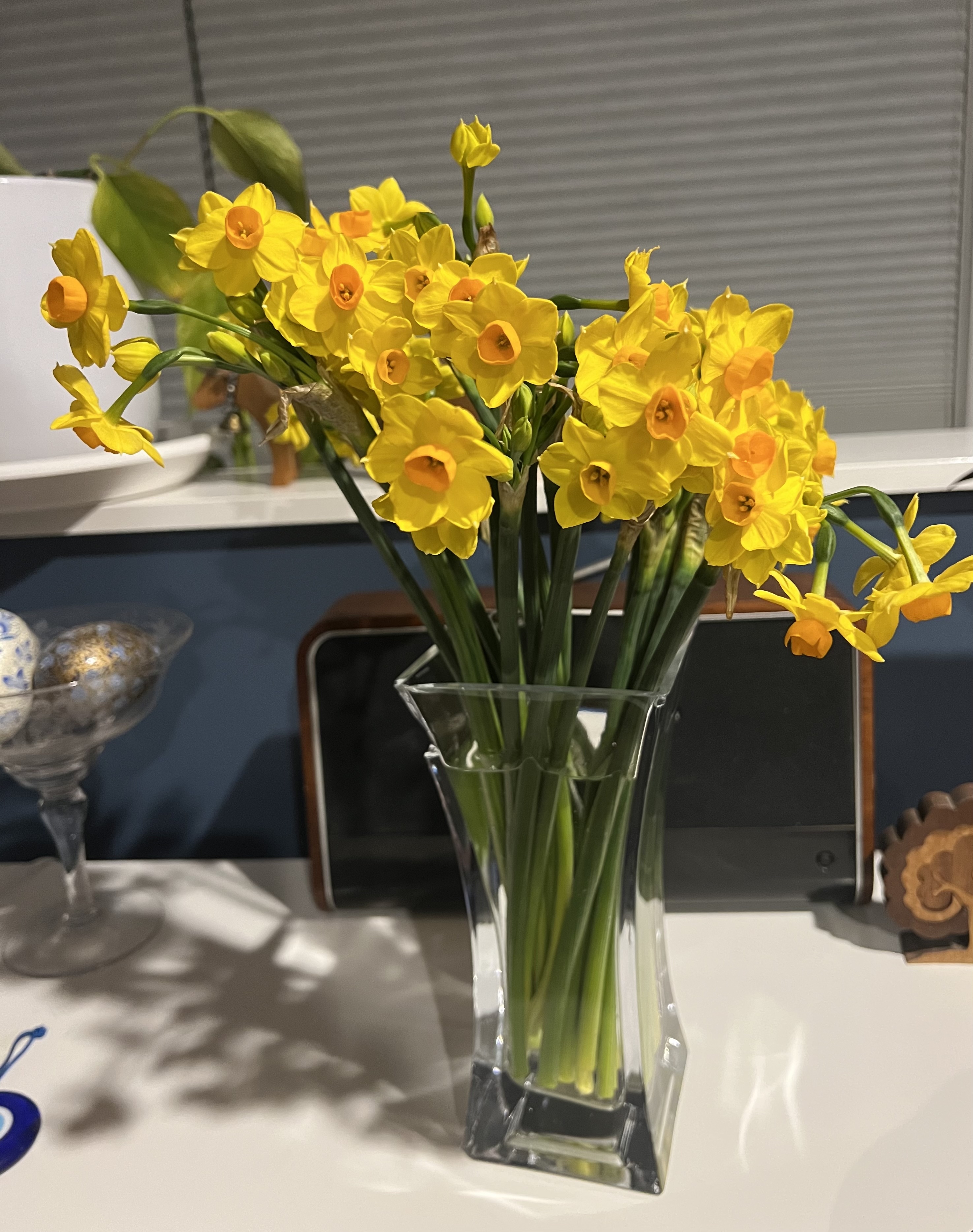
As I come around the last isle, bright yellow jonquils catch my eye. It is mid-winter, yet here they are, heralding spring. Massed in large plastic buckets, their sweet fragrance borders on pungent. I can’t resist. Two bunches are rolled into tissue paper while I hand over a ten dollar note.

Flowers always brighten my day. I’m drawn to their beauty and fragrance. It turns out there is a reason for this feeling. Flowers can spark the release of dopamine and serotonin in our brain by their bright colours and pleasant smell. There are studies that show that having flowers in the house can lower cortisol levels. They create a relaxed and aesthetically pleasing environment which makes us feel more relaxed. 

Before I knew any of these benefits, I instinctively bought flowers when I felt downhearted. Back in 1987, I spent a rather miserable winter in Berlin. The cloud cover arrived in October and never left for six months. The short days felt like eternal dawn or dusk; it was impossible to tell which. It was during these months that I began the habit of buying flowers every Friday afternoon as I returned from university. The florist around the corner wasn’t cheap but made the most exquisite flower arrangements. They reminded me of the Japanese art of Ikebana. The designs were always minimalist, and they took my breath away. I had very little money left for luxuries, but my Friday ritual never felt like an extravagance.

This memory came flooding back as I purchased my jonquils. While I don’t possess the patience to artistically place flowers in a vase, it doesn’t much matter. A dull winter’s day has been transformed into delight by their smiling yellow faces. And for the next week, there will be guaranteed sunshine every morning.

Low light, low mood

Today is the winter solstice, the shortest day of the year. Things are on the way up from here. Don’t get me wrong, I love the brisk, cold winter days but I do get affected by the shorter days. It can be as cold as it likes but I need light. A lack of light can make me feel quite listless and despondent. All I want to do is roll up in a ball and hibernate.

I don’t know whether I truly have SAD or Seasonal Affective Disorder but some of the symptoms fit. Symptoms like lack of energy, fatigue, sleeping too much, eating too many carbs, difficulty in concentrations, physical aches and pains, feeling anxious, blue, restless are all there but doesn’t everyone experience these at some point in their lives? It reminds me of looking at a horoscope and cherry picking your traits. Oh yes, I’m such a Virgo/Libra/Sagittarius because these five very generalised traits apply to me. Is it all in my head?

Well yes, it is all in my head in one way or another. And does it really matter if I can assign a label to my feelings? I just know I feel better when there is light around me, I just don’t like the heat that comes with it. One of the best days I can recall was a mid-winter freezing cold day in the Swiss alps with snow all around me, blue skies and a blazing sun above. I felt on top of the world, full of energy, weightless, content.

It doesn’t help to have to get up before the sun comes over the horizon. I’m gloomy and moody in the mornings until I get outside. Once I’m out walking and the sun appears, I am fine but cloudy days press down on me and keep me downcast.

I now understand why I have always felt depressed when curtains are drawn in summer to keep the heat out. It explains why I have opted for translucent blinds in my current home and why I fell in love with it the moment I walked in. There are large windows on three sides of the main room which not only let in light but the sight of trees.

I now have a better appreciation as to why people worship the sun. Even those of us who prefer to hide in the shade are drawn to her light. It isn’t her heat that I need, just her brightness and clarity. And so, on this shortest day of the year, I look forward to the light returning, day by day, minute by minute until the days are long and bright and my mood rises above the horizon.

From Asters to Astoria

Asters are star shaped flowers with tube like petals that come in a variety of dazzling colours. I was given a bright pink bunch a couple of weeks ago and I delighted in their cheery presence, especially in this bleak and wintery weather. Sadly, their stems soon began to droop, but the flowers retained their sunny disposition. That’s when I decided to cut off their stems and float the flowers in a bowl of water. They have continued to bring joy for two weeks and still look fresh.

Their flower heads remind me of daisies, so I wondered whether they were related. It turns out they are. Like a daisy, the disk florets in the centre of the flower are bright yellow, which is why we think of them as being sunny. Asters bloom late autumn and provide an important food source for bees and when there is little nectar to be found. My pink asters are native to Australia but as a species, there are more than 250 varieties in the world.

While researching the humble aster, I learnt that the Hungarian revolution of October 1918 was also called the ‘Aster Revolution’. The name was derived from soldiers removing the Austro-Hungarian symbols from their caps and replacing these with asters.

The ‘headquarters’ for the revolutionaries was at the Astoria Hotel in Pest, on the eastern side of the Danube of the dual city of Budapest. This stunning seven storey hotel, featuring fin-de-siècle architecture is still one of the best loved hotels in the heart of the city. However, at the time of the revolution, it was only four years old and without a doubt one of the most elegant places in Budapest. It was from one of its balconies that the leader of the First Hungarian People’s Republic, Mihály Károlyi, announced the end of the Hapsburg empire and the foundation of the republic to jubilant supporters below. This was the only revolution that Hungarians have ever won.

Reading about the significance of the Astoria took me back to the 1980s, when during a particularly cold winter, I arrived in Budapest to find the transport in the city had ground to a halt. Metre high snow lay frozen on the side of roads; there were abandoned cars and trams everywhere, and the occasional taxi or bus that was still operational wouldn’t stop.

I stood at a bus stop with dozens of commuters needing to get out of the cold. They were locals, while I was a tourist with a 30kg backpack that I could barely carry. When a bus finally stopped, they roughly pushed past me to get on board. I slipped on the ice, fell on my back and was transformed into a giant beetle, like Gregor Samsa in Kafka’s Metamorphosis. By now the bus had left, and I lay on the ground, legs in the air, crying, asking for my father’s intercession to get me out of this mess. After all, I was in his hometown, chasing ghosts.

Getting up seemed to take an eternity. I was cold, miserable and lonely. My only contact was my aunt who lived in a Soviet style high-rise in Buda. It was miles away. That’s when I spotted the Hotel Astoria on the other side of the road. Surely, someone could help me there.

I trudged across the road, entered the building and was greeted by a friendly face. I wiped away my tears. The woman behind the counter took pity on me and called my aunt who immediately took charge of the situation. All I had to do was to wait outside until she bribed a taxi driver to drive back into the city to collect me. Within half an hour the taxi arrived, and I arrived safely at my aunt’s place fifteen minutes later.

The weather improved the next day. I took the bus into town, found a florist and bought a pot of chrysanthemums. These I delivered to my saviour at the Astoria. At the time I had no idea of the hotel’s history. Nor would I have known that chrysanthemums are closely related to asters.  

A capital fog

Canberra is located at the foothills of the Snowy Mountains, within the Great Dividing Range. Its altitude is 577m above sea level, which may not seem like much by South American standards where cities often sit above 1000m, but it is quite high compared to other cities in Australia and Europe. In fact, Canberra’s elevation is 168m above that of Zürich.

The elevation and the fact that it is a relatively sheltered valley near mountains, allows cooler air to sink and the warmer air to form a blanket above it, especially when there is little or no wind. These are perfect conditions for thick fog to occur. On average, there are around 20 heavily foggy days in winter.

I relish these foggy days which give the city a magical air. I love walking in it, not knowing what is in front or behind me, just focusing on one step at a time. I don’t even mind driving in it, although I admit that I prefer driving in fog when I know a route well. But then I have had years of experience driving in the Blue Mountains, where fog can envelop a valley even in summer.

Canberra airport was built on one of the lowest lying areas in the city. The result is that many flights are delayed and cancelled, especially after 10am when incoming flights can’t land due to the lack of visibility. It does seem like a huge oversight to have located an international airport in one of the worst affected areas in town.

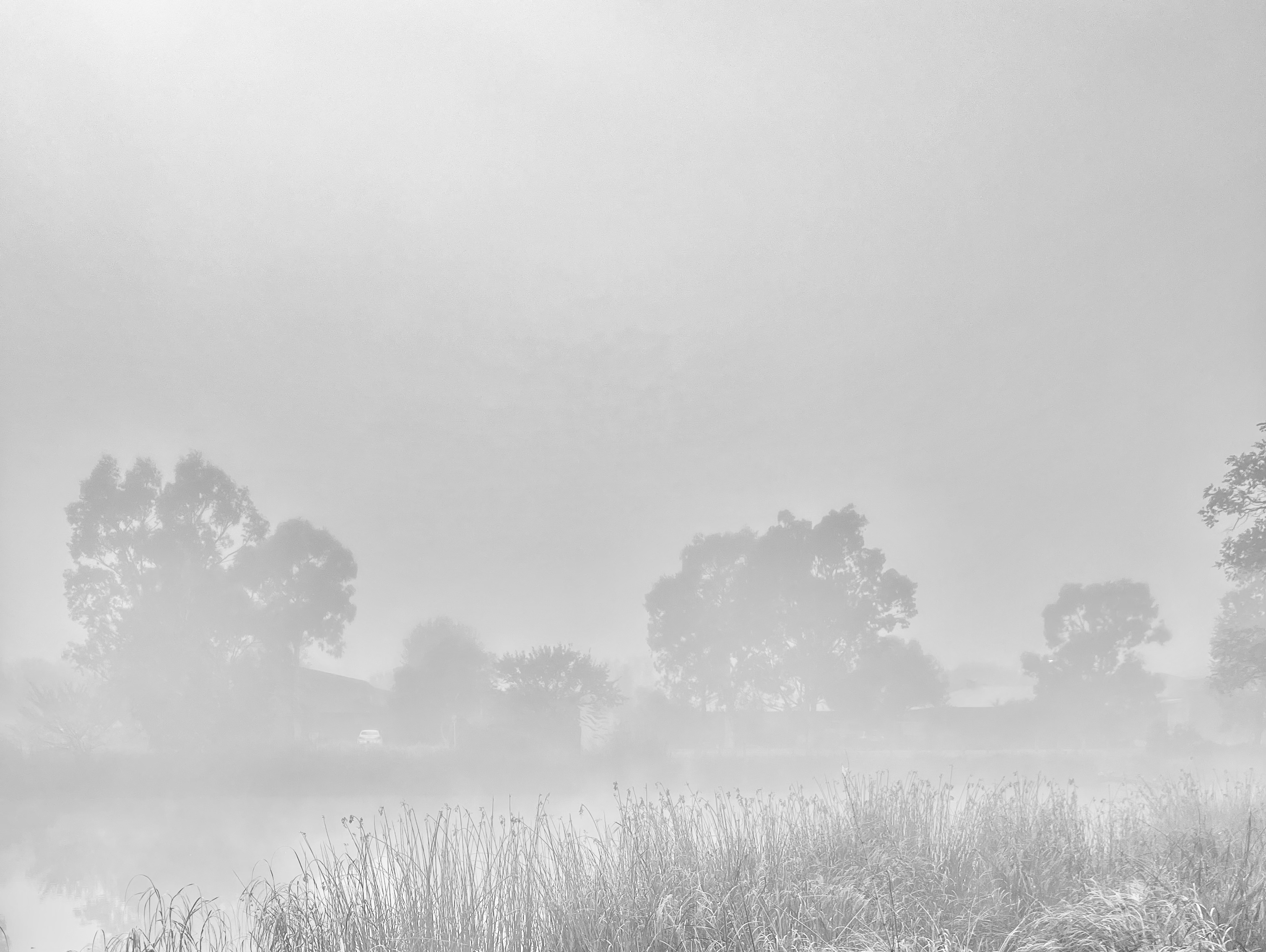
Where I live is only 9km from the airport and it shares its propensity to fog. There are mornings when I can only see shadowy outlines of the trees across the road. When I walk the dog, she disappears ahead of me, and I can confuse markers ahead for people coming towards me. It is a strange, fairy-tale landscape where both time and space seem to conflate. It is muffled and eerie, yet stunningly beautiful and comforting at the same time.

When I worked at Blackheath in the Blue Mountains, I often watched the fog roll in like hay bales on a farm. One would roll up the main street and gather moisture and momentum as it shrouded everything in its path, white as a freshly washed sheet. I’d look out onto the playground and play a game of ‘now you see me and now you don’t’; 350 children there one moment and gone the next.

Fog is an enormous doona spread over the city to make all of us more aware of our senses, to hone our navigation skills and to remind us of the things we can’t control.

It is also a lesson in awe and wonder inviting us to pay close attention to our surroundings. Fog is the winter coat I wear gladly. Wrapped around me, I feel peaceful and lovingly enveloped.

Early winter

Frosty mornings have arrived, covering the grass in icy, white droplets. The dog’s breath turns to vapour as we make our way across the road to the park. I too can see my breath ahead of me and plunge my hands deep into my pockets. The cold nibbles at my ears and nose, but a down coat keeps the rest of my body warm.

 The dog doesn’t seem to feel the cold. She happily lies on this carpet of frost, frolicking and licking the icy dew. There’s a wild look in her eye and I know she is about to run in ever-widening circles, stretching her body fully with each stride. I watch as she performs her exercise routine with unashamed, abundant joy, and I can’t help but feel a vicarious sense of being fully alive. I admire her ability to be so present that nothing else matters to her at all.

These morning walks before work are now as important to me as they are to the dog. Some mornings, the park is shrouded in fog, and we venture into unfamiliar terrain, uncertain of what we may come across along the way. The trees become mysterious creatures with outstretched arms, ready to catch me should I stumble too close. These mornings I am transported into a fairy tale where inanimate objects take on human form in the distance, only to turn back into posts or small bushes when I come near. It never feels menacing, but laden with the promise of some adventure.

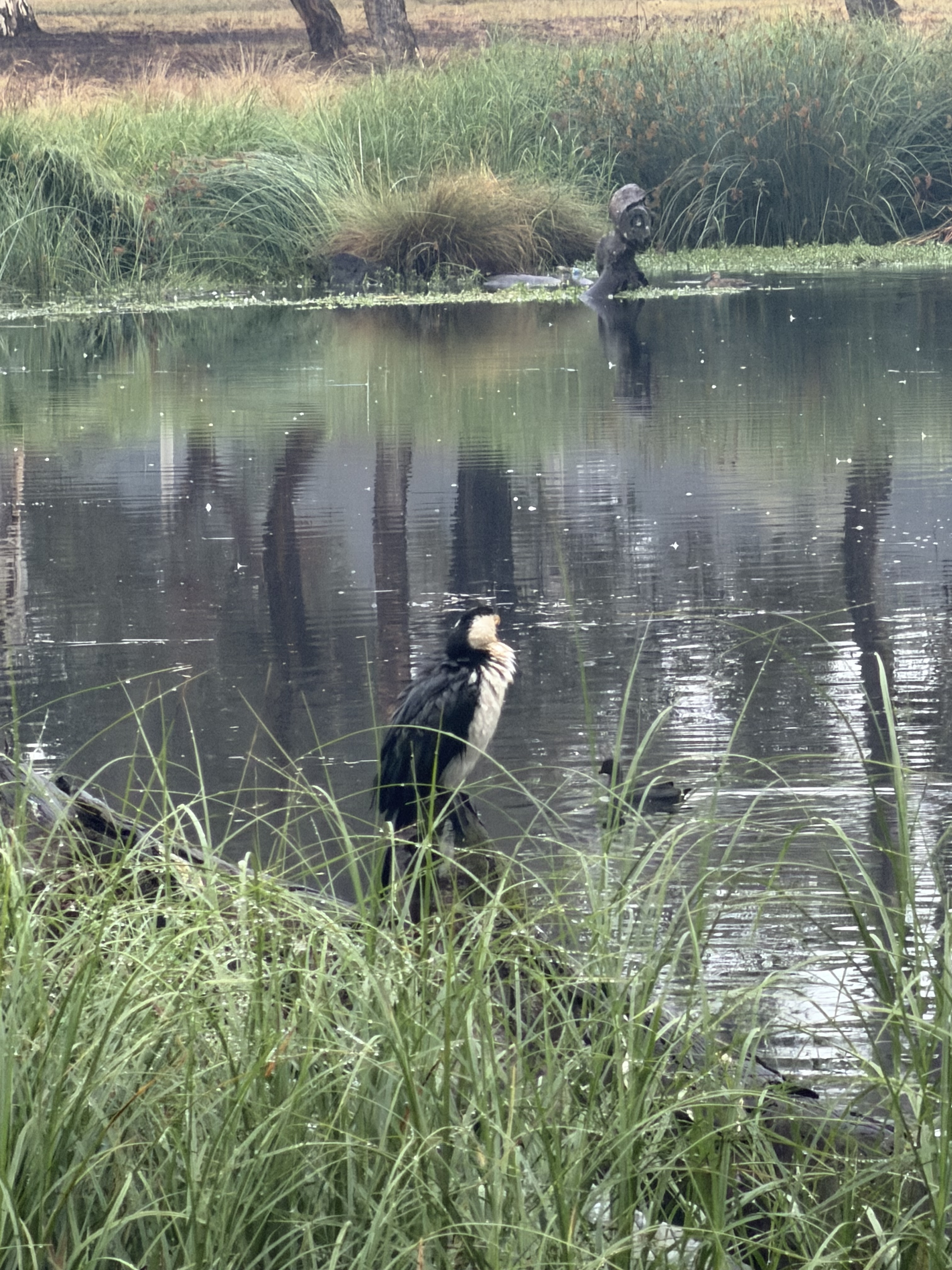
The black swan that had appeared one day on the billabong has continued its journey.  I wonder where they fly for winter. Only the ducks are left and a cormorant or two. Even the magpies seem quieter in the morning now, or am I imagining this? In any case, the park has taken on a different feel; it is quieter, and the colours are muted. The park is now in calm repose.

My day continues with work hours, obligations, and errands. By late afternoon, I feel the urge to visit again before the light fades completely. I take the dog for her second walk of the day, this time with greater urgency and less time to reflect. Despite my desire to be there, the walk becomes perfunctory. I’m thinking about cooking dinner and jobs that still need to be done before the day is out. Other people in the park seem harried too. Everyone wants a bit more time outside before the light fades completely.

Back home, I can just make out the outline of the canopies. Soon, the inky black sky will blanket the city. The day, with all its cares, is over. A brand-new walk awaits us in the morning.