
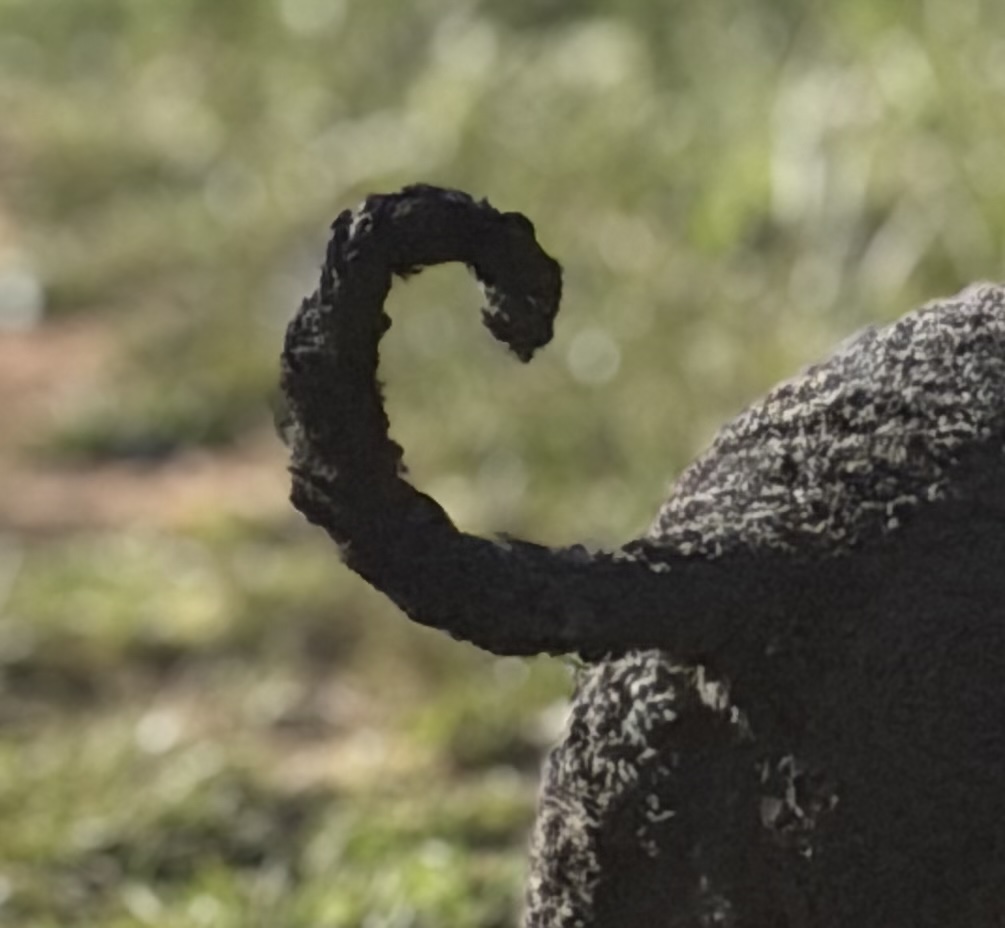
On my daily dog walk, I watch a motley crew of dogs enjoying their outing. They always make me smile, if not laugh at their antics. Today, though, I found myself fixated on their medley of tails.
There was a border collie with its long, sweeping brush of a tail and white tip, then a greyhound with its sleek, elegant tail, perfectly suited to running at speed. A schnauzer joined us, its tail thick at the root and pointing slightly upward. The toy poodle that followed had a similarly upward-curving tail, topped with a pom-pom. But it was the sight of a boxer with its tapered tail that made me realise why I was finding the subject so interesting and amusing. Until about twenty years ago, many of the dogs I saw would have had their tails docked. When I bought our first poodle in 1996, its tail was docked too.
Until 2004, it was unusual to see breeds such as corgis, cocker spaniels, boxers or rottweilers with their full tails. Some breed standards treated an undocked tail as a fault. That began to change when Australia’s states and territories introduced bans on cosmetic tail docking, with the practice banned nationwide by 2004. In the United States, docking remains not only accepted but encouraged by the American Kennel Club for many breeds. It is estimated that up to 1,000,000 dogs get their tails docked per annum in the States.
The practice can be traced to seventeenth- and eighteenth-century England. Some people believed that shortening a dog’s tail would strengthen its back and increase its speed. Another explanation links docking to dog taxes. A docked tail could identify a working dog, which was exempt from the tax. Even after the tax was repealed in 1796, the practice of docking remained.
A dog’s tail is an extension of its spine, made up of a series of flexible vertebrae. Tails help dogs balance when making sharp turns, act as rudders when swimming, and communicate with people and other dogs. We use the idiom ‘left with his tail between his legs’ to describe someone who feels humiliated after a reprimand, much as a dog might. A dog’s tail can signal that it is relaxed or friendly, or that it is agitated or fearful. There are many subtleties in this communication.
When I’m walking my dog, I find myself reading the body language of the dogs we meet. I realise that beside a dog’s stance, raised fur or ear position, I get much of my information from its tail. A happy wag, a relaxed neutral tail or an inquisitive tail held high all offer clues about how a dog might be feeling and whether or not I ought to approach it.
If beauty is in the eyes of the beholder, the exuberant abundance of dog tails also gives us the chance to appreciate nature’s wonderful quirks. I just wish our ancestors hadn’t lost theirs 25,000,000 years ago.

