Frost

Canberra is the coldest city in Australia, even eclipsing Hobart in mid-winter. Early morning temperatures are often in the minuses, with heavy frost or fog being quite common. Frost often occurs on days with clear blue skies, which makes the contrast even more alluring.

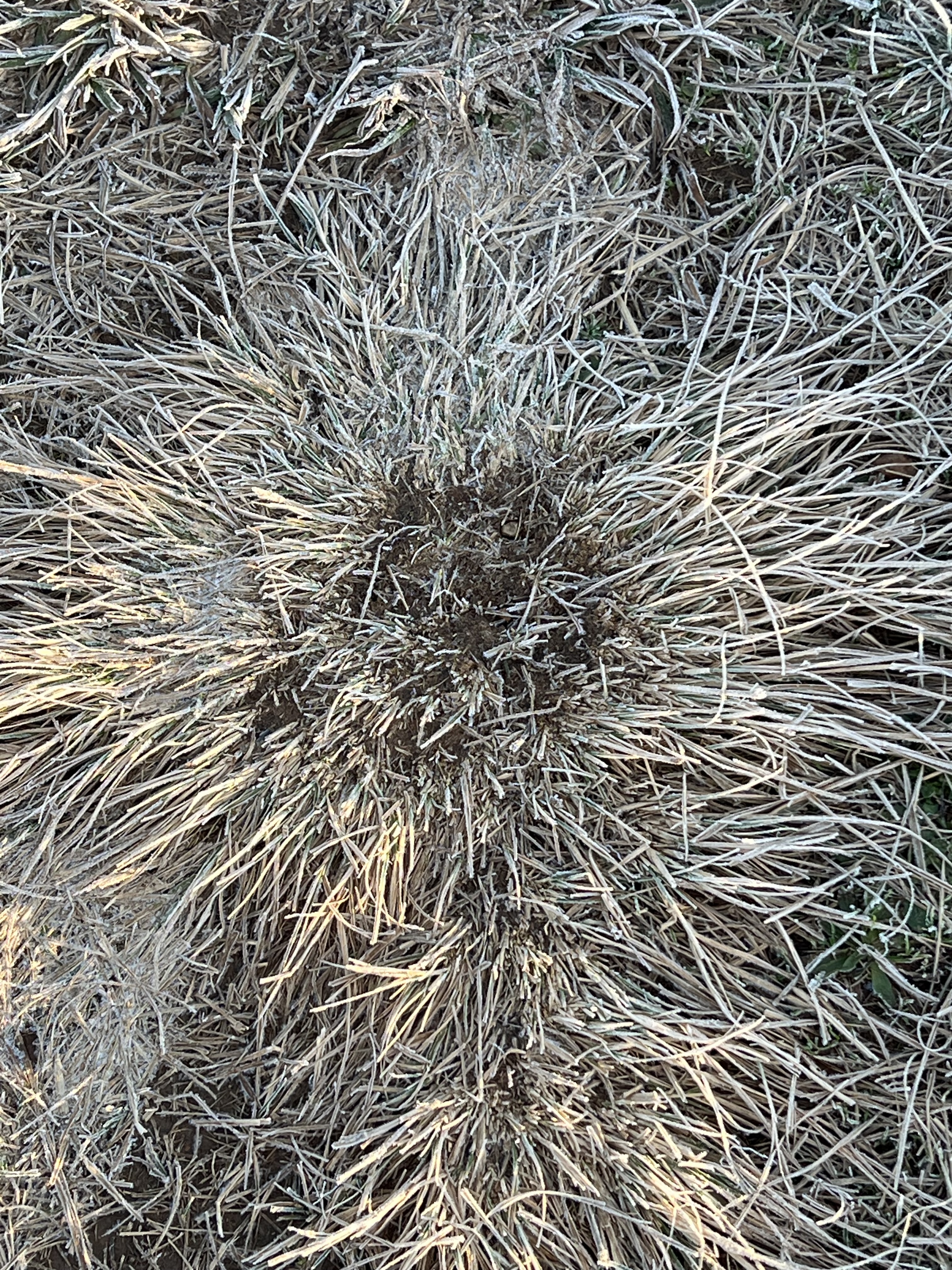
Walking the dog on this sea of grey-white is a wonderous experience. The dog, energised by the cold, slips and slides as she bounds across a field. She stops to lick the grass, roll on it, before leaping around with feet going every which way. Her joy at this winter wonderland is infectious. I can’t help but laugh and run after her. I make a mental note to take her to the snow this winter to see her reaction.

The field is like an old man’s closely shaved beard; patchy, grey and uneven. The grass’ reaction to the cold is to go dormant and conserve the energy it has until it becomes warmer and more conducive to growth. It is a reaction with which I empathise. Getting up early to take the dog for a walk is getting harder with each degree that the temperature drops.

Yet once I am out here, my nose numb and hands firmly planted in my pockets, I know I am alive, ready for next marvel the world offers. As the sun’s rays reach the frosty grass, I notice a shimmer as if fine glitter were strewn across the landscape. I look closely and discover that tiny frozen dewdrops are melting, refracting the sunlight. A soft white glow surrounds these droplets, which I have discovered are called Heiligenschein even in English. It means halo, but I much prefer the German word joining holy and glow. There is something otherworldly and awe-inspiring about these tiny droplets. The more I walk along this path, the more I realise that each morning offers up a novel experience. This is what makes rolling out of bed worthwhile.

From barren to blooming

Costa Georgiadis argues that no space is too small for a garden. On Gardening Australia, he has presented stories of magnificent indoor gardens and balcony gardens. I never took much notice as I neither had a balcony nor much light inside my house to grow indoor plants. The truth is, while I enjoy visiting beautiful gardens, I am not a gardener. I’m impatient, get frustrated with weeds and find the whole never-ending process akin to cleaning. A boring chore.

One feature I like about my townhouse is its miniature courtyard. I also like the balcony upstairs, but I immediately bequeathed it to the cat, so she had a place to escape from the dog. There was only one problem with that. It looked so desolate with only a cat litter tray and her little trampoline, and I don’t cope well with desolation. It lacked what Germans identify as Gemütlichkeit or what Danes call hygge. No-one bar the cat would want to spend any time there.

I may not enjoy the work that goes into making a patch of green space, but I do value the benefits it brings. Sure, the nature reserve is only across the road, but it turns out I needed something closer than that. I knew there were health benefits that come from spending time in nature and that cities that have more parks score higher on measures of well-being. Maybe that is why Canberra ranked second in the world for a city with the best quality of life. While that is reassuring, I still felt I needed to transform my barren balcony into something more pleasing. As Danielle Shanahan from the University of Queensland said, ‘There is plenty of evidence that you will get a range of benefits even if all you can manage is putting a plant in your room or looking at trees through your window at home.’

Plants don’t have to be sourced from expensive nurseries. I kept a look out for second-hand plants and nice pots and spent a day last weekend driving to people’s houses. I met a woman who propagates proteas, someone else who is moving house and then migrating to Spain and a suspicious person who left me standing in the cold, locking the screen door, while she retrieved the plant from inside. It was an interesting study in human behaviour.

This weekend, I purchased some shoe racks which I am using as plant stands. I cleared the area and began my arrangement. It is still a work in progress, but I am pleased with the results. Now when I look out onto the balcony from my desk, I see freshly planted pots in the foreground and the trees across the road in the nature reserve. It is a perfect place to write.

Crafting dreams

https://www.instagram.com/foxyfine_furniture/

The moment I saw Thomas Fox’s work, I knew I this was a young man with a passion for creating beautiful, tactile objects. I was taken by the simplicity of his plant stands, the careful joinery and ingenious design which allowed it to be packed flat and reassembled in seconds. I found myself drawn to his exquisitely crafted coffee tables and inlaid cutting boards. Online, I discovered that he also created larger furniture pieces like sofas and desks, always maintaining a balance between form and function. I bought one of his larger plant stands, which fits perfectly in a gap between some bookshelves and a cabinet in my lounge. It brings me much joy to see a well-crafted object add to the aesthetic of the space I in which I live.

What struck me most, when meeting Thomas Fox, was his youth. Much older men who have had a lifetime of practice normally work with wood at this level of competence. Thomas looked to be in his 20s and was deeply passionate about his craft and wanting to make a living from it. When I suggested a retail outlet she should approach, he replied it was a place he was aspiring to, but wanted to perfect his craft before he approached them. I thought he was much too modest.

I kept thinking about this young man and wondered why he had captivated me. I realised it was his passion for his art and that he was willing to put everything on the line to live an authentic life. On Instagram, I discovered he had given up his day job for this dream. That was well over a year ago, and he is still working on what he loves best. I thought about his courage and determination, his work ethic and belief in himself. I realised then that I had much to learn from the way this young man lives his life with purpose.

There was also a thread running back to my late partner, Roger, who was a self-taught carpenter. In fact, we met over a handsome chest that he sold me here in Canberra many years ago now. He also made beautiful tables which he sold at markets. He was never happier than when he had a piece of wood in his hand and an idea of how to transform it. The moment I met Thomas, I knew what Roger would have said. It was as if he were standing by my side. Roger would have congratulated him, taken his card, and immediately set about to drum up business for him. That was the kind of man he was.

I am now seriously thinking of commissioning Thomas to make me a desk. I saw the photo of one he made for a customer, which was simple, stylish and yet a little quirky. That ticks all the boxes for me. I also know that if I wait too long, I won’t be able to afford his work. This is an artist who is going places.

Suitcase rummage

https://www.suitcaserummage.com.au/market-dates

Saturday morning, I walked through the saddest little trash and treasure market in Haig Park. Lining the path were a dozen or so blankets with various pieces of personal effects, mainly clothing. One small suitcase had a sign saying that the owner of the meagre belongings was about to head home and needed to sell everything on display. I didn’t like her chances.

It was a cold morning, and the prospective sellers were huddled on their blankets. They were either rubbing their hands together or had them wedged under their armpits, trying desperately to keep warm. Some were rocking back and forth in the hope that some movement would bring relief to their cold bodies. Looking at their wares, it was difficult to think of anyone who would buy what they had to offer. In a world where a brand-new basic T-shirt can be bought for as little as $2.50, how much could they hope to get for a second-hand garment? And how many people still carry coins or cash for that matter? I did a quick calculation of an hourly rate and concluded that most of them would be lucky to earn the equivalent of a cup of coffee.

I felt like a voyeur looking into the drawers of their bedroom closets and was embarrassed to do so. There is so much you can tell from the items themselves and the way people display them. At one stall there was an open suitcase with belongings spilling out as if they had been dropped from a balcony. At another, each item was folded neatly and arranged according to their colour. It felt far too intimate to be comfortable for a prospective buyer to lay their hands on the items. I wanted to flee.

Something about the sad display reminded me of documentaries of the aftermath of WWII when people with tattered suitcases sat on the back of drays, making their way across the countryside on their way home. Maybe it was the old-fashioned suitcases that most had brought along, or maybe I have seen too many German movies at the festival in the past three weeks.

I left the park feeling disconcerted. I thought about all those items and how they were once new and desirable. A strange thing happens when we bring our purchases home. They take on quite a different life to the one they had in the shop. They become an expression of our personality, or they refuse to fit in and look forlorn or out of place. Unfortunately, most of the items for sale looked forlorn.

Early winter

Frosty mornings have arrived, covering the grass in icy, white droplets. The dog’s breath turns to vapour as we make our way across the road to the park. I too can see my breath ahead of me and plunge my hands deep into my pockets. The cold nibbles at my ears and nose, but a down coat keeps the rest of my body warm.

 The dog doesn’t seem to feel the cold. She happily lies on this carpet of frost, frolicking and licking the icy dew. There’s a wild look in her eye and I know she is about to run in ever-widening circles, stretching her body fully with each stride. I watch as she performs her exercise routine with unashamed, abundant joy, and I can’t help but feel a vicarious sense of being fully alive. I admire her ability to be so present that nothing else matters to her at all.

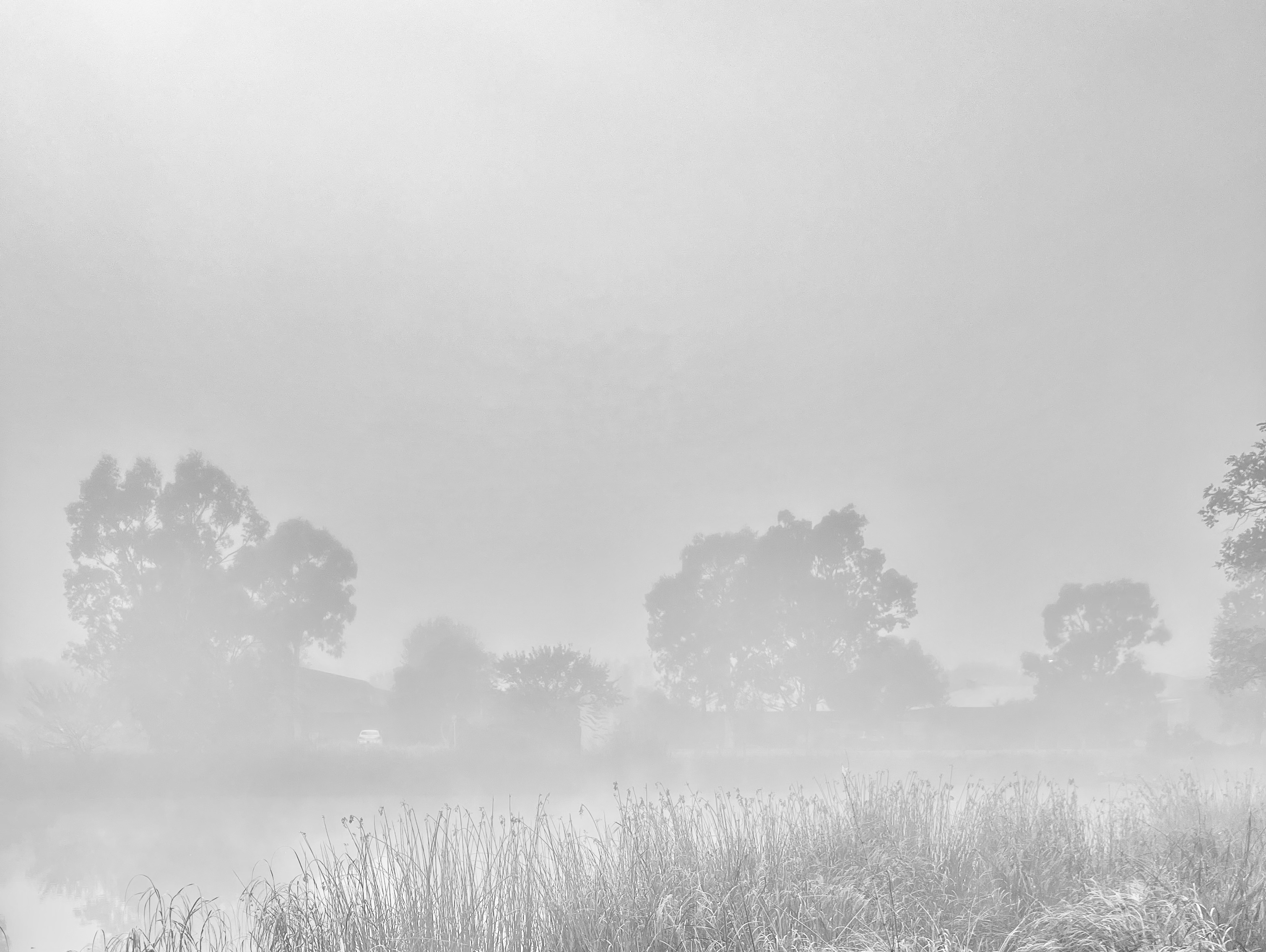
These morning walks before work are now as important to me as they are to the dog. Some mornings, the park is shrouded in fog, and we venture into unfamiliar terrain, uncertain of what we may come across along the way. The trees become mysterious creatures with outstretched arms, ready to catch me should I stumble too close. These mornings I am transported into a fairy tale where inanimate objects take on human form in the distance, only to turn back into posts or small bushes when I come near. It never feels menacing, but laden with the promise of some adventure.

The black swan that had appeared one day on the billabong has continued its journey.  I wonder where they fly for winter. Only the ducks are left and a cormorant or two. Even the magpies seem quieter in the morning now, or am I imagining this? In any case, the park has taken on a different feel; it is quieter, and the colours are muted. The park is now in calm repose.

My day continues with work hours, obligations, and errands. By late afternoon, I feel the urge to visit again before the light fades completely. I take the dog for her second walk of the day, this time with greater urgency and less time to reflect. Despite my desire to be there, the walk becomes perfunctory. I’m thinking about cooking dinner and jobs that still need to be done before the day is out. Other people in the park seem harried too. Everyone wants a bit more time outside before the light fades completely.

Back home, I can just make out the outline of the canopies. Soon, the inky black sky will blanket the city. The day, with all its cares, is over. A brand-new walk awaits us in the morning.

The German Film Festival

https://germanfilmfestival.com.au/

It has been a long time since I had the chance to attend film festivals. In my early 30s, I used to have a share in a ticket for the Sydney Film Festival and I saw many fabulous films from around the world. After my daughter was born, this became much more difficult to organise, but I still managed to get to a few films at the French and German Festivals. Once we moved out of Sydney, these events became rare treats and at best, we would see a film or two at the events.

Moving to Canberra has allowed me to indulge in some of my favourite old pastimes. Attending the German Film Festival is one of them. I have selected 17 films over a three-week period, and, on some days, I have been watching two movies back-to-back. I have forgotten how demanding that can be!

As always, there are films that shake me to my core and others that leave me wondering how the film ever got off the ground. Regardless, I am enjoying the breadth of films, ranging from historical drama set in WWII to funny yet profound films about dysfunction, relationships, and alcohol abuse. So far, I have seen six films, of which three have been excellent. They were From Hilde, with Love (In Liebe, Eure Hilde), Lubo and One for the Road. Of these, From Hilde, with Love is the standout. From Hilde, with Love, tells a compelling true story of a young Nazi resistance activist in Berlin who gets detained and eventually tried for treason. The story builds slowly towards its inevitable climax, which jolts the audience. While there are many moving films about WWII, this one offers fresh insight through the personal experience of a young woman who becomes politically engaged, falls in love, and pays the ultimate price for her convictions.

Lubo, the only Swiss offering at the festival, is a remarkable film. It fictionalises events that occurred in Switzerland after the war, when authorities forcibly removed children from ‘gypsy’ parents, placed them into foster homes, separated them from their siblings, subjected them to sexual abuse, and disconnected them from their culture. This will sound horribly familiar to Australian viewers. In 1972, the Swiss government apologised and paid some reparations to families that were affected and, while this was a very late reckoning, it took the Aboriginal Stolen Generations until 2008 to receive a formal apology. Lubo belongs to a minority nomadic community called Yenish. During the war, his wife lost her life while trying to prevent authorities from taking their children. Lubo spends his life documenting the disappearance of his own children and those of his community. This film echoes the pain and suffering of First Nations peoples and minority groups.

These films are thought provoking yet enjoyable. I am making up for the years that I haven’t been able to see European films. I like the meandering story lines, the stunning settings and the slow pace that many of these films have in common. I may be a tad tired over the next three weeks, but I won’t regret it.

A trip to New Zealand

Or the long-lost friend, a tech savvy daughter and a generous birthday gift.

Wellington foreshore guerilla knitters

Annie and I met in 1989 while working for a private college teaching English in Sydney. Our clients were Chinese, and the massacre at Tiananmen square in June of that year affected them all deeply. They came from cities and villages, desperate to earn money so they could repay the enormous debt they had back home which funded their airfares and tuition fees. None of them knew about life in Australia or the cost of living in Sydney.

Annie and I gravitated towards each other and soon became friends. We spent many a weekend going to the Glebe markets, meeting up for coffee and going for walks along the cliffs at Bondi. I left the college disillusioned with the management and teaching. She stayed for a while longer before travelling to Canada and Nepal. We kept in touch throughout this time.

In my memory, Annie was footloose and fancy free, always looking for the next adventure and travel destination. I was three years older and in a steady relationship. I admired her ability to save money and her courage to travel to far-flung places on her own. I admired her freedom and her trust in finding work wherever she went.

I was one of many friends she had, but she was my best friend. When I was about to give birth to my daughter, Annie was the obvious choice to be my support person. At 8 moths pregnant, I remember driving over some speed humps in my ancient Beetle. We shrieked with laughter as I landed heavily back in my seat. I could always rely on Annie to boost my mood and have a good laugh. No need for nitrous oxide with her by my side!

As our lives became more complicated with partners, jobs and eventually children, it was more difficult to catch up regularly. By then we lived in different parts of the city and eventually my small family moved out of the city altogether. Not long after that, Annie and her family moved back to New Zealand, which she had always called home. We lost touch.

Years passed. I always had a framed photo of Annie on my bookshelf and often wondered where life had taken her. My daughter heard stories about this special friend who was there at her birth and knew how much she meant to me. So she found her on the internet and booked me an airfare to Wellington.

Little did she know I would arrive on the eve of Annie’s birthday. What a treat to celebrate this special day with her loved ones. I finally met her adult children, was reacquainted with her husband and was welcomed into their home.

For a week, we walked the rugged beaches of Wellington with Dexter, their wonderful and quirky dog, catching up on 25 plus years of our lives. So much had changed for us both, but that initial spark from all those years ago still ignited our friendship. We share the same values, care about the same things and, interestingly, experienced similar challenges. We both stayed in teaching; she became an early childhood educator while I became a primary teacher. After teaching adults for many years, we gravitated towards teaching young children.

I loved being taken to her favourite haunts, the supermarket down the road and the café she frequents on weekends. I can now imagine her daily life; the route she takes to work, the walks she takes to clear her head, and I have met the people who are dearest to her. 

We spent some time sight-seeing, but those aren’t the memories I shall hold dear. While I loved walking through the botanical gardens, the museums along the waterfront, and the quirky shops on Cuba Street, what I loved most were the connections I was making. Talking politics with Annie’s 93-year-old mother was definitely a highlight. I loved her joie de vivre and her passion for social justice. May we all be as erudite and passionate no matter our age!

I’ve now been back home for three weeks. Neither of us have contacted each other since the first couple of days. We both have busy jobs and parenting responsibilities. There’s not much time left at the end of the day, especially when there is a two-hour time difference to navigate. It is all too easy to fall into habits of neglect. But this time I’m determined not to lose our precious connection again.

Emily Kam Kngwarray exhibition

Untitled, 1990, Emily Kam Kngwarray

A visit to view Emily Kam Kngwarray’s works at the National Gallery provoked much thought about how Western eyes view Aboriginal art. I freely admit that I have no training or understanding of how to view art, nor do I understand the desert culture from where the artwork originated.

Kngwarray was an eminent contemporary 20th century painter, whose work has paved the way for many other Indigenous women to engage in making art. Her career only spanned eight years but, in that time, she created a huge number of significant paintings and batiks which depict Dreamtime stories of which she was a custodian, and she also painted her Country around Utopia. Many of her paintings depict yam and emu dreaming, seasons and the contours of her land.

The sheer magnitude of her paintings amazed me. Her most famous one, titled ‘Earth’s Creation’, is 2.7m high and 6.3m wide. It takes up the length of a wall in the gallery. This painting is mesmerising and awe-inspiring. It fetched over $1,000 000 at an art auction in 2007. From my readings about her, what makes her unique and celebrated is not just the sheer size of her canvases but the range of different styles she employed as well as her layering technique using a cornucopia of colours, which is quite different to other Aboriginal art. Some art critics consider her to be on par with Monet, which begs the question why she has to be compared to a French male artist to establish her importance.

I couldn’t help wondering about this old woman who took up painting in later years. Besides the joy of painting and having her work exhibited in many countries, how did the work and fame benefit her and her community? How did she feel about having her work taken out of Utopia, stretched, mounted, and displayed in galleries where only the privileged can view them?

The artists would have produced these paintings with the canvas lying on the ground. Kngwarray may have kneeled on and maybe even walked upon her paintings. To reach the spaces in the center of the canvas, she would have touched them all over. Now, they are hung in a gallery with security guards ensuring that nobody comes anywhere near her works. How did she feel about this? Alienated? Are we viewing Aboriginal art, which most of us don’t really understand, how white people once viewed First Nations people as ‘noble savages’, curios there for our entertainment? I have no answers to my questions, only a sense of discomfiture as I view these pieces out of context.

I understand Kgnwarray’s importance as the first female painter to be recognised in an art movement that was dominated by men and the path she created for other women to follow in her footsteps. I can also see the significant benefit of recognising the value of First Nations artists and the great potential it offers to make a livelihood. And yet.

Perhaps one appeal of an exhibition like this one is the multitude of questions it raises for each of us to consider, regardless of the conclusions we may reach.

Flat packs

Instructions, screws and tools.

Moving house is detrimental to writing. In my spare time I have been carrying box after box up thirteen stairs, unpacking each of them, flattening the cardboard and taking that down to the stairs to the garage. At one point, I was wading through thigh deep cardboard to get to my letterbox.

The contents of the boxes all had to be distributed somewhere. I realised very quickly that my books would not fit in the number of shelves I had brought with me. A lovely large bookcase I wanted in the bedroom didn’t make it through the door and had to be manoeuvred back down. Another required four people to lift it over the balustrade to make it into the lounge room.

To avoid further such pitfalls, I joined the rest of today’s consumers and began to buy flatpack furniture. As there is only one of me, yet always two people indicated on the assembly instructions, it took me at least twice, if not thrice as long to get the job done. The items from the Swedish furniture giant were the easiest to assemble but didn’t always have all the bits needed. The assembly instructions from some of the smaller companies ranged from woeful to abysmal.

One set of shelves came with three screws to attach each shelf, but only two pre-drilled holes. That confused me for a while until I realised it was them and not me who had made the mistake. Left and right weren’t shown, yet required opposite pieces, holes were too large or too small to hold screws and the Allen keys provided were too short to do a complete turn.

My favourite piece, a rotating bookshelf, came with instructions in only Chinese. The pictures were miniscule and gave nothing away. Then, the QR code took me to a non-existent website, but I didn’t give up. The first set of shelves took me two and a half hours to put together, the second about an hour. Who would have ever thought that a battery drill would become a girl’s best friend?

I have finished putting all the pieces of furniture together now. I’m already beginning to forget some of the pain of crawling on the floor, trying to line up screws with pre-drilled holes, dropping Allen keys and losing my sanity, but not my dogged determination to get the job done. For now, the drill is resting in the dark recesses of a cupboard. Until next time…

Palm Sunday 2024

Living back in a city where everything is close by, reminds me of my twenties when I was much more politically active. Today, especially, felt like an echo from my youth when regularly I attended rallies.

I was away for the weekend but woke up super early to drive three hours to get back to Canberra in time to meet up with my friend Lizzie. She was here for a couple of days and about to head back home.

I picked her up from a far-flung suburb and we drove back to the city for lunch. We also decided to attend the Palm Sunday rally together, the theme of which was Justice for Refugees. Lizzie, like me, has a strong moral compass. In my case, it has come from lived experience. Both my parents were refugees who didn’t have passports or permanent residency status in the many countries where they had lived. As a result, I was born stateless and remained so until I took on Australian citizenship at 18.

I am glad we arrived in Australia in a different era when governments of both persuasions still adhered to the 1951 Refugee Convention. I am also glad that I had the foresight to take up citizenship so that I cannot be deported, as many people in situations not dissimilar to mine have been.

I am ashamed of Australia’s treatment of refugees, many who are left locked up for years as they await the outcome of their applications. The longest held refugee has been in detention for 16 years! As I read of past atrocities where governments have had to apologise and sometimes pay compensation, I wonder how future Australians will look back on these inhumane practices.

I know that attending a rally won’t change the policies of the government, but I refuse to stay silent. I never want to be counted as someone who stood by and was complicit or worse, simply didn’t care. My voice runs counter to the fear campaigns and injustices that successive governments have committed. And my voice, however small, will continue to demand fairness and dignity for all.