Tides, Trees and Time

I have lived away from Sydney longer than I ever lived in that city, yet it keeps pulling me back like the tide along its shores. After living elsewhere for twenty five years, I can still find my way around the inner suburbs. I know the backstreets and shortcuts and have even kept up with the new motorways. In contrast, I often get lost in Melbourne, where I grew up. But it isn’t the streets, or their familiarity, that draw me back to Sydney.

This Christmas, I was greeted by flowering frangipanis in a friend’s garden. Their heady, tropical fragrance carried me back to past summers, to easy, carefree days spent on the beach at Nielsen Park or Bronte, inhabiting what seemed like endless summers. We would lie under the generous shade of Morton Bay fig trees, admiring the large, eel like buttress roots that extend several metres from the trunk. These trees are gigantic, with canopies that can reach up to fifty metres. They offer the best escape from summer heat in Sydney, and their large, often gnarled branches allow for endless adventures for children.

Blooming jacarandas are another Sydney hallmark. Every student at Sydney University knew that when the jacaranda bloomed in the Quadrangle, exam time had arrived. It was a favourite place for graduation photos, and I have one of my husband standing beneath the old tree. That tree collapsed in 2016, but it has since been replaced by new jacarandas to continue the tradition.

Southern Sydney suburbs are known for their jacaranda plantings. In the 1950s, Sister Irene Haxton, who worked at the Jacaranda Hospital in Woolooware, gave jacaranda seedlings to new mothers, who planted them in their gardens. Now there are suburbs where almost every garden hosts a magnificent jacaranda blooming in November. The purple flowers form thick carpets along driveways, a stunning sight, even if not always so welcome to the people who live there.

One of my all-time favourite flowers, which grows easily in Sydney, is the gardenia. Like the frangipani, its heavy, sweet perfume is intoxicating. I bury my nose into one of its creamy flowers and swoon, giddy with the pure pleasure of its scent. Unfortunately, gardenias do not cope well with frost, which precludes them from gracing my small garden in Canberra.

I used to return regularly to Sydney for cultural events, concerts and exhibitions, fleeting overnight visits that rarely allowed time to notice the flora I once took for granted. Now I tend to return to see friends, people who have been there through life’s highs and lows. Sydney is where I met my husband, where my daughter was born, and where many loyal friendships were formed.

I have no desire to move back to Sydney, with its stop start traffic and planes roaring overhead. I am much more at home in the slower pace of Canberra. I love its distinct seasons, with vibrant autumns and bracing winters that sharpen my senses. So, it isn’t that I miss Sydney as much as the memories that come alive whenever I visit. Each street, each smell, each tree reminds me of the path I have trodden, the life I have lived, and the friends who have shaped me. Sydney will always be those heady, fecund years of my thirties, when I sowed seeds of love and friendship. Now, in my sixties, I can return and enjoy its full florescence.

Summer Pudding

Summer pudding

I discovered summer pudding many years ago at my mother-in-law’s place. It felt as if the dessert had been invented just for me. Cherries and berries are my favourite fruits and from the moment they come into season, my hands and lips are stained red and blue. I have been known to eat a kilo of cherries on a long car ride, with disastrous consequences to follow. Still, I can’t help myself. ‘Just two more,’ I tell myself, and then 2 kilometres later, ‘just another two and I’ll stop.’ These days I only buy 500 grams at a time. Self-control has never been my strong suit.

Summer pudding combines all my favourite fruits in a simple, almost humble dish. It originated in England, and I expected it to have a long, storied history. Surprisingly, the recipe dates back only to the late nineteenth century. In my mind, I had imagined a tradition going back hundreds of years. I pictured young girls wandering through fields, gathering wild berries for their mothers to turn into a cheap pudding. In reality, those girls probably ate the berries as fast as they picked them.

Nowadays, berries are expensive unless there happens to be a glut. Mulberries, raspberries and blackberries can be wildly expensive. Early season cherries are a luxury not many people can afford. Even strawberries, the most reliable and affordable of the berries, fluctuate in price. Making a summer pudding, at least without access to free fruit, ends up being more expensive than baking an elaborate cake. So much for my fantasy of it being a poor man’s pudding.

The trickiest part of making it is leaving it to set overnight. Patience is another virtue I lack. Every time I open the fridge, I can see the pudding with my cast iron teapot on top, pressing the bread down over the fruit. It will be ready by tomorrow afternoon, I remind myself. Less than twenty-four hours to go. And besides, I don’t even have clotted cream. Yet.

If this dessert sounds like heaven to you, here is a recipe. The quantities aren’t exact. Use whatever fruit you have, however much of it you can get your hands on. You could make a summer pudding entirely from raspberries, but I prefer a mixed variety.

Summer pudding

Stale sliced white bread to line the bowl
1kg mixed summer berries such as strawberries, cherries, blackberries, mulberries, raspberries
¼ cup caster sugar
A splash of liqueur such as Kirsch if you like
Clotted cream to serve

Cut the crusts off the bread.
Wash the fruit and remove stalks, stones and pips.
Cut the strawberries into pieces.
Place all the fruit into a pot with the sugar and about ¼ cup of water.
Cook for 2–4 minutes, until the sugar dissolves, the fruit softens and the juices run.
Drain the juice.
Brush the stale bread with the juice and line a bowl, juicy side outwards.
Slightly overlap each slice so there are no gaps.
Cover the bottom of the bowl too.
Pour the fruit into the bowl with a little juice and cover the top with bread.
Press the pudding down with a saucer and some heavy items on top.
Refrigerate overnight or longer.
Run a knife around the edge of the pudding and pour a little juice around the outside.
Invert the bowl onto a plate and ease the pudding out.
Serve with the remaining juice, clotted cream and extra fruit if desired.

Thank you dear Margaret for sharing this recipe and memories they evoke.

Post script

I bought clotted cream, invited a neighbour and a friend, and we attacked the pudding. It was delicious. The cream had to be scooped off the spoon, it was that thick. If you think the cream is unnecessary, you’d be mistaken. The pudding is quite sweet and needs the richness of the cream to balance the flavours. As scrumptious as it was, none of us could fit in seconds.

Jonquils in July

I make a last-minute dash to the markets for some Batlow apples. Most stallholders are busy sweeping the concrete, packing their unsold wares onto trucks. Everyone is looking forward to getting home and for some, there is a long drive ahead. They have been here since five in the morning, setting up and waiting for the first customers to arrive. I hastily look for my favourite stall and I’m lucky, the girl selling apples is still serving customers.

I take a walk around what’s left of the markets, buy some mushrooms and am given an extra bag of woodland browns to take home. These late saunters on a Saturday morning, when the place empties, are my idea of bliss and there’s always a bargain to be had.

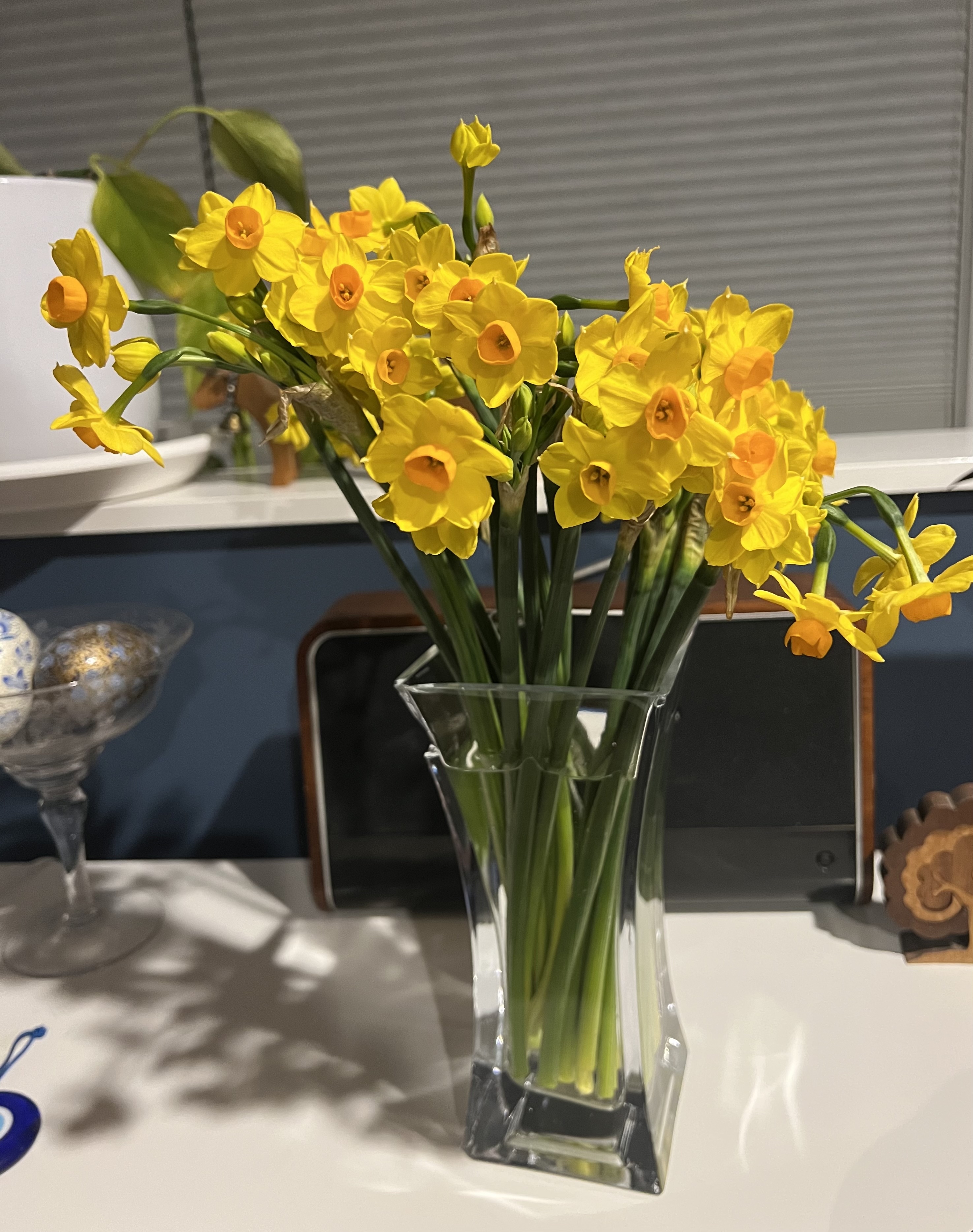
As I come around the last isle, bright yellow jonquils catch my eye. It is mid-winter, yet here they are, heralding spring. Massed in large plastic buckets, their sweet fragrance borders on pungent. I can’t resist. Two bunches are rolled into tissue paper while I hand over a ten dollar note.

Flowers always brighten my day. I’m drawn to their beauty and fragrance. It turns out there is a reason for this feeling. Flowers can spark the release of dopamine and serotonin in our brain by their bright colours and pleasant smell. There are studies that show that having flowers in the house can lower cortisol levels. They create a relaxed and aesthetically pleasing environment which makes us feel more relaxed. 

Before I knew any of these benefits, I instinctively bought flowers when I felt downhearted. Back in 1987, I spent a rather miserable winter in Berlin. The cloud cover arrived in October and never left for six months. The short days felt like eternal dawn or dusk; it was impossible to tell which. It was during these months that I began the habit of buying flowers every Friday afternoon as I returned from university. The florist around the corner wasn’t cheap but made the most exquisite flower arrangements. They reminded me of the Japanese art of Ikebana. The designs were always minimalist, and they took my breath away. I had very little money left for luxuries, but my Friday ritual never felt like an extravagance.

This memory came flooding back as I purchased my jonquils. While I don’t possess the patience to artistically place flowers in a vase, it doesn’t much matter. A dull winter’s day has been transformed into delight by their smiling yellow faces. And for the next week, there will be guaranteed sunshine every morning.

When a snip becomes a road trip

Every six weeks, I get my hair cut. There’s nothing out of the ordinary about that. Hair grows and if you like it short, it needs to be cut regularly. Nor is it unusual for women to travel across town to visit their hairdresser. Once you have established a good relationship, it is difficult to start over with someone else. It’s a bit like an old relationship where you are comfortable bearing all to each other.

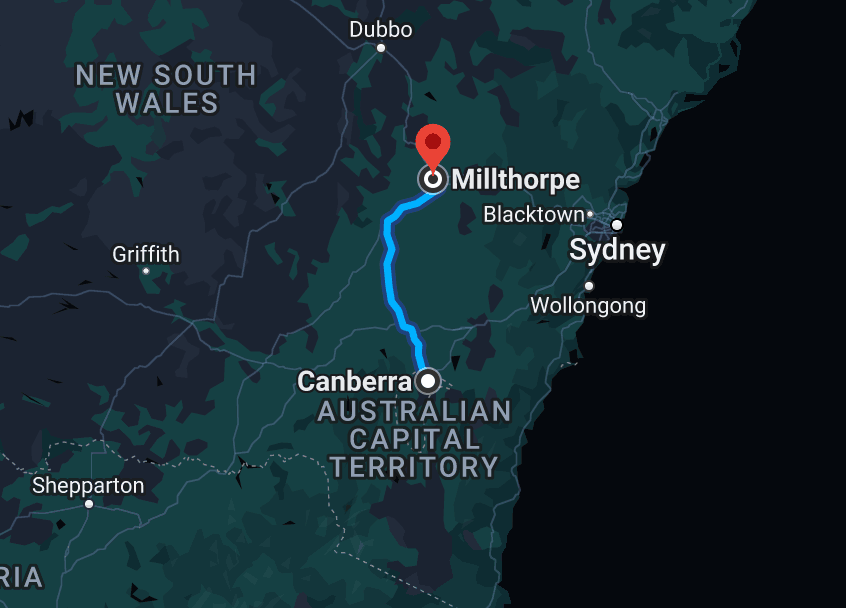
I probably take this further than most. Visiting my hairdresser involves a ritual of driving 270km each way and staying overnight with friends in Millthorpe where I used to live. That’s the equivalent of driving from Milan to Venice or further than Vienna to Budapest. In Europe this would be insane, in Australia just slightly bonkers. We readily acknowledge that we have a different relationship to distances. In my misspent youth, I dated guys who used six packs (beer) as their preferred unit of measure between cities. (Not condoned!) That was before drink driving was taken seriously. I have a tendency to measure distances by increments of towns. Canberra to Millthorpe is three hours; one hour to Boorowa, one hour to Cowra and then one hour to Millthorpe. It’s a rough estimate, but it works for me.

My hairdresser is good but there’s probably 50 equally good ones within a 10km radius from where I live. She knows me well by now and doesn’t bother with social niceties. If we talk, there’s a point to it. She’s a no-nonsense woman who has no need to pretend to be anything else. I like her. But that’s not the only reason I make the trip.

Over the seven years I lived in Millthorpe, I have made some good friends and rekindled some old friendships from a different part of my life. Funny how that works out. When I moved to Canberra, I left some very good friends behind, and it seems a shame to keep losing friends as we age. So, I decided not to let that happen. My hairdresser appointment is a good excuse to visit friends regularly. For I know when we say, ‘let’s keep in touch,’ it rarely eventuates. Our lives become busy, other priorities take over and before we know it, we have lost contact. Getting my haircut is my way of ensuring that I keep up with friends. I now need to come up with a similar strategy to see my friends in Sydney!

How far do you go to keep up friendships?

Bottled Ink

I have always loved the smell of bottled ink. It has a distinctive acrid smell that takes me back to learning to write in my first year at school. While today I find the smell nostalgic and comforting, the experience of forming letters on a page was torturous. Unlike children in Australia who learn to write using large, soft pencils, in Austria, we were expected to master the vagaries of the fountain pen at the age of six.

My memories of that time are shrouded in tears and ink blots on the page. Did I push too hard or was the pen leaky? Was the nib too thick or did I not hold the pen at the correct angle? Fountain pens can be tricky at the best of times. I don’t think I ever had ink free hands for the duration of my primary school years.

While quills have been used for centuries, the modern fountain pen was only invented in the early 1800s. It continued to evolve, with advances made by Lewis Waterman in America. His pens were able to be refilled and he invented a mechanism to allow ink to flow more freely. To this day, Waterman fountain pens are renowned for their style and reliability.

My pen clearly wasn’t a reliable one. My inky fingers no doubt made their way into my mouth as I turned pages. However, unlike with the forbidden book in Umberto Ecco’s Name of the Rose, there was no danger of any intellectual threat emerging from my scribbles. I was hardly going to be poisoned for my inattention by licking my blackened fingers. The only danger I faced was the wrath of my teacher for messy handwriting and blotting my copybook.

I am heartened that even King Charles has experienced the painful exposure to inferior pens even if he does own a Montblanc Solitaire among other prestigious pens. His outburst at Hillsborough Castle was beamed around the world. The newly crowned king was affronted by a leaky pen and let everyone know it. My own outbursts were met with a dressing down, a stern directive to stop moaning and to try harder. Not that any of this helped.

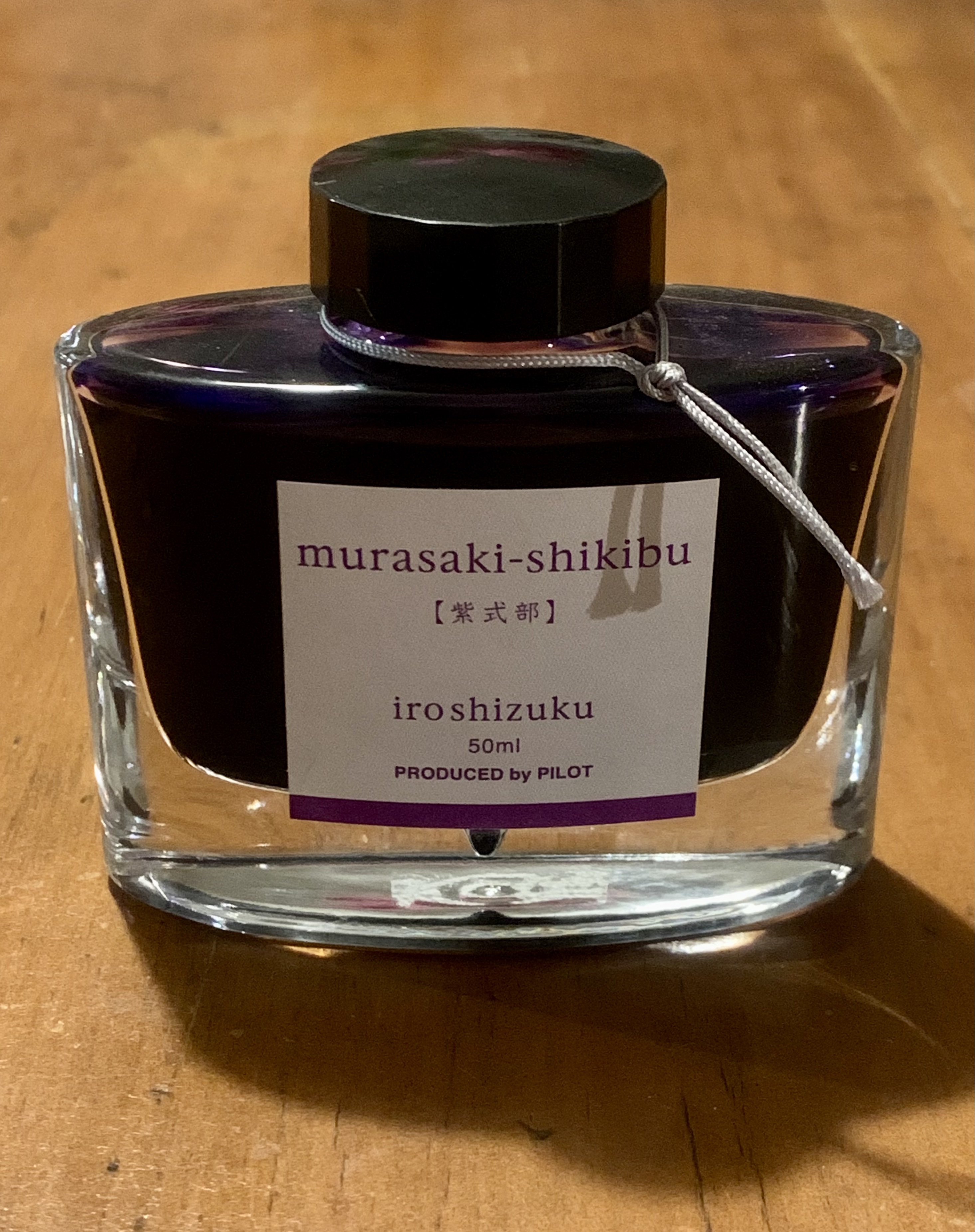
I don’t quite understand why I have persisted with fountain pens. Mine still leak and from time to time my blackened fingertips take me back to being a six-year-old. While I love all the wild ink colours that are available, I usually stick to black, just in case my signature needs to be validated or a page photocopied. Still, I love my Japanese murasaki-shikibu purple ink, named after the female Japanese writer who wrote the exquisite Tale of Genji in c.1010. This Japanese ink has a much more pungent smell than the inks I associate with my childhood. The shade of purple reminds me of my paternal uncle who would only write with a violet biro. Every time I use purple ink, it is a nod to my Hungarian uncle Lajos and his slight eccentricity which he maintained throughout his life. In a country where only blue or black were commonly available, it is hard to imagine where he sourced his pens.

I, on the other hand, am spoilt for choice. Besides the Pilot Japanese purple, my favourite Lamy colour is turquoise. In the Waterman range I adore absolute brown which is perfect for a nostalgic sepia look, harking back to the early twentieth century. For durability, however, I can’t go past Montblanc permanent black.

There is something almost subversive about writing with a fountain pen in the digital age where uniformity is prized over individuality. Colour is definitely not to be encouraged. But as always, I am happy to be counted among the renegades.

Photos on my phone

Fifteen years ago, I had to remember to take a camera if I wanted to take a photo. I may have remembered to take it along to special occasions or when we went on holidays. I chose my subjects carefully and tried to take the perfect photo in one shot. Before digital cameras, the roll of Kodak film often sat in the fridge for a year or two before I remembered to have it developed. The result was either joy at remembering a forgotten moment or the disappointment of a badly executed composition. Usually, it was the latter.

Now that we all have a camera in our pockets, it is easier than ever to take bad photos. The only difference is that we don’t have to print them. We now store these along with the thousands of other photos on our phones, computers and of course the cloud. We keep it all because we can. We have photos of wi-fi passwords, breakfasts we have consumed months ago, screen shots of travel arrangements and of course thousands of photos of pets and the occasional human.

By the time we have several thousand photos, culling becomes a chore best avoided. There’s always something more important on the to do list.  Who wants to spend hours making one decision after another? Generally, this task is only attempted when we are running out of memory on our devices. Even then, people will go to great lengths to avoid pressing the delete button. The number of photos slowing down a device is often the excuse for buying a new phone or iPad with bigger memory and better camera to continue our bad habits.

I have recently updated my computer and decided it was a good time to do some digital culling. I deleted thousands of files and even made a start on the photos. My worst offenders were images of work-related PowerPoint presentations that reminded me of my good intentions to revisit them. Of course, I haven’t looked at them. Not once. This was followed by random photos of cute dogs, hundreds of photos of my daughter at graduation, catching each expression milliseconds apart. I do it because it is easy; just a slight push on the glass screen and I have a memory that is less likely to fail than the memory stored in my mind. At the same time, I realise it is another version of mindless consumerism. I can now outsource remembering to my phone.

My friend Lizzie once gave me some advice when I felt overwhelmed with my (lack of) filing. The piles of paper were screaming at me every time I entered the room. I felt shame and a good measure of embarrassment whenever I glanced across at the papers. She suggested spending no more than 15 minutes on the task each afternoon. It worked. Slowly the pile began to recede and as I acquired stamina, I could face twenty minutes or even half an hour to get it done. The problem I have always faced is all or nothing thinking. Either I sort through the lot, or it isn’t worth starting. Yet the reality is that deleting 5 photos is better than deleting none.

Currently, I still carry 5 838 photos and 132 videos in my pocket. What about you?

A brush with the Law

In 1977 it was hard to get a job. Only a year before, students like me who had finished school with a Leaving Certificate could find work in the major banks, the post office or Telecom. But times had changed, and unemployment was on the rise. On Saturday morning, I bought the Age, circled jobs, and waited until Monday morning to make my phone calls at a phone booth. The jobs were often gone by the time I got through. One day, I saw a job as a court clerk. I had done Legal Studies at school, and it was a subject I really enjoyed. I loved learning about different legal cases and the precedents they established or built upon. My enthusiasm must have landed me the interview.

As I had no work clothes, I borrowed a blue wrap around skirt with matching shoes from Cat with whom I shared a flat. The shoes had a wedge heel which was a novelty for me. I had exactly 40 cents left for the week which was the cost of the tram ride from the top of Milton Street to Flinders Street station. The solicitor’s office was located in a turn of the century building on Flinders Street near Elizabeth Street.

I walked up two flights of marble stairs, holding onto the heavy wooden balustrade so I wouldn’t go over on my ankles. On the landing was a heavy wooden door. I stepped into a small office and his secretary ushered me into the solicitor’s room. A kindly old gent sat behind a desk piled high with folders, tied with pink legal tape. He invited me to sit down and tell him why I wanted the job.

‘Legal studies was my favourite subject at school. I love reading about cases and the stories they tell.  You know, like Donoghue v Stevenson. That snail in the bottle, and she actually won! Duty of care and all that.’

He smiled. ‘Tell me about yourself, about your family and what you want to do with your life.’

‘My father died a couple of months ago and I’m looking for work now. I’m a real hard worker, you won’t regret giving me the job.’

‘Can you see yourself finishing your studies?’

‘Oh, yes! I’d love to finish my HSC and maybe go to uni. I’d love to study Law.’

‘Well, in this job you will be getting files ready and taking them to court. There’s a lot of running around but you will meet interesting people. It’s a good start for someone interested in the Law.’

‘Does this mean I have the job?’ I asked hopefully.

‘Well, I do have another couple of girls to interview but you are definitely on my shortlist. You don’t have a phone number, do you?’

I shook my head.

Well, give me a call tomorrow morning at nine and I’ll let you know.’

I shook his hand firmly with good eye contact. I had this in the bag.

Outside, the sun promised a beautiful day ahead. As I had spent my last 40c on the tram ride, I began my long walk home. The tram ride had been a pleasant half hour trip but the walk in Cat’s shoes proved much more arduous. It seemed to take forever just to get to Domain Road and there were still a few kilometres to go. I walked past all the modern office blocks and hotels on St Kilda Road, feet aching, and mouth parched. I walked past wolf-whistling construction workers, eyes firmly fixed on the footpath, self-conscious about how I looked. I walked past confident men in suits and tall women in tight skirts trying to keep up with the pace.

I walked past the boarded-up factory where my father once worked, and eventually reached St Kilda town hall where a few years earlier I had requested permission to keep a bus filled with animals in front of St Kilda marina! There were memories everywhere I looked, yet I still had quite a few more blocks to walk. All I wanted to do was to take the shoes off and drink a glass of cold water.

Finally, I reached Milton Street and the block of flats where I lived with three friends. When I arrived home, the girls were out. I put Cat’s shoes back into her room, wiggled my blistered toes and sat down, tucking my feet under my bottom in one of our large 1930’s armchairs. I sipped on a cup of instant coffee with two and a half sugars and closed my eyes. I never borrowed Cat’s shoes again.

The next day, I took some money from the kitty to make the phone call.  I was excited for my first real job in a lawyer’s office. The phone rang three times before my future boss answered.

’Thanks for ringing back. It was a tough decision. I can see that you would make an excellent court clerk and I’d love to have you on board. But when I got home last night, my neighbour came by. His daughter is looking for a position and, well, I’ve known the family for over 30 years. I felt I had to give her a chance. I’m sure you understand the position I’m in.’

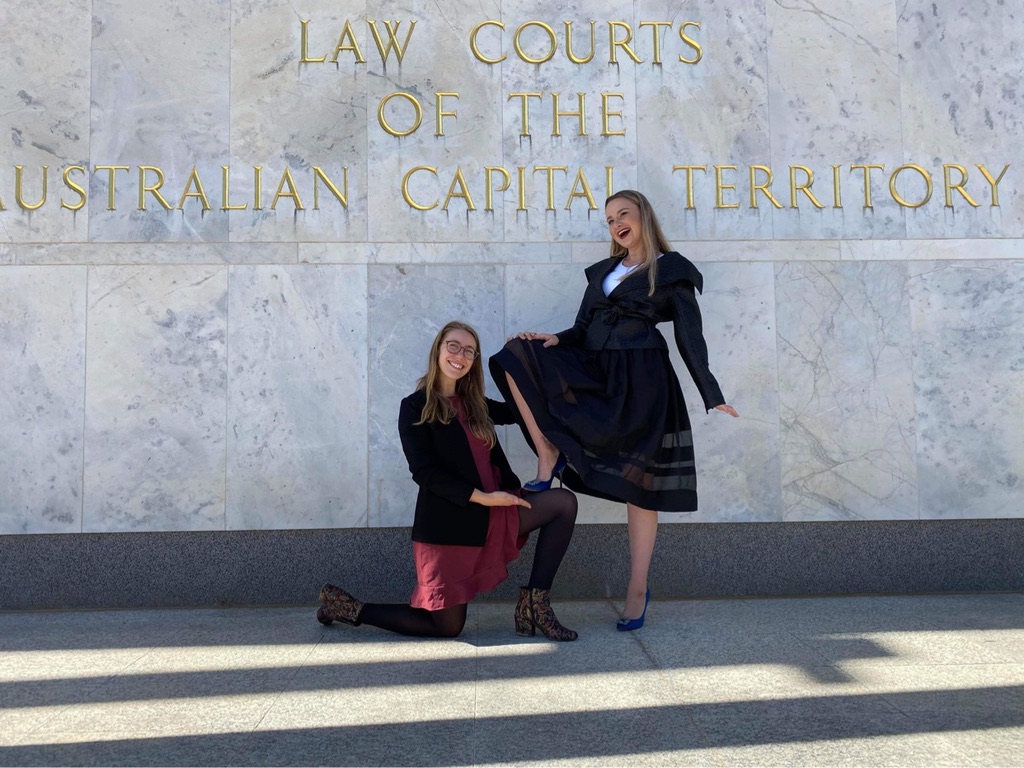
I choked on my words, said thank you and hung up. It was a moment when my life could have taken a different turn and I was fully aware of the chance I had lost. I never did pursue a legal career. In one of those odd turns of fate, it was to be my daughter (above right) who would finish her Law degree and be admitted to the Bar.

Adelaide Markets

In my late teens, I spent most Saturday mornings at the Adelaide markets. It was where we did our weekly shopping for fruit and vegetables and met friends from other share houses. The markets were a grid of trestle tables laden with fresh produce and boxes underneath containing cauliflower leaves and silver beat stalks. The stall holders were loud middle-aged, leather faced men jostling with each other for customers.

There were only a few shops along the side, mainly delicatessens. One of my favourites was Greek and it had dozens of dried Yevani bunches of basil hanging on ceiling hooks. The shop sold vine leaves and other delicacies and I loved the smell of herbs that infused every corner of this tightly packed store.

After our weekly shopping trip, we headed to Victoria square. Most demonstrations started from this vantage point. We often took leisurely strolls through the city streets calling out slogans against uranium mining, for Aboriginal Land rights or made a general plea for peace. There was never any trouble; we marched with our vegetables, stood up for what we believed in and headed home.

I haven’t been back to Adelaide since the halcyon days of my youth when everything seemed possible, and change was in the air. It just turned out that the change that was coming was not what we had bargained for.

I felt disoriented when I walked into the markets this morning. My memory was playing tricks with me. I seemed to remember Victoria Square to my right but it is to my left. Then there is the market itself. It looks nothing like it did back then. I walked all the way around the perimeter looking for the Greek deli, but it has been replaced with trendy coffee shops ubiquitous in every Australian city.

Even the fruit and vegetable stalls look neater and have permanent signage above them. There are rows of cheese shops, coffee roasters and specialty stores selling everything from body lotions to boutique distillery gin. The rhubarb gin was delicious, although it felt very wrong to try it at 9:30 in the morning.  However, the charming salesman reminded me with a wink that it was 5pm somewhere in the world. This certainly wasn’t the markets I remembered from my youth.

I feel an odd unreciprocated nostalgia when I visit places where I have lived. It is as if the place has moved on, but I haven’t. At least not when it comes to my expectations of the familiar. I know the streets and can find my way around, yet I am disoriented. I search for a familiar building to find it has been replaced by a concrete box with offices. As I walk, I recognise that this is undisputedly Adelaide just not the way I know it. My Adelaide will always be locked away in my untrustworthy memory, made tender with age.

On the move again…

I was about to turn five and father and I were on the move again. This time, we were going to Kétegyháza, on the Southern Great Plain of south-east Hungary, near the Romanian border. Once there, my father looked for his brother-in-law, who was the director of an agricultural college. Uncle Attila lived in the caretaker’s house with his family. It must have looked like bucolic bliss.

‘Can she stay a while with you? It’s complicated right now. I’m trying to work out whether I can come home to Hungary and start afresh. There’s a lot to consider,’ my father confided to Attila.

‘Of course she can stay, Stephen,’ my uncle answered. ’She’s family and we always look after family.’

‘It’s only for a while,’ my father said and then he was gone again. I didn’t mind being left this time. I loved my time with Uncle Attila, Aunt Margot and their twelve-year-old son, Atti. My cousin and I adored each other from the moment we met. He treated me like his little sister and I saw him as the brother I’d never had. For Atti, I was a welcome distraction from his exacting parents and for me, he was nothing short of a demigod whom I idolised. For that one magic summer, we were inseparable.

It was fun to be in the country where I was allowed to play all day and make as much noise as I wanted. The house and garden seemed enormous after my time at my grandmother’s deathly quiet flat in Budapest. My stay seemed perfect in every way, and I honestly can’t remember missing my parents at all.

I followed Atti everywhere. Every morning we ran out of the house, climbed trees, played hide and seek. When we were tired, we lay down in meadows and watched clouds drift across the sky, I picked a riot of wildflowers for my aunt. There were so many that my fingers barely reached as I hugged the bunch to my chest. Everything about this summer was expansive like the soft blue sky above us.

In the evenings, I sat on the veranda and watched the colour of the sky change from pale blue to pink then orange and finally to ink. I inhaled the intense sweetness of lilac flowers and kept an eye on the light show in the sky. For hours I sat mesmerised watching uncle Attila whittle away at a piece of wood which would become a miniature blacksmith’s block with a tiny anvil on top. He also carved tiny hammers which made up the blacksmith’s set. I never tired of watching my uncle, although I did think at the time that the tools he made would be too small even for one of the seven dwarfs. Years after my uncle’s death, I would learn that he had made these intricate ornaments to supplement his income.

‘Let’s go and pick some apricots,’ Atti said, near the orchard at the back of their garden. ‘I know the best tree to climb. Catch me if you can!’

I ran after him barefoot. Knee deep in grass, I felt the soft blades brush against my calves. In the orchard dappled apricots hung heavily, ready for the taking. But then, inexplicably, agonising pain. Piercing pain shot shards up my left foot. I screamed.  Atti raced back to find me sitting in the grass, fat tears tumbling onto my cradled foot.

‘Show me,’ he said, and, ever so gently, he removed the bumblebee stinger.

I limped along beside him attuned to the drone of bees. Sure footed, Atti arrived at the orchard, reached up and picked ripe, freckled apricots. He ran back offering the sweetest antidote to a bee sting. One bite and the sting lost its power.

That summer passed far too quickly. It was almost time for Atti to return to school. I couldn’t imagine the house without the sound of his footsteps searching for me, inviting me to come and play. My aunt and uncle spoke about me in hushed tones and then, just like that, my father walked through the front door.

Fifty years later, my cousin Atti explained what had happened on that day. My aunt and uncle had desperately wanted another child and when I arrived on their doorstep, it was as if their prayers had been answered. They put their case convincingly to my father. If he allowed them to formally adopt me, I would not only stay within the wider family, but I would be assured of a secure future with excellent educational prospects and loving ‘parents’ to look after me. Uncle Attila, who was always self-assured, could also be loud and overbearing. No doubt, he clearly spelled out the advantages that my father could not provide. I think he made my father feel inadequate. Indignant, and above all proud, my father packed my few belongings and we left for the train station. In a little over three hours, we arrived in Vienna. He had a few leads to follow but besides those, he knew no-one.


Scooby

My mother’s first job in Australia was at the ABC in Ripponlea back in 1972. She worked at the canteen where she served meals, made cups of tea, and cleared tables. My mother often took me to work so she could keep an eye on me. Naturally, I was bored and began chatting to the staff when they came down for their break. It was there that I met Leigh, a young university student doing a work placement over the summer holidays. She took a liking to me, and we spoke about many things that summer, including our love of dogs. Leigh lived with her parents in Ferntree Gully and owned a kelpie.

‘Kelpies are Australian dogs. They’re the best,’ she said. ‘Would you like to come and meet him?’

‘Would I ever!’ I said

‘I’ll have a talk to your mum. Maybe you could come over this weekend to meet him,’ she suggested.

Leigh kept her word and arrived the following Saturday to collect me in her Mini Minor. My parents hadn’t owned a car since I was five and I felt grown up and important sitting in the front seat. At that time, I had seen very little of Melbourne and only knew the places in my immediate environment, places I could walk to easily. We drove for what seemed like hours, down straight roads and through endless suburbs. Finally, we came to a house up on a hill. The driveway was steep and treeless. A sleek brown kelpie ran to meet us, barking and nipping at the wheels. When Leigh stepped out of the car, he could barely be contained. His tail wagged his whole body. This dog was loyal, smart and a whole lot of fun. I wanted a dog just like him.

Leigh and I hatched a plan to get a rescue pup.

‘I won’t be allowed to keep it, Leigh’

‘Leave it to me, I’ll talk to your mum.’

I wasn’t so sure. ‘What if she says no?’

She laughed. ’I’m pretty good at convincing people.’

Leigh worked her magic on my mother, and I was finally allowed to go with her to the Lort Smith animal home in North Melbourne. We drove from the ABC during one of her long breaks. Going in the car with Leigh always felt like an adventure. We drove down St Kilda Road all the way into the city, then past Queen Victoria markets and up Flemington Rd. Everything was so new to me. The modern office blocks on St Kilda Rd, Flinders Street station with its open mouth reminding me of the entrance to Luna Park on the St Kilda Esplanade and the smells wafting from Victoria markets were all new sights and sensations. I could have driven around town with Leigh for hours, but I was anxious to get my new pup.

When we finally arrived, we were taken to where dogs were kept in what looked like large cages. The sound of dogs barking, whining, and howling echoed along the concrete walls. The result was a cacophony of misery. Walking along, I felt as if I were a warden in a prison, just like I had seen on our black and white television set. It was a depressing scene to witness. Dogs came to the front of their cages and pleaded with us for their freedom. I found it hard to meet their gaze. And then there was the foul odour of too many dogs in a confined space. It smelled like wet dog, excrement, and fear. It may have been cleaned regularly but the smell crept into every corner and was impossible to eradicate.

Finally, we came to an enclosure teeming with tiny black and tan pups. The warden with the key opened the gate and we were let in.

‘Go and choose one,’ Leigh said. ’Take your time and choose the one you like best.’

There were about ten puppies in the enclosure. It was feeding time. The pups all ran towards the trough and the strong ones pushed the weaker ones aside. One small pup with a protruding belly was trying to get to the food but was not strong enough to muscle in. It looked sad and forlorn. My heart went out to that pup.

‘This is the one I want,’ I said, pointing at it.

‘Are you sure?’ Leigh asked.

‘Yes, this is the one that needs me.’

The pup was taken for a check-up at the veterinary hospital attached to the facility. The vet looked at us.

‘Are you sure you want to take this one? It looks as if he could have distemper, and he may not survive,’ he said gravely.

‘He is the one I want.’ I said with tears welling in my eyes. ‘If he dies, at least he will be loved until that time.’

The vet looked apologetically at Leigh.

‘We’ll take him,’ she said.

‘Look, if he dies in the next couple of weeks, we’ll give you another one,’ said the vet. What will you call him?’

‘Scooby,’ I said. ‘Like Scooby-do.’ It had been my favourite cartoon when I lived in England.

Leigh paid not only for the dog but also for his vet bills. It must have cost her a packet. Despite everyone’s concerns, Scooby pulled through and lived to a ripe old age.

My mother stopped working at the ABC and Leigh went back to university. After that summer, I lost contact with her. Even now, so many decades later, I wish I could express my gratitude to her for the kindness and generosity she showed to that little migrant girl in her fledgling months in Australia.