25 names in 25 days

http://www.vecteezy.com

Late to the arrival of Facebook, I only signed up because my daughter was overseas at the time. As a teacher, it was a decision I did not take lightly. I wanted to keep my anonymity. It was only when a dear friend suggested that I did not have to use my real name that I finally relented. I became Lotti McNiece. Lotti was the name of our mini poodle and McNiece was my husband’s surname. People who knew me could find me, others would have a hard time.

Years after Lotti died, I kept her name. People would walk up to me saying, ‘Aren’t you Lotti?’ and my standard reply was, ‘Well, yes and no…’ My husband had his own version of an alter ego. A Francophile, he studied the works of Louis Aragon and often used the name Louis when ordering at coffee carts. At home he became Louis Leoir, a struggling student in our daughter’s make believe class. And when we played our own version of Fawlty Towers, she became Polly and we imitated Sybil and Basil. Playing with names became a family tradition.

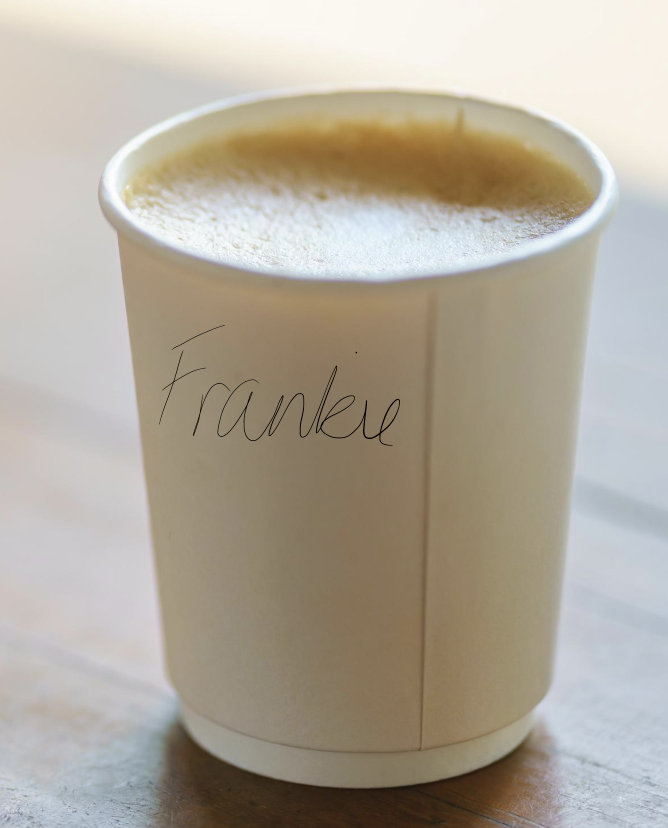
As a nod to my late husband, I use a variety of different names when ordering coffee. I seem to be fond of Frankie, Lotti, Zoe, Clara and Ella. At times I have even used Mark and Dan just to get a reaction. Alas, nothing can shock a barista. They probably think I am ordering coffee for someone else. Colleagues, on the other hand, giggle whenever I use a pseudonym as if they are witnessing some mischievous folly.

Most people I know are very attached to their names while I am, at best, ambivalent. As a child I was known by my middle name, Angela. This changed on the day I started school in Australia. As there was already an Angela in the class, my teacher insisted on calling me Viktoria. I hated it. It sounded so pompous. The moment I could find my voice, I began to call myself Vicki in an attempt to fit in. At home I had a nickname, so I learnt to respond to any of the four names I could be called. In my late twenties I reverted to Viktoria in an attempt to sound more mature. It is definitely a name to grow into. Over the years, some people have consistently called me Elizabeth, a misassociation of my name with the late queen of England instead of her great-great-grandmother, Queen Victoria. I respond well to Elizabeth.

While standing in line for coffee today, I watched a young man attempt to place his order. The woman behind the counter could not make out his name. She repeated several possibilities, none of them right. In the end, to keep the queue moving, he simultaneously nodded and shrugged when she said, ‘Josh?’ And so he became Josh for the duration of his brew. I leant over and confessed that I often use a pseudonym in these situations. It’s fun to try on different personas.

‘25 names in 25 days,’ he said with a twinkle in his eye. A conspiratorial moment shared between two strangers before I ordered my coffee.

‘Name?’
‘Frankie,’ I said, with a wink at Josh.

This Quiet Unfurling

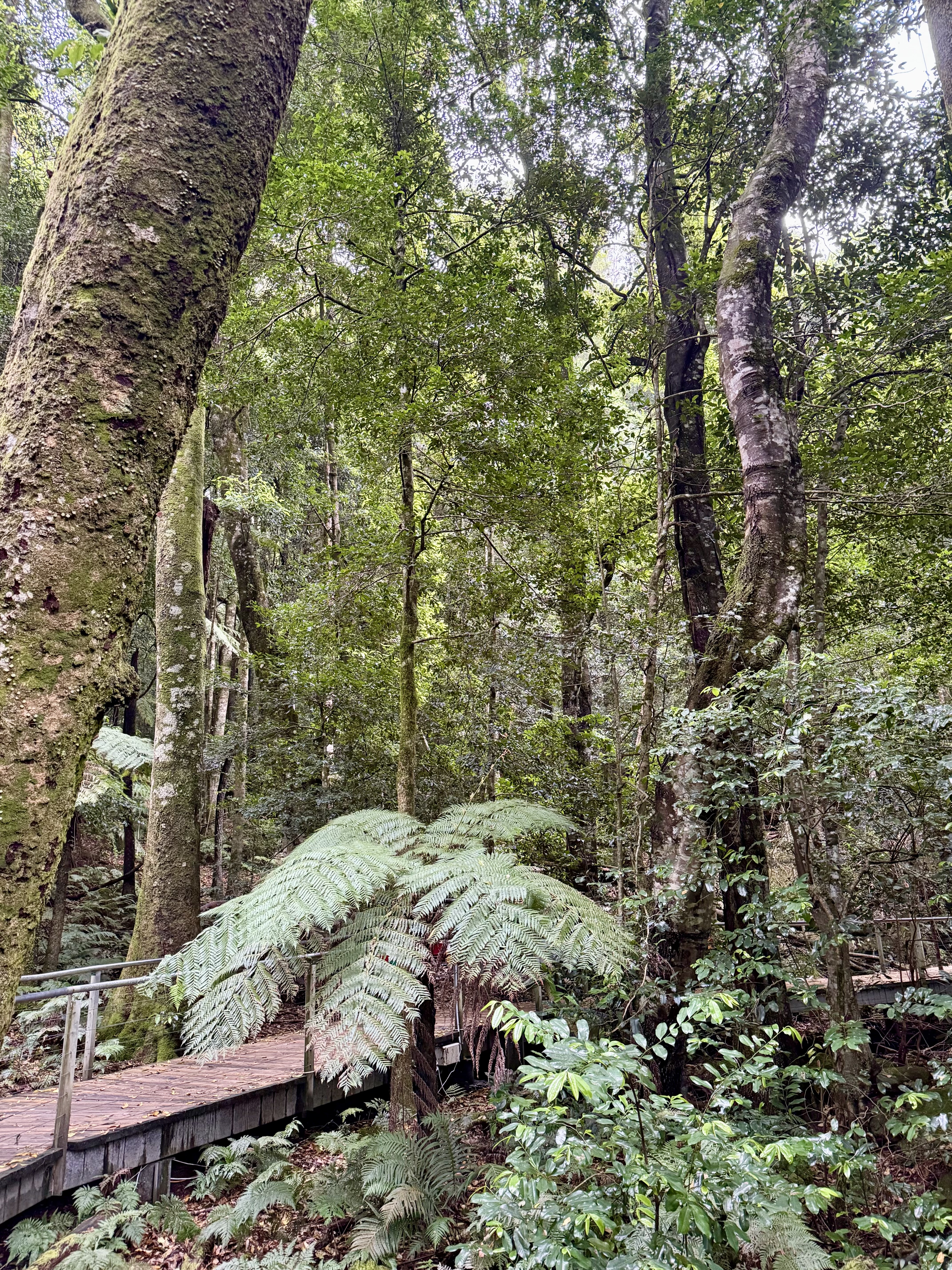
There is an ancient rainforest at the bottom of a gully in Katoomba. To reach the forest floor of the Jamison Valley, I take a cable car that drops 200 metres at a 36 degree incline to attend a special session of the 2025 Blue Mountains Writers’ Festival. As we descend, the vertical sandstone cliff face looks almost close enough to touch. Three hundred million years ago, an expansive sea spread over this area. Over millennia, sediment and sand formed into hardened layers which we now recognise as sandstone. Each layer reveals its geological history through erosion, sedimentation or uplift. This cable car is my TARDIS. It is the closest I come to time travel.

The sandstone is ragged. Tiny ledges mark the layers, and wherever a square centimetre can be found, life takes root tenaciously. Small trees curl their roots around rock and somehow find enough nutrients to stay alive. I am in awe of the miracle of life I am privileged to witness.

My TARDIS docks next to a wooden boardwalk that winds 2.4 kilometres beneath a rainforest canopy. This area is a privately operated tourist attraction that has managed, for the most part, to keep the rainforest pristine. Some added features feel kitsch, like scattered ‘dinosaur’ bones for children, but they are confined to one side of the boardwalk, so I simply look the other way.

I am enchanted by the ancient trees, vines and ferns that surround me. Some ferns are as tall as trees and about two hundred years old. Smaller ferns, unfurling their fronds, show tight spiral shaped leaves, an example of the Fibonacci sequence in nature. Mesmerised, I regard a delicate formation that follows this complex logarithmic pattern. I am not a mathematician, but I have a deep respect for how mathematics explains so much of the natural world. We seek patterns.

After a fifteen minute walk, I reach the Rainforest Room, a yurt like structure without walls that accommodates about one hundred and fifty people. Seats begin to fill. We are here at 7.45 on a Sunday morning to hear three writers talk about their books. Nature is the common element in their writing, though not all are happy to be labelled nature writers. I have come to hear Inga Simpson, whose work I admire. I don’t know the other two writers, Jessica White and Jane Rawson, but I know I will enjoy the session.

We sit in silence, looking out onto the rainforest. I am struck by the Coachwood trees, which have paintbrush wide white splotches. It looks as if someone has wiped their brushes on the trunks. Later I discover these marks are caused by lichen. They look stunning.

I recognise Sassafras, Turpentine and the Blue Mountain Gum among the trees. Then my ear attunes to songbirds tentatively striking up a melody. Within a minute, they are drowned out by the raucous sound of Sulphur Crested Cockatoos. I can’t help but smile at these juvenile delinquents who arrive with their boom boxes, ready to crash any party. Good luck hearing a song underneath all that squawking.

The event starts and I listen to Jane Rawson speak about her latest book Human/Nature, described as a lyrical work of creative nonfiction. I am drawn to her honesty and humour as she talks about establishing a life in the Huon Valley. Inga Simpson speaks about her latest book The Thinning, which I read some time ago. While it wasn’t my favourite of her works, it is interesting to listen to its reception within this group of readers. Jessica White talks about Silence Is My Habitat, her book of ecobiological essays. I am drawn to the title. Silence has always been my friend. I occasionally play music, which I love, but silence is what I long for most. I am listening to a kindred spirit, but her silence has been imposed by deafness, which she acquired at the age of four after pneumococcal meningitis. Her deafness has rendered the world silent, but it has given her the superpower of acute observation, especially of the natural world.

I love listening to these women in conversation. My soul is nourished by their words, their deep respect for one another and their reverence for nature. A tiny, oft ignored voice gently reminds me of a suppressed longing. I want to be a writer. First heard when I was six years old, I have held onto this dream tenaciously, much like the stunted trees clinging to the sandstone ledges. Their roots wrap around the rock the way my fingers furl over the keyboard, finding a letter here then there, forming words and sentences. It may not be much, but I hold on as if my life depended on it.

From Zurich to the Bush Capital

When I jump into the deep end of a pool, I can always dog paddle until I find my stroke. This is what life has taught me. I always get to the other side. I may not be a great swimmer but I am buoyant. Knowing this has served me well.

In 2008 I spent a year in Switzerland with my family. It was a crazy opportunity that came out of nowhere and I was willing to take the chance. Arriving in Zurich was like jumping off a diving board. The first week felt like a massive belly flop and I wondered whether I had made the right decision, not only for myself but for my family.  

It didn’t take us long to learn some of the idiosyncrasies of our new home. School starts before 8 a.m., shops close for lunch, trains and buses run on time. There were other quite annoying things such as having to do your washing on a Friday (everyone has a designated day), no flushing toilets after 10 p.m. (house rules) and no paracetamol available except at chemists which are closed on Sundays.

I was quite cocky before we left. Why would I have trouble understanding the Swiss, when I understand Swabian and Austrian dialects?  What could be so difficult? Well, maybe vocabulary, grammar and pronunciation as a start! It took me much longer than I expected to follow simple conversations. Nor did I expect the Swiss to frown upon my high German. After all, it is meant to be the official language in the German cantons.

As we became increasingly familiar with how things operated, we began to appreciate the small things of life. Wherever we were in the countryside, we’d find a cat in a field, ears pricked up, ready to pounce. We could even spot them from the train! Why do Swiss cats do this and not other cats? It remained a charming mystery.

If land didn’t have a dwelling on it, there were cows grazing there, kept in place by movable electric fences. Behind our nearest bus shelter were three cows and behind them were rows of multi-storey flats. If it wasn’t cows grazing, it was goats. These animals could be found in any of the suburbs of large towns. I grew to love this proximity to farm animals. It made for a slower and much calmer pace.

In 2024, I jumped off the diving board once more, this time to move to Canberra. It wasn’t anywhere near as disorientating as moving to Switzerland but it did feel much more permanent. I had bought a townhouse, changed jobs and began the process of acclimatising. At least I can speak the language here and know how society operates but it still takes time to adjust.

At first, I was confused by the wide streets and wanted to turn into the oncoming traffic not realising that the lanes were one way. Then there were all the roundabouts and roads that go around in circles. I have been caught out more than once with the all-day 40 km school zones with no flashing lights. In fact, I have never had as many fines as I have since moving here. The rules can be quite perplexing!

In Canberra, I can buy a bottle of wine at the supermarket, just as I could in Switzerland. However, when I go to work across the border, this is no longer possible. Lately, I have begun to see other similarities with where we lived in Switzerland. Every morning I drive past ducks that may waddle across the street, only 100 m from a main arterial road. Near the first roundabout as you enter Canberra coming from Sydney, there is a small herd of Angus cows grazing in a paddock that will eventually be turned into medium density housing. I had to laugh when I first saw them.

My drive to work takes me along a stretch of a freeway that has paddocks on both sides. There are agisted horses, cows and small farms all within a ten-minute drive from the centre of the city. I hope this doesn’t change in my lifetime. Next to one of these farms there is a small ‘shop’ that works on an honesty system. Here, I can buy eggs, cheese and honey on my way home. It reminds me of a place in Switzerland which was a ten-minute walk up the hill from our place. We could buy seasonal fruit from the farmer who had a wooden box on the side of the road where we would leave money. Honesty boxes could be found all over Switzerland including deep in forests where 2 Franks could be exchanged for a swig of Absinthe!

Canberra has retained the feel of a large country town with plenty of green space. No wonder it prides itself on being the Bush Capital. Maybe I recognised some of its similarities to Switzerland which I grew to love. I think about this more often as I approach my second anniversary living in Canberra. The longer I spend here, the more I appreciate its beauty, surrounded by farms, nature reserves and the stunning Brindabellas in the distance. I’ve found my rhythm once more; steady, buoyant and much more at home.

Telstra Tower and Other Small Miracles

The other day I listened to Dr Ellen Langer speak about mindfulness as a way of being rather than a practice. She described the art of seeing the ordinary with fresh eyes, of really looking, really noticing. It struck me how easily the rhythm of daily life can lull us into living on autopilot.

Her talk reminded me of the Buddhist Monk, Thich Nhat Hanh’s definition of mindfulness, doing the ordinary things in life with a sense of purpose and attention, whether that be opening a door or turning on a tap. Each of these little acts can be done either mindlessly or mindfully. Doing it one way we are absent from our life while doing it mindfully we become alive to the present moment. And the present moment, as we know, is the only moment. Whatever happened 5 minutes ago is in past and whatever is coming is in the future. Life can only be lived in the small moments of now.

I have known this for many years but I am not very good at being grounded. My mind takes me hither and dither and I can be quite the scatterbrain. Where’s my phone? My wallet? Did I turn off the lights? Did I just lock myself out? These are daily micro-moments of panic I experience on repeat. My daughter just laughs and says she never gets past counting to 17 before my problem-of-the-moment is resolved!

This morning has been a scattered start. I’m still in my PJs deciding on shower, getting dressed, making to do lists, going to the shop and walking the dog. It really shouldn’t be this hard. Just start with the first logical step (have a shower) and keep going. It hasn’t helped that I am unwell and brain fog has settled in for the day. That’s when I stopped and looked out the window. No, not just looked out the window but really looked out the window. I saw the usual scene before me with fresh eyes. Trees swaying in the wind, leaves like windchimes. Thousands of hushed, eucalypt windchimes trembling on trees only a few metres from the glass pane. I was mesmerised by the bounty of their beauty and then looked further afield towards the horizon.

Erupting in a belly-laugh, I couldn’t believe my eyes! I have lived here for 20 months and have never seen it. Yet there it was, clear as the day before me. The largest structure in Canberra, a 195metre telecommunications tower known as Telstra Tower and it can be seen from my window! How often have I mindlessly looked out and never seen it? How can I miss an obscenely large structure like this? I shook my head in disbelief and couldn’t help but laugh at my selective blindness. Sadly, this is nothing new, many people know this about me but it still catches me completely unawares.

I now have a new landmark to celebrate when I look out the window and I wonder what other delights await me as I learn to look once more with fresh eyes. It’s both humbling and heartening to realise that wonder was there all along. As Thich Nhat Hanh says, “We all have the ability to look at things with fresh eyes and see them as if seeing them for the first time. If we have lost our freshness, all we have to do is practice breathing in and out to restore it.” (From A Handful of Quiet, Happiness in Four Pebbles.)

And so I breathe in and out and learn an old lesson anew. I laugh at how life patiently keeps offering me reminders and I resolve to open my eyes and look deeply as if for the very first or very last time.

Six Days Horizontal

Getting sick is like sitting down on a chair that’s much lower than anticipated. You land hard and wonder why you didn’t see it coming. The signs were all there – lack of energy, headache, a bit of a cough but it didn’t seem that bad. Until it was. And then the crash landing.

Six days in bed felt like long drawn out weeks. There were nights where minutes felt like hours and hours stretched into infinity until dawn. Unable to breathe through my nose, I sat half upright, sipping endless glass after glass of water in a futile attempt to keep my lips moist. It was pretty grim by Wednesday night. Thoughts meandered irrationally in and out of my consciousness. At one point I was writing scripts for ‘Vera’; trains of clever dialogues rattled by without ever stopping at a station. At other times I was coming up with ideas for Podcasts. Perhaps that synapse of an idea will make this suffering worthwhile.

Being sick for a length of time gave me ample of opportunity to appraise my life. Existential dread arrived on cue between the hours of three and four a.m., no alarm necessary. Had I done enough with my one wild life? Clearly not. My shortcomings lay exposed, expectorating. I was condemned, guilty on all counts. My optimism fled at the first sign of the tempest raging in my head.

The week has been confronting. I turned into a creature I barely recognised. I could have walked out of the pages of Fear and Loathing in Las Vegas. Any veneer of humour was chipped away, hope no longer resided in my soul. And my old friend, gratitude? She too deserted me and has only fleetingly reappeared in the past two days. A fair-weather friend on whom I thought I could rely. Faith too had deserted me.

Here I am on day eight and the fog is slowly lifting. I am now fully dressed and have even eaten a meal. I’ve stopped trying to wrestle with what I can’t control and settled into reluctant acceptance. My mood has steadied and the storm has eased. I am emerging, somewhat battered but essentially intact. I tell myself I’ll never take my health for granted again, and even as I think it, I know it’s probably horseshit.

It takes a village

My granddaughter was born two and a half months ago. She’s generally a ‘good baby’ (as if any baby could be bad), but she does struggle with sleep. In this regard, she reminds me of my daughter as a baby. She was a wakeful child, who would become overtired and then unable to sleep at all.

Now, of course, my daughter wishes she could sleep. Even a ten-minute nap is bliss, and she catches rest whenever she can. Her husband is a hands-on dad, which means both of them are running on empty. Nothing can prepare you for parenthood. It can only be understood through living it. I look at them and marvel at their resilience, but I also recognise that fine line between coping and breaking point.

One unfortunate inheritance I’ve passed on to my daughter is chronic migraines. She remembers me lying down with a bucket beside the bed, waiting for her father to come home and take over the evening routine. It probably happened once a week, certainly often enough to leave an imprint. Like me, she can only lie down, hope to sleep, or ride out the waves of pain. I know what she’s going through, but all I can really do is empathise, bring her medicine, prepare food, and care for the baby so she can rest.

Today she called me in desperation, asking where I was. After hours of trying to settle the baby with multi-day migraine, she had reached her limit. She did the wisest thing she could, put the baby down safely and walked away to her bedroom. I remember the guilt of those moments, when I too had to step back. Yet that distance, that breath of space, is what saves both mother and child. No-one can prepare you for motherhood and the contradictions it carries: joy and frustration, love and exhaustion, light and shadow.

She’s fortunate to have a close friend nearby who stepped in until I arrived. Together we cared for the baby, giving my daughter the reprieve she needed. Watching her, I thought about how difficult it can be raising a child in a nuclear family. How much gentler it might be if grandparents, aunts and uncles lived nearby, ready to lend a hand or a listening ear. There is much to be said for the extended family networks that are woven naturally into other cultures. As for us, we simply muddle through, doing our best, one tired, love-filled day at a time.

What Might Have Been, What Still Is

It is seven in the morning and I’m walking my dog. There are a few people about; a Border Collie here, an Oodle there, a Kelpie in the distance. As I come to cross path, an older couple appear without a dog in tow. This seems odd. At this time of the morning, most people walk briskly with their dogs, giving them a quick outing before work. Over time, most of these people have become familiar faces which I acknowledge with a nod and smile, or with whom I exchange a comment about the weather.  

Ever curious, my eyes follow the older couple as they walk in-step, hands in pockets, elbows lightly touching. As I watch from a distance, my heart aches for the familiarity and affection I sense from their movements. In their steps, I glimpse the path I imagined for myself long ago. This is how I always wanted my old age to be; my husband and I, walking along with a dog running ahead, enjoying companionable silence, or the conversation that makes up a lifetime shared.

Watching them, my heart aches but there’s also joy in my sadness. Joy, because they beat the odds of divorce, death or the malignancy of indifference. They have not ended up in a law court fighting out a bitter dispute or learned to loathe each other in silence, bickering away the fleeting moments of their lives. I celebrate this couple and all those who stood the test of time, those who have learned to love through pain, heartache and oh so many joys that life has to offer, to finally arrive at old age together, whether it be by luck, good fortune or good health. And as I watch them go, I know without doubt and without sentimentality that this would have been us, had death not severed my beloved from my side.

Floriade and Friendship

Many a weekend is spent on housework and chores. That’s a fact of life for those of us who work full-time. But there’s more to life than dishes and socks. Weekends also need to include recreational activities to recharge us.

This week my dear friend Heidi announced she would come to visit. We live about 110 km from each other but even with this relatively short distance in Australian terms, we don’t see each other often. I suggested going to Floriade, a Canberran institution which is held every year in September. She readily agreed.

Floriade is a celebration of spring held at Commonwealth Park each year. An overall theme is selected for the various garden bed designs. This year Floriade features 12 large garden beds highlighting Australian Scientists through the contribution they made to a scientific field. The garden bed themes have names such as Molecular Structure, Spectrum and Petri Dish. By carefully observing the design of each bed, the theme presents itself. My favourites were the double helix for DNA and the Atom.

While massed tulips are the main attraction, there are many varieties of flowers in an assortment of colours. There are Pansies, Chrysanthemums, Hyacinths and Violas to name but a few. Each display is painstakingly planted to represent the facets of science it celebrates. It can be difficult to discern the images portrayed from ground level but when viewed from above, the images become clear.

I suggested going on the Ferris Wheel to get a better view. After a long wait, we clambered into a swinging carriage that was to take us up for a better view. From above, it was much easier to discern the themes. It was very windy at the top and we rocked from side to side which made taking pictures difficult. Our best photos came from when we stopped half way up.

Heidi and I had a wonderful time exploring the gardens. We were mesmerised by the variety of colours of the flowers we encountered. Black Pansies and deep purple hyacinths! We had never seen either of these. We marvelled at the ingenuity of the of the garden bed designers.

While the flowers occupied the centre of attention, we still had time to catch up with each other’s lives. We are empty nesters; our children flapping their fledgling wings. We talked about our plans for retirement, the joys of having a dog, our fears for future generations.

There is immense comfort in a friendship that has lasted forty years. Surprisingly, in all that time, we have only lived in the same town for roughly two years. Yet like tulips at the Floriade, our friendship has returned season after season, surprising us with vivid palettes of colour and the patina that the years provide.

Floating My Way into Calm

The first time I encountered a floatation tank was in Melbourne sometime in the 1990s. Back then, they were small pods which could either be closed completely or left ajar for those who suffered from claustrophobia. I didn’t know what to expect and found the experience relaxing but rather boring. It was also before I learnt to meditate.

On a whim, I decided to book a 60-minute floatation experience. I reasoned that if I fell asleep during an MRI, I would find floating in an enclosed tank relaxing. I booked into the nearest ‘Wellness Centre’ and a calm young woman met me at the front counter. The process was explained via a short video on an iPad; she then offered me a cup of tea and took me to the floatation room.

Instead of an enclosed tank, I found myself in a very spacious room with a shower on one side and a floatation pool taking up the length of the room. I was surrounded by blue light which I could turn off for complete sensory deprivation. Once showered, I stepped into the pool and immediately floated to the surface of the water. I chose not to have any music and turned off the light.

This may remind some people of solitary confinement and in a sense it was. I began a mindfulness of breathing meditation, where I counted each in and outbreath as one and then continued until I reached ten before starting at one again. I managed to focus for ten times ten breaths which roughly equates ten minutes before I lost track. I’m not sure how long I persevered with counting my breath before I fell into a deep sleep in zero-G.

Sensory deprivation is often used to reduce stress, relieve pain and help with concentration. When sensory input is minimised, it is easier to allow our parasympathetic nervous system to do its job and relax the body. It can lower the heart rate and produce a profound sense of calm. Sensory deprivation, especially when combined with high levels of magnesium sulfate (Epsom salts), can assist with muscle recovery and improved sleep quality. These are all sorely needed when we are always on the go, and my sore body sure appreciated the benefits.

A faint voice awakened me. I stirred, found the light switch and showered once more, washing the salt from my body. Heading to the lounge area, I encountered a number of slow moving, gently smiling people. After tea and a few quiet moments in the lounge, I opened the door and returned to the world outside; calm, rested, and savouring the silence within.

September Stirrings

As September and my birthday approach, I become acutely aware that the year is heading into the final waning quarter. We race about exclaiming ‘where did the year go?’, like we have done every year before this and no doubt will in years to follow. But years come and go in days and hours, in the actions and inactions that we succumb to in the moment. At the time they seem such tiny decisions that they really don’t matter but when we add them up, those moments become minutes and hours and then days and months.

It reminds me of that small biscuit that can’t possibly make a difference yet over time adding up to extra kilos or the five dollars for a coffee that can add up to a substantial amount of money when invested. We often look for the big things that make a change in our lives when we should be looking at the micro-moments that have the real impact.

Recently, I have begun to question every one of my purchases. Do I really need it? Will I really use it? How much will it be worth to me in six months’ time? They are quite sobering questions, and I have found that many things are quite unnecessary. This has also allowed me to appreciate the things I do have. The exception to my newfound frugality is buying books, but even there, I have curbed my spending. In part, because I am running out of both shelf and wall space to accommodate them.

As I approach the last quarter of the year, I am disappointed with my lack of progress on some goals but at the same time, I am buoyed by the progress of others. On reflection, this sounds fairly normal. We dream big at the beginning of the year but then, getting through the day with all its demands wears us down little by little. In addition, like joker cards, life’s twists and turns can jolt our lives onto a different track altogether. 

I head into my birth month taking stock of this past year, what I can achieve as we sprint towards the finish line of 2025 and what lies ahead for me in the coming year. I’ll be a year older, none-the wiser, but feeling positive about some of the habits I have been developing. Spending less and living within my means is a basic tenet in life that I should have acquired decades ago but I am proud that in this season of my life, I am on my way to conquering my spending habits and learning to make the moments count. It turns out, the last quarter of the year, and of life, is also shaped by the smallest of choices.