Suburban dystopia

Suburban life has never attracted me. I find the rows and rows of ticky-tacky houses on small blocks with double garages and endless lawns stifling. While there are plenty of cars, I hardly see a person walking and everything is far, far away. The only way to get somewhere is by private motor vehicle.

Shopping centres out in the ‘burbs are large scale. If there are any main street shops left, they are run down. The rest are found in shopping malls with enormous car parks where people circle like sharks trying to find a park. I have visited a few recently. They inevitably have a one or two supermarkets, cheap chemists, tobacconists an uninviting café or two and of course the ubiquitous two-dollar shops and cheap clothing stores by the dozen. All I can see is the landfill they will produce within weeks of purchase.

Teenagers hang around in groups at the Plaza; there’s very little else for them to do. Young women push their prams, old ones their walkers and those in between walk around with their shopping bags hanging by their sides. I see little joy in their faces. Shops are often empty with salespeople leaning on counters looking out, willing customers to come in and spend. It’s the bottle shop and supermarket that are busy in these places.

I look at people’s faces and wonder whether it is the emptiness inside that is fuelling their consumption. Things always look better when displayed in shop windows and I too have fallen for the trap thinking that an item will transform my space or make me feel better. Rarely has this been the case. If anything, I have often regretted the hole in my budget and the hours I had to work in exchange for that item.

I am not a minimalist and doubt that I will ever embrace that lifestyle. However, I try to think about my purchases and buy quality rather than quantity. My last pair of boots lasted ten years before I wore them out and items like crockery and furniture are decades old, except for my recently purchased desk. You won’t find me throwing out broken shelves at the council cleanup because the ones I have are made to last.

While I see why suburban life may appeal to some people, I can’t ignore its suffocating mundanity. There’s a deeper fulfilment to be found beyond cookie-cutter houses and sprawling parking lots. Choosing quality over quantity and seeking life affirming experiences is essential for a truly meaningful life. I want us to challenge and reject mindless consumption, not just for the sake of our well-being, but that of our planet. And we all deserve spaces that inspire us and choices that reflect our passions. Life is too short to settle for banality.

Rescue, reclaim and write!

Whenever I move house, the first thing I set up is my desk. It has to be in the right position, preferably in front of a window. I love looking out when I am trying to think of the right word or phrase to express exactly what I am trying to say. Looking at a wall is stifling, no matter how many lovely post cards or pictures I have placed there.

I have had many desks in my life, starting with an ancient desk that my parents bought me when I was six or seven. I loved sitting there with an ancient Remington typewriter perched upon it. It made me feel important, like a real writer. At that desk, I typed my first stories and contemplated the idea of becoming an author. I couldn’t think of anything more magical than writing of lands far away, where anything was possible, and where readers could explore places unlike those they have ever encountered. I still have that dream. 

Since then, I have had pretty desks, utilitarian desks, large and small desks, old and more modern desks, desks that I have loved and ones I have loathed. My last one should have been perfect, except it was far too low for me to feel comfortable. No matter what I tried, it just didn’t feel right. I dreamt of a desk that was made just for me and had all the right dimensions.

Serendipitously, I met Thomas Fox at a local market. When I saw his woodwork, I knew he was the person who could design and make the desk I was after. He is an artisan with an eye for form and style. I wanted a desk with sensuous curves and a surface that would connect me to the age and beauty of the wood. I wanted a desk I could love, not just for its utility but for its inherent beauty, a desk to caress like a lover.

After months of refinement, we settled on a design. Thomas went to work on translating those ideas into something tangible and exquisitely elegant. Several months later, the desk arrived, ready to have its final polish and placement in my study. I took pleasure in hearing about the reclaimed wood he used, its provenance, and how the unique pieces of wood were rescued from iconic buildings around Bega. While its latest form as a desk is new, parts of it are over 150 years old. Each section of the desk has its own story, and its character has developed over the years from previous uses. It has come to me as a palimpsest, waiting for me to imprint meaning without erasing its history. I foresee a lasting, rich collaboration between us.

Going Under

Last Wednesday, I drove to Orange for my friend Seana Smith’s book launch.  Writing is a solitary occupation, but once the work is complete, it’s time to emerge and celebrate. Going Under was published only a few weeks ago. There is nothing more joyful than a beaming author holding up a copy of their book in print.

I met Seana through the Central West Writers, a group of people who met monthly in various locations. We were both members for several years, even if we didn’t attend regularly. When we came together, we listened to writers read sections of their work, offer a suggestion or two and cheer them on. When we saw their work come to fruition as a published article or book, it gave everyone encouragement to keep going. Writers’ groups can be a beacon of hope when we are stuck in the messy middle.

Seana’s book, Going Under, is a memoir which fearlessly chronicles her lifelong struggle with drinking. Like so many people I know, she has dealt with intergenerational alcoholism and trauma. These scars run deep, but we can effect healing when we face our demons.

Growing up in Scotland, drinking was part of the landscape. Moving around the world and finally settling in Australia didn’t change that. Nor did being successful in a variety of high-profile jobs. As an extrovert, Seana likes company, and having a glass in hand livens up a party. But drinking was much more than that for her. After much soul searching, Seana’s struggle with alcohol has finally come to an end. ‘My life will be better if I never drink again,’ came to her like a mantra that she could not ignore. And for over four years now, Seana has become a champion for sobriety.  

Going Under is published by Ventura Press. If your bookstore doesn’t have a copy, you can always place an order like I did. Or you can listen to the book in her wonderful braid Scots on Audible.

Whispers of an ancient land

The sun has slipped behind the rounded mountain at the rear of the cabin where I’m staying. Its rock face is in the shade for most of the day. I can tell from the height of the trees and the snow that lies in patches near the summit. Outside, it is 3 degrees, and we haven’t reached sunset yet.

I’m staying in an eco-cabin in the snowy mountains, a short distance from Jindabyne. Mobs of lazily grazing kangaroos straighten backs and ears before returning to their feed. We pose no threat. There are neat piles of square scat near the front door. A wombat’s calling card. Further up the mountain, wallabies hop leisurely across our path. Their pointy dark faces hold our gaze for a moment and before returning to forage in the scrub.

An echidna crosses the road in front of me. Breaking hard, I stop two metres before a ball of waddling spikes. Without a car behind me, I can wait for it to get across the deadly bitumen. I hope it stays on this side of the road. I have seen too much roadkill on this trip already. A sign announces emu corner. I turn to see two emus in the grassy paddock next to cattle and a ‘roo. This place is teaming with wildlife.

Snow gums are everywhere. These hardy trees have survived in subzero temperatures as well as blazing summer days. Most have a definite lean to them from the prevailing winds. Their smooth bark is ghostly white, with grey green or yellow vertical patterns. it peels in strips like sunburnt skin. Their lanceolate leaves droop, weeping and brooding.

There is a melancholy beauty to these twisted and stunted trees. I notice many dead trees walking in the alpine forests. Snow gum dieback is spreading throughout the region. Longicorn beetles are the culprits causing this mass destruction as they eat right through the tree from the outer to inner bark, leaving behind a graveyard of trees. These beetles are native and have never caused such destruction in the past. Could it be that successive droughts and higher than normal temperatures are creating the conditions for these beetles to reach plague proportions?  

Granite boulder outcrops mark the landscape. These stunning, smoothly rounded boulders of various sizes are clustered in paddocks and throughout the wooded areas. They are crystalised masses of magma brought to the surface over 400 million years ago. I am looking at an ancient landscape and I’m unable to process what it all means.

The Ngarigo and Walgal people know and understand this country deeply. It has been their spiritual home for millennia. The landscape holds within it the culture and knowledge which is inseparable from its traditional custodians. As an outsider looking in, I can feel the spiritual force of this place and am humbled by all that I don’t understand on a rational level. But I can feel its spirit and its message running through the contours. I see, but I’m unable to decipher. I am beholden to this ancient land, its stories, knowledge, and mystery.

Seville oranges

Towards the end of winter I went to look for Seville oranges at the farmers’ market. I asked every stall holder I came across, but had no luck. No one seems to plant Sevilles anymore. This reminded me of a road trip Roger and I went on five years ago.

Roger was known in the village as the marmalade man. Every winter he’d order a box of Seville oranges from a grocer he knew and then he’d spend the next week finely cutting and boiling the fruit. It was a ritual he loved. ‘I just let my mind wander,’ he’d say when I asked whether he was ever bored cutting oranges hour after hour. For him, it was a form of meditation. He made dozens of jars which he sold to loyal customers and there were always some left for family and friends.

One year, he wanted to do a trip down memory lane and take me out to the country he loved best. We headed for the Hay plains, stopping first at West Wyong and then Griffith, where he had worked many years ago. Griffith is orange country and some of the best fruit comes from its surrounding orchards. We stopped at at least six different farms asking for Seville oranges only to be told that they had pulled out the trees years ago. No one was buying them anymore.

These bitter oranges originated in Africa and were introduced to Europe by Genovese sailors in about the 10th century. Many believed these oranges were harbingers of happiness and, as such, the Moors planted them all over Spain. To this day, the city of Seville has over 14 000 of these bitter orange trees which make the best marmalade in the world. Sadly, there were none left in Griffith.

We returned from that trip with glorious memories, but no oranges. That year he made whisky marmalade using Navels. As Roger’s health deteriorated, I begged him to teach me the secret of making marmalade and the following year, when he sourced some of the elusive Sevilles, he relented.

‘Cut it on an angle like this,’ he’d admonish, or ‘that’s too thick’, but eventually he commended the efforts of his apprentice. Since his untimely death, I have continued the yearly marmalade tradition.

I went back to the farmers’ market a month ago and found a stall I hadn’t seen before. They only sold oranges and had a myriad varieties on offer. When I asked about Sevilles, the young woman said she’d ask the boss. A good sign, I thought.

‘The boss says they’re not quite ready to pick. Try again next week,’ she said. I was delighted. But the following week they still weren’t ready. After three more visits, the oranges finally arrived. In a mad bout of enthusiasm, I bought 3kg, which makes about 25 jars of marmalade.

The first batch was passable, but a poor imitation of Roger’s expertise. The next batch, however, was a perfect colour and consistency. I opened a jar for a taste test. Not bad, I thought. I fact, it is almost as good as his.

Weather Whiplash

I must have blinked and missed it. A week ago, night-time temperatures were in the single digits but today spring has arrived and daytime temps are in the twenties. Trees that seemed dormant a few days back are suddenly blooming. Not just one or two trees, but rows of trees along streets that appeared bare the last time I looked.

Officially, spring is at least another week away, yet Sydney basked in 27 degrees today. This past year has been the second warmest on record, but fortunately rainfall has been average, at the very least in the Eastern states. Luckily, because bushfire season is starting earlier each year and dry vegetation acts like kindling.

For the 16 years that we lived in the Blue Mountains, every spring brought with it that heart-in mouth feeling as fire trucks raced by. My daughter developed a keen sense of bushfires. She can smell one miles away. This is the inadvertent training young children get who live in fire prone areas. We saw the destruction around us with alarming regularity and knew several people who lost their homes. I never knew the full extent of the effect it had on me until I left.

Unfortunately, it is expected that we will have to endure more heatwaves, extreme conditions in summer and increasingly hazardous weather conditions earlier than ever before and not just in Australia. We will all have to learn mitigation tactics and put an end to being complacent about our impact on the planet. It is high time we stop talking about the weather and work together to actively improve the climate.

Fitting room fiasco

Swimsuit shopping is an ordeal like no other. You find yourself in a cramped cubicle with lighting that makes you look pallid and anaemic at best. Every blotch on your face is magnified, every fold on your hips highlighted. A bored twenty-something salesperson is on the other side of a flimsy curtain, and you’re left regretting every life choice that led you to this moment.

The four-item limit per cubicle is a cruel joke. If nothing fits, you’re either forced to wait with chattering teeth for the salesperson to come back from their morning tea, or get dressed and face the horror of starting over. It’s enough to make anyone want to avoid getting wet.

Determined not to miss out on future beach ‘fun’, I braved online shopping. My one-piece swimsuit arrived, but it didn’t fit. I swapped it for a tankini and bottoms to go with it—success with the pants, but the top was bursting at the bust. Multiple returns later, I finally have a swimsuit. It almost fits perfectly. At this stage, close enough is good enough.

At least this process was less of a nightmare thanks to a responsive online store that has a real shop front in Brisbane. But honestly, I hope I never have to do this again. Maybe I should’ve ordered two—one for now and one for ‘Ron.

To the lighthouse

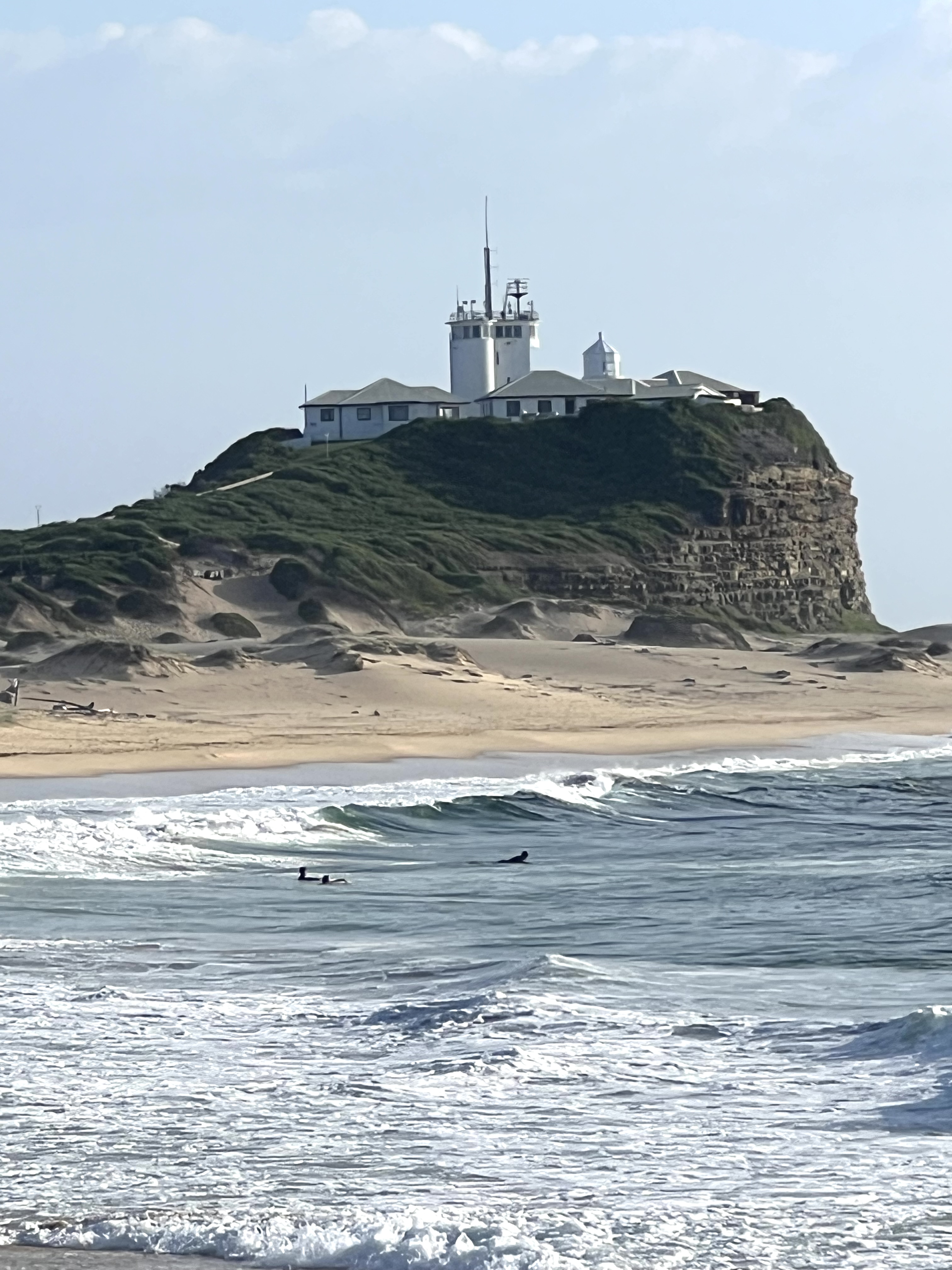
Attribution: This photo is taken from the Lighthouse Art residency application form

Rarely do I receive an unsolicited email that I decide to read. This one, however, came from the Hunter Writers’ Centre and it piqued my interest. It was advertising a fresh round of residencies at Nobbys lighthouse in Newcastle. The photo was enough to make me want to apply. Imagine spending a week on the stunning Nobbys-Whibayganba Headlands looking out onto the Pacific Ocean!

No sooner had I decided to apply than I talked myself out of it. Why would they offer it to me? There were much better writers out there. Who was I to think that I was worthy of this opportunity? Luckily, I saw this chatter for what it was – a self-limiting belief that didn’t deserve the airtime it was getting. So, I shut down the megaphone in my head and applied anyway.

I was thrilled to receive an offer letter for a week in December. From 8 to 4, I will have a desk in a room with a view. Pedestrian access along Macquarie Pier is the only way to get there, and the walk is long and in parts steep. It is exposed to the elements. In Awabakal language, Whibayganba means ‘the place of the one who makes it windy’. I have been forewarned.

I am very grateful to the Hunter Writers’ Centre for the chance to dedicate a week to a final edit of my memoir. It will also be a chance to ponder what lies ahead in 2025 and beyond. Few of us ever dedicate time to profound self-reflection.I am committed to make the most of this opportunity and look forward to a week, where my only distractions will be the vagaries of nature and awe-inspiring scenery.

The National Library: A Sanctuary for the Curious Mind

Stained-glass window by Leonard French

One of the delights of living in the capital city is access to the National Library. While I can’t borrow items to take home, I can request anything from their collection which has more than 7 000 000 items. It also houses a delightful café and a bookshop that I can never resist. As a Friend of the National Library, I receive a 10% discount at both the bookshop and the café which makes it a desirable place to visit.

The National Library and I share a birth year. However, time has been kinder to the grand lady on the lake. She has grown into stately resplendence and made her mark on the landscape. Her wide steps invite us to enter a modernist cathedral built to venerate history and knowledge. This is echoed within the building by the tall stained-glass windows on either side of the foyer, which functions like a church narthex.

Once the foyer is traversed, a sentinel verifies the visitor is fit to enter the hallowed halls. From there on, a hush descends. It is one of the few libraries that still has rules about eating and drinking, remaining quiet and using mobile phones. No-one complains.

Today, I spent two hours in the library reading. I observed students, researchers, members of the public accessing the latest issues of magazines. I love that in a world of user pays, this facility is free to use and available to anyone in Australia. You don’t need to be an academic or a writer, just someone who is curious to follow a line of enquiry.

The National Library is a cultural treasure, a gift to the country. There are always interesting exhibitions; currently there is one about migration. In August there is a webinar on family history for beginners, a lecture on Aboriginal perspectives on landscape and a book launch of Australian flora, to name a few. There are collections focusing on maps, oral histories, performing arts, Australiana and Australian writers, and many more. You can access many resources through Trove, a library database owned by the National Library at https://trove.nla.gov.au/.

Road Sage: Self-Help Adventures

Image generated by ChatGPT

Audiobooks keep me sane on the road. I am a kinder and somewhat slower driver when I listen to books. It means I arrive at my destination fuelled by dopamine rather than norepinephrine. In case you were wondering, norepinephrine is the neurotransmitter responsible for emotions such as anger. Just don’t ask me to pronounce it.  

I’m a self-confessed self-help junkie on the road. Luckily, breathalysers don’t register this drug yet, otherwise I could be in a bit of strife. Like people who assiduously follow their horoscopes yet don’t believe in it, I have the same relationship to self-help. Luckily for me, there are a couple of authors in this game who are equally sceptical, which makes it fun to listen to them.

Recently, I discovered Jon Acuff with titles such as ‘Finish’, ‘Soundtracks: the surprising solution to overthinking’ and ‘All it takes is a goal.’ Like all American authors writing in this genre, his books are padded with stories and every step is broken down into micro steps to reach the word count of the book. At the heart of each book, there is a good idea that’s explored which, if acted upon, has the potential of significant benefit. However, these authors know that good intentions rarely make it past the starting block and so they write a new book to motivate the reader to have another go. At least Jon Acuff sees his own flaws, makes dad jokes and puns, which keep me amused as I hurtle down the freeway. And there’s always a gem or two to hold on to.

One exercise in his book is to make a list of your best moments. There are a few reasons he suggests this. First, when you see all your best moments, you can’t help but be grateful for all the wonderful things you have had in your life. It also focuses your mind on what you value and what you would like your life to be like. He then asks the reader to categorise these best moments into experiences, accomplishments, relationships and objects. Whichever list is the longest will let you know where your values lie. For him it was achievements, for me, experiences. Rarely, if ever, do you find people whose best moments centre around objects. This makes sense intuitively, yet Western culture is predicated on convincing us to consume more.

Here are a few of my favourite moments in random order.

  • Laughing with friends
  • Writing
  • Walking the dog
  • Drinking a cup of hot tea
  • Helping others without them knowing
  • Playing board games with my family
  • Going on a retreat
  • Visiting good friends
  • Coming across cows at the bus stop in Switzerland
  • Listening to birds
  • Falling in love
  • Finishing my memoir
  • Smelling the pages of a book
  • Snow crunching beneath my boots

What would make your favourite moments list?