I’m back at work after two glorious months off. While I was still working diligently on my own projects, the days and weeks had a different rhythm. Often, it was difficult to tell which day was which, as the weeks rolled into each other. There’s a deliciousness about feeling that we are outside of time, but it also has its downsides. Like forgetting about business hours for example and realising that others work on a different set of assumptions about working hours.
Now that I am back in the Monday to Friday world of work, weekends have a special quality to them. I can sleep in, read a book, go to the market and walk my dog at a more leisurely pace than during the week. This morning, I took my dog Zoë to the local café, wrote in my journal, drank my latté and shared a freshly baked croissant with her. Bliss.
Walking back, I took my time and noticed the small things that go unnoticed when on a deadline. Like the slight breeze that caressed my bare arms ever so gently. Entering a copse of trees, I saw the shadow of the leaves dancing on the path beneath my feet. I stopped to watch this shimmer of shadow and light – a performance dedicated to the spectator who chose to notice its exquisite beauty.
Back home I performed all the mundane duties that accumulated during the week. I didn’t grumble or delay, I completed them with a sense of joy that comes from being truly present to miracle of life and all it has to offer. Or as Eckhart Tolle put it,’Always say ‘yes’ to the present moment… Surrender to what is.’
My childhood memories of bumblebees are vivid. They were big, bright and booming creatures I encountered in meadows, underfoot and once in the backseat of a car. An early encounter with a bumblebee set the scene for melissophobia (fear of bees) that plagued me for decades.
I remember the occasion clearly. In the back seat of my uncle’s car, the window was wound down to let in some fresh air. A bumblebee flew in and was buzzing loudly at the back window, trapped. The bee looked so pretty with its striped and furry body, and I was fascinated. My mother’s voice boomed from the front seat.
‘Don’t touch!’
This was enough to make me want to do just that. I was a contrary child who could never follow orders, especially not those given by my parents. So, I did exactly the opposite to what I was told. I reached out to touch the bee and was stung on my hand. I wailed in pain and tears flowed freely. I probably received a few ‘I told you sos,’ and nothing could console me. I grew weary of these gentle giants that fly awkwardly from flower-to-flower pollinating as they go. I also developed a fear of all insects in flight
Bumblebees are considered a pest in Australia, and I have only ever encountered them in Tasmania. Like so many imported species, they compete with native species and they also compete with honeybees. An interesting fact about bumblebees is that they do not produce honey. Due to their size, they can damage flowers which makes them unusable for other pollinators that come along.
I have only overcome my fear of bees in the last few years after learning more about their importance to the ecosystem. Somehow, understanding their vital role in our own survival has changed my attitude towards these creatures and my fear has subsided. I treat bees with respect and keep my distance, but I am no longer afraid. I appreciate all that they do and now watch in awe as they engage in their complex ritual dances to let other bees know where the best nectar can be found.
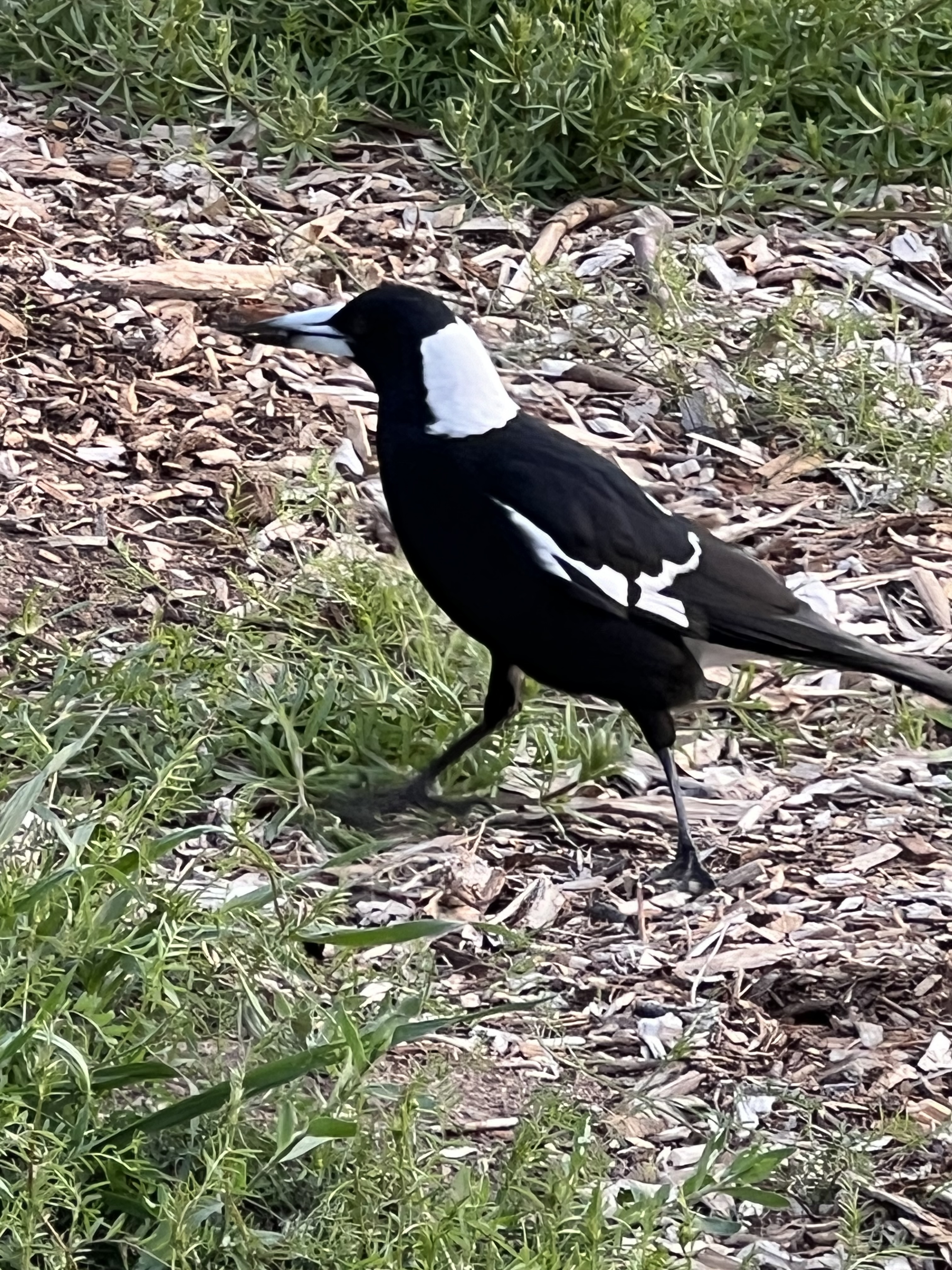
It’s magpie swooping season. In the past two weeks, I’ve been pecked on my head three times and my dog has had Northrop B-2 Spirit magpies stealth-bombing her from behind. Always from behind. She doesn’t move from my side now when we go near trees, and she looks up nervously at her sworn mortal enemies.
For nine months of the year, magpies are a joy in the neighbourhood. They warble in groups of two or three every morning and know us all by sight. They have excellent facial recognition, and recognise everyone in their patch, which is roughly the size of 30 suburban blocks. Magpies know exactly who is naughty or nice, and they pass on this information to other birds.
I always imagined their warble as a joyous expression of welcoming a new day or singing because they are happy. It turns out I was completely deluded. It takes a lot of energy to sing and warble, which is why most songbirds only do it when they are trying to attract a mate. Magpies, however, continue to sing each and every day and it turns out that it is purely to protect their territory. That lovely warble is hurtling expletives at other magpies within earshot. ‘Stay away or else!’
When I lived in the country, three magpies came to the bird feeder most mornings. They’d eat seeds I had put out for parrots, then throw their heads back in what I thought was appreciation and warbled. I referred to them as the three tenors. I must have watched too many Disney movies where all animals are anthropomorphised and given cutesy human traits, for it never occurred to me they were warding off other birds from their find.
Many years ago, I heard an ornithologist interviewed on ABC radio. He explained that 90% of magpies show no aggression at all and that it is only 10% of males who cause all the trouble during mating season. Tongue in cheek, he claimed Australia would be uninhabitable if all magpies swooped. After my last attack, I can only concur. Still, 10% of magpies are a sizable number. Of these aggressive males, half will attack only pedestrians and/or dogs, approximately 16% will attack only cyclists, 16% will go for posties and 18% will randomly attack anyone they come across. These figures are not made up; attacks have been extensively researched and quantified.
Magpies only ever swoop from behind and only if you are in the vicinity of a nest that has chicks in it. All attacks happen within 50 to 100m of a nest, so the sensible thing to do is to avoid the area once you’ve been swooped. When the chicks finally leave the nest, the male returns to being a placid bird until the following year. The best thing you can do in the meantime is to look at your attacker; a magpie won’t ever attack if it can see your face. The worst thing you can do is to run for your life, because then it will surely come after you. If you are on a bike, get off and walk the next 100m until you are in the clear. And yes, the cable ties on helmets work, not that it will stop the swooping, but at least it stops the frightening experience of a beak making repeated contact with the helmet.
For the next two months, I am avoiding the beautiful gums in my neighbourhood. Still, I walk the dog, greet any magpies I meet in a friendly tone and stay out of their territory. There will be time enough to enjoy a shady walk under the spotted gums once spring has passed. In the meantime, I remind myself that I am the intruder here.
Canberra is located at the foothills of the Snowy Mountains, within the Great Dividing Range. Its altitude is 577m above sea level, which may not seem like much by South American standards where cities often sit above 1000m, but it is quite high compared to other cities in Australia and Europe. In fact, Canberra’s elevation is 168m above that of Zürich.
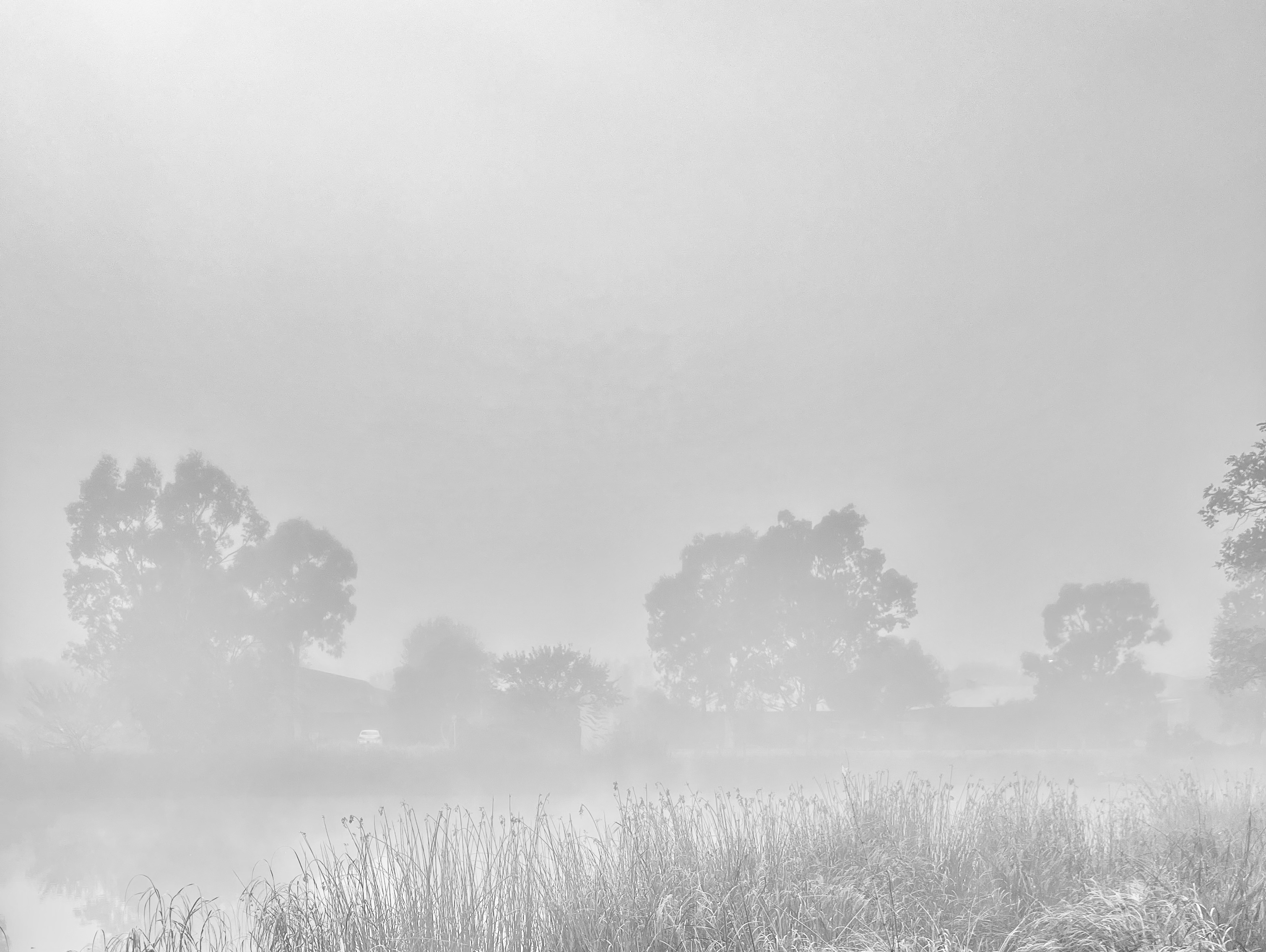
The elevation and the fact that it is a relatively sheltered valley near mountains, allows cooler air to sink and the warmer air to form a blanket above it, especially when there is little or no wind. These are perfect conditions for thick fog to occur. On average, there are around 20 heavily foggy days in winter.
I relish these foggy days which give the city a magical air. I love walking in it, not knowing what is in front or behind me, just focusing on one step at a time. I don’t even mind driving in it, although I admit that I prefer driving in fog when I know a route well. But then I have had years of experience driving in the Blue Mountains, where fog can envelop a valley even in summer.
Canberra airport was built on one of the lowest lying areas in the city. The result is that many flights are delayed and cancelled, especially after 10am when incoming flights can’t land due to the lack of visibility. It does seem like a huge oversight to have located an international airport in one of the worst affected areas in town.
Where I live is only 9km from the airport and it shares its propensity to fog. There are mornings when I can only see shadowy outlines of the trees across the road. When I walk the dog, she disappears ahead of me, and I can confuse markers ahead for people coming towards me. It is a strange, fairy-tale landscape where both time and space seem to conflate. It is muffled and eerie, yet stunningly beautiful and comforting at the same time.
When I worked at Blackheath in the Blue Mountains, I often watched the fog roll in like hay bales on a farm. One would roll up the main street and gather moisture and momentum as it shrouded everything in its path, white as a freshly washed sheet. I’d look out onto the playground and play a game of ‘now you see me and now you don’t’; 350 children there one moment and gone the next.
Fog is an enormous doona spread over the city to make all of us more aware of our senses, to hone our navigation skills and to remind us of the things we can’t control.
It is also a lesson in awe and wonder inviting us to pay close attention to our surroundings. Fog is the winter coat I wear gladly. Wrapped around me, I feel peaceful and lovingly enveloped.
Frosty mornings have arrived, covering the grass in icy, white droplets. The dog’s breath turns to vapour as we make our way across the road to the park. I too can see my breath ahead of me and plunge my hands deep into my pockets. The cold nibbles at my ears and nose, but a down coat keeps the rest of my body warm.
The dog doesn’t seem to feel the cold. She happily lies on this carpet of frost, frolicking and licking the icy dew. There’s a wild look in her eye and I know she is about to run in ever-widening circles, stretching her body fully with each stride. I watch as she performs her exercise routine with unashamed, abundant joy, and I can’t help but feel a vicarious sense of being fully alive. I admire her ability to be so present that nothing else matters to her at all.
These morning walks before work are now as important to me as they are to the dog. Some mornings, the park is shrouded in fog, and we venture into unfamiliar terrain, uncertain of what we may come across along the way. The trees become mysterious creatures with outstretched arms, ready to catch me should I stumble too close. These mornings I am transported into a fairy tale where inanimate objects take on human form in the distance, only to turn back into posts or small bushes when I come near. It never feels menacing, but laden with the promise of some adventure.
The black swan that had appeared one day on the billabong has continued its journey. I wonder where they fly for winter. Only the ducks are left and a cormorant or two. Even the magpies seem quieter in the morning now, or am I imagining this? In any case, the park has taken on a different feel; it is quieter, and the colours are muted. The park is now in calm repose.
My day continues with work hours, obligations, and errands. By late afternoon, I feel the urge to visit again before the light fades completely. I take the dog for her second walk of the day, this time with greater urgency and less time to reflect. Despite my desire to be there, the walk becomes perfunctory. I’m thinking about cooking dinner and jobs that still need to be done before the day is out. Other people in the park seem harried too. Everyone wants a bit more time outside before the light fades completely.
Back home, I can just make out the outline of the canopies. Soon, the inky black sky will blanket the city. The day, with all its cares, is over. A brand-new walk awaits us in the morning.
One of the enjoyable aspects of moving to a new city is discovering what others take for granted. Since moving into my daughter’s unit in Braddon while my place undergoes a facelift, I’m seeing this suburb with fresh eyes.
As a visitor, I had been to Haig Park several times, usually to visit the Sunday morning markets. Now that I live across the road, I have quite a different relationship with it. As I need to take my dog down several times a day to do her business, the park is perfect for a quick comfort stop or a longer run off leash. We have met several dogs and their owners, some chatty, others rather off-hand. Humans that is, never the dogs.
The park has a rather curious design. It runs the length of two suburbs and is 1780m long. It has 14 rows of trees, planted equidistant from each other, giving it more of a feel of a state forest. The plantings of pine trees reinforce this, although on closer inspection, there are four different species of trees which all have their own dedicated rows. Where I am, I can see Italian Cypress, Pin Oaks, and Deodar Cedars, but there are also Argyle apple trees and Radiata Pines. The row upon row of trees gives it a rather eerie feel at night, especially as the lighting is virtually non-existent. I certainly wouldn’t venture across it in the dark.
During the day, it is a much friendlier place, although it still feels odd to be walking up and down in straight lines between trees. This made me wonder about the history of the park, as many of the trees are quite old. A little research yielded the answer to its odd design. It was originally planted as a windbreak in 1921 when Braddon and Turner were fledgling suburbs and needed to be protected from the dust and wind battering it from the north. I can’t imagine Braddon being a fledgling suburb as it is now as close as you can get to the centre of the city.
I haven’t explored the Turner side of the park yet. But I have discovered a couple of interesting things at the Braddon end. The first thing I came across were two metal cabinets that are attached to a pole. The cabinets aren’t locked and unfortunately, this means that possums and crows regularly raid the contents and leave them strewn. A notice attached to the top of one of the cabinets describes their purpose. They are there for food donations for anyone in need. Despite the clear instructions to only use it for non-perishable items, people still leave bread that gets eaten by local wildlife. It also makes a mess around the cabinets. It is a shame that great initiatives often have unwanted consequences.
A little further across the park, I came across a labyrinth. This was an unexpected delight. Unlike other labyrinths I have walked, this one is in the shape of a hand. It is called the Ngala labyrinth. Ngala is the Ngunnawal word for tree. At first, I thought it looked a little too simple compared to the Chartres design. However, walking the labyrinth, I discovered its own beauty. The centre is within the palm, which of course has echoes Proverbs 30.4 ‘God holds us in the palm of his hand.’ But there are also reverberations within Buddhism, Taoism and Yoga where the palm is associated with subtle energy or chakras. Then there is also the connection to fortune telling and palmistry. Clearly, there is a long spiritual tradition which treats the hands as a metaphor. Walking this labyrinth, I felt at peace and grounded upon the land I was on, a stark contrast to the hustle and bustle of Lonsdale Street just a few hundred metres away.
To see the world with fresh eyes is a gift that moving to a new place offers. It is my sincere wish that this stage has longevity so that I may continue to be observant and approach my surroundings with childlike curiosity.
We have become familiar with street libraries which have popped up in the most unlikely places providing a much-needed community service. People take books that pique their interest and bring back ones they have read, but no longer wish to keep. There are no forms to fill out, no due dates nor any fines to worry about. It is a self-regulated system that works because everyone who uses it benefits. It only takes one person to start it, keep an eye on what comes and goes, tidy up every now and again, and occasionally cull. No wonder they have become such a hit.
Yesterday, as I was walking two dogs at a local park in Watson, Canberra, I discovered a variation on the theme – a stick library. My first reaction was joyous laughter. Such a charming idea matched with a quirky sense of humour, and a doggone purpose. In its vicinity, I spied four people and at least double that number of dogs. I should also mention that there was a lagoon nearby. The humans were standing at its edge, throwing sticks into the water for the dogs to fetch.
I walked up to a man whose Border Collie ran towards us with two sticks in his mouth.
‘What a great idea,’ I said, pointing to the stick library.
‘Yeah, whenever we used to come down here, no one could ever find a stick to throw,’ he said. ‘Then some guy decided to do something about it and since then, people bring sticks back for others to use.’
‘I love the community here in Watson,’ a younger woman chimed in. ‘The stick library speaks volumes about the kind of people who live here. It’s such a friendly place.’
‘Someone called ABC radio the other day to say thank you for the stick library and the switchboard lit up,’ the man added. ‘Now they’ve tracked down a guy called Tom who’ll give an interview at the local radio station.’
I nodded in appreciation and could immediately see the appeal of this good news story. After all, we are a dog loving nation. One in three households in Canberra owns a dog. You don’t have to walk very far to encounter a pooch with its special human beaming with pride as they make their way to the nearest off-leash area. Exercise is essential, especially in a city brimming with apartments. And what better exercise than to fetch a good old-fashioned stick?
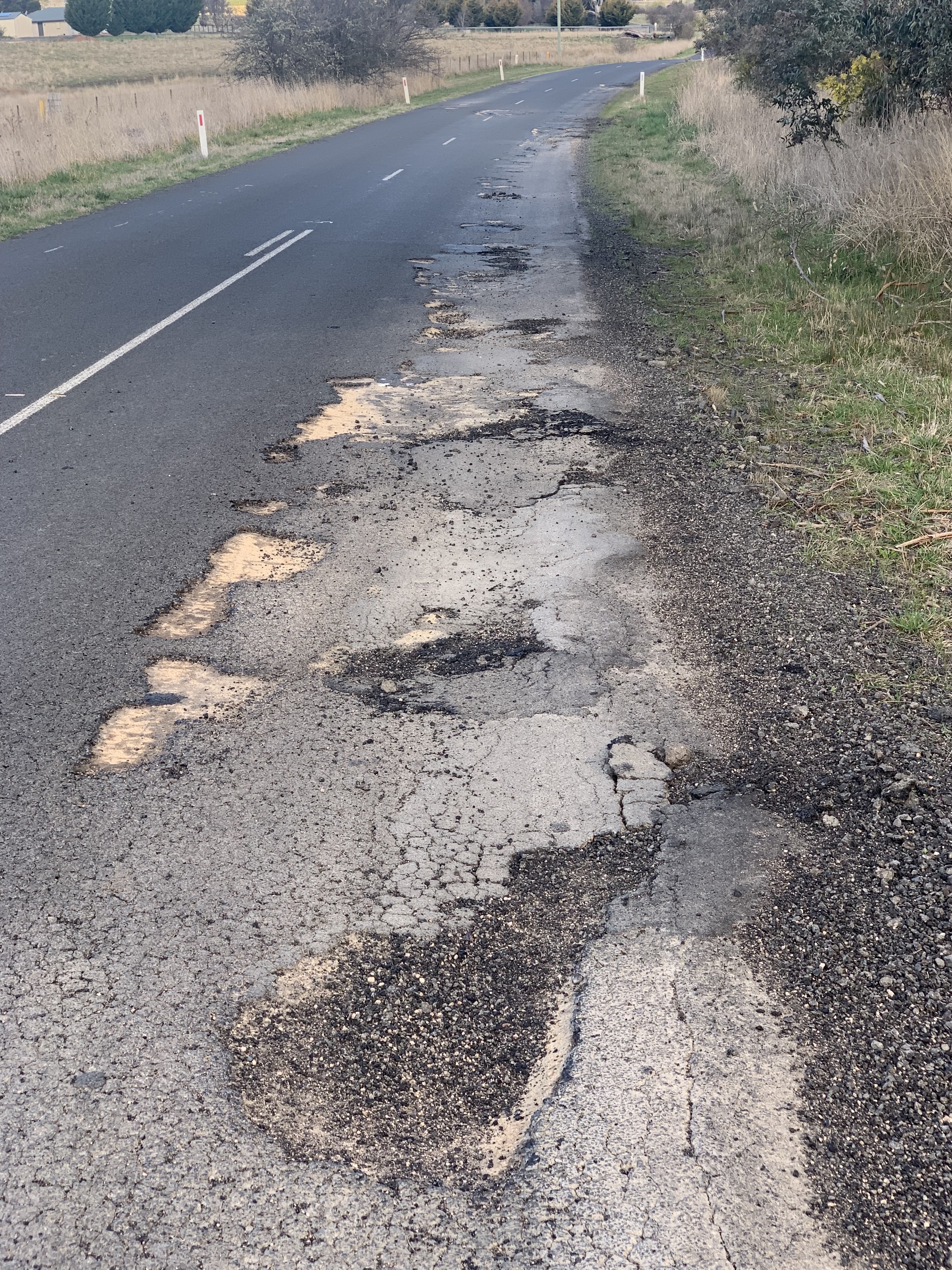
Rain has washed away whole sections of country roads. Wherever I look there are potholes, thoroughfares which are no longer passable and ‘rough surface’ signs to alert drivers to the obvious. I recently punctured a tyre as I plunged into a hole much deeper than anticipated and last Thursday, a loose rock hit my windscreen leaving it with a sizable crack.
I have had ample opportunity to ponder the pothole, both real and figurative, as I white-knuckle clench the steering wheel. There have certainly been some rough rides. Last week as I drove along a dark country highway, trying to avoid both kangaroos and potholes, I suddenly found myself going over a flooded roadway. I could hear the safety ads loud and clear, ‘Do not enter floodwaters’ but it was too late. I was already deep in the water and accelerating out. The sun had dropped behind the horizon, and I was left to navigate unfamiliar, rugged roads at night.
While potholes are perilous for travellers, I find solace in the fact that we haven’t been able to bend nature to our will altogether. In the great battle between the elements and bitumen, the elements win every time.
And as I navigate the great and small potholes in my life, I draw some lessons from driving along country roads. If I am lucky to see the pothole ahead, I can always move over to the other side, as long as there is no oncoming traffic. There are often ways to mitigate the great and small disasters in life by course correcting.
Potholes make me slow down. Instead of rushing from A to B, I need to be measured and disciplined to get there safely. This is a lesson I need to learn over and over. When confronted with overwhelm, it is best to slow down and approach tasks with a well-considered plan rather than plough ahead at full speed.
Then there is the detour. At times it is well worth obeying the sign. It may take longer to get wherever I’m going but there’s a reason for the diversion. These roads are often scenic and may lead to unexpected pleasures along the way. A detour whether forced or voluntary can provide insights which otherwise could easily be missed.
I am learning to approach potholes as moments to pause and reflect. They may be an unwanted disruption, but they teach me that I can’t control everything. And ever so slowly, I am learning to accept the things I cannot change.




 From Quill to Quote