This Quiet Unfurling

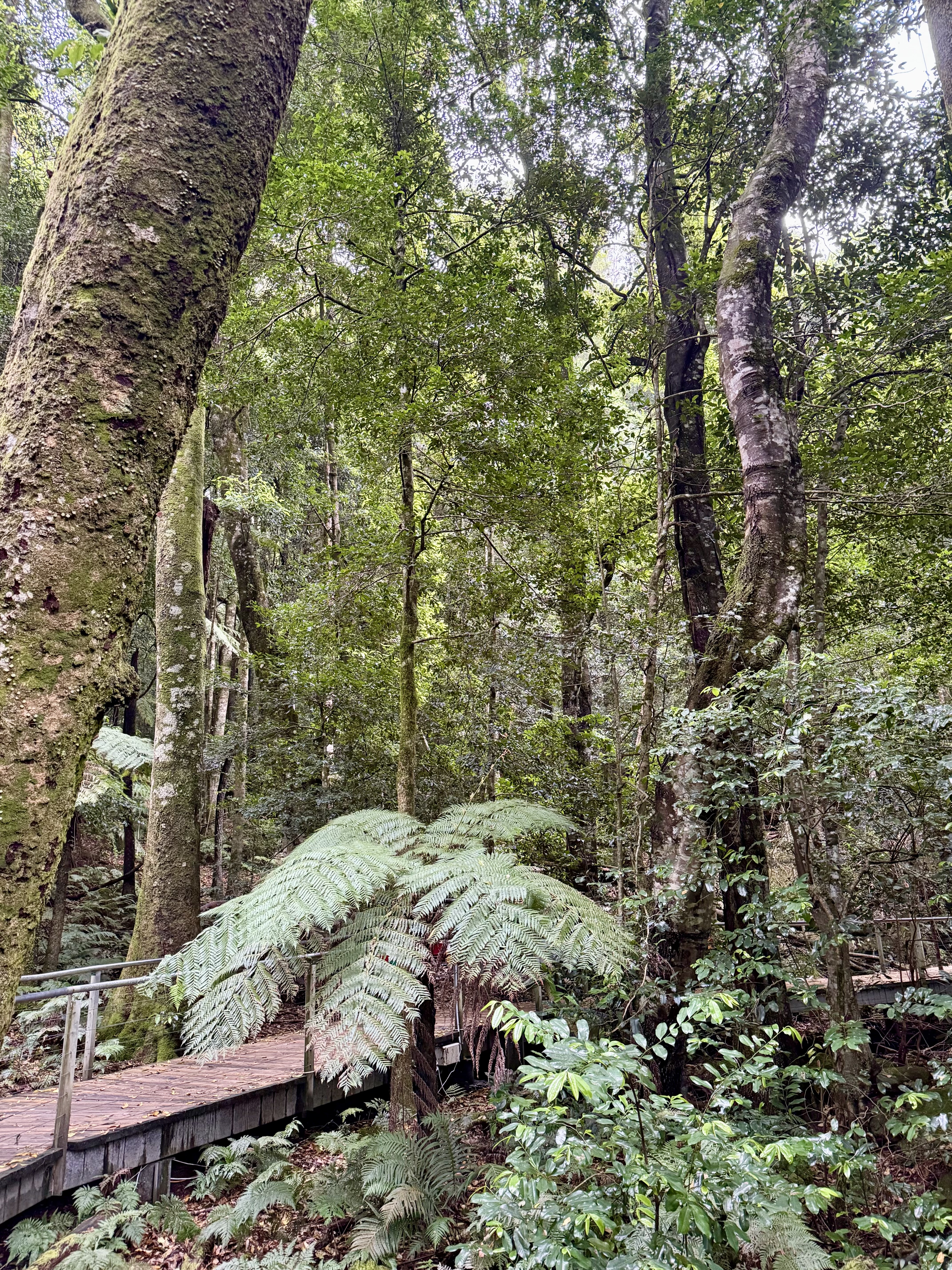
There is an ancient rainforest at the bottom of a gully in Katoomba. To reach the forest floor of the Jamison Valley, I take a cable car that drops 200 metres at a 36 degree incline to attend a special session of the 2025 Blue Mountains Writers’ Festival. As we descend, the vertical sandstone cliff face looks almost close enough to touch. Three hundred million years ago, an expansive sea spread over this area. Over millennia, sediment and sand formed into hardened layers which we now recognise as sandstone. Each layer reveals its geological history through erosion, sedimentation or uplift. This cable car is my TARDIS. It is the closest I come to time travel.

The sandstone is ragged. Tiny ledges mark the layers, and wherever a square centimetre can be found, life takes root tenaciously. Small trees curl their roots around rock and somehow find enough nutrients to stay alive. I am in awe of the miracle of life I am privileged to witness.

My TARDIS docks next to a wooden boardwalk that winds 2.4 kilometres beneath a rainforest canopy. This area is a privately operated tourist attraction that has managed, for the most part, to keep the rainforest pristine. Some added features feel kitsch, like scattered ‘dinosaur’ bones for children, but they are confined to one side of the boardwalk, so I simply look the other way.

I am enchanted by the ancient trees, vines and ferns that surround me. Some ferns are as tall as trees and about two hundred years old. Smaller ferns, unfurling their fronds, show tight spiral shaped leaves, an example of the Fibonacci sequence in nature. Mesmerised, I regard a delicate formation that follows this complex logarithmic pattern. I am not a mathematician, but I have a deep respect for how mathematics explains so much of the natural world. We seek patterns.

After a fifteen minute walk, I reach the Rainforest Room, a yurt like structure without walls that accommodates about one hundred and fifty people. Seats begin to fill. We are here at 7.45 on a Sunday morning to hear three writers talk about their books. Nature is the common element in their writing, though not all are happy to be labelled nature writers. I have come to hear Inga Simpson, whose work I admire. I don’t know the other two writers, Jessica White and Jane Rawson, but I know I will enjoy the session.

We sit in silence, looking out onto the rainforest. I am struck by the Coachwood trees, which have paintbrush wide white splotches. It looks as if someone has wiped their brushes on the trunks. Later I discover these marks are caused by lichen. They look stunning.

I recognise Sassafras, Turpentine and the Blue Mountain Gum among the trees. Then my ear attunes to songbirds tentatively striking up a melody. Within a minute, they are drowned out by the raucous sound of Sulphur Crested Cockatoos. I can’t help but smile at these juvenile delinquents who arrive with their boom boxes, ready to crash any party. Good luck hearing a song underneath all that squawking.

The event starts and I listen to Jane Rawson speak about her latest book Human/Nature, described as a lyrical work of creative nonfiction. I am drawn to her honesty and humour as she talks about establishing a life in the Huon Valley. Inga Simpson speaks about her latest book The Thinning, which I read some time ago. While it wasn’t my favourite of her works, it is interesting to listen to its reception within this group of readers. Jessica White talks about Silence Is My Habitat, her book of ecobiological essays. I am drawn to the title. Silence has always been my friend. I occasionally play music, which I love, but silence is what I long for most. I am listening to a kindred spirit, but her silence has been imposed by deafness, which she acquired at the age of four after pneumococcal meningitis. Her deafness has rendered the world silent, but it has given her the superpower of acute observation, especially of the natural world.

I love listening to these women in conversation. My soul is nourished by their words, their deep respect for one another and their reverence for nature. A tiny, oft ignored voice gently reminds me of a suppressed longing. I want to be a writer. First heard when I was six years old, I have held onto this dream tenaciously, much like the stunted trees clinging to the sandstone ledges. Their roots wrap around the rock the way my fingers furl over the keyboard, finding a letter here then there, forming words and sentences. It may not be much, but I hold on as if my life depended on it.
Red Plaits, Freckles and a Dash of Mischief

The first Children’s book week took place in Australia in 1945. Every year since then, children participated in book week parades, dressing up as their favourite character from a book. This year is especially significant as we celebrate 80 years of encouraging children to immerse themselves in books and find novel ways (pun intended) to engage with reading.

The Children’s Book Council of Australia confers awards to authors and illustrators of outstanding children’s books published in the past year. The ‘long list’ or notable books is announced around February, followed by the ‘short list’ from which the finalists are selected. The books that receive prizes often become best loved classics with children.

Book week parades started out with simple home-made costumes and a lot of imagination. Today, parents can spend a small fortune on costumes, wigs and accoutrements. My favourites, however, remain the simple imaginative costumes. If I could have given a prize this year, it would have gone to a little boy at my school who wore rainbow stockings, a long t-shirt, a hand-sewn felt snake’s head and a crocheted blanket made of colourful granny squares. He was the rainbow serpent! Second prize would have been awarded to the girl in leotards with underpants over it. She was ‘Captain Underpants!’

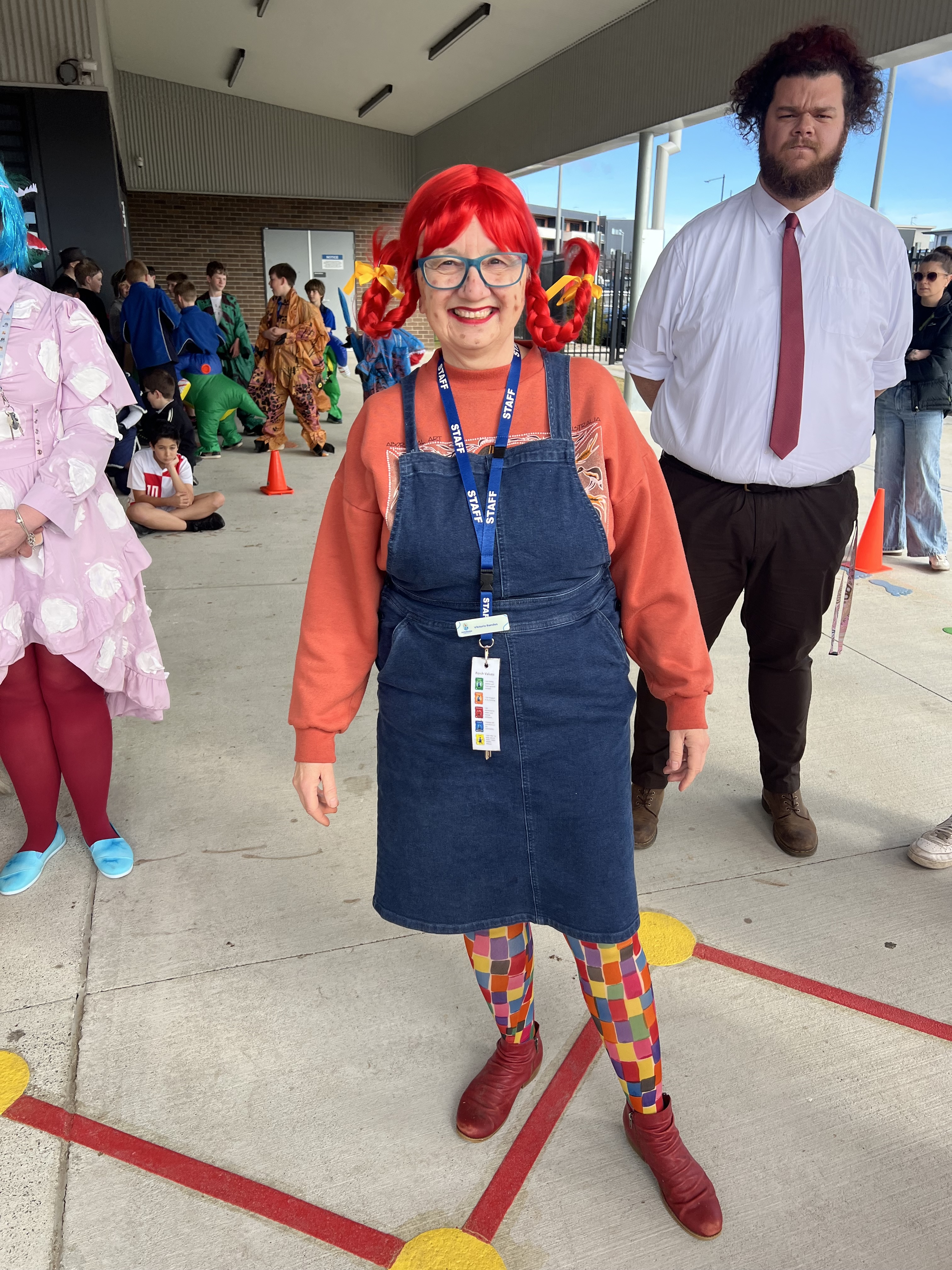
Teachers almost always join in the fun with costumes of their own. My go to is Pippi Longstocking because she was my childhood favourite character. This year, the book turned 81, a year older than the CBCA celebrations. I loved and envied Pippi. She lived on her own in Villekulla cottage in Sweden with her monkey and horse as company. Her father was a pirate and there was little mention of her mother. She was superhumanly strong, lived by her own rules and adults had no power over her, no matter how hard they tried. Recently, I was amused to read that she has been pathologised- it is now thought that she had ADHD and oppositional defiance disorder traits!  I couldn’t help but laugh at this. Are we about to prescribe her Ritalin?

There definitely is a bit of Pippi in my genes. I think that’s the genius of Astrid Lindgren, her creator. Every child has a little Pippi in them wanting to come out. Some manage it better than others. Of course, our job as adults is to keep the lid on the shenanigans and keep children from jumping off roof tops or attempting other dangerous things. Still, the yearning is always there to break free.

So once again, I embraced my inner Pippi and drove to school with my red plaits, multicoloured stockings and painted on freckles. The only downside was that the teachers recognised who I was but none of the children had ever heard of the one and only Pippilotta Delicatessa Windowshade Mackrelmint Ephraim’s Daughter Longstocking.  

Dogs and Laughter: How Zusak Stole the Show

This weekend, I am attending the Canberra Writers’ Festival. It is my first time. I have been really impressed with the line-up of speakers and it was hard to choose the few I would attend. There were the ones whose books I have read and enjoyed and a couple of new ones that I thought looked interesting.

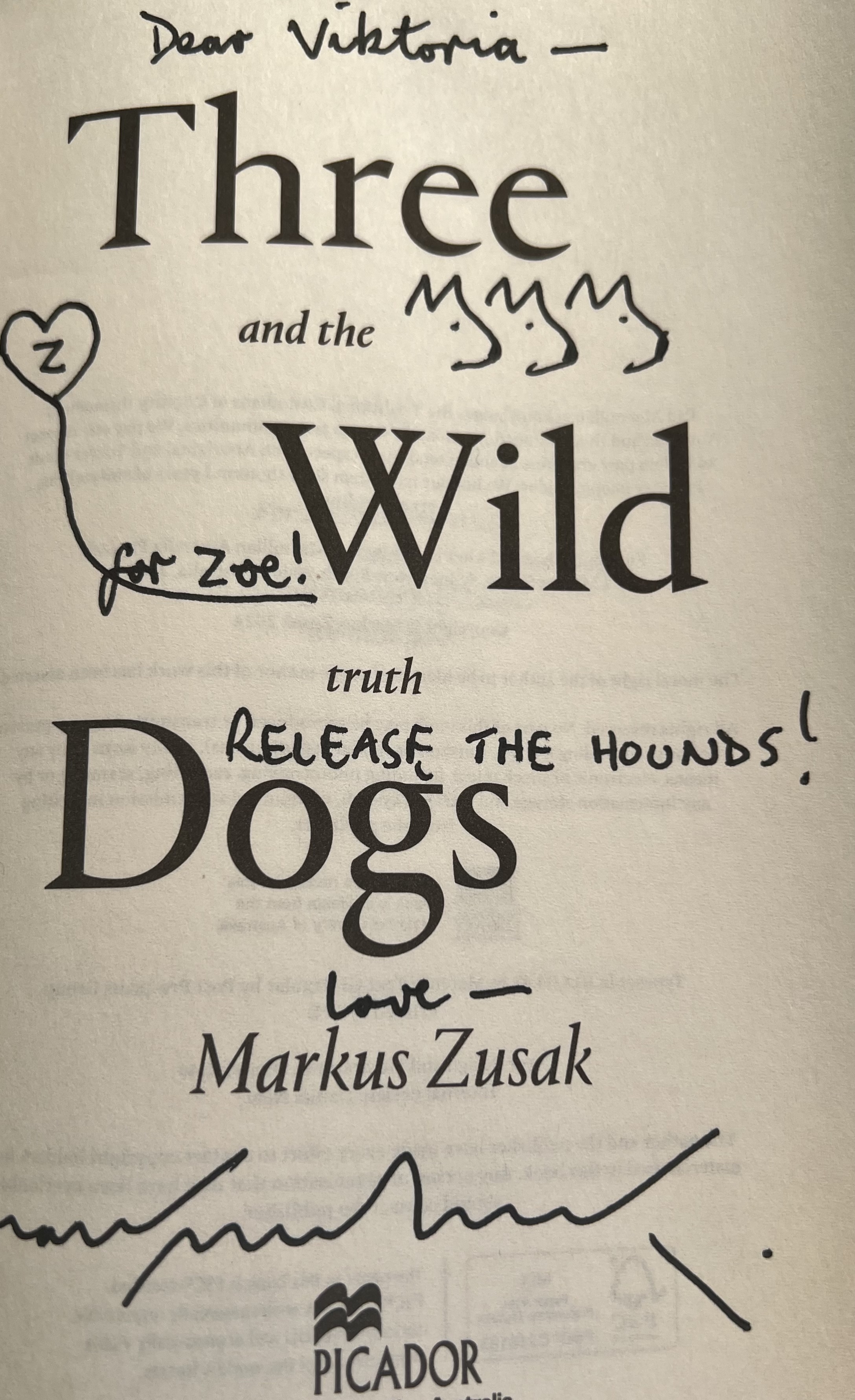
Of the big names on the list, I chose to see Markus Zusak. I have just finished reading Three Wild Dogs and the Truth, which was a present from a dear friend. As a dog lover, whose own memoir may one day appear with the title Blue Dog Girl, I couldn’t pass up the chance to hear him speak.

The book most people associate with Zusak is The Book Thief. Three Wild Dogs have none of the qualities of that book. It is a raw, unflinching, violent, tragic and oozing with love for these three crazy, havoc-wreaking mongrels. Zusak doesn’t portray himself as a perfect dog owner, far from it. I can imagine some dog owners recoiling in horror over some things he has done. But he is truthful, full of humour and passionately devoted to these dogs.

I wasn’t sure what to expect, but I wanted to get a glimpse into this man who could produce two books that couldn’t be more different. From experience, meeting an author whose work you adore can be a hit and miss affair. Once, I signed up for a six-week writing class with an author I idolised, only to find him pompous and condescending. I was in for a treat with Zusak.

The talk was held in the foyer of the Australian National Museum. By the time I arrived, hundreds of people had taken their seats. It was clear from the from the first question on that he was going to go off script and tell hilarious stories, rather than purposefully answer questions. He had such a wonderful connection with the audience that by the time he finished, we all felt that he was our friend. I have never seen an author work a crowd the way he did. He was clearly enjoying himself on that stage.

I lined up to get my book signed. When I reached him, he easily engaged in conversation by asking about my dog. He then told me a little anecdote about Standard Poodles while drawing three dog faces on the title page. Markus was charming and generous with his time.

It is rare to have an experience like this at a Writers Festival. It made readers feel part of a valued relationship. He honoured us as much as we honoured him. I’ll cherish this evening, as a testament to the magic that can happen when writers and readers come together.

Bibliophile

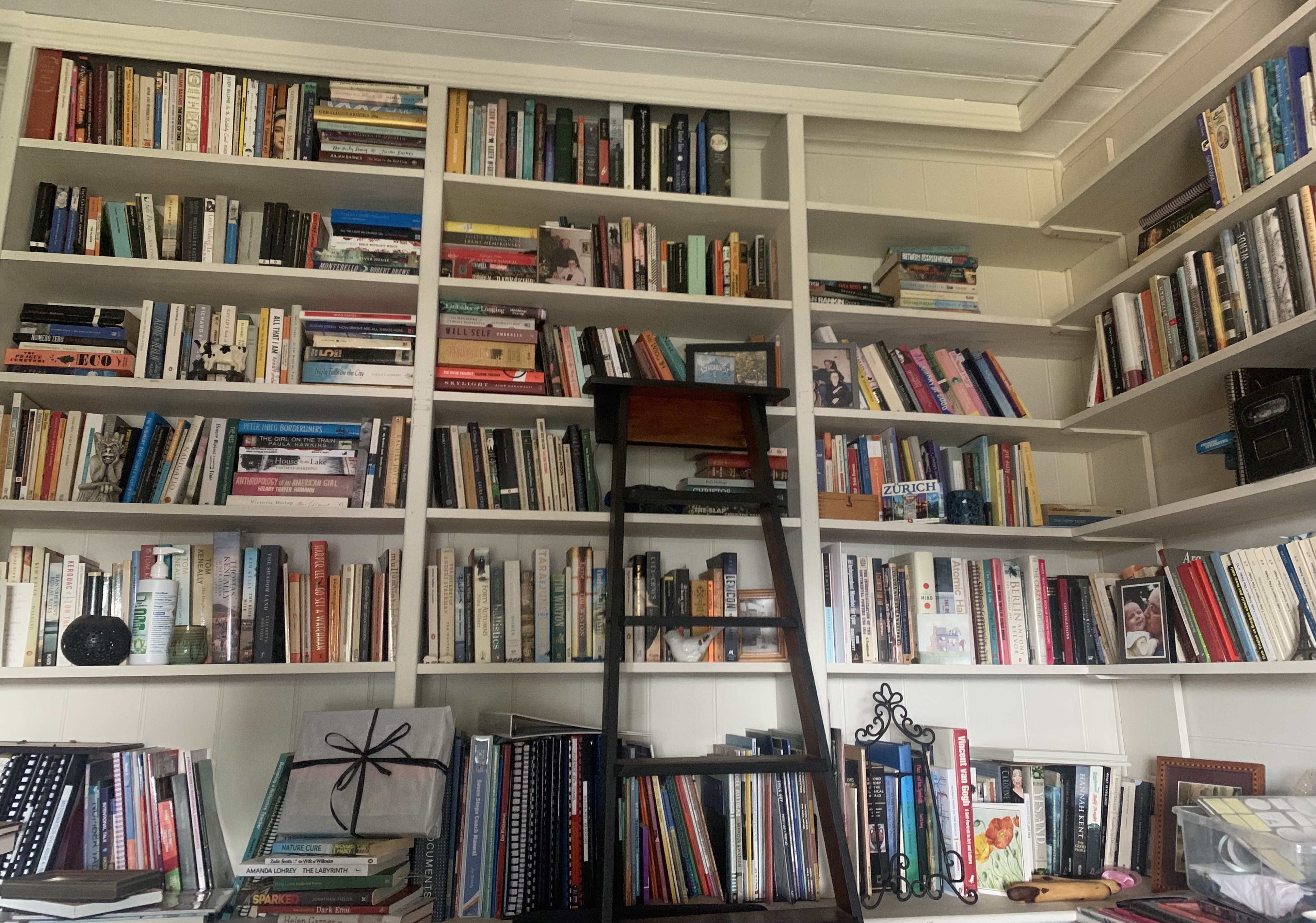
I am a self-confessed bookhound. I cannot walk past a bookshop without browsing and buying at least one book, even when I have no intention of a purchase. Sometimes I enter a store with a particular title in mind, but most of the time a book will call out and attract my attention before my rational mind can produce a scintilla of common sense. It doesn’t matter that I have thousands of unread books on my shelves, another one is added on a whim.

The last time I moved house, I counted well over 50 boxes of books. I packed them with a close friend at my side. I was glad to have her there, not only for the purposes of packing, but also to stop me from looking at each one to lovingly remember how it came into my possession. Had I attempted the exercise on my own, it would have taken days to complete the task.

This time, I know I will not have enough shelves at my new place to house my collection. Not only that, but there won’t be the wall space either. I am already investigating rotating shelves and other innovative designs. Regardless, I will have to downsize.

Today I set myself a target of reducing my collection by a mere 50 books. The first ten weren’t hard, but as I kept going, the task became increasingly difficult.

“But I haven’t read this yet!”

“I may not have enjoyed it, but it is a classic.”

“What if I want to revisit this passage and find the book is out of print?”

I listened to all the irrational arguments and kept adding books to the out-pile. It felt good to reach my target, even though I knew I would have to be more rigorous in my next cull.

Luckily for me, there is a street library down the road and its shelves were looking decidedly sparse. My contribution of 50 paperbacks has now filled all those empty spaces. I know my books will provide hours of pleasure to the readers of Millthorpe.

But will I resist the call next time I walk past a bookshop?