Jonquils in July

I make a last-minute dash to the markets for some Batlow apples. Most stallholders are busy sweeping the concrete, packing their unsold wares onto trucks. Everyone is looking forward to getting home and for some, there is a long drive ahead. They have been here since five in the morning, setting up and waiting for the first customers to arrive. I hastily look for my favourite stall and I’m lucky, the girl selling apples is still serving customers.

I take a walk around what’s left of the markets, buy some mushrooms and am given an extra bag of woodland browns to take home. These late saunters on a Saturday morning, when the place empties, are my idea of bliss and there’s always a bargain to be had.

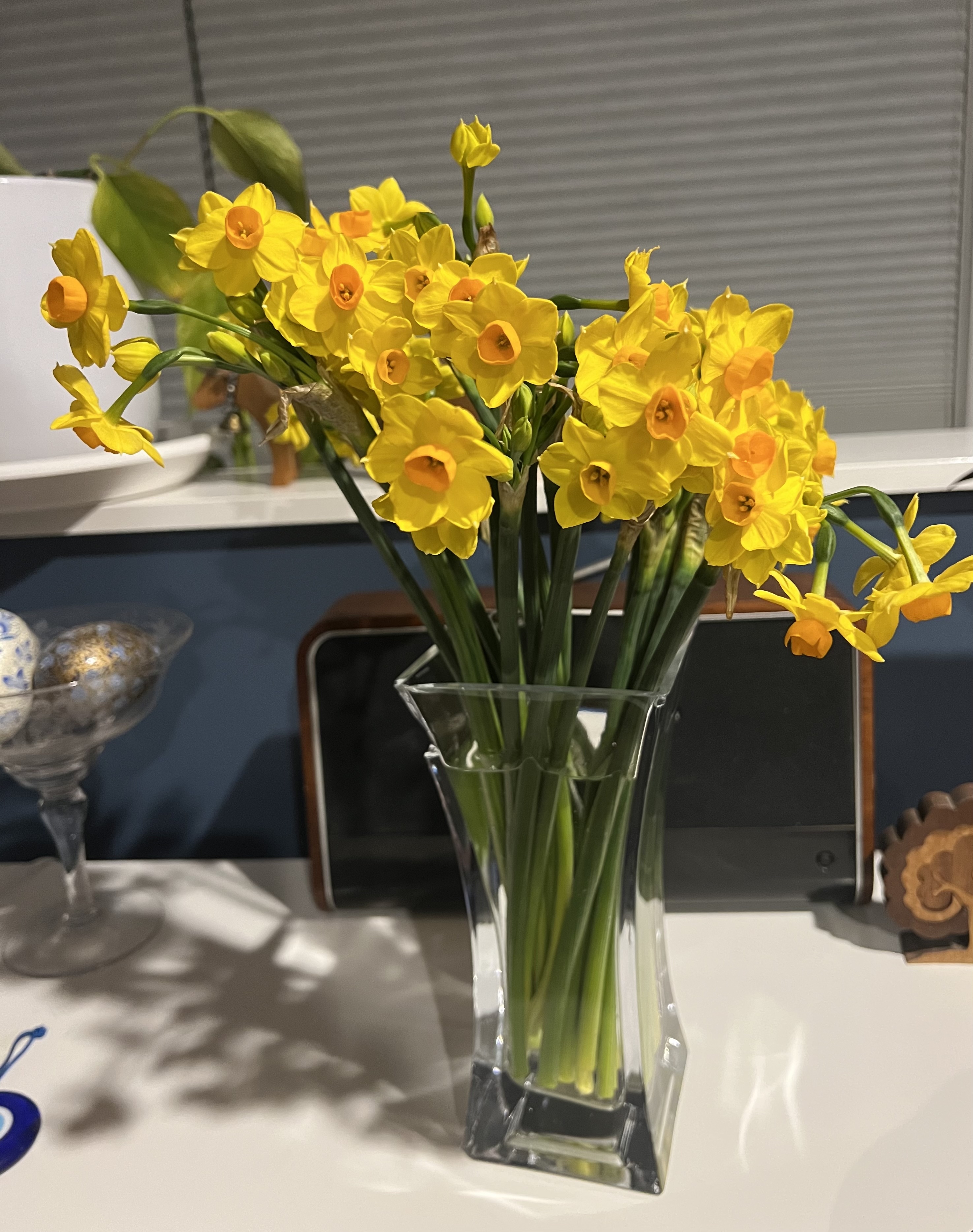
As I come around the last isle, bright yellow jonquils catch my eye. It is mid-winter, yet here they are, heralding spring. Massed in large plastic buckets, their sweet fragrance borders on pungent. I can’t resist. Two bunches are rolled into tissue paper while I hand over a ten dollar note.

Flowers always brighten my day. I’m drawn to their beauty and fragrance. It turns out there is a reason for this feeling. Flowers can spark the release of dopamine and serotonin in our brain by their bright colours and pleasant smell. There are studies that show that having flowers in the house can lower cortisol levels. They create a relaxed and aesthetically pleasing environment which makes us feel more relaxed. 

Before I knew any of these benefits, I instinctively bought flowers when I felt downhearted. Back in 1987, I spent a rather miserable winter in Berlin. The cloud cover arrived in October and never left for six months. The short days felt like eternal dawn or dusk; it was impossible to tell which. It was during these months that I began the habit of buying flowers every Friday afternoon as I returned from university. The florist around the corner wasn’t cheap but made the most exquisite flower arrangements. They reminded me of the Japanese art of Ikebana. The designs were always minimalist, and they took my breath away. I had very little money left for luxuries, but my Friday ritual never felt like an extravagance.

This memory came flooding back as I purchased my jonquils. While I don’t possess the patience to artistically place flowers in a vase, it doesn’t much matter. A dull winter’s day has been transformed into delight by their smiling yellow faces. And for the next week, there will be guaranteed sunshine every morning.

Wings of Desire 1987

First released in 1987, Wim Wenders’ film, Wings of Desire is a love poem to a city which at the time was riven in two. Viewing it now, feels like watching archival footage of a Berlin I knew back then but which no longer exists. It also features real archival footage taken just after the war, when ‘Trümmerfrauen’ or ‘rubble women’ cleared streets, cleaned bricks, and helped reconstruct the bombed city.

The scenes depict many of the iconic places in the then West Berlin. The angels in the film sit atop the Victory Column on a golden statue of an angel. It is from there that they observe the city beneath them. They also congregate in the State Library, a stunning modernist building which reminds us of an ocean liner. There are images of Anhalter Bahnhof (railway terminus) in ruins, as well as Potsdamer Platz, the centre prewar Berlin, which until unification, was a deserted and muddy no man’s land butting up against the Wall. In addition, we see local nightclubs of the 1980’s and hear the post-punk, emotionally intense music of Nick Cave and the Bad Seeds.

Most of the movie was shot in black and white which gives the film a dreamlike quality echoing the story of the angels who watch over preoccupied people as they go about their lives. Adults are unable to see the angels, but children can, and so we lament the loss of childlike wonder and children’s openness to possibilities beyond logical understanding.

The angels are poetic creatures who bear witness to humanity but are unable to participate in physical experience. This is amplified by the script, which was cowritten with Peter Handke, a well-known, if controversial, Austrian poet. These angels can only assume the meaning of human experience as they document their words, but they cannot feel them. When one of the angels, Damiel (Bruno Ganz) falls in love with a trapeze artist, he decides to trade his immortality to feel something real. Through his own actions, the fallen angel invites us to be amazed at the singularity of our own existence and be in awe of feeling the full extent of our humanity. After all, he has chosen to eventually die for the privilege to become fully human. At the end of the film, Damiel states, ‘I know what no angel knows’ and we are to understand that this knowledge, with all its complexities, ought to matter most.