From Asters to Astoria

Asters are star shaped flowers with tube like petals that come in a variety of dazzling colours. I was given a bright pink bunch a couple of weeks ago and I delighted in their cheery presence, especially in this bleak and wintery weather. Sadly, their stems soon began to droop, but the flowers retained their sunny disposition. That’s when I decided to cut off their stems and float the flowers in a bowl of water. They have continued to bring joy for two weeks and still look fresh.

Their flower heads remind me of daisies, so I wondered whether they were related. It turns out they are. Like a daisy, the disk florets in the centre of the flower are bright yellow, which is why we think of them as being sunny. Asters bloom late autumn and provide an important food source for bees and when there is little nectar to be found. My pink asters are native to Australia but as a species, there are more than 250 varieties in the world.

While researching the humble aster, I learnt that the Hungarian revolution of October 1918 was also called the ‘Aster Revolution’. The name was derived from soldiers removing the Austro-Hungarian symbols from their caps and replacing these with asters.

The ‘headquarters’ for the revolutionaries was at the Astoria Hotel in Pest, on the eastern side of the Danube of the dual city of Budapest. This stunning seven storey hotel, featuring fin-de-siècle architecture is still one of the best loved hotels in the heart of the city. However, at the time of the revolution, it was only four years old and without a doubt one of the most elegant places in Budapest. It was from one of its balconies that the leader of the First Hungarian People’s Republic, Mihály Károlyi, announced the end of the Hapsburg empire and the foundation of the republic to jubilant supporters below. This was the only revolution that Hungarians have ever won.

Reading about the significance of the Astoria took me back to the 1980s, when during a particularly cold winter, I arrived in Budapest to find the transport in the city had ground to a halt. Metre high snow lay frozen on the side of roads; there were abandoned cars and trams everywhere, and the occasional taxi or bus that was still operational wouldn’t stop.

I stood at a bus stop with dozens of commuters needing to get out of the cold. They were locals, while I was a tourist with a 30kg backpack that I could barely carry. When a bus finally stopped, they roughly pushed past me to get on board. I slipped on the ice, fell on my back and was transformed into a giant beetle, like Gregor Samsa in Kafka’s Metamorphosis. By now the bus had left, and I lay on the ground, legs in the air, crying, asking for my father’s intercession to get me out of this mess. After all, I was in his hometown, chasing ghosts.

Getting up seemed to take an eternity. I was cold, miserable and lonely. My only contact was my aunt who lived in a Soviet style high-rise in Buda. It was miles away. That’s when I spotted the Hotel Astoria on the other side of the road. Surely, someone could help me there.

I trudged across the road, entered the building and was greeted by a friendly face. I wiped away my tears. The woman behind the counter took pity on me and called my aunt who immediately took charge of the situation. All I had to do was to wait outside until she bribed a taxi driver to drive back into the city to collect me. Within half an hour the taxi arrived, and I arrived safely at my aunt’s place fifteen minutes later.

The weather improved the next day. I took the bus into town, found a florist and bought a pot of chrysanthemums. These I delivered to my saviour at the Astoria. At the time I had no idea of the hotel’s history. Nor would I have known that chrysanthemums are closely related to asters.  

The Quiet Cost of Disconnection

A few weeks back, I drove 330 km to attend friend’s birthday lunch. I hadn’t seen her for about six months and was delighted to surprise her on the day. I also caught up with a couple of friends I hadn’t seen for years on that weekend. Since then, my life has revolved around work, and I have barely seen anyone. Usually, I don’t mind at all, I’m a bit of a loner and rarely feel lonely. Lately though, there’s been a niggle gnawing within me, a slight feeling of dissatisfaction, which I’m finding disconcerting.

I talk to lots of people during the day, so it isn’t a lack of contact. However, most of my interactions are transactional and I don’t feel connected in any meaningful way. Today, it occurred to me that I know very little about the private lives of my colleagues and they know very little about me. Whilst I don’t expect to have all my social needs met at work, it is where I spend a large chunk of my time.

We always think about the quality of our diet and exercise as the main risk factors for our health. Recently, studies have identified another risk factor, which could be equally as important to longevity and health – the importance of social relations. This may be because the support that friends offer can lower our stress hormones, it can even help regulate insulin and help with our gut function. It reminds me of studies that have been done on positive coronary effects of purring cats on laps. We all need companionship and physical touch.

What matters most is the quality of our interactions. Happy marriages can help prolong life; unhappy ones can lead to poor health outcomes. While not causal, there’s a definite a link. This also applies to friendships. The stronger and more harmonious our friendships, the happier and healthier we tend to be.

But it isn’t just the social interaction that’s been lacking from my life. I haven’t done much of the two things that keep me centred. The first is walking and the second is writing. Before work, I only fit in 15 to 20 minutes of a walk and, now that winter has arrived, I mostly get home after dark. I miss my hour-long stroll after work and so does the dog. No such excuses for my lack of writing.

After a few weeks of missing the online London renegade writers’ group, I finally logged on today. We wrote, we chatted, we laughed and cheered each other on. Such a simple step and I already feel better. Two hours later, I’m buoyed, smiling, and content with my lot once again. And here’s the blog post to show for it.

Music in the Margins

Dickson is an inner-north suburb of Canberra, well known for Asian restaurants and specialty grocers. The shopping precinct is also known for people sleeping rough, alcohol and drug problems as well as boarded up shop fronts. Coles and Woolworths are two retail giants competing against each other, but small shops struggle to make ends meet. It is a mixed bag.

In the centre of the shopping precinct is a plaza with a public library servicing the surrounding areas. At night, the covered entrance way provides shelter for the homeless. Vinnies does a night patrol in the area, providing food, jackets, sleeping bags, and offering non-judgmental social interaction. There are many who would like to clear out the poor and ‘improve’ the suburb. They speak of a clean-up as if it were a matter of getting some mops and brooms, sweeping away unwanted people.

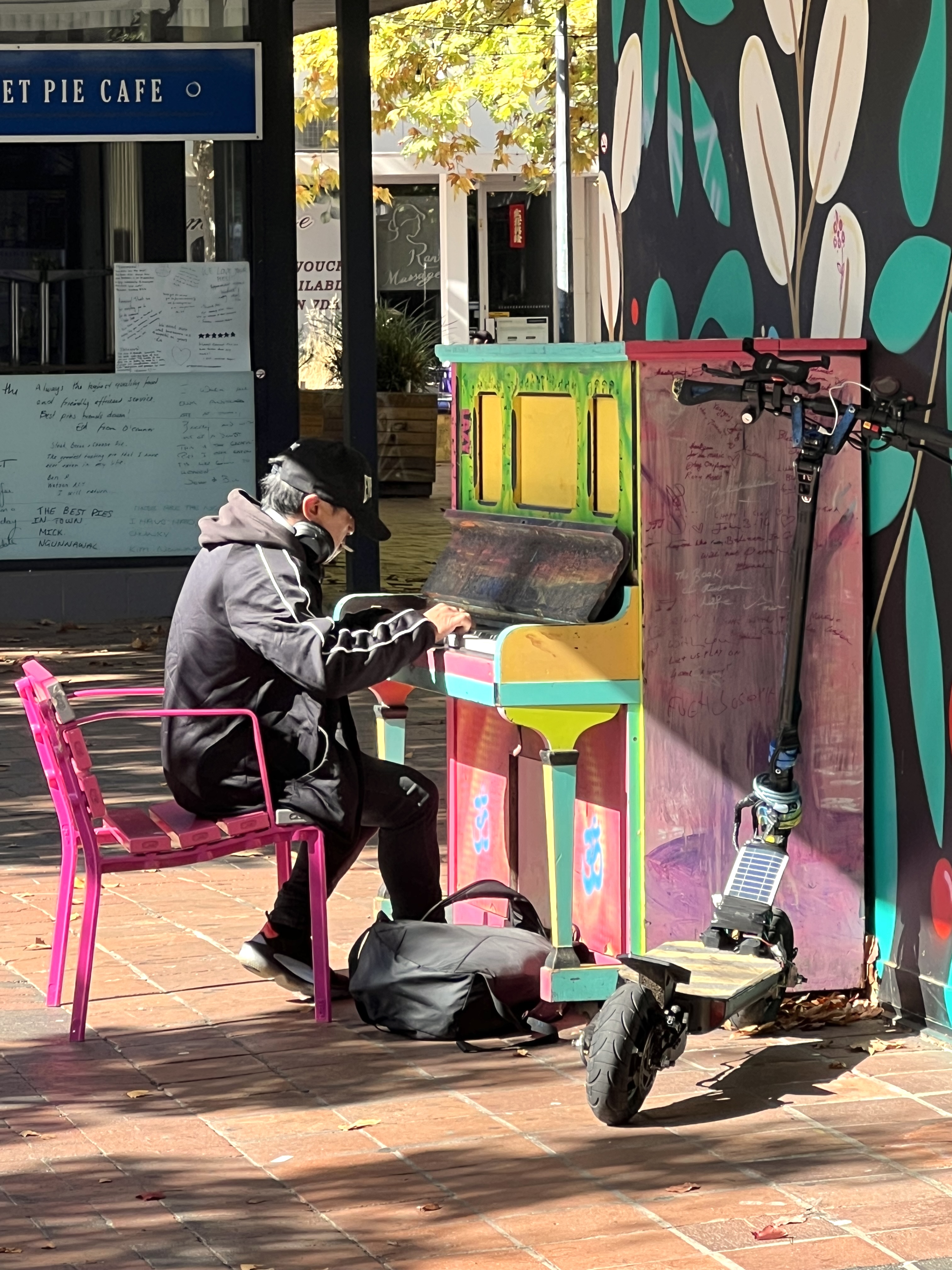
Yes, I can attest to the problems in the area, but I also see a richness and community spirit. While waiting for a prescription to be filled, I sat on a bench opposite a muralled wall where an upright piano stands under the eaves of a building. It is old and weather-beaten, but its keys are intact. Playable, even if most likely out of tune.

A man in his 40s, wearing a black backpack, sat down, rolled a cigarette and began to play. The music that flowed from his hands was enchanting. As it was a public holiday, there were very few people about. Yet those who were about to walk past, stopped, took videos or simply listened before continuing on their way. I stood up and commented on the soaring melodies to a woman with a pram. Her toddler was transfixed. Soon, someone else joined us and we were strangers no more. The pianist had brought us together to enjoy the moment, doing what he loved best, awakening within us the power of music.

At the end of a song, I approached to say thank you. He was rather bashful, telling me he was self-taught and had only been playing for two years. He could only play by ear, and as he hadn’t worked out how to use the black keys, he could only play in C major or A minor, the two scales that can be played solely on the white keys. He probably wasn’t aware of that. Nevertheless, he sounded accomplished, and his repertoire was extensive.

This man, rich in spirit but poor, had transformed my trip to the chemist into deep appreciation for the gifts that people can offer each other. He touched the hearts of everyone who walked past and allowed people to connect who would otherwise not strike up a conversation. All because someone had leaned an old piano against a wall in the mall.

I have seen the architect’s impression of a precinct, a master plan of hundreds of new apartments and clean, green public spaces. The language of conservation (zero waste) and Connecting with Country (green corridors) are present, appealing to our middle-class conscience.  No doubt the suburb will enjoy a process of gentrification and it will be prices rather than the broom that will eventually sweep the suburb clean of people like the piano man.

Smitten and Smote: Biblical Ponderings with Shampoo

Does anyone else think too much in the shower? I lather my hair and my mind wanders down odd side tracks and into cul-de-sacs. A quick rinse is never enough. Even on busy mornings, I stretch time to follow my thoughts.

This morning, my mind began to wonder about the American pronunciation of the word ‘herb’, which is ‘erb. Was this an older form of the way we say it, fossilised from when America was colonised? Most likely, I thought. Does this mean that they would say an herb rather than a herb? Again, I answered in the affirmative. If we say an hour, it makes sense that they would say an herb. After all, we sometimes see a history and an history in printed form.

How did I come to mull over this word? I have been hearing it a lot while listening to both podcasts and lately, when listening to the Old Testament as an audiobook. I don’t know how I came to buy an American version rather than the one narrated by David Suchet of Poirot fame. However, I am used to the American woman’s voice by now and will have the pleasure of listening to her for the next 65 hours.

I decided to listen to the Old Testament because I have only ever known fragments of it. The classic stories like Adam and Eve, Noah’s Ark, Moses and the Exodus, the Ten Commandments and Lot’s wife turning to salt were about the extent of my knowledge. And some Psalms of course. I wanted to go deeper to understand more of the foundation of the three Abrahamic religions, namely Judaism, Christianity and Islam. Of these three, Islam split off quite early, following the lineage of Ishmael, son of Abraham, while Judaism from whence Christianity originated, followed the lineage of Isaac, Abraham’s other son. However, in Islam, Isaac, Moses and Jesus are still acknowledged as prophets.

I was thinking about these things and the language used in the translation of the Old Testament from Hebrew. There’s much begetting, smiting and going in under women. Smite, smitten, smote. I have only been smitten in the positive sense. But I guess that too has the implication of being inflicted a heavy blow, like being hit with Cupid’s arrow.

There are a multitude of abominations and even more circumcisions. King Saul demanded that David bring 100 foreskins of Philistines as a price for Michal, his daughter. How did he carry them back, I wondered. In a bag or perhaps pierced on a stick? I did squirm a little at that thought.  I’m only part way through and I’m already desensitised to the brutal killings, wiping out of whole towns including women, children and ‘sucklings’.

Words have always fascinated me. To tarry for example. In the bible it means to wait or to linger for longer than intended. It has a sense of being delayed by someone or something. Nowadays when we tarry, we are slow in action or in departure, but it is rarely used in everyday speech. I can only imagine it used satirically as in, ‘tarry not, young wench!’

I have tarried too long under the shower. Time to rinse off the ‘erbal conditioner and seize the day, lest I be smote for the abomination of wasting precious resources of this dry country.

Missing the Date, Catching the Moment

My mind is scattered. The other day, I drove to Sydney for an appointment on the wrong day. That’s a six hour round trip I could have avoided. I have a bad habit of skimming emails and assuming details. It has got me into trouble before. But I decided against self-flagellation and make the most of a day in the city.

Although there were many options to get into town, I chose to take the light rail from Dulwich Hill. Not the quickest way but I wanted to see what it was like. Having grown up with trams in Melbourne, I have always had a soft spot for them. I much prefer them to trains and buses. I like that I can see the driver, that they are smaller and more intimate than trains, and travel at a slower speed. There’s a human scale to them, almost a little quaint now, yet efficient at moving people from one suburb to the next.

The track goes along a narrow goods train corridor which hasn’t been used for years. For most of the journey, there’s vegetation on both sides of the track, making it a pleasant ride through a green corridor. On this particular day, the leaves of the trees we were dappled in sunlight, giving the effect of passing through an arbour. I was captivated by the changing light and shadow on the various shades of green. Yet when I looked at my fellow passengers, hardly anyone noticed. Familiarity breeds contempt.

As I began to observe the commuters, I noticed two women reading a book, maybe three people sitting quietly and the rest were either scrolling on their phones or wearing earbuds. In the past, commuters may have been reading a newspaper or book, knitting or striking up a conversation with someone nearby. People would have made eye contact with each other or even given a slight nod. I remembered a TV show aired on SBS called ‘Going Home’. We used to watch it regularly after the news. Filmed in 2000-2001, it followed the lives of a fictional group of commuters on their homeward train journey. The characters shared aspects of their lives with one another, noticed if someone was missing and discussed current affairs. This series could not be made now. Who would watch a group of commuters staring at their phones for 20 minutes a day?

Once more, I focused my gaze outwards as we passed Jubilee Park, Wentworth Park and then made our way into the city. It had been a pleasant trip, musing about the nature of change and the joys of travelling along a green corridor. Did it matter that I arrived on the wrong day? Not really. I spent the day doing a bit of shopping and surprised a dear friend, turning up unannounced. A perfect, unscripted day.

A School Life, A Full Life

We are approaching the end of the term. I can tell. My floors aren’t vacuumed, and the bed is overdue for clean sheets. Lots of little jobs are falling by the wayside. I tell myself that I will get to them next week when I finally have some time.

Today, I arrived home after 7pm and my number one priority was feeding the animals and then cooking my own meal. My poor dog didn’t even get out for her customary walk tonight. I’ve snuggled into my dressing gown and I have no desire to brave the elements.

To be fair, not all of it has to do with working at a busy school. Last week, I had several engagements that left me with little time at home. The first was a delightful dinner on Friday night where good company, a bottle of bubbly and the funniest conversations made me laugh so hard that I had to hold my sides. Both food, and company were outstanding.

Saturday, I drove back to Millthorpe where I used to live to catch up with dear friends and get a haircut. It is a three hour drive one way. That’s quite some distance to travel for a hairdresser. While I like the Salon and the quality of the cut, my main reason for not swapping over to someone else is that I enjoy catching up with friends. As we move away, it is harder and harder to keep in contact. ‘We must keep in touch,’ is a common refrain but life gets busy and after a short time the connections are weakened until they are completely severed. I didn’t want that to happen.

The downside of being away for a weekend is that the washing, cleaning and weekly preparation doesn’t get done. I went headlong into this week without much of a plan. I’m feeling the effects of it now. My Monday has been taken up with reactive tasks and the important items on my to-do list never got a look in. When I packed up in the afternoon, I discarded a full cup of tea I had made myself at midday. I hadn’t been near my desk since then.

Am I frustrated? Maybe just a little. But life is more than just the tasks we feel we have to complete. I’m glad that I went to the dinner with good friends on Friday, and then off to see more lovely friends on the weekend. The washing can wait. I still have plenty to wear. While I may be tired, I am also incredibly grateful for my full life in loving company.

I’m grateful for friends – old and new, grateful for shared laughter, and for the chance to be of service, even on the messiest of Mondays. The to-do list can wait. For now, my dressing gown, a warm meal, and a quiet moment are exactly what I need.

Music, Memory and Manners

On the spur of the moment, I bought myself a ticket the Freiburg Baroque Orchestra. I have been in Canberra for just over a year and so far, have attended four concerts. Having access to more cultural events was one of my reasons for moving to the city. So why wasn’t I getting out more?

I am happy with my own company, but when it comes to going out, I still subscribe to the outdated notion that I need to go with a friend. What a ridiculous idea! Sure, it would be nice to talk about the concert, but during the recital we’d be sitting next to each other in silence. Would I enjoy the music more because I know the person sitting next to me? Of course not! So, I decided to drop this limiting belief and go anyway.

The concert consisted of a Bach symphony in G minor followed by the Mozart piano concerto ‘Jeunehomme’, with Kristian Bezuidenhout on Fortepiano. In Baroque music, I’m much more used to the sound of a Harpsichord, so it was interesting to listen to the Fortepiano which is more like the piano we know today but with a much softer, less sustained tone. Bezuidenhout’s playing was magical. Unfortunately, the man in front of me was tall and bobbed his head this way and that, making it hard for me to watch the action on stage. I felt sorry for the people behind me who must have watched his head go one way, mine the other, to get a glimpse.

There were two children behind me with their mother. I am guessing they were between 8 and 11 years old. Neither could wait for the interval to get some food. Poor kids! Afterwards, the boy, bored with the event, was hoping the concert would end after each piece. His sister was much quieter. It reminded me of taking my daughter to concerts when she was little, but she was much more engaged. Maybe that was because we started taking her from about the age of three and she was a compliant child. At that age, she sat on one of our laps, listened to the music for the first half and fell asleep after intermission. I wasn’t concerned about the children behind me – they only spoke between the pieces when people were clapping.

After the interval, the orchestra played the Violin Concerto No.5 in A major, ‘Turkish’. Gottfried von der Goltz was truly mesmerising on violin. I thought about my daughter, who also learned to play violin. I would have loved her to become a violinist but while she had the aptitude, she didn’t have the application. She pursued it for a couple of years at university but never quite seriously. At the time, I was a little disappointed. Now, I see that her interests have evolved and what she does pursue, she does with passion and full-hearted commitment. All these thoughts went through my mind as I listened. I also considered how lucky I am to have my daughter nearby. Had she become a violinist, she would most likely be overseas by now.

It is hard for a casual connoisseur to concentrate on only the music for over two hours. My mind went to many places during the evening. One place I wished my mind hadn’t turned to, was feeling annoyed with a man two rows in front of me. He not only arrived late but scrolled on his phone for the entire performance. No matter how much I told myself that I had no control over the situation, it kept annoying me. I tried to tilt my head so I couldn’t see the screen, but the phone kept lighting up. I felt sorry for the people sitting either side of him. I couldn’t understand why they didn’t ask him to put it away. It made me wonder why we seem to have traded manners, which are about the way we behave towards others, for the right of the individual to do as they please. Dear Lord, I’m beginning to sound self-righteous!

The end of the concert caught me by surprise. I must have drifted off a little. It had all been quite pleasant except for the mobile phone man. We streamed out of the concert hall, most people well past their sixties, judging by the number of grey heads. I felt like a youngster in comparison. Walking to the car I thought how easy and enjoyable the evening had been. From now on, I am fully embracing my independence.

When Your Body Says No

By mid-morning on Friday, I knew the blistering headache was here to stay. I kept pretending—a sip of water, a bite to eat, a can of Coke. Nothing worked. Then, by mid-afternoon, I wanted to get home as quickly as I could and by mid-evening I was in bed, bilious and head pounding. A migraine.

I haven’t had an attack as bad as this one for a long time. Since discovering Maxalt, I have been able to stave off the worst attacks. Unfortunately, I didn’t have a script with me and no tablets at home. During the worst of the pain, I tried to ‘ride the wave’. It wasn’t working. No matter how much I tried to relax, do yogic breathing or take my mind of it, the pain was unbearable. I had forgotten about this level of pain and how it had affected most of my adult life until about 10 years ago. Once or twice a week I would drive back from work, unable to turn my head. Once home, I crawled into bed and waited for my husband to arrive so he could make dinner and look after our daughter. This was how we lived our lives.

I had hoped not to pass on the migraine gene. Unfortunately, my daughter suffers from them as much as I used to. I texted her as the pain surged to a new level and she arrived with medication in hand, a sleeping pill and a cold compress for my head. I lay there as she tidied my kitchen and waited for the medication to take effect. I was incredibly thankful but couldn’t help but wonder about my declining years. Will it be her fate to look after me in twenty years’ time? It’s not what would ever want.

As far as migraine sufferers go, I am relatively lucky. Mine usually don’t last for longer than a day and I function well by the next morning. Not this time. For the past two days I have felt like there’s sludge moving through my body. I have a slight headache, stiff neck, back and hips, no energy and brain fog. Every plan I had for this weekend had to be shelved. This was going to be the weekend when I worked on projects, went out and did a thorough clean. All I managed to do is walk the dog, read a little and write a few words.

Tomorrow is Monday and I’ll be back at work. To be on top of my game, I need to relax, let go of the weekend’s frustrations and go to bed early. To stop feeling overwhelmed, I have compartmentalised my to do list. Some things will have to wait until mid-week, others until next weekend and the rest can go on the long finger or drop off the list altogether. Health isn’t just a priority—it’s the foundation for everything else. And this weekend, my body made sure I remembered that.

The Old Lady’s Silent Farewell

The other night, an enormous moth came into my study. Each of the dark brown wings had a blue ‘eye’, no doubt to intimidate a predator. I saw it settle on a window and watched awhile. I ought to get a large glass to capture and release it on the balcony, I thought. Then, momentarily distracted, I forgot all about the moth.

A week later, I found it dead on the table near the window. Even in death, it looked majestic. I felt guilty that I hadn’t remembered to release it and hoped it had a chance to mate and produce another generation of Southern Old Lady Moths. What an odd name for such a stunning moth!

Once I found out its name, I was curious to learn more. It is such a human trait. Naming something makes us feel more connected to it. So, I did a little research. Southern Old Lady Moths can be found where there are acacia trees, and we have plenty of them in the nature reserve across the road. Their caterpillars feast on wattle leaves and can grow up to 6cm. Their heads and feet are orange, just like the underside of the moth I found.

Once they emerge from their chrysalis, the moths are nocturnal. During the day they hibernate in small, out-of-the-way spaces, sometimes even in houses and garages. During these times, the moths remain perfectly still. This was what I was hoping for when I found the moth on the table, but I quickly realised this was not the case.

I felt responsible for its demise. I wished I had remembered to take it out when I first noticed it. Now, in death, I had the opportunity to observe it closely. I marvelled at its markings and its orange underside and head. Then, belatedly, I placed it in a pot plant on the balcony. Though I had forgotten it in life, I gave it a place in death. Here it will either provide food for a bird or turn to compost, completing its cycle of life.

Aching for Attention

Recently, my body has been telling me to pay attention through aches, pains and annoying niggles. The message is clear; take heed, you are more than the mind and your thoughts. The physical form is just as important, ignore it at your own peril.

I have suffered from migraines for most of my life and they have often come about when I have pushed myself to the limit. Things like forgetting to eat lunch, sitting in front of a computer for hours on end, not getting enough sleep are just a few ways I have abused my body and while it faithfully keeps going for a long time, eventually it tells me to stop. Usually, it does so in a not-so-subtle way. That’s because it knows that only a sledgehammer will stop me.

I often find wild bruises on my legs or dried blood on my arm, and I have no idea how I acquired these. I brush off minor cuts or bumps as inconveniences only to discover later that they weren’t so minor after all. I am not proud of this. It comes from an attitude of considering my body as an inconvenience that I carry around with me. I see it as a limiting factor in what I try to achieve. So, I ignore it as much as I can instead of working with it or giving it the care it needs. If I am honest, it has been a lifetime of neglect.

The last week has been particularly tough on my body. I stupidly wore high heels to work on a ten-hour day when I had to run from one building to the next and greet people in an official capacity. By the end of the day, I was hobbling back to the car, in pain and exhausted. That night, I slept 12 hours. My body said ‘enough’.

I woke with a headache this morning and instead of reaching for pain killers, I reached for water. You’re learning, I thought. My body felt stiff, aching all over even after my morning shower. I looked at my to do list and promptly closed my diary. It could wait. Instead of pushing myself to get the next thing done and crossed off, I walked my dog to the local café, enjoyed a coffee and decided to honour my body with a massage.

After forty-five minutes of pleasure and pain, I thanked the Chinese masseuse and floated out onto the street. Colours seemed brighter as did my mood. Back home I approached chores with more energy and decided others could wait. I took the dog for another long walk and met up with some of the regulars in the park. Looking up at cotton ball clouds, I watched their shapes change. I noticed a colony of ants build a nest on the side of the path and I realised I was pain free and happy. All I needed was a little self-care and acknowledgment of my body.