Christmas cake

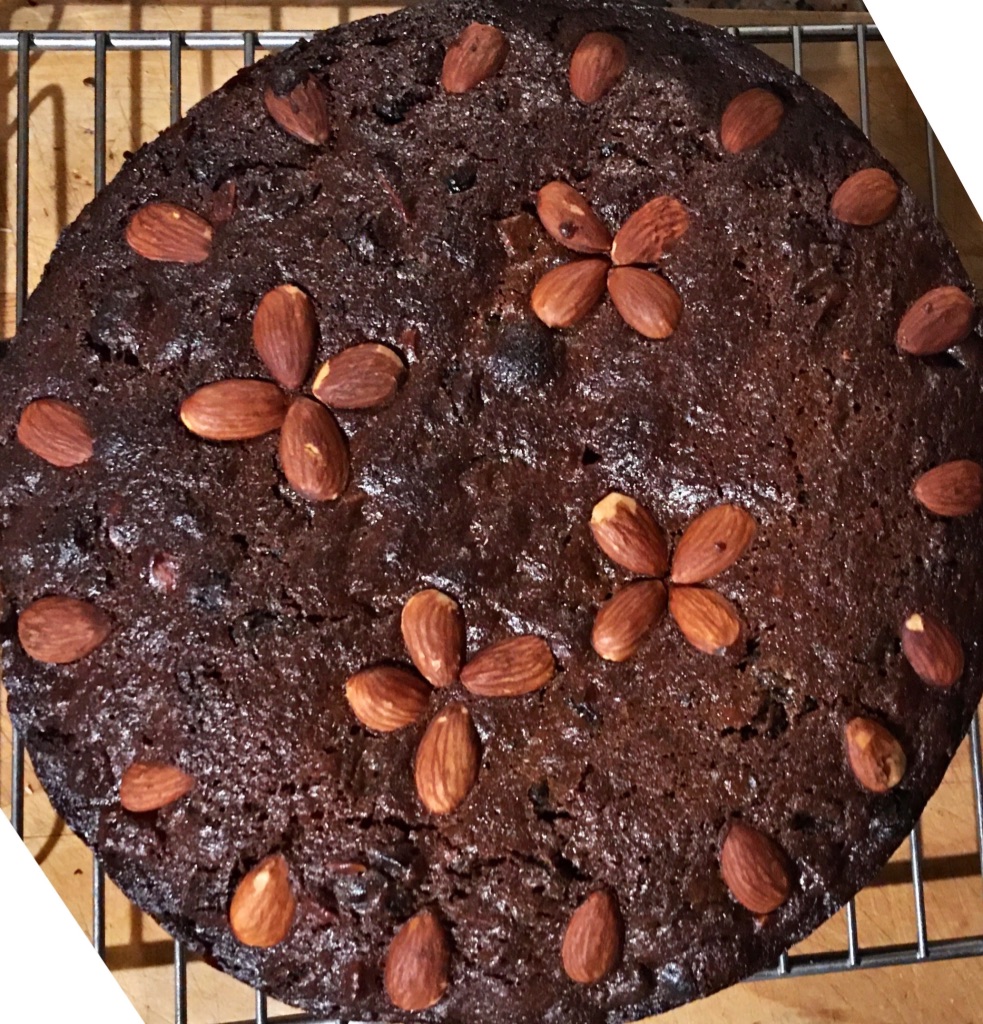
My mother-in-law, Jean, introduced me to fruitcake. I had tried it before but could never quite understand what the fuss was about. The fruit cakes I had eaten up to that point were shop bought and mass produced. Pretty ordinary, I thought. And they were. When Jean began sending us fruit cakes several times a year, I began to appreciate a good fruit cake made with brandy, soaked fruits and nuts. She liked to experiment with various recipes, and I loved them all.

One day, Jean announced that she would no longer bake cakes. She was getting old and found the process increasingly difficult. I decided to step into the breach and began sending her the cakes she had taught me to make. In time, I perfected a fruit cake with chopped almonds that is just perfect. And so I carry on the family tradition of making and giving home-made cakes.

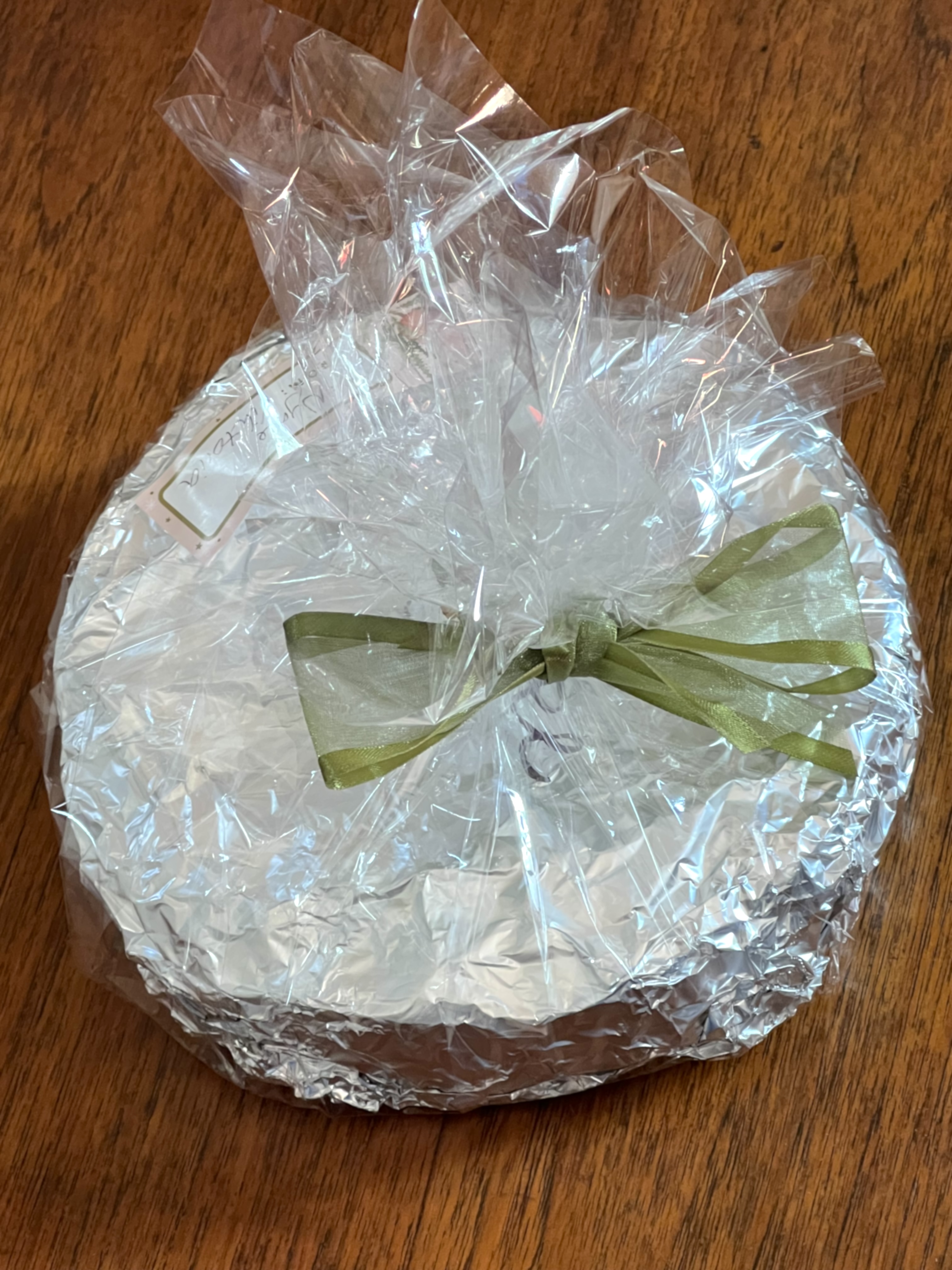
This year, I decided to bake fruit cakes for many of my friends. Over a period of about a month, I made 11 large cakes and more than 20 small, muffin-sized ones. The only restriction I placed on myself was that I wouldn’t post any. The cost of postage has become prohibitive over the years.

Making one cake after another took on a rhythm of soaking fruit, zesting oranges and lemons and watching the mixture froth when I added bicarb. I stirred in the flour and poured the mixture into baking tins which I then surrounded with brown paper and tied with twine. This helps to cook the cake evenly and stops the top from burning. Finally, it would go into the oven for a couple of hours during which I had time to start the next cake.

What I enjoyed most about this process was that I always had the person in mind for whom I was baking. I thought about each individual, their special qualities and the joy they brought to my life. It felt like a version of a Buddhist loving kindness meditation practice. I dedicated time to think about each person, added a little more of this, a bit less of that to suit their taste and wished them well for the coming year. I found it a lovely practice to think about each person, rather than bake all the cakes and allocate them randomly. This way, I could add a couple of magic ingredients to the mix – gratitude and love for recipients of each cake.

Artichokes

Artichoke plant

I’ve been watering my friends’ garden during an uncharacteristic heat wave. As my threshold for boredom is low, they have set up sprinkler systems to make the job easier. All I have to do is turn on the tap and return a while later to switch it off. In theory. It turns out that the sprinkler system is not very efficient around the vegetable garden. No matter how far I turn the tap to left, all I get is a piddle at the other end. So, I began watering that part of the garden with an old-fashioned watering can. It’s not surprising that this made me start paying more attention to the plants there.

The most outlandish vegetable in that patch is the globe artichoke. It stands high and lofty, towering above the other plants and, if truth be told, it is quite unattractive. It reminds me of the weeds I have been battling in my own garden which makes me wonder how people discovered it was not only edible but a delicacy. While the ensuing internet search did not yield an answer to that question, I did learn some interesting facts about its history.

I wasn’t too far wrong when I compared it to the weeds in my garden. The artichoke belongs to the thistle family, and I’m growing plenty of those. The artichoke’s spiky flowers and thorny leaves attest to this lineage. I was surprised that it is one of the oldest vegetables we are aware of. Most likely, it originated from the wild cardoon found in Northern Africa, and was then imported to Sicily and Greece in the 5th century B.C.E. Both the Romans and Greeks regarded it not only a delicacy but also an aphrodisiac. Considering how little is ingested with each nibble of a leaf, I imagine it may take quite a while for this to take effect.

The artichoke finally made it to the rest of Europe in the 16th century when Catherine de Medici introduced it to France upon her marriage to King Henry II. Nowadays, it is difficult to imagine French cooking without artichokes, whether in tarts or artichokes à la barigoule. Artichokes are firmly embedded in French cuisine.

My favourite way of eating this peculiar vegetable is either dipping the cooked leaves into garlic butter or home-made mayonnaise before scraping off the minuscule bits of soft flesh with my teeth. Either way, it is a simple and satisfying if not particularly couth dish to devour. As the butter or mayo invariably drips from my chin, it is a dish best shared with close friends and preferably not in a classy restaurant.

Hello and goodbye

Seven years ago, when I bought my house, it was under very unusual circumstances. Ruth, who sold me the house had only advertised it on Facebook. I turned up on her doorstep and decided to buy it on nothing more than the of strength feeling that this was the right place for me. I agreed to the price, we shook hands and began negotiating a long handover period. She trusted my word, I trusted hers and we kept in touch until three months later we could finally make it happen. We popped a bottle of bubbly and worked out moving days. There was no agent involved, just a couple of solicitors and banks. I’m sure we were both told that this was a crazy way to go about things, but we did it anyway and it worked out perfectly for us both.

This time around, I did get an agent involved mainly because he had worked closely with my late partner. I knew I could trust him implicitly. He too had his share of bad luck in the past few years – a stroke, which he survived, has left him with a lame leg and difficulty with movement. His once thriving business has suffered greatly from this setback. Yet his mind is as sharp as it ever was, and he is a good salesman. While I was close to becoming a nervous wreck in the process of the sale, he remained calm and optimistic and got on with the job.

When the eventual buyer came to look at the house, he was quietly optimistic. He answered her queries truthfully and when she requested to meet me after an inspection, he was happy to pass on the request and get out of the way. Gayle and I met and found that we communicated with ease and honesty. We had many things in common ranging from our love of books through to pens, inks and beautiful papers. There were other similarities too in our loves and our losses, in small, serendipitous moments that made one of us call out, ‘I was thinking about that just the other day,’ or simply, ‘me too!’ I knew she was the right person for this house while she felt the house calling for her. It had to be.

I have never forgotten Ruth’s generosity when I bought the house. She invited me to meet her friends, waited patiently for the sale of my house to go through and allowed me to store some of my belongings before we even signed contracts. It was time to pay it forward.

I invited Gayle to come up for a weekend so I could show her around Millthorpe and Orange, get a feel for the house and let her measure rooms and spaces. Unusual, yes, but also very sensible and welcoming to a new person in a village that is known for its inclusivity and friendliness.

Gayle arrived on Friday, and we took a stroll in the main street of the village. A couple of the local shopkeepers were sitting on a bench in front of their shops drinking bubbly. The moment we approached, we were offered a glass. We sat and chatted a while and met more people on our way back. Gayle was trying to remember the names of all the people she had met. Everyone had stopped to chat and welcomed her the way I knew they would.

The next night I had a couple of neighbours over for dinner. Over wine, cheese, and risotto we told stories and jokes, enjoyed each other’s company and parted with great fondness for the good people in the neighbourhood.

Today we visited the markets, bought Christmas presents and then took the dogs for a run. I showed her the closest large supermarket, hidden in a back street of Blayney, which only locals would ever know was there. Over the weekend, I showed her many little hidden gems that otherwise would take months to discover. Where to buy the best bread, how to get to the hardware store, the best cafés in town and the best op shops to find a bargain.

Why did I do this? I wanted to pay Ruth’s kindness forward and because I genuinely love this village and will shout its praises to anyone willing to listen.

I enjoyed having Gayle as a visitor to ‘our house’ and wish it were possible for more people to do business in such a civilised and caring manner. It was as important for my leave taking as it was for her arrival. I consider this handover as a rite of passage which will have ripple effects for us both for years to come.

Hurkle-durkling

To hurkle-durkle is a wonderful old Scottish term which means to lie in bed or lounge about when one should be up and about. It reminds me of words like shilly-shally, dilly-dally, argy-bargy, topsy-turvy and hoity-toity. Their humorous effect derives from the rhyme or alliteration. They are fun to say and capture a sense of their meaning.

I have come across hurkle-durkle from a number of sources lately. I first heard Susie Dent speak about it on the Something Rhymes with Purple podcast, then a friend reminded me of the word not long ago. Since then, I have seen it pop on Facebook and Instagram. It clearly accommodates a need in the English language.

Whether it is driven by jealous parents of teenagers who hurkle-durkle from their mid-teens through to their early twenties, or by blurry eyed workaholics who can only dream of such a luxury, it seems to have touched a nerve in the productivity driven twenty-first century. It is interesting to see the word make a comeback at precisely the time when the double-shot morning espresso has become a badge of honour for many.

As far as I’m concerned, we should all hurkle-durkle a lot more than we do. I’m sure we would be less stressed and more satisfied with life, if we allowed ourselves this little luxury more often. It is difficult to think of a hurkle-durkler committing road rage or being rude to shop assistants. We all behave better when we are well-rested.

We are now entering that crazy part of the year which we euphemistically call ‘the silly season.’ It isn’t silly at all. If anything, it should be called the frantic season. The list of things to get done before Christmas seems to get longer each year. Things ramp up at work as we approach the final weeks of the year and then there are all the social commitments, presents to buy and cards to write. No wonder we wind up cranky by the time we get to Christmas Day. You know my answer to this insanity. Sure you do. Go and spend some quality time hurkle-durkling and ride out the season in style.

Bird Song

One morning while having breakfast, I tuned in to sparrows chirping. They like hiding in an overgrown hedge out the back providing them with ample shelter. It is never one sparrow that sings but a host of them. Their simple song, made up of only a few notes, is sung mainly by the male to attract females or fend off invaders. I can’t help but smile at their incessant bright chirruping. It isn’t very loud and provides a pleasant soundscape as I sip on my cup of tea.

Soon another sound gets my attention. The blackbird’s song is one of my favourites, mainly because it reminds me of my childhood. I even named a dog after this bird. While its song varies for each verse, it always seems to start on the same mellow note. Their phrases are short and often include ‘djuk djuk’ clucks. No other birds have the same slightly melancholic effect on me.

Scientists have found that listening to bird songs is conducive to mental health. It surprises me that we need this confirmed through research. This revelation reminds me of the recent discovery of ‘silent walking’. Those brave enough to try this new trend have reported a reduction in feeling distracted. Who would have thought. It turns out that being in touch with nature is calming.

I can now hear my three tenors warble at the font of the house. This is what I affectionately call the magpies that come to feed on the front veranda. Magpies often get a bad rap for being aggressive. In a small town like Millthorpe, they know all the people and can distinguish between those who treat them well and those who do not like their company. I am often rewarded for being kind to them with their mellifluous warbles as they sit on the railing, necks craned, beaks raised skyward.

Nature plays a vital role in our quality of life especially for those who live in cities. We are seeing an increased willingness to consider the health of urban environments through improving biodiversity. I’d like to see a greater variety of birds in the heart of Australian cities beyond pigeons, gulls, and ibises.

Of course, not all bird sounds have a positive effect on us. Some can be downright irritating. Take the Koel for example. To be subjected to the coo-eee call of a Koel rising in pitch and fervour is akin to torture. The kindest thing I can say about them is that I am grateful that they are migratory birds. I’d much rather listen to a flock of local sulphur crested cockies. Noisy as they are, I have a soft spot for these larrikins. They are mischievous, funny creatures who relish play and pleasure. I love the way they hang upside down from the gutter to look through my window or find novel ways to open my garbage bins to see what is hidden inside. Curious, cheeky and utterly uncontrollable, they are the epitome of the rebel without a cause. Cockatoos often wreak havoc, yet I can never be cross at them for long. Theirs may not my favourite bird call but they make me laugh like no other bird can.

There is so much to learn from pausing to listen to our natural environment. Tuning in to bird songs helps me get out of my head and pay attention to my surroundings. I focus wholeheartedly on listening rather than looking. It’s a skill many of us neglect.

Melbourne Cup Day

Sirius, Melbourne Cup winner 1944

Roger could recite every Melbourne Cup winner going back to his birth year, 1944. It was his favourite party trick. Starting with Sirius, he could name them all and knew details about most. He loved horses, had a fervent interest in racing carnivals, but never had a bet. The last horse to be committed to his phenomenal memory was Verry Elleegant, the first horse to ever win the Melbourne Cup from barrier 18.

While I admired his passion, I could never reconcile the love of horses with racing. My heart broke every time I heard about an accident on the field. These horses rarely survive. It also seems to me that we don’t need to encourage betting in a nation that has the greatest per capita losses from gambling worldwide.

The day that Dunaden won the Melbourne Cup is seared into my memory. My husband, Peter, was returning to work after several months on sick leave. He had a part of his lung removed after we discovered that his Melanoma had spread. Things were going well; he felt better and was looking forward to returning to work. We dared to be optimistic.

I received a muffled phone call at about 10am on Cup Day. He was calling from the waiting room of the hospital where he had received his previous treatments. ‘I’m alright,’ he said in the way he did when he wanted to shield me from distress. I had to prise the details out of him, the way I always did when I needed to know the truth.

‘I wasn’t feeling well on the train and when I got off, I collapsed. People helped me up and eventually I had enough strength to walk to the medical centre. They sent me straight to hospital.’

At that moment, I knew. I knew we were at the starting post of a race against time and the odds were stacked against us. It was a race we would never win, no matter how much I pleaded with the specialists. We were riding on their mercy and time was running out. I didn’t believe in miracles, but I dared to hope. I dared to hope for Christmas, then New Year.  After that, I hoped for our daughter’s birthday and our wedding anniversary. He never made it to either. The race had run its course.

Melbourne Cup Day makes me anxious. I am taken back to these dark times of loss. The loss of a partnership of over two decades, the loss of innocence for my daughter, and the loss of a deep love. I am also reminded of a more recent loss, that of losing a second chance at love with a man whose joyful connection to the Melbourne Cup is all the more lamentable now that he too has run his final race. Yet I can’t help but feel grateful to have accompanied both of my valiant men on their final stretch to the finish line.

Poplars

Listening to trees whisper, sigh and brustle as they sing their wind songs is one of the delights of walking in the country. The soughing of the wind through various trees often escapes our notice, but if we listen carefully, there’s much to be learnt about the trees we encounter.

A common feature in rural Australia, the Lombardy Poplar stands tall and erect. They make for graceful avenues and provide useful windbreaks for farmers. As they are deciduous, they look like sad sentries in winter but come spring, they emerge in full verdant glory with thousands of diamond shaped leaves. But it is their susurration that fascinates me. They sound like no other tree I know. Their flat petiole that attaches to the leaf creates a trembling, a shimmy-shamming sound that reminds me of unfolding crinkled tissue paper. I am sure I could recognise a copse of Poplars by simply listening to them.

My late partner once owned a country house in Manildra where he planted a row of poplars on his side of the road to match the ones on the other side. His neighbour scoffed at the extravagance of watering the trees, but he did it anyway. Their slender beauty would have captured his imagination. A lover of gardens, he appreciated a good view. As people drove past, they were enveloped by the poplars providing a change of scenery from the flat paddocks on either side.  They were also heralding the houses on this lonely stretch of road. I can almost hear him instructing visitors, ‘Keep driving until you see the poplars, then turn right into the first driveway. Ours is the Federation house with all the roses along the fence.’

Lombardy Poplars have also been used to complement architectural features of well-known public buildings in Canberra. They were introduced there in the early 1900s, around the time that the house out at Manildra was built. They grace the forecourt of the National Library and can be found in many of the older parks around Lake Burley Griffin even though they are now considered a weed and prohibited under the ACT Pest and Plants and Animal Act 2005 due to their vigorous growth and propensity to invade waterways.

Last weekend Millthorpe hosted a Garden Ramble. It is a much-loved event which brings many visitors to the village. The gardens range from small backyards through to several acres of manicured parklands. Each is different, not only in size but also in aesthetic composition. Some favour the wild cottage garden effect while others are formal and majestic. It was at one of the oldest gardens that Poplars greeted me, sibilating in unison at my sight. Leaves waved like an old friend. These were ancient for Poplars, about forty metres tall, with roots that extended into the pond next to which they were originally planted. Their branches were in part straggly, but new growth was evident at the base of the trees.

Poplars, like church spires, reach to the heavens. I love them for their solemn beauty and wistful songs. Shimmering leaves in shamrock green remind me of the mother-of-pearl curtains of my youth refracting the sun’s rays. I am mesmerised by their wind-dance, their subtle choreography and siren song, drawing me ever closer into their embrace.

Bottled Ink

I have always loved the smell of bottled ink. It has a distinctive acrid smell that takes me back to learning to write in my first year at school. While today I find the smell nostalgic and comforting, the experience of forming letters on a page was torturous. Unlike children in Australia who learn to write using large, soft pencils, in Austria, we were expected to master the vagaries of the fountain pen at the age of six.

My memories of that time are shrouded in tears and ink blots on the page. Did I push too hard or was the pen leaky? Was the nib too thick or did I not hold the pen at the correct angle? Fountain pens can be tricky at the best of times. I don’t think I ever had ink free hands for the duration of my primary school years.

While quills have been used for centuries, the modern fountain pen was only invented in the early 1800s. It continued to evolve, with advances made by Lewis Waterman in America. His pens were able to be refilled and he invented a mechanism to allow ink to flow more freely. To this day, Waterman fountain pens are renowned for their style and reliability.

My pen clearly wasn’t a reliable one. My inky fingers no doubt made their way into my mouth as I turned pages. However, unlike with the forbidden book in Umberto Ecco’s Name of the Rose, there was no danger of any intellectual threat emerging from my scribbles. I was hardly going to be poisoned for my inattention by licking my blackened fingers. The only danger I faced was the wrath of my teacher for messy handwriting and blotting my copybook.

I am heartened that even King Charles has experienced the painful exposure to inferior pens even if he does own a Montblanc Solitaire among other prestigious pens. His outburst at Hillsborough Castle was beamed around the world. The newly crowned king was affronted by a leaky pen and let everyone know it. My own outbursts were met with a dressing down, a stern directive to stop moaning and to try harder. Not that any of this helped.

I don’t quite understand why I have persisted with fountain pens. Mine still leak and from time to time my blackened fingertips take me back to being a six-year-old. While I love all the wild ink colours that are available, I usually stick to black, just in case my signature needs to be validated or a page photocopied. Still, I love my Japanese murasaki-shikibu purple ink, named after the female Japanese writer who wrote the exquisite Tale of Genji in c.1010. This Japanese ink has a much more pungent smell than the inks I associate with my childhood. The shade of purple reminds me of my paternal uncle who would only write with a violet biro. Every time I use purple ink, it is a nod to my Hungarian uncle Lajos and his slight eccentricity which he maintained throughout his life. In a country where only blue or black were commonly available, it is hard to imagine where he sourced his pens.

I, on the other hand, am spoilt for choice. Besides the Pilot Japanese purple, my favourite Lamy colour is turquoise. In the Waterman range I adore absolute brown which is perfect for a nostalgic sepia look, harking back to the early twentieth century. For durability, however, I can’t go past Montblanc permanent black.

There is something almost subversive about writing with a fountain pen in the digital age where uniformity is prized over individuality. Colour is definitely not to be encouraged. But as always, I am happy to be counted among the renegades.

Cut flowers

Since my house has been on the market, I have bought flowers every week before the next inspection. It makes the dining room table look cheerful and inviting, adding colour and a touch of whimsy. I always choose brightly coloured ranunculus in a riot of hues. There is nothing serious about these flowers, and like gerberas, they make me smile each time I glance at them.

The flowers are grown by a local hobby farmer who brings half a dozen bunches to the local coffee shop each Friday. Her smile is every bit as bright as her flowers. The last time I saw her at the shop, she insisted I take a freshly picked bunch, so that the joy they bring lasts a day or two longer. I thanked her and paid my twenty dollars, an extravagance to some, but I love their impact on my house and mood.

As international flights have enabled cut flowers to be flown around the world so that orchids could be enjoyed mid-winter in Canada or Norway, it feels so much more intimate to buy freshly picked seasonal flowers.

In my twenties, as a student living on a small allowance in Berlin, I bought flowers each week to conjure up the sun in the eternal twilight months of winter. This small weekly ritual helped to soften loneliness and feeling lost in a new city. It brought hope of new life to come in spring, when the clouds would clear, and days lengthen.

Today, I am buoyed by the same message of hope. This period of my life will pass – clouds will part to reveal whatever comes next. I don’t need to know the details yet; all I need to do is to invite grace. And if flowers are to bring me hope and joy, they are worthy of a special place at my table.

Courage to share his story

Photo: Andreas F. Borchert

He approached us after casting his vote. A stranger who needed to share his story, to explain himself and his actions. A stranger who trusted that two women supporting an Aboriginal Voice would listen as he gave voice to his own story. 

He began to tell us of his Irish mother, a woman he loved dearly. She always claimed he was ‘fey’, alluding to his intuition and ability to sense things from beyond. He showed a keen interest in his Irish roots and had wanted to take his mother back, but this was not to be. After she died, he decided to make the trip on his own.

He sought out the places that were dear to his mother and met long lost family. The more time he spent on his mother’s Country, the more he felt the place holding him, welcoming a lost son. This feeling finally overcame him when he entered a small church in the village where his mother was born. As he stood at the baptismal font where she and generations of her family had been baptised, he succumbed to a flood of tears, held back for the longest time.

A gentle hand touched his shoulder. It was the parish priest.

Welcome home, son,’ he said, and our traveller felt he had truly arrived.

It was a moment akin to transcendence, a knowing that this was where his roots were, no matter where he would live out the rest of his life.

I too have experienced this sense of homecoming. A homecoming to a place that I can no longer call home, but a place where I feel the pull of my roots stronger than any other place I know. It is a feeling of merging and becoming one with the land, the trees and the birds that roost within them. I expand to take in all that is and experience both rapture and rupture between me and what lies beyond. Words cannot capture what happens in these moments, they will always stay ineffable.

Like my stranger, after experiencing what the Irish call ‘Thin Places’, where the veil between heaven and earth momentarily falls away to reveal the transcendent, I have but an inkling of Aboriginal people’s connection to Country. But like the man I met ever so briefly, I know where I stand and why I have chosen to take that stand.