Dogs and Laughter: How Zusak Stole the Show

This weekend, I am attending the Canberra Writers’ Festival. It is my first time. I have been really impressed with the line-up of speakers and it was hard to choose the few I would attend. There were the ones whose books I have read and enjoyed and a couple of new ones that I thought looked interesting.

Of the big names on the list, I chose to see Markus Zusak. I have just finished reading Three Wild Dogs and the Truth, which was a present from a dear friend. As a dog lover, whose own memoir may one day appear with the title Blue Dog Girl, I couldn’t pass up the chance to hear him speak.

The book most people associate with Zusak is The Book Thief. Three Wild Dogs have none of the qualities of that book. It is a raw, unflinching, violent, tragic and oozing with love for these three crazy, havoc-wreaking mongrels. Zusak doesn’t portray himself as a perfect dog owner, far from it. I can imagine some dog owners recoiling in horror over some things he has done. But he is truthful, full of humour and passionately devoted to these dogs.

I wasn’t sure what to expect, but I wanted to get a glimpse into this man who could produce two books that couldn’t be more different. From experience, meeting an author whose work you adore can be a hit and miss affair. Once, I signed up for a six-week writing class with an author I idolised, only to find him pompous and condescending. I was in for a treat with Zusak.

The talk was held in the foyer of the Australian National Museum. By the time I arrived, hundreds of people had taken their seats. It was clear from the from the first question on that he was going to go off script and tell hilarious stories, rather than purposefully answer questions. He had such a wonderful connection with the audience that by the time he finished, we all felt that he was our friend. I have never seen an author work a crowd the way he did. He was clearly enjoying himself on that stage.

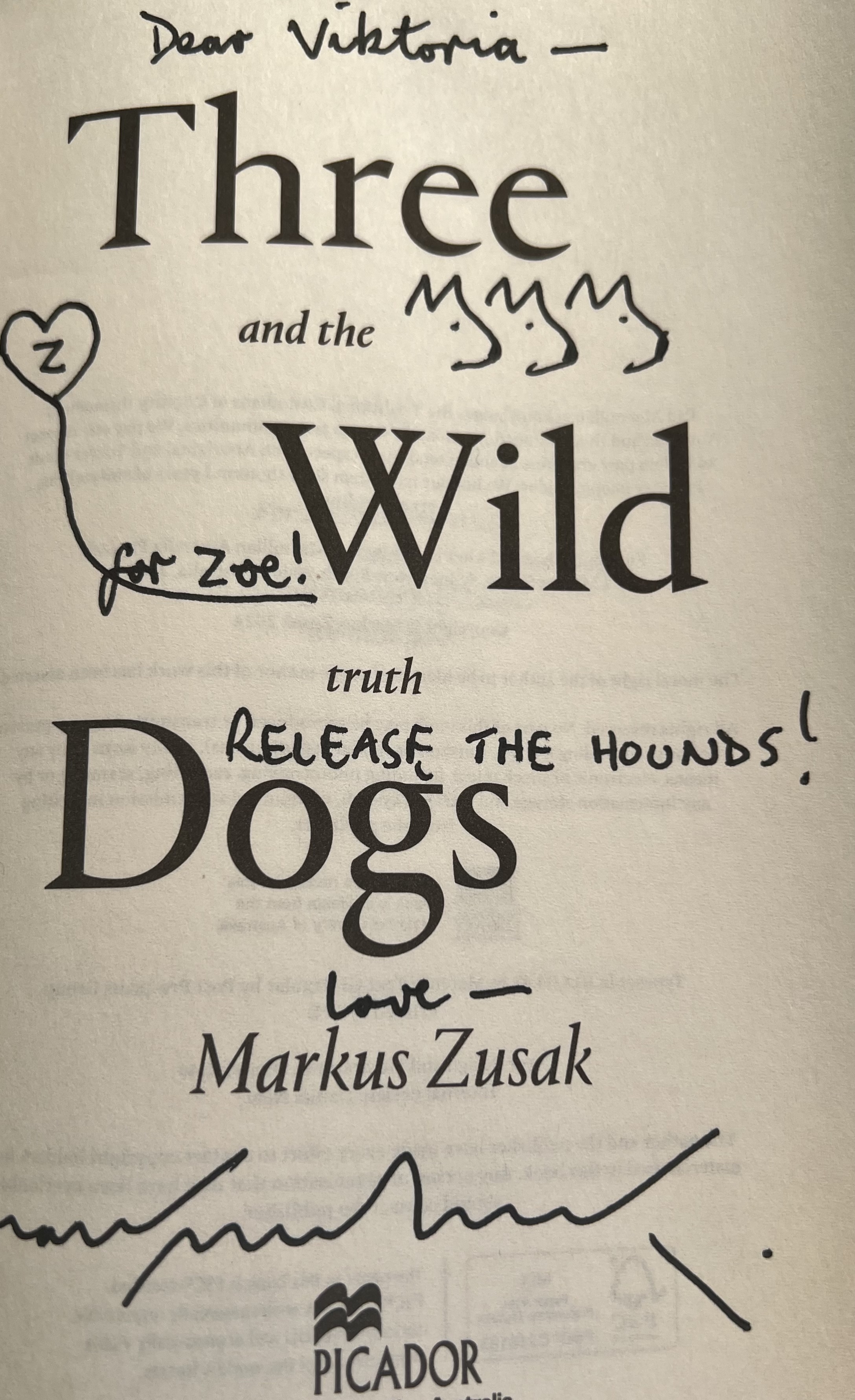
I lined up to get my book signed. When I reached him, he easily engaged in conversation by asking about my dog. He then told me a little anecdote about Standard Poodles while drawing three dog faces on the title page. Markus was charming and generous with his time.

It is rare to have an experience like this at a Writers Festival. It made readers feel part of a valued relationship. He honoured us as much as we honoured him. I’ll cherish this evening, as a testament to the magic that can happen when writers and readers come together.
In Luna’s embrace

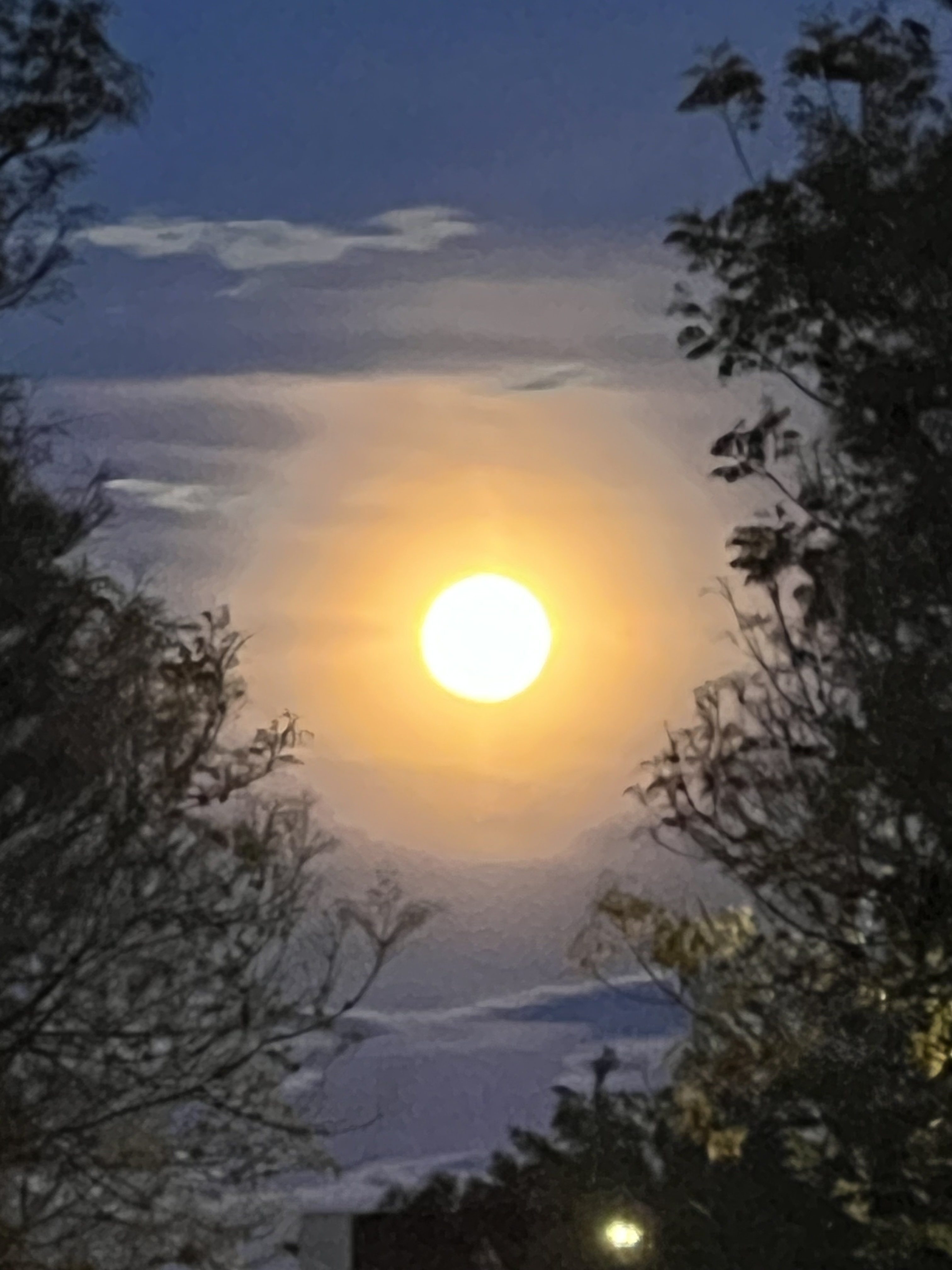
Like tides, I am drawn to the moon. Looking up from the cares of the world, there is my constant companion. Waxing, waning, lighting my way. Full moons always bring me joy. Every full moon catches me by surprise as if saying, ‘here I am, did you miss me?’. I sure did.

 I was unaware of all the hype around October’s super moon, when the Moon is at the closest point to us in its orbit. This super moon was the closest the Moon has been for quite a while and appeared at least 10% larger and 30% brighter than the faintest moon of the year.

The Western world colloquially refers to the full moon in October as the ‘Hunter’s Moon’. Traditionally, it was the best time to see deer and other wild animals to hunt and preserve for the coming winter. Of course, this makes little sense in the Southern Hemisphere as we await sweltering summers, but the name persists.

 There is a strong feminine connection with the moon, from the menstrual cycle which follows the 28-day lunar cycle, through to goddesses such as Luna and Selene named after her. The moon has played an important part in many cultures and religions. The Jewish calendar is lunisolar. Jewish people celebrate the first night of Passover when a full moon occurs after the spring equinox. In the Christian tradition, Easter falls on the first Sunday after the full moon following the spring equinox. Islam uses a lunar calendar with the new crescent moon marking the beginning of each month. The moon has influenced humanity since time immemorial.

Yet every light creates its own shadow. The moon has also been associated with madness, as in lunacy. Consider the quote from Shakespeare’s Othello ‘It is the very error of the moon. She comes more near the earth than she was wont. And makes men mad.’ There is, of course, no evidence to this myth, but it continues to flourish. Think of all the horror movies depicting a full moon and wolves howling. Then, in the early 19th century in the era of Romanticism, poets were associated with madness and mental illness. In truth, it was probably syphilis that caused their psychosis and mania.

Is it any wonder that seeing the full moon makes my heart jump a beat? I look up and see her on the horizon, as beautiful as a pregnant woman’s belly, about to bring forth new life on this planet. I swoon. My first instinct is to call my daughter, another lunar devotee, and tell her to look up NOW. Every minute counts as the moon rises and the optical illusion of a giant moon fades. Often, I will simply stop what I am doing, feast my eyes on her beauty and breathe in luscious long breaths in gratitude for what I have received.

Magpie Mayhem

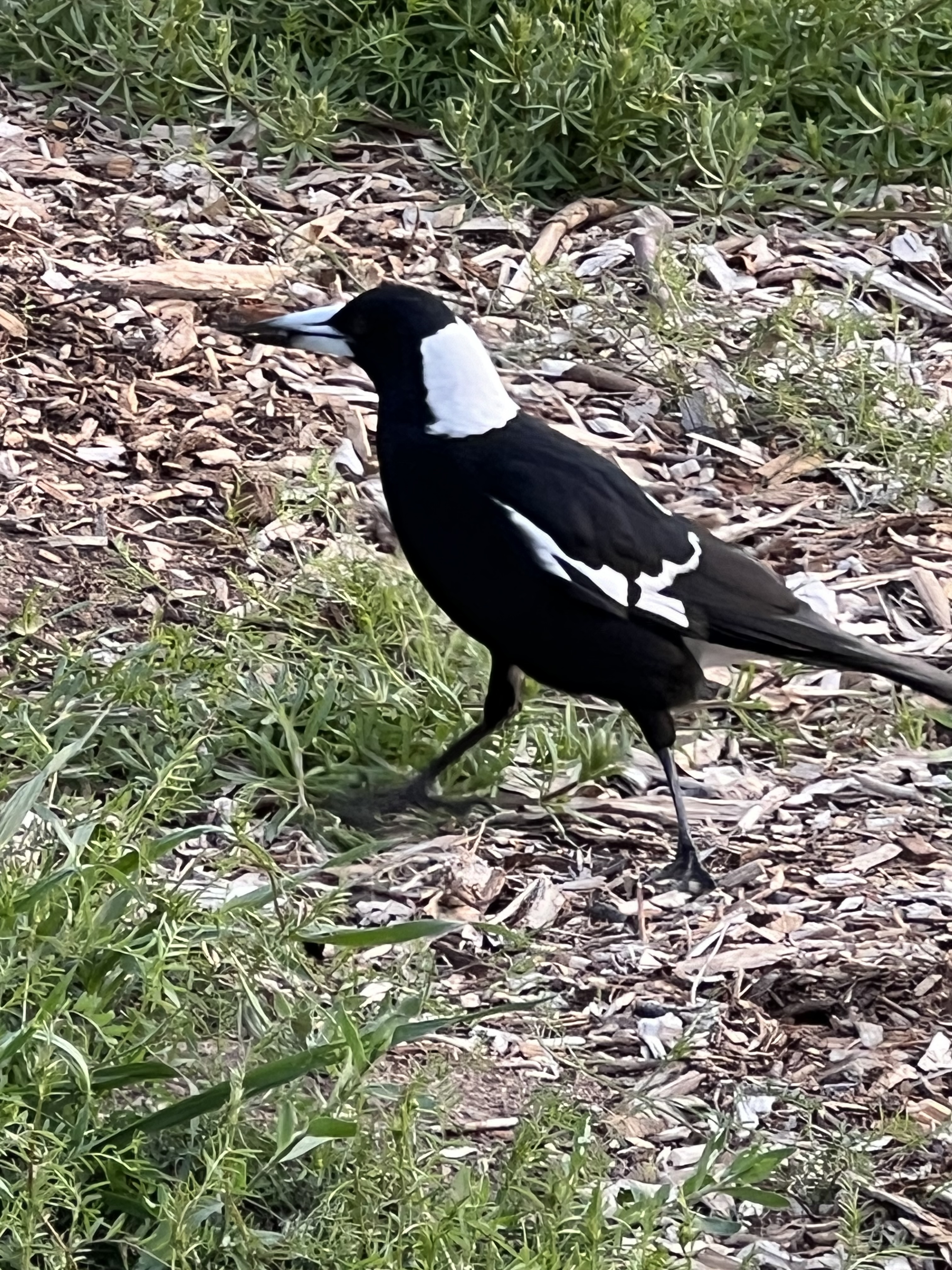
It’s magpie swooping season. In the past two weeks, I’ve been pecked on my head three times and my dog has had Northrop B-2 Spirit magpies stealth-bombing her from behind. Always from behind. She doesn’t move from my side now when we go near trees, and she looks up nervously at her sworn mortal enemies.

For nine months of the year, magpies are a joy in the neighbourhood. They warble in groups of two or three every morning and know us all by sight. They have excellent facial recognition, and recognise everyone in their patch, which is roughly the size of 30 suburban blocks. Magpies know exactly who is naughty or nice, and they pass on this information to other birds.

I always imagined their warble as a joyous expression of welcoming a new day or singing because they are happy. It turns out I was completely deluded. It takes a lot of energy to sing and warble, which is why most songbirds only do it when they are trying to attract a mate. Magpies, however, continue to sing each and every day and it turns out that it is purely to protect their territory. That lovely warble is hurtling expletives at other magpies within earshot. ‘Stay away or else!’

When I lived in the country, three magpies came to the bird feeder most mornings. They’d eat seeds I had put out for parrots, then throw their heads back in what I thought was appreciation and warbled. I referred to them as the three tenors. I must have watched too many Disney movies where all animals are anthropomorphised and given cutesy human traits, for it never occurred to me they were warding off other birds from their find.

Many years ago, I heard an ornithologist interviewed on ABC radio. He explained that 90% of magpies show no aggression at all and that it is only 10% of males who cause all the trouble during mating season. Tongue in cheek, he claimed Australia would be uninhabitable if all magpies swooped. After my last attack, I can only concur. Still, 10% of magpies are a sizable number. Of these aggressive males, half will attack only pedestrians and/or dogs, approximately 16% will attack only cyclists, 16% will go for posties and 18% will randomly attack anyone they come across. These figures are not made up; attacks have been extensively researched and quantified.

Magpies only ever swoop from behind and only if you are in the vicinity of a nest that has chicks in it. All attacks happen within 50 to 100m of a nest, so the sensible thing to do is to avoid the area once you’ve been swooped. When the chicks finally leave the nest, the male returns to being a placid bird until the following year. The best thing you can do in the meantime is to look at your attacker; a magpie won’t ever attack if it can see your face. The worst thing you can do is to run for your life, because then it will surely come after you. If you are on a bike, get off and walk the next 100m until you are in the clear. And yes, the cable ties on helmets work, not that it will stop the swooping, but at least it stops the frightening experience of a beak making repeated contact with the helmet.

For the next two months, I am avoiding the beautiful gums in my neighbourhood. Still, I walk the dog, greet any magpies I meet in a friendly tone and stay out of their territory. There will be time enough to enjoy a shady walk under the spotted gums once spring has passed. In the meantime, I remind myself that I am the intruder here.

Suburban dystopia

Suburban life has never attracted me. I find the rows and rows of ticky-tacky houses on small blocks with double garages and endless lawns stifling. While there are plenty of cars, I hardly see a person walking and everything is far, far away. The only way to get somewhere is by private motor vehicle.

Shopping centres out in the ‘burbs are large scale. If there are any main street shops left, they are run down. The rest are found in shopping malls with enormous car parks where people circle like sharks trying to find a park. I have visited a few recently. They inevitably have a one or two supermarkets, cheap chemists, tobacconists an uninviting café or two and of course the ubiquitous two-dollar shops and cheap clothing stores by the dozen. All I can see is the landfill they will produce within weeks of purchase.

Teenagers hang around in groups at the Plaza; there’s very little else for them to do. Young women push their prams, old ones their walkers and those in between walk around with their shopping bags hanging by their sides. I see little joy in their faces. Shops are often empty with salespeople leaning on counters looking out, willing customers to come in and spend. It’s the bottle shop and supermarket that are busy in these places.

I look at people’s faces and wonder whether it is the emptiness inside that is fuelling their consumption. Things always look better when displayed in shop windows and I too have fallen for the trap thinking that an item will transform my space or make me feel better. Rarely has this been the case. If anything, I have often regretted the hole in my budget and the hours I had to work in exchange for that item.

I am not a minimalist and doubt that I will ever embrace that lifestyle. However, I try to think about my purchases and buy quality rather than quantity. My last pair of boots lasted ten years before I wore them out and items like crockery and furniture are decades old, except for my recently purchased desk. You won’t find me throwing out broken shelves at the council cleanup because the ones I have are made to last.

While I see why suburban life may appeal to some people, I can’t ignore its suffocating mundanity. There’s a deeper fulfilment to be found beyond cookie-cutter houses and sprawling parking lots. Choosing quality over quantity and seeking life affirming experiences is essential for a truly meaningful life. I want us to challenge and reject mindless consumption, not just for the sake of our well-being, but that of our planet. And we all deserve spaces that inspire us and choices that reflect our passions. Life is too short to settle for banality.