Aching for Attention

Recently, my body has been telling me to pay attention through aches, pains and annoying niggles. The message is clear; take heed, you are more than the mind and your thoughts. The physical form is just as important, ignore it at your own peril.

I have suffered from migraines for most of my life and they have often come about when I have pushed myself to the limit. Things like forgetting to eat lunch, sitting in front of a computer for hours on end, not getting enough sleep are just a few ways I have abused my body and while it faithfully keeps going for a long time, eventually it tells me to stop. Usually, it does so in a not-so-subtle way. That’s because it knows that only a sledgehammer will stop me.

I often find wild bruises on my legs or dried blood on my arm, and I have no idea how I acquired these. I brush off minor cuts or bumps as inconveniences only to discover later that they weren’t so minor after all. I am not proud of this. It comes from an attitude of considering my body as an inconvenience that I carry around with me. I see it as a limiting factor in what I try to achieve. So, I ignore it as much as I can instead of working with it or giving it the care it needs. If I am honest, it has been a lifetime of neglect.

The last week has been particularly tough on my body. I stupidly wore high heels to work on a ten-hour day when I had to run from one building to the next and greet people in an official capacity. By the end of the day, I was hobbling back to the car, in pain and exhausted. That night, I slept 12 hours. My body said ‘enough’.

I woke with a headache this morning and instead of reaching for pain killers, I reached for water. You’re learning, I thought. My body felt stiff, aching all over even after my morning shower. I looked at my to do list and promptly closed my diary. It could wait. Instead of pushing myself to get the next thing done and crossed off, I walked my dog to the local café, enjoyed a coffee and decided to honour my body with a massage.

After forty-five minutes of pleasure and pain, I thanked the Chinese masseuse and floated out onto the street. Colours seemed brighter as did my mood. Back home I approached chores with more energy and decided others could wait. I took the dog for another long walk and met up with some of the regulars in the park. Looking up at cotton ball clouds, I watched their shapes change. I noticed a colony of ants build a nest on the side of the path and I realised I was pain free and happy. All I needed was a little self-care and acknowledgment of my body.

Weekends: The Gift of Time Well-Spent

I’m back at work after two glorious months off. While I was still working diligently on my own projects, the days and weeks had a different rhythm. Often, it was difficult to tell which day was which, as the weeks rolled into each other. There’s a deliciousness about feeling that we are outside of time, but it also has its downsides. Like forgetting about business hours for example and realising that others work on a different set of assumptions about working hours.

Now that I am back in the Monday to Friday world of work, weekends have a special quality to them. I can sleep in, read a book, go to the market and walk my dog at a more leisurely pace than during the week. This morning, I took my dog Zoë to the local café, wrote in my journal, drank my latté and shared a freshly baked croissant with her. Bliss.

Walking back, I took my time and noticed the small things that go unnoticed when on a deadline. Like the slight breeze that caressed my bare arms ever so gently. Entering a copse of trees, I saw the shadow of the leaves dancing on the path beneath my feet. I stopped to watch this shimmer of shadow and light – a performance dedicated to the spectator who chose to notice its exquisite beauty.

Back home I performed all the mundane duties that accumulated during the week. I didn’t grumble or delay, I completed them with a sense of joy that comes from being truly present to miracle of life and all it has to offer. Or as Eckhart Tolle put it,’Always say ‘yes’ to the present moment… Surrender to what is.’

What Do You Mean I Have a Criminal Record?

A couple of days before Christmas I went to my letter box, expecting to find some lovely cards from friends near and far. Yes, there couple, but there was also an official government letter. I was curious. I had just paid my rates, and I was sure I hadn’t been speeding or handling my phone in the car. What could it be? When I opened it, I could make no sense of the contents. It was from the Magistrates court, informing me that my ‘case’ had been before the court, and I hadn’t attended the hearing. I was clueless. What case? Was this some hoax or an elaborate scam? I leafed through the pages to see why I had been summoned. There was a fine and court costs totalling roughly $700. What for? I still couldn’t work it out. Finally, I on the last page, the offence: a parking fine with no further information.

I called the court. Yes, they had a record of the court case, no, they couldn’t tell me anything else. Contact Access Canberra. Onto my next call.

‘Can you tell me the infringement number?’

‘No, because I never received one.’

‘Your name please?  Vehicle registration?’

‘Sorry, we can’t find any infringement relating to that vehicle or under your name. Try the police. Their infringement notices don’t come through to us.’

The police had no record, so I contacted the court again. I was put through to a different department to a woman who had access to more information than the person I had encountered earlier.

‘A yes, it is a parking fine issued by the Australian National University (ANU) on February 7, 2024.’

I suppose I could have been there, but I certainly hadn’t received a notice of the fine, nor a reminder, let alone a summons to attend court.  At this point I realised I had entered Kafka’s ‘Trial’. As he said, ‘The right understanding of any matter and a misunderstanding of the same matter do not wholly exclude each other.’ Yes, this made perfect sense under the circumstances. Where to next? The ANU parking office of course!

‘We have photographic evidence of the parking ticket on the vehicle.’

That’s when the penny dropped. ‘My daughter attends ANU. She must have borrowed my car, received the parking fine and then forgot all about it,’ I mused.

‘Very common,’ replied the woman on the other end of the phone. I suggest you ring the court and ask for a form to have the matter put aside.’

I thanked her and made yet another call to the court…

An operator at the court advised in dulcet tones that unlike other jurisdictions in Australia, the Australian Capital Territory regarded unpaid parking fines a criminal matter once it came before the court. I was incredulous. A criminal record for an unpaid parking fine of which I had no idea and no letter of demand? Once again Kafka came to rescue to try and make sense of my situation.

‘But I’m not guilty,’ said K. ‘there’s been a mistake. How is it even possible for someone to be guilty? We’re all human beings here, one like the other.’

‘That is true,’ said the priest ‘but that is how the guilty speak.’

I downloaded the form to appeal the conviction. Besides my name, there was no part of the form I could have completed without legal advice. I was required to state ‘briefly, but specifically, grounds relied upon and the questions of law to be raised.’

I am a literate person with a high level of education, yet I could not complete the form. I had to call someone with legal training who was able to find me the specific law, including clauses and subclauses, we would have to rely on. My daughter completed the form, and I paid $102 to appeal the judgment.

As a teacher who needs a police clearance every 3 years, I am at the mercy of the judge to quash the conviction. It could also affect which countries I can enter and whether I get stopped at the border when leaving or entering Australia. While I think this will make a funny dinner anecdote in the future, I am also appalled at how easy it is to get caught up on the wrong side of the law. If I didn’t have the contacts I have, didn’t have the money to appeal, was illiterate or a dozen other handicaps that could derail the appeal process, I could wind up with a criminal record for life.  As dramatic as it sounds, I could even get a jail sentence for being unable to pay the fine which keeps increasing with every wrong turn.

So, cross your fingers for me on February 17, when I go to court to have my appeal heard. If I don’t succeed, I’ll sing a verse of Arlo Guthrie’s ‘Alice’s Restaurant’ and walk out. For those of you too young to get the reference, there’s always YouTube.

Messy Pages and Plot Twists: Journaling, Cinema and the Creative Spark

A couple of years ago, I revisited the Julia Cameron’s The Artists Way. I have kept journals on and off for the past 30 years and certainly consistently over the past 8-10 years. As Julia suggests, I write 3 pages each day, but I rarely get to do this in the morning. My pages are completed as part of my evening routine.

There is nothing earth shattering within the hundreds of pages I have written. They are mainly trivial recollections of the day with the occasional piece of insight. No historian will ever want to read it. I miss most of the important things that have happened on the world stage. Instead, I concentrate on the minutia of my life. Still, I keep writing and find it a comforting daily exercise.

While I write my blogs on the computer, my journals are all handwritten. I use a fountain pen because I love the feel of the nib as it glides across the paper. My writing is both messy and ‘ample’ as someone once said. I prefer a medium nib that lets the ink flow like my words tumbling out onto the paper. Sometimes I get the first part of a word on paper and part of the next. My hand can’t keep up with my thoughts. But that’s OK too. Nobody will read this, not even me. I have boxes of journals under the stairs which would make good kindling for my funeral pyre.

But writing the three or so pages daily is only part of Julia Cameron’s routine. Another practice she advocates is the artist date. She points out that this is one of the hardest to keep. We create all sorts of reasons why we can’t make time for ourselves. I had forgotten about this until last week. I realized that I had not been out anywhere for weeks, except the shops and my customary dog walk. Something had to change.

On a hot day there’s nothing better than escaping to the airconditioned comfort of a cinema. My favourite place is the Palace Electric in Acton which also hosts various film festivals. There were several films to choose from. I decided on ‘Conclave’ which was a drama centred on the election of a new pope. I was surprised as to how many people were in the audience. I presumed it would only be Catholics or those who had an affiliation with Catholicism who would find the film interesting. It seems it had a much broader appeal. The intrigues and machinations reminded me of ‘The Name of the Rose’, at a smaller scale. The acting was superb, but the characters mainly depicted nationalistic stereotypes. Nevertheless, the film took me on a pleasant cinematic ride. It had one of the best plot twists I never saw coming at the end.

After the movie, I thought about why Julia Cameron advocates the Artist’s date. Yes, there’s the usual ‘you need to fill your cup’ first type answer, but I sensed that there was more. I thought about the experience of walking into the foyer, smelling the popcorn, watching people mingling at the bar, wondering whether I should get a glass of wine (I didn’t), then walking into the dark cavern of the cinema itself. I had to find the row, the seat number, wonder whether people were going to sit next to me. Then when more people arrived, I had to practise equanimity as the talked and talked right through the ads. I hoped they’d stop once the film started, and they did. Then the feeling of watching a film on a big screen, the clarity and immediacy of it. Finally, leaving the theatre and listening to snippets of people’s conversations about the film. The experience brought me into the world and out of my head where I had been stuck for days. A writer has to experience things and Julia Cameron invites us to do just that. Or as Hemingway put it ever so eloquently – ‘In order to write about life first you must live it.’

Ringing Bells and Deepening Breaths: A Practice in Presence

Breathing, such a simple act. An involuntary function of the body that stays with us from the moment we come into this world to the moment we leave it. So why is it so hard to for us to master?

Like many people I know, my breath is shallow unless I pay attention to it. When I consciously think about it, my breathing slows and moves to my belly. At the same time, my shoulders drop, and I feel calmer after just two or three rounds. I am not meditating, just paying attention while I go about my daily tasks. Yet I don’t remember to do this simple exercise often enough.

Today I heard Jonathan Fields talk about the importance of breathwork. He starts his mornings with taking some inbreaths and then exhaling just a little longer. As he repeats this, the breaths naturally get longer, and the exhalation is also lengthened. This has the effect of calming his mind and starting the day feeling at ease. I think this is a worthwhile routine to incorporate into my morning.

The scientific reason why this works is that stress puts the sympathetic nervous system in charge, which activates the ‘fight or flight’ response. On the other hand, when we breathe deeply, we engage the parasympathetic nervous system which slows the heart rate and makes us feel relaxed. As our breath is always available to us, we can use it to help us regulate emotions.

I was reminded of something I always do when I hear bells ring. I stop and breathe consciously until I can’t hear them anymore. In Eastern meditation practices, the bell is always a reminder to return to the breath. This practice was easy to incorporate into my daily life in Europe where church bells often chime on the quarter hour. When I was teaching in a small town in Switzerland, the bells were always there to help me come back to my breath during the day. It made me present to that moment with my students. I miss hearing them in Australia.

So today, I set a gentle sounding timer for each hour of the day, reminding myself to consciously breathe, drop my shoulders and to move my body. I spend too much time in front of my computer and am unaware of the tension I hold. Now, I have an external reminder to bring me back to the physicality of my body and my breath. As Thich Nhat Hanh said ever so simply, ‘breathing in I calm my body, breathing out I smile.’

A High-End Wrap for a Low-Key Lunch

Packing a simple cheese sandwich should have been the easiest part of my day. At the Airbnb where I was staying, I had all the ingredients in a small bar fridge. Once assembled, I looked everywhere for a scrap of paper or cling wrap for my sandwich. Apart from toilet paper, there was nothing even vaguely suitable. While potentially amusing, I couldn’t face the toilet paper option. It reminded me too much of Barry Humphries eating a tin of pea soup out of an airsick bag on a flight to London. Funny but deeply disturbing.

I decided to opt for a more pedestrian alternative. While out for dinner, I went into a Lebanese corner shop which had a good selection of essentials. I walked down the aisle which sold every variety of dried pulses known to humankind and kept my eye out for cling wrap, foil or sandwich bags. I reached the back of the shop and was about to turn back empty handed, when I noticed both cling wrap and aluminium foil on the bottom shelf. Success! All I had to do was choose between them.

As I leant down, I noticed a much smaller packet of aluminium foil than the one I usually bought. I only wanted to wrap a sandwich, so I thought it’d be more economical to buy the smaller one. I was aghast when the cashier charged me $10. Highway robbery I thought, but dutifully paid the amount.

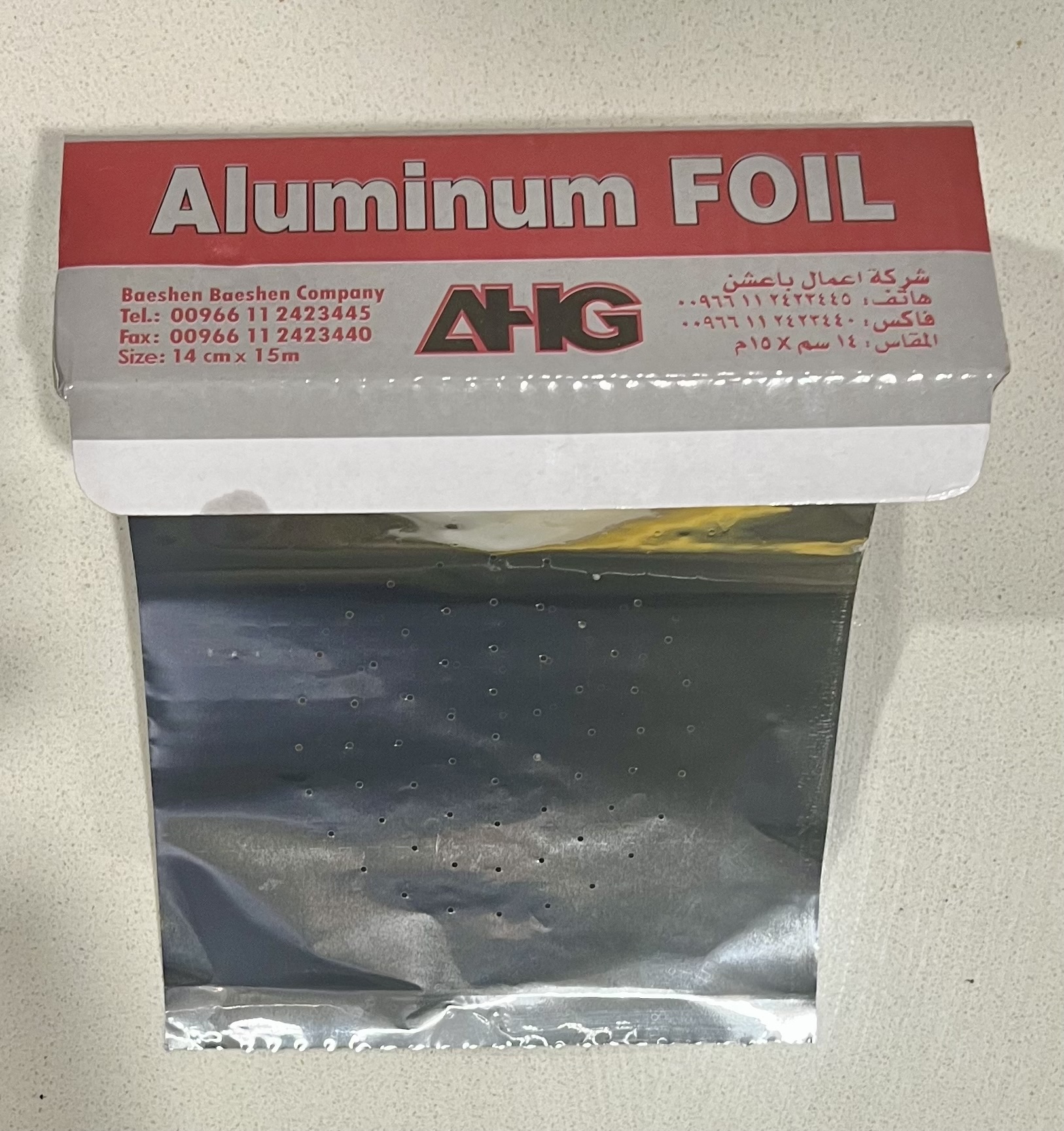
Back at the Airbnb, I made my sandwich for the next day. Opening the Aluminium foil, I was surprised to find it had perforated lines at regular intervals for easy separation. These were roughly the size of toilet paper squares. Perhaps, I should have stuck with my original choice of wrapping, I thought. It certainly would have been much cheaper. Then, I noticed small pin-pricked holes in concentric circles on each of the sheets. Moreover, the foil was quite thick, much thicker than the stuff I had at home. Clearly not meant for a sanga wrapper!

Suspicious, I began to Google the mysterious foil. Nothing on the box gave a clue as to its intended use. I wasn’t getting anywhere. Finally, it occurred to me to take a photo to see if Google lens could assist. And there it was:

‘Discover the ultimate hookah experience with the AHG Premium Shisha Foil Roll.’

I was about to wrap my sandwich in premium shisha foil!

Four sheets were ample for the job. Best of all, I could reuse the foil again and again. The stuff proved indestructible. Yet now that I’m back home, I find the cheaper foil much easier to use. And, as an added bonus, I don’t have to explain myself in the lunchroom the next day.

When a snip becomes a road trip

Every six weeks, I get my hair cut. There’s nothing out of the ordinary about that. Hair grows and if you like it short, it needs to be cut regularly. Nor is it unusual for women to travel across town to visit their hairdresser. Once you have established a good relationship, it is difficult to start over with someone else. It’s a bit like an old relationship where you are comfortable bearing all to each other.

I probably take this further than most. Visiting my hairdresser involves a ritual of driving 270km each way and staying overnight with friends in Millthorpe where I used to live. That’s the equivalent of driving from Milan to Venice or further than Vienna to Budapest. In Europe this would be insane, in Australia just slightly bonkers. We readily acknowledge that we have a different relationship to distances. In my misspent youth, I dated guys who used six packs (beer) as their preferred unit of measure between cities. (Not condoned!) That was before drink driving was taken seriously. I have a tendency to measure distances by increments of towns. Canberra to Millthorpe is three hours; one hour to Boorowa, one hour to Cowra and then one hour to Millthorpe. It’s a rough estimate, but it works for me.

My hairdresser is good but there’s probably 50 equally good ones within a 10km radius from where I live. She knows me well by now and doesn’t bother with social niceties. If we talk, there’s a point to it. She’s a no-nonsense woman who has no need to pretend to be anything else. I like her. But that’s not the only reason I make the trip.

Over the seven years I lived in Millthorpe, I have made some good friends and rekindled some old friendships from a different part of my life. Funny how that works out. When I moved to Canberra, I left some very good friends behind, and it seems a shame to keep losing friends as we age. So, I decided not to let that happen. My hairdresser appointment is a good excuse to visit friends regularly. For I know when we say, ‘let’s keep in touch,’ it rarely eventuates. Our lives become busy, other priorities take over and before we know it, we have lost contact. Getting my haircut is my way of ensuring that I keep up with friends. I now need to come up with a similar strategy to see my friends in Sydney!

How far do you go to keep up friendships?

Twixtmas

I have always been fascinated by liminal spaces: doorways, verges, airport terminals and the inbetween times in our lives. The time between Christmas and New Year, six days of waiting for the old year to pass and the new year to start, sees us standing at the threshold of the old and the new, in limbo, neither here nor there quite yet.

My new diary for the year is pristine, bar a couple of appointments. It is empty, yet full of promise for what is to come. 365 days of dreams and hopes await, yet I have little control over what will actually happen. Which of us will make it to this very day next year? Who will join us in our midst? What will be the joys, the sorrows, the moments we will remember? How will we show up for them?

The other day, I looked through the photos on my phone, starting at January 1, 2024. I made two pages of notes of all the important events I had captured. They were overwhelmingly positive this year, but then we rarely capture our sorrows unless they are marked with a ritual. I am sure there were plenty of mediocre days there, but I chose to focus on the things that uplift me. I will remember this in the coming year and focus on the positives. I’ll leave the downside of life to news reporters.

Twixtmas is a good time to take stock and reflect. I want to get into the habit of doing this much more often. We all know that our notion of time is a mental construct, that time keeps going on without stopping on December 31 and starting again on January 1. But it is useful to draw a line somewhere and give ourselves a chance to begin anew. While I am not a believer in new year’s resolutions, I do set a guiding principle for the year. 2025 will be the year of Imperfect Action.

Imperfect Action calls for movement towards something before I am ready, before I have all the information, before I can talk myself out of it. It is a way to get out of my head (and out of my way) to attempt new things without expectations. It is a belief that if I act, the outcome will look after itself. It is a realisation that I can only control my actions, not what the result will be.

When we recognise our task is to lean into action rather than expect outcomes, we can live with increased equanimity. Life becomes less of a grind and infinitely more fulfilling. We can take each step with intention and let the outcome take care of itself. Trust your effort will lead you exactly to where you need to be. Happy Twixtmas!

Boxing Day: Box it up!

You don’t have to be a minimalist to want to declutter your life after Christmas. We, who are lucky enough to live in wealthy countries, have more than our fair share of possessions and after a while, the sheer volume of it makes us feel stifled. Never more so than after Christmas, when even more things come into our homes, not all of it is welcome.

Generally, I try to give presents that are consumables like special items of food or at least useful around the house. I do make an exception with a friend with whom I exchange ridiculous gifts, but even these are practical. I don’t get hung up on whether things I give get re-gifted; if I got it wrong, let someone else enjoy it! Nor do I mind giving money if I know it is the best gift for the person.

I find it difficult to fathom that people would want to go out and spend more money on Boxing Day sales, unless, of course, there is something very special that they have been waiting for. For me, Boxing Day is a good day to begin the purge and box up all the things I no longer need. I go through my wardrobe and ask myself honestly whether I have worn that item in the past year, whether it still fits me and whether I still like it. If the answer is no to any of these questions, it gets folded and put into a box. I also go through my linen cupboard, shoes, kitchen utensils, herbs and spices, and food items at the back of the cupboard. The only thing that escapes my scrutiny is books. We all have our weaknesses.

While I am by no means a loyal follower of Marie Kondo, there is some truth in what she has to say. Although, she too has changed her tune somewhat since she has had children. She is less rigid and acknowledges the inevitable clutter that comes with raising kids. If you have children, you will need to be much more flexible with your approach to clutter. Still, you can go through clothes that no longer fit and toys that no longer hold their interest. Box it up!

Those of us who don’t have young children in our care need to think about the things we have accumulated and whether they will help or hinder us when transitioning into the next stage of our lives. Moving from a house to a small townhouse at the beginning of the year has certainly taught me about which things spark joy and which things spark nothing but trip hazards. There is only so much that fits into that container, which we refer to as our home.

I am not advocating Swedish Death Cleaning either. As far as I’m concerned, if someone benefits from receiving my inheritance, let them clean up after me. No, I am advocating doing some decluttering for ourselves. We will be the beneficiaries of a place where we can easily find things and where we can walk to the bathroom at night without encountering an obstacle course of our own making.

Let Christmas Day be about giving and receiving. Enjoy the presents, the food, and your loved ones. Then, when Boxing Day comes, and you look at the mess that’s left behind, take out the boxes and begin sorting. Come the New Year, you will be so thankful you did.

Lighthouse reflections

Some things are seriously worth waiting for. Like the Artist residency at Nobby’s beach, Newcastle. I was counting down the months, then the weeks until it was finally upon me. Five glorious days to spend on my memoir that has been sitting on a shelf for the past year, patiently waiting for me to come back and give my undivided attention.

There were eleven of us at the lighthouse. Some writers, some artists. Several had returned for the second time and were delighted to meet up with old friends. Two of us came from Canberra and, to my surprise, there was a large Melbourne contingent. One younger woman had grown up at the lighthouse as her father was the last signals operator before that job too became automated. We loved hearing stories about the people who lived there and the history of each of the rooms where we worked. For her, it was a chance to paint the lighthouse and its surrounds which had played such a significant part in her early life.

There is something magical about lighthouses. They are often metaphors for safe passage, guidance, and protection. They offer illumination for the dark nights of the soul and are a beacon of hope. In a port city like Newcastle, this lighthouse has the important function of guiding vessels into the harbour and up the Hunter River.

Before I arrived, the lighthouse became the beacon guiding me to cross the finish line of the year with a sense of achievement. It didn’t disappoint. I found it easy to get into flow and felt focused for hours on end. Many of us met at 12.30 for lunch in the common room, enjoyed each other’s company, and went back with a fresh burst of energy for the afternoon session. By the end of the week, I cut 21 000 words from my manuscript. I consider it a boon for my future readers. The engagement with the work has also rekindled my enthusiasm for the project.

The knowledge that Nobby’s lighthouse is one of the oldest operational lighthouses in the country made it feel like a workplace rather than some anachronistic holiday destination. I felt connected to both its current significance and its historical legacy.

Back in 1854, it first guided commercial shipping and 88 years later, it became important for military operations during WWII. The three small cottages erected on the site and these were used by defence staff during the war. An unexploded shell fired from a Japanese submarine damaged one of them.

Various lighthouse staff occupied the cottages after the war until the late 1990s. Lighthouse Arts, which is an initiative of the Hunter Writers’ Centre, now uses these cottages to hold exhibitions and offer artists and writers a space to create.

The area where the lighthouse is located is now known as Nobbys-Whibayganba headland. So finally, there is recognition of the Traditional Custodians, the Awabakal people and their deep cultural connection to the land, saltwater and the Dreaming.

I am grateful I could nurture my calling on this spiritually laden Country. It gave me much needed clarity and purpose. As such, I am already planning my next sojourn.

If you feel you would benefit from having a week to commit to your creative project, apply at https://hunterwriterscentre.org/2024/11/28/lighthouse-arts-residencies/  

We may even meet each other there.