Advent Calendar

I don’t remember ever having an Advent Calendar as a child, but I always loved the countdown to Christmas. The days were short in Europe, and winter had set in. Every house looked festive and there was a sense of expectancy in the air. The best day by far was the Feast Day of St Nicholas on December 6 with its promise of good things to come. Well-behaved children could look forward to St Nicholas to fill up their boots with delicacies such as chocolate, nuts, Spekulatius biscuits and oranges. Oranges all the way from Jaffa – a delicacy in the middle of winter! Of course, naughty children would not be rewarded. They were threatened with St Nicholas’ offsider, Krampus, a devil like figure dressed in black who carried a carpet beater to give them a thrashing. Krampus would also stuff coal into the boots of these naughty children.

Every child in Austria looked forward to St Nicholas Day but at the same time feared the arrival of Krampus. Nobody could make it through the whole year without getting into trouble. All one could hope for was that St Nicholas would turn a blind eye to small misdemeanours. My boots were filled with nuts and sweets but there was always one piece of coal to remind me of my failings.

When my daughter was born, I continued the tradition. I made my own Advent calendar with pockets for each day and found little treats for each one. When she was four, I gave her a wooden railway track and train, with each piece of track tucked into a pocket all the way to December 24. By Christmas she could build the complete track and run the train. Of course, I also made her polish her boots and put them outside on the eve of St Nicholas Day to be filled to the brim with delicacies I knew she loved. I never told her about Krampus though. I had no desire to make her fear a mythical figure and emotionally scar yet another generation.

I continued this tradition with the Advent calendar right through her teenage years. Some of the pockets were filled with hair ties, lip gloss or a pair of socks. When she went to university and moved to another city, I tried to see her before the first of December to stuff her Advent calendar. Then, when I could no longer guarantee to get there in time, I came up with an innovative way of continuing the tradition. I embraced the twenty-first century and went virtual. Each day in December, I now transfer her $5. For one month of the year, her morning coffee is paid. It’s ingenious. I get to hold on to our family tradition and she gets to enjoy her adult version of Advent.

This year, she will be with me for St Nicholas. I won’t have to remind her, I’m sure of that. Her boots will be polished and left outside for Mother Nicholas to fill. My daughter is twenty-five now, a young woman living her own life, making her own decisions, right or wrong. So, I wonder. Is this the year to learn the lesson of the piece of coal? After all, none of us can claim to be perfect.

Christmas Pudding

Remember to soak in brandy and flambé!

I am the sole heir of a Christmas pudding recipe handed down through the generations. While Margaret was alive, she referred to it as her family’s secret recipe and I was the only person with whom she shared it. Over the years, I have faithfully followed the recipe and have delighted many friends both in Australia and overseas with this traditional Christmas treat.

I always think of recipes in terms of the person who shared it with me. Each time I make a dish, it is infused with love for, and memories of, the person who was kind enough to share their skill and knowledge with me. It is a true act of friendship to hand someone the gift of a great recipe. I hardly ever use commercially printed cookbooks, but I always return to the scraps of paper with scribbled recipes that friends have shared. Not only does it bring joy to think of people who have accompanied me at points in my life, it also brings joy to the people who are in my life now. A recipe is a gift of paying it forward.

I have never cared much for keeping secrets. Now that I am the sole guardian of Margaret’s Christmas Pudding recipe, I wonder about the felicity of the secret. Imagine if our forebears had kept recipes for bread or wine a secret. Would we have national cuisines if all recipes were fiercely guarded or just family feuds over the best dishes?

I don’t want to be the last in line to make this adaptation of a great Christmas pudding. The recipe is too good for that. My apologies darling Margaret but the secret is out.

                                                Christmas Pudding

6 oz breadcrumbs
2 oz flour
4 oz butter
½ lb sultanas
½ lb currants
4 oz raisins
2 oz glacé cherries
1 tsp nutmeg (freshly grated)
½ tsp mixed spice
½ lb brown sugar
2 eggs
¼ pint stout
½ cup grated carrots
1 tsp marmalade
½ cup warm milk
Juice and grated rind of 1 lemon
1 tsp bicarb

Mix butter and sugar until smooth. Mix all dry ingredients except spices and bicarb. Dissolve latter in warm milk, add lemon juice, rind and add beaten eggs and stout. Mix all ingredients together. Cover and leave. Stir again and if dry, add more milk and stout.

Cook for 5 hours in buttered pudding container with a tight lid, lined with grease proof paper. Serve hot.

Gosling Creek Reserve

“The path reveals itself once you start walking.”
― Abhijit Naskar, Aşkanjali: The Sufi Sermon

The grass is long after all the rain. In parts of the reserve, it reaches past my shoulder. Rivulets of water course down the slopes to form boggy marshland and the creek runs fast and free to pool in a small pond. These are the things I forgot to mention when I invited my friend, Penny, for a walk with her two dogs. I have sensible walking boots; she wears flat slip-ons. Our dogs run wild while we jump across puddles or find grass tufts that take our weight as we cross the great wet expanse. Her shoes squelch and slide, but we make it across the worst of it with our balance intact.

Birds twitter in treetops and we hear a stream burbling not too far from us. As we approach a small bridge, the type you would find depicted in a Monet but without any of the charm, water rushes past us as if in a hurry to make it downstream. One of her dogs leaps in and lets the deluge wash over him. We can’t help but be swept along with his exuberance. After a while, he joins us on the path shaking the water off his loose skin, seemingly in both directions at once with a whip-flick motion that drenches us as he runs past. We laugh at his joie de vivre and watch the dogs bound through the high grass.

As we reach a well-trodden path around a pond, we hear a chorus of frogs in the tall reeds. Looking closer, we see a mother duck with five tiny ducklings drift towards the foliage for protection. The dogs haven’t noticed them. They are much more interested in a larger version waddling on the path ahead of us and make a half-hearted attempt to run after it. The duck launches itself into the pond and elegantly glides away. None of the dogs have an appetite for a serious chase, especially one that involves the effort of swimming. They are already running zigzag, following a new smell that has caught their attention.

On the other side of the pond is a park bench. We head towards it for a rest. The bench is dedicated to the memory of a girl called Mel, the same age as my daughter. She would have been 25 when she died. I think of her family and friends and the unspeakable loss they must continue to endure. My heart breaks for these nameless strangers. I wonder how this young woman died and why the seat was erected here. I can’t help but imagine various scenarios and fill the gaps with conjecture, but I will never know her true story.

We take a seat, but the dogs start barking and beseech us to keep moving. After a couple of minutes, we give in to their demands and begin our walk back. I decide that the asphalt track does have its merits, especially as we feel the first drops of rain, first on our arms and later, on our shoulders. Tree roots have cracked open the surface of the path and we tread carefully to avoid tripping on fissures and craters. At the same time, I’m glad nature is winning the battle here, and consider it likely that the trees will outlast the asphalt.

The path is suddenly steeper. We see hemlock growing up to two metres and it has invaded large tracts of the grassland. The plant is highly toxic and there is no antidote to hemlock poisoning. We call the dogs and make sure we don’t brush against it. This section of the reserve looks neglected, and we are aware that there may be snakes in the weedy vegetation. Best move on swiftly.

A galah flies across our path while a magpie struts in the next field, head bobbing forward and back until it sees our dogs. Begrudgingly, it flies to the nearest branch and keeps a wary eye on these bumbling, ground-sniffing predators. The birds, as ever, win against these domesticated, well-fed, and pampered dogs.

We reach a plateau where large fallen limbs of tress are neatly placed along the verge of the path. No doubt a storm has raged here not long ago. Some of the branches are horizontal while others lean precariously on the trunk of a tree. In time they will offer shelter to ground dwelling creatures and their sacrifice will not be in vain. Further, there are trees with protruding branches at crazy angles that remind me of some Halloween prank. They look almost human with one or two additional limbs waving in the wind. We marvel at their shapes and pick up our pace. We can feel the steady drops of rain on our faces now and head for the car.

The dogs have one final crazy dash across a field. They sprint in circles just as though they were running on an invisible racetrack. We call and they return, tongues to one side, panting and spent, content to go home. We laugh at their antics and know we must come again soon. At the carpark, we say our goodbyes and stomp to remove the mud from our shoes.

Fire

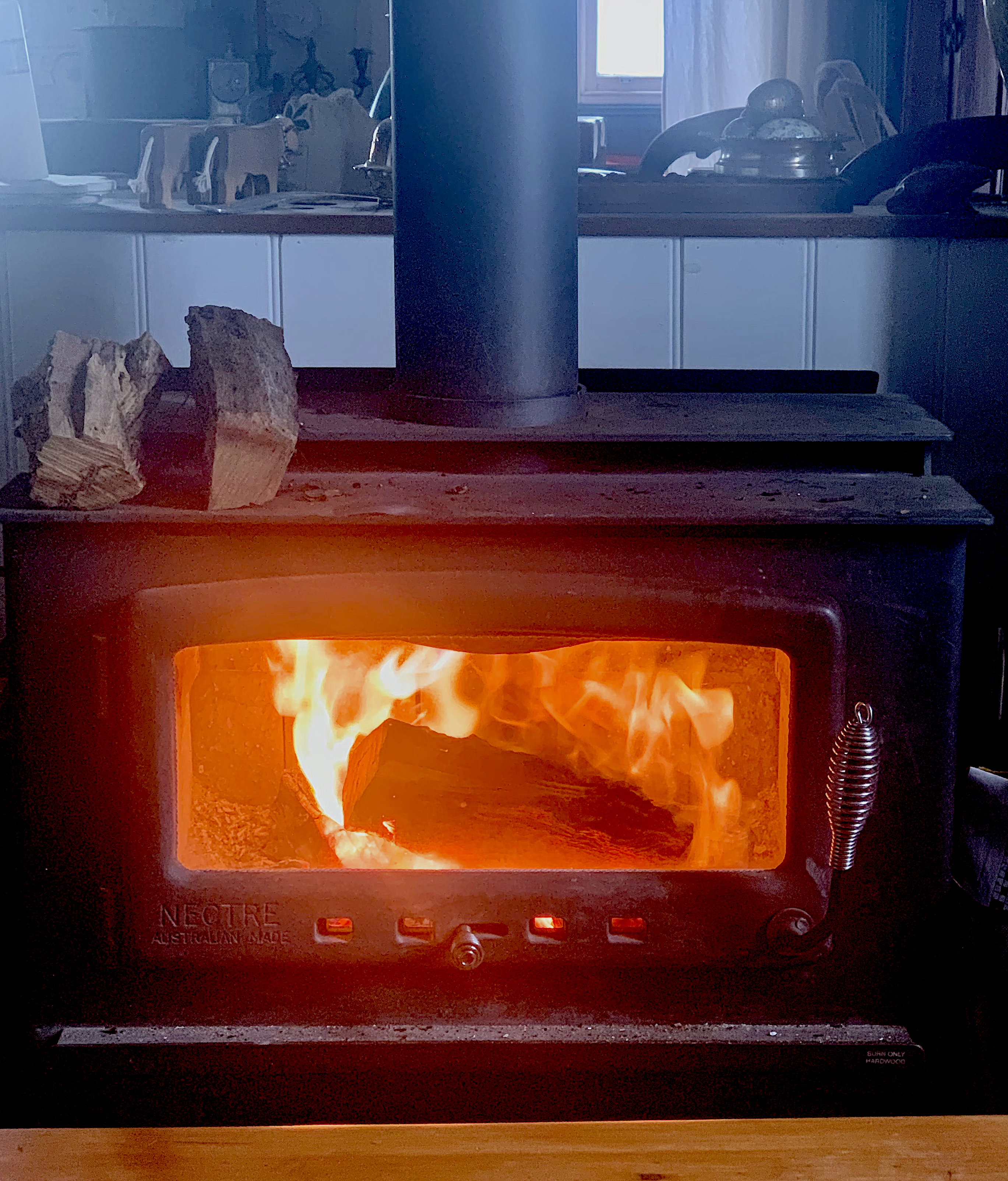
I turn off the TV after the 7 o’clock news. The thought of watching another twee English ‘who dunnit’ with a meddling vicar is exasperating. Instead, I brave the lashing rain and Antarctic winds to get wood from the backyard. I peel back the tarp to find a dry stack and begin to load up my left arm with four or five logs, nowhere near enough to last the night. I repeat the process, cursing under my breath as l lose my footing and slip forward onto my knees. I drop the bundle and have to start all over. My right knee smarts and my jeans are now wet.

Tonight, I couldn’t be bothered with the careful assembly of paper and twigs to make sure the fire starts. Outside, it is six degrees, and I am cold. Impatiently, I shove pieces of cardboard into the fireplace, break up a cube of Samba firelighters and build a tepee of kindling around it. Thankfully, the fire catches and I slowly add larger pieces of wood.

I stare into the fire for a long time, watching the flames engulf the wood. The strong winds must be helping to draw the fire up. I watch mesmerised as the flames lick the back and then the sides of the log. The underside is glowing a crazed orange with hairline cracks developing in the structure of the wood. I can’t stop watching this dance of the flames and soon I notice that I am no longer cold.

The dog stretches out in front of the fire box and falls asleep. Her fur becomes hot to touch but she remains there, contented. I keep watching, unable to take my eyes off the log as it turns from brown to yellow to orange with tinges of blue. The fire now consumes everything I care to feed it. It has turned into a crackling, hungry beast.

In Greek mythology, Prometheus, against Zeus’ wishes, took fire from the gods to give to his beloved mortal beings. This knowledge gave humans not only the means of survival, but it was the cornerstone that enabled civilisation, culture, and the arts to flourish. Zeus’ punishment was to nail Prometheus to a mountain and send an eagle to devour his liver. As Prometheus remains immortal, his liver regenerates, and the eagle feeds evermore.

I am grateful for the warmth still left in the glowing embers. But I do think about poor Prometheus. Looking at tonight’s culmination of culture on TV, I wonder whether he has since regretted giving humanity the gift of fire. I’m not sure I would have bothered.

Nicknacks

I will never be minimalist, a giver away of objects that don’t bring me joy. Nor will I join the latest Swedish craze of death cleaning. As far as I’m concerned, I spent what seems like a lifetime cleaning up after my daughter, and she may as well return that favour when I die.

I like my house filled with books and nicknacks. I look up and see a row of seven miniature blue and white houses that I brought back from Amsterdam in my twenties and think fondly of the four days I spent there. Admittedly, three of these were wasted in various bathrooms as I valiantly fought off food poisoning. I couldn’t look at mayonnaise nor chips for eight long years thereafter. Ironically, the delft houses are now on a shelf in my kitchen, a sober reminder to check use by dates and abide by the three-day rule for leftovers.

In the lounge room, two carved wooden cows take me back to the year we spent in Switzerland. Real cows greeted us daily as we waited at the bus stop in front of a row three storey apartment blocks. They seemed as incongruous there as the many cows here in my living room. Somehow, these two carved cows attracted bovine themed curtains, black and white ‘cowhide’ gumboots and a large painting of a heifer by a well-known artist.

Then there are the two pairs of babies’ boots – my own and my daughter’s, 35 years apart. While I have no memory of wearing my own, I do have memories of my daughter wearing hers. This includes collecting her from childcare and hearing her cry all the way home. When I finally removed her shoes, I found that one of her toes had accidentally been bent back in the boot. I felt faint looking at the deformed toe, but it snapped back into position and her smile returned as if nothing had happened.

On another shelf are some of the penguins I acquired after watching a movie at 3am when I was 19. It was called Mr Forbush and the Penguins. I don’t know whether it was the twilight zone that flicked a switch in my brain or whether the movie was really that compelling, but I began noticing penguins everywhere. Before I knew it, my house turned into a rookery. Of course, once friends noticed my obsession, they feed it for years. I was the easiest person for whom to buy a present. Truth be told, I have grown out of them, but they have become somewhat of a talisman, and I still keep ten or perhaps twenty on show.

Sometimes, when I’m feeling a little morbid, I try to imagine my nicknacks at an op-shop. It is a depressing thought. Instead of thrilled punters on the Antiques Roadshow, I imagine strangers picking up each of my possessions and wondering, ‘what was she thinking?’ This is exactly what I think when I see someone’s treasures randomly placed with mementos from another person’s life. The objects look lacklustre and dull as stripping them of their story has rendered them lifeless.

Yet, when I look at my nicknacks, I connect with them individually. Each one beckons me to remember a moment in my life: the time my grandmother gave me her wedding ring, the time a lover chanced upon a perfect gift or the time my daughter brought back a hand-painted tray from Myanmar. These objects become a container for a story.

Minimalism, on the other hand, is like a brand-new, expensive notebook. It may be beautiful to look at yet never used for fear of despoiling. It’s not for me. I like my dog-eared, ink-splotched notebooks, the ones that have stories inscribed in their very fabric. I consider every one of my objects to be imbued with a narrative gift, and I’m glad of it. It means I will never run out of stories to write.   

Four-leaf clovers

I found my first four leaf clover in a meadow as a nine-year-old child. It felt like a miracle. I picked the clover and put it in my pocket only to find it had shrivelled by the time I arrived home. The disappointment loomed larger than the original miracle. Still, if I could do it once, I knew I could do it again. I became obsessed with finding another one.

I learned that fragile leaves had to be pressed between paper, the quicker, the better. A book would work as would a bus ticket or even a lolly wrapper. At that time, I hadn’t yet acquired my habit of carrying a book everywhere I go, so relied on folded scraps of paper in my pockets.

I began to make a pact with fate – if I were to find a four-leaf clover, it would mean I wouldn’t get into trouble at home; I’d be allowed to go to the cinema on the weekend or the boy I liked would finally speak to me. However, finding the second four-leaf clover, eluded me for a quite a while but I wasn’t deterred. I spent many summer hours in fields looking at clover patches and at first all I saw was a sea of green. Slowly, patterns emerged and then, aberrations in the pattern. Not all of these resulted in finding four-leaf clovers, but I began to find them with increasing regularity.

My obsession hasn’t abated. In fact, my eyes have become so accustomed to spotting slight differences in clover patches that I often notice one as I walk past. It is my special superpower. Not very useful I must admit but I am often met with amazement when I bend down to pick one. Mostly I have an old receipt in my pocket so I can immediately press it, or at worst, I push it down onto my phone screen with my thumb, which works well enough until I get home.

My friends often receive a four-leaf clover in a card wishing them a happy New Year. I note this hasn’t stopped any of the calamities that have befallen us in the past few years. Still, it makes people happy, if only for a few short moments. It is a tangible symbol of my best wishes for their coming year.

As age creeps up and I keep pursuing my childish endeavours, my mind turns to pithy epitaphs I may consider. This one has held its attraction for a while now:

Finder of four-leaf clovers, maker of her own luck.

Mt Fairy

I’m on a sheep farm at Mt Fairy. The homestead and the garden are a nod to English Romanticism, planted to look overgrown with wildflowers and roses, but carefully planned and sown by a gardener with an eye for beauty, balance, and a prophetic ability to see the future of a mature garden.

It is spring and nature erupts with abundance that is almost too much to bear. There is an almost wasteful opulence of beauty and sensual pleasure. With each breeze, petals are shed from the May Bush and form a cream carpet on the grass below. Life bursts with vigour all around us but decay is already evident within the bloom.

I sit under an oak that must be at least 70 years old with a majestic spread across the lawn. It may look English but instead of squirrels, woodpeckers or Hummingbirds, this tree provides shelter to Magpies, rosellas, and king parrots. Then, at night I hear a Southern Boobook above the din of the frogs; it makes a hauntingly beautiful tone, then a second, as if an echo to its own call. It may be tranquil, but it isn’t silent here. Magpies warble from early morning through to the late afternoon and thousands of bees provide a steady hum that forms the percussive backdrop for all other sounds. Flies, like kamikaze pilots, criss-cross my path and thud into the glass panes of the cottage where I am staying. The breeze chimes high-pitched through tree leaves and birds squawk, twitter or chirp at indiscriminate intervals composing their own celebration to the profusion of life.

Beyond the garden, a long dirt driveway beckons to walk a kilometre or two to explore paddocks left and right. At the cattle grid, the illusion of the English countryside ends suddenly.  It has been raining and the road is rutted. There are deep, water-logged potholes to avoid, and I am on the lookout for snakes in the tall grass along the verge. I have my curious dog with me and know I must protect her from the instinct to play with anything that moves. Instead of a snake, I see a blue tongue lizard sunning on the pale compacted earth. It doesn’t move as we approach, not even as I stop to run my fingers down its smooth, scaly back. Instead, it looks at me and darts its blue tongue in and out. I hold the dog, step around the lizard, and let it bask in this early spring warmth.

Between rows of young oaks, the grasses along the paddock fences are up to a metre tall. The rough spear grass sways hypnotically and shimmers like angels’ hair in the distance. It is the only endemic grass I recognise. Other grasses are introduced, like sheep sorrel, which stands out with its rusty small florets. There’s orchard grass and false oatgrass, the tallest of the erect grasses. I watch the breeze bend long and slender stems and look at their weeping heads bob up down, playing with the sunlight. Even weeds are endowed with their own beauty today.

As I walk back unencumbered, I see the owner of the property in the distance. He who has poured his heart and soul into this land, a land that has been in his family for the last sixty years. I see him work each day, moving sheep, mowing lawns, fixing fences, chopping wood. He has transformed the cottage I inhabit from a wool shed to a charming spot for lovers, dreamers, and writers to escape. A place adorned by climbing roses with onion dome buds pressing against the window, a place where I can choose beauty and the pulse of life. I am grateful for this enchantment and the freedom to observe, think and write.

The wild garden

Blackbirds sing their songs of love to my crushed heart. I look to the garden you planted only a few years ago and am astonished at the height of the trees. The wind rustles slender silver birches and the leaves of ornamental pears shiver in rapport. Bees head for an overgrown patch of woody lavender, then to the purple snake bush and the rosemary. These are the only flowers in bloom this early in spring, but I can see budding carnations which are only days in the offing. Apart from these blue hues, the garden captures the full range of verdant tones from olive to sage, emerald to St Patrick’s Shamrock green.

The riot of roses that will transform the garden to a perfumed oasis are yet to emerge. I won’t cut their first blush for your bedside this year. The table shall remain bare, a reminder, should I need one, that you are no longer there. The roses will bloom, and I will reminisce, yearning for the gardener who brought life to barren land. Yes, I will see the beauty of the roses and I shall feel the full sting of their thorns.

A summer without you, in the garden you have sown, is hard to envision. It will live on, your creation, even if you are no longer here to tend it. My heavy hands will attempt your work and every flower will remind me of you.

I asked for an untamed garden, a garden of reckless colour, a garden that reflected my heart and you delivered. And now, now that you have left to return to the eternal, I grieve in the wild garden of my soul.

The nursing home

Recording: https://anchor.fm/viktoria-rendes/episodes/The-nursing-home-e18eob6

My mother-in-law is a fiercely independent woman who at 90 still lived in her own home. That is, until the day when she got out of her armchair, took an awkward step and fell. 

For a long time, everyone in the family had the same unspoken fear. ‘What will happen if she has a fall?’ It was like living with a time bomb. The subject was difficult to broach. Jean wanted to stay in her own home and any other suggestion felt like betrayal. Like all of us, she hoped she would go to bed one night and not wake up the next day.

The night Jean fell, she crawled back across the tiled floor to her armchair. She had shattered her hip. Luckily, she had her mobile. Her first call was to her daughter, not 000. By the time the ambulance arrived to take her to hospital, she was out of her mind with pain. The doctors decided to operate, even though they were concerned about the effects of the general anaesthetic. We didn’t think Jean would pull through. She survived the operation but when she awoke, the pain returned with a ferocity that sapped her will to live. She pleaded with us to end her suffering. She didn’t want to go on. It was difficult to watch. We all felt helpless and unprepared. 

When Jean was admitted, her full name and date of birth were recorded. Her legal name is Janet but she has never answered to this name. Everyone calls her either Jean or Jannie. While for years, Jean had doggedly guarded her independence, she nevertheless readily submits to authority. From the moment she was admitted and her full name entered into the medical database, she became Janet, a name she never liked and part of her identity was stripped away. 

After a couple of weeks in hospital, Jean was moved to the acute ward of a much smaller hospital in a country town. She received excellent care and, with some physiotherapy, managed to take a few steps with assistance. There was a short period where she seemed to understand that her only way out of this predicament was to learn to walk again. Unfortunately, this only lasted a week or two before she fell into a depressive state. Once more, she began to talk about wishing to die. Considering the current spotlight on mental health, it surprised me that no psychological help was on offer for her increasingly depressed state of mind.

Jean still talked about returning home. Some days she confided that she no longer had a clear picture of where everything was in the house. This distressed her. I didn’t feel it was my place to burst that bubble. However, with each day spent immobile, the possibility of going home became increasingly remote. During this time, Jean lamented that she could no longer remember certain parts of the house with clarity and this began to really bother her. Her thoughts looped like a coil:  how much she ‘owed’ me for some hand-creme, whether the gardener had cut back the roses in time and when the next instalment of the rates was due. She worried about forgetting the things that still connected her to the outside world so she repeated each of these thoughts over and over in her mind.

After three months in hospital, the hip had healed but Jean hadn’t. Her daughter found a modern, well-resourced aged care facility not too far from where she lives and Jean moved in. 

When I go to see her there, I can’t fault the nursing staff. A genuine culture of care is evident in the way they interact with the residents. The food is quite reasonable and her room is bright and clean. The furniture is stylish and each room has a large television set for entertainment. Jean sits at a large window that faces onto a courtyard where birds can be seen flitting from one tree to another. The view is serene. But it isn’t home.

Jean tells me that one night a man in wheelchair had made his way into her room before staff could come to wheel him away. This frightened her. And sure enough, the same man wheels himself part way through the door while I sit on her bed. He is convinced it is his room. A member of staff arrives and wheels him away, telling him that he won’t find what he is looking for in Janet’s room. 

Jean looks dismayed. ’I mustn’t complain,’ she says as though she is trying to convince herself that everything is as it should be. 

When I walk through the lounge area, a number of the residents are playing a quiz game without much enthusiasm. A carer reads trivia questions and beckons the oldies to answer. 

‘What is the largest city in Africa?’…’No, it’s not Johannesburg.’ 

’That’s right, Nancy, it is Cairo.’ I cringe, recognising a patronising tone that I wish wasn’t there.  ’Don’t worry, I have chocolates for all of you,’ the carer croons as she proceeds to the next question on her list. 

Back in Jean’s room, lunch arrives. She doesn’t like the soup. ‘I’ve gone off pumpkin,’ she says. ‘But there’s no point in telling them what I don’t like, it comes anyway.’ And later, ‘I like the muesli here but I wish the milk was warm. I always heated my milk in the morning.’ It seems like such a small thing but when your life is reduced to meals, bathroom visits and the telly, the smallest things become magnified.

I take some cups to the dining area as Jean is running out of space on her tray. A woman in her 80s, slumped in a wheelchair looks up. She becomes animated as she sees me advance towards her. 

‘Scuse ee, scuse ee,’ she pleads. I see an open notebook resting on her lap. Two phone numbers in spidery writing dance across the page. ‘Phone? You have phone?’, she asks in a thick accent. I don’t. Not on me. She reaches out, holds my hand and I cannot look away. There’s desperation in her eyes. I promise to return with my phone. ’Thank you, thank you,’ she says over and over. ‘ Maria, my name is Maria.’ 

I dial the first number and get a message from Optus. The number is incorrect. I try the second. This time the phone rings. I hand it to Maria with trepidation. Part of me feels I shouldn’t be complicit in this. 

‘Christina? Is Christina? Please come. Take me home. I no like it here. Please Christina.’ Maria is fighting back tears now. ‘Why no, Christina?’ ‘No, he no come.’ Then, ‘Ok, bye.’ She hands back the phone. Now it is my turn to fight back tears. 

 ‘My name’s, Maria. I come from Italy. Three children, I have three children and what you get? Nothing. All the way from Italy. What for? You get old and they treat you like dirt.’ She almost spits this last phrase to get the taste of dirt out of her mouth. I squeeze her shoulder and slowly walk back to Jean’s room. 

Over the next few hours I become acutely aware of the constant noise and movement around me. Jean likes to keep her door slightly ajar. The corridor outside is a busy place where residents come and go, squeaky trolleys are wheeled along and everyone speaks too loudly. Not even the television can mask the commotion. I imagine myself living here. Me, who craves stillness and silence. 

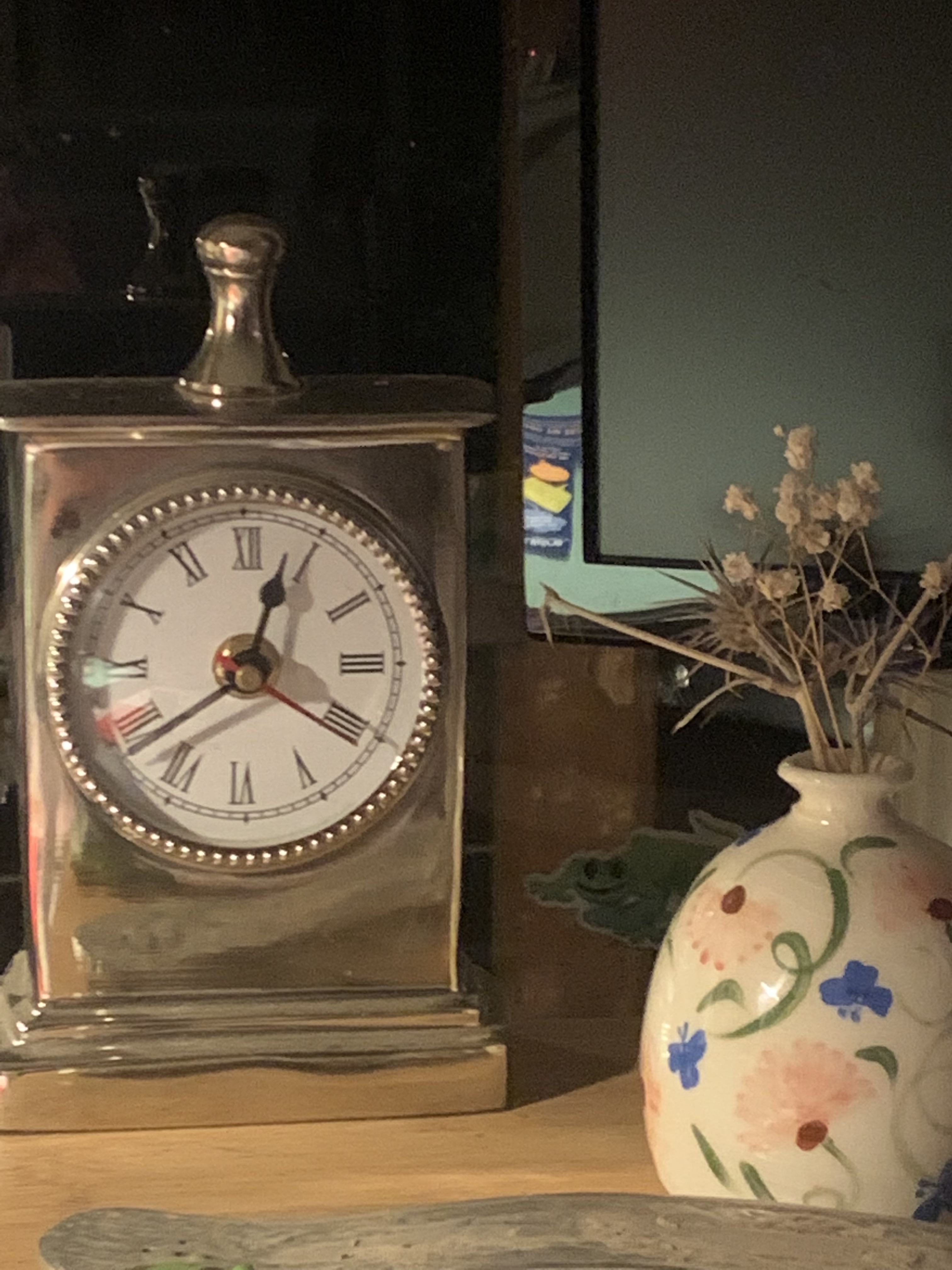
‘The nights are the worst,’ says Jean. ‘I can’t sleep and I can’t have sleeping pills. I just look at the clock and watch the minutes go by.’ 

I take my leave when her evening meal arrives. I plant a kiss on her head and say goodbye. Walking out to the carpark, the sun, lower now, still warms my back. 

It is a long wait until morning.

Making marmalade

Roger makes the best marmalade. People buy his distinctive squat jars of marmalade with their hand-drawn labels to give as presents, but I expect not all jars make it to the intended recipient. His marmalade is legendary. His Seville range is my all-time favourite, but others swear by the whiskey marmalade, mandarin, or cumquat.

‘It is all in the way the fruit is cut,’ he says enigmatically and when I watch him make a batch, I see what he means. He takes his time, halving the orange and halving it again before he begins cutting along one side on an angle. He uses his fingertips as a guide and employs a large sharp knife to cut exceptionally fine slices.

‘That’s the trick,’ he says, ‘most people cut the oranges too thick, and you don’t get the same flavour.’

Roger is right of course. Home-made marmalade is usually chunky with pieces of hard rind which is bitter while shop bought marmalade is over processed mush and much too sweet. Spending the time to cut it finely makes a big difference to the final product.

He rapidly boils the fruit in water before reducing it to a gentle simmer. Floating in the liquid is a small muslin bag he has fashioned with the seeds and pith of the oranges. This releases pectin and helps the marmalade set.

Before adding the sugar, he tastes the rind to ensure it has softened. This is where the magic begins. The marmalade is stirred often, and a small plate awaits in the freezer for the all-important setting point test. Roger has made marmalade for so long now, he needs only to look at the simmering pot to determine whether the timing is right. A small spoonful of the sticky liquid is dropped onto the plate, and he gently pushes his finger from its edge towards the middle. If the surface crinkles, the marmalade is ready to pour into the sterilised jars he retrieves from the oven.

Roger works quickly now, pouring the marmalade into the jars and tightening the lids on with a double twist action. The jars are then taken out into the cold night air and left overnight. This works like a charm. In the morning, the marmalade has set, and the sun plays with the rich, translucent amber colouring.

After the jars are brought back in and cleaned, it is time for the labels. These are handwritten using a quill dipped in India ink. Roger draws a small tree with orange dots on the left-hand side of the label before adding a ‘date of birth’ for each batch. Dozens of exquisite jars line shelves in the kitchen, ready for the taking.

There’s always a smidge of marmalade left which is poured into a small bowl. This is the breakfast marmalade, awaiting a slice of toast or two. There is no point resisting temptation. I shun the margarine, reach for the butter and marmalade and brew myself a strong pot of tea.