The wild garden

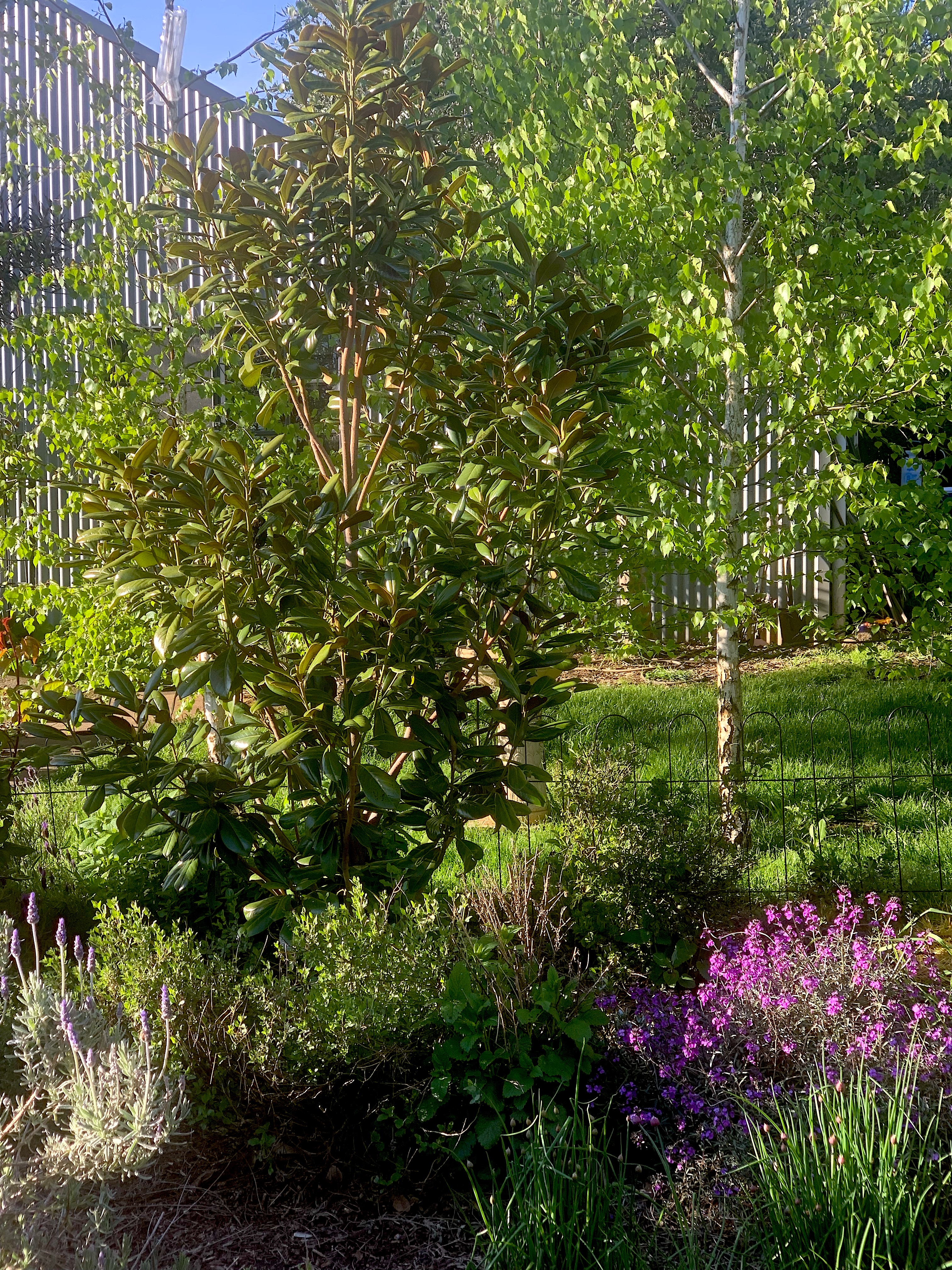
Blackbirds sing their songs of love to my crushed heart. I look to the garden you planted only a few years ago and am astonished at the height of the trees. The wind rustles slender silver birches and the leaves of ornamental pears shiver in rapport. Bees head for an overgrown patch of woody lavender, then to the purple snake bush and the rosemary. These are the only flowers in bloom this early in spring, but I can see budding carnations which are only days in the offing. Apart from these blue hues, the garden captures the full range of verdant tones from olive to sage, emerald to St Patrick’s Shamrock green.

The riot of roses that will transform the garden to a perfumed oasis are yet to emerge. I won’t cut their first blush for your bedside this year. The table shall remain bare, a reminder, should I need one, that you are no longer there. The roses will bloom, and I will reminisce, yearning for the gardener who brought life to barren land. Yes, I will see the beauty of the roses and I shall feel the full sting of their thorns.

A summer without you, in the garden you have sown, is hard to envision. It will live on, your creation, even if you are no longer here to tend it. My heavy hands will attempt your work and every flower will remind me of you.

I asked for an untamed garden, a garden of reckless colour, a garden that reflected my heart and you delivered. And now, now that you have left to return to the eternal, I grieve in the wild garden of my soul.

The nursing home

Recording: https://anchor.fm/viktoria-rendes/episodes/The-nursing-home-e18eob6

My mother-in-law is a fiercely independent woman who at 90 still lived in her own home. That is, until the day when she got out of her armchair, took an awkward step and fell. 

For a long time, everyone in the family had the same unspoken fear. ‘What will happen if she has a fall?’ It was like living with a time bomb. The subject was difficult to broach. Jean wanted to stay in her own home and any other suggestion felt like betrayal. Like all of us, she hoped she would go to bed one night and not wake up the next day.

The night Jean fell, she crawled back across the tiled floor to her armchair. She had shattered her hip. Luckily, she had her mobile. Her first call was to her daughter, not 000. By the time the ambulance arrived to take her to hospital, she was out of her mind with pain. The doctors decided to operate, even though they were concerned about the effects of the general anaesthetic. We didn’t think Jean would pull through. She survived the operation but when she awoke, the pain returned with a ferocity that sapped her will to live. She pleaded with us to end her suffering. She didn’t want to go on. It was difficult to watch. We all felt helpless and unprepared. 

When Jean was admitted, her full name and date of birth were recorded. Her legal name is Janet but she has never answered to this name. Everyone calls her either Jean or Jannie. While for years, Jean had doggedly guarded her independence, she nevertheless readily submits to authority. From the moment she was admitted and her full name entered into the medical database, she became Janet, a name she never liked and part of her identity was stripped away. 

After a couple of weeks in hospital, Jean was moved to the acute ward of a much smaller hospital in a country town. She received excellent care and, with some physiotherapy, managed to take a few steps with assistance. There was a short period where she seemed to understand that her only way out of this predicament was to learn to walk again. Unfortunately, this only lasted a week or two before she fell into a depressive state. Once more, she began to talk about wishing to die. Considering the current spotlight on mental health, it surprised me that no psychological help was on offer for her increasingly depressed state of mind.

Jean still talked about returning home. Some days she confided that she no longer had a clear picture of where everything was in the house. This distressed her. I didn’t feel it was my place to burst that bubble. However, with each day spent immobile, the possibility of going home became increasingly remote. During this time, Jean lamented that she could no longer remember certain parts of the house with clarity and this began to really bother her. Her thoughts looped like a coil:  how much she ‘owed’ me for some hand-creme, whether the gardener had cut back the roses in time and when the next instalment of the rates was due. She worried about forgetting the things that still connected her to the outside world so she repeated each of these thoughts over and over in her mind.

After three months in hospital, the hip had healed but Jean hadn’t. Her daughter found a modern, well-resourced aged care facility not too far from where she lives and Jean moved in. 

When I go to see her there, I can’t fault the nursing staff. A genuine culture of care is evident in the way they interact with the residents. The food is quite reasonable and her room is bright and clean. The furniture is stylish and each room has a large television set for entertainment. Jean sits at a large window that faces onto a courtyard where birds can be seen flitting from one tree to another. The view is serene. But it isn’t home.

Jean tells me that one night a man in wheelchair had made his way into her room before staff could come to wheel him away. This frightened her. And sure enough, the same man wheels himself part way through the door while I sit on her bed. He is convinced it is his room. A member of staff arrives and wheels him away, telling him that he won’t find what he is looking for in Janet’s room. 

Jean looks dismayed. ’I mustn’t complain,’ she says as though she is trying to convince herself that everything is as it should be. 

When I walk through the lounge area, a number of the residents are playing a quiz game without much enthusiasm. A carer reads trivia questions and beckons the oldies to answer. 

‘What is the largest city in Africa?’…’No, it’s not Johannesburg.’ 

’That’s right, Nancy, it is Cairo.’ I cringe, recognising a patronising tone that I wish wasn’t there.  ’Don’t worry, I have chocolates for all of you,’ the carer croons as she proceeds to the next question on her list. 

Back in Jean’s room, lunch arrives. She doesn’t like the soup. ‘I’ve gone off pumpkin,’ she says. ‘But there’s no point in telling them what I don’t like, it comes anyway.’ And later, ‘I like the muesli here but I wish the milk was warm. I always heated my milk in the morning.’ It seems like such a small thing but when your life is reduced to meals, bathroom visits and the telly, the smallest things become magnified.

I take some cups to the dining area as Jean is running out of space on her tray. A woman in her 80s, slumped in a wheelchair looks up. She becomes animated as she sees me advance towards her. 

‘Scuse ee, scuse ee,’ she pleads. I see an open notebook resting on her lap. Two phone numbers in spidery writing dance across the page. ‘Phone? You have phone?’, she asks in a thick accent. I don’t. Not on me. She reaches out, holds my hand and I cannot look away. There’s desperation in her eyes. I promise to return with my phone. ’Thank you, thank you,’ she says over and over. ‘ Maria, my name is Maria.’ 

I dial the first number and get a message from Optus. The number is incorrect. I try the second. This time the phone rings. I hand it to Maria with trepidation. Part of me feels I shouldn’t be complicit in this. 

‘Christina? Is Christina? Please come. Take me home. I no like it here. Please Christina.’ Maria is fighting back tears now. ‘Why no, Christina?’ ‘No, he no come.’ Then, ‘Ok, bye.’ She hands back the phone. Now it is my turn to fight back tears. 

 ‘My name’s, Maria. I come from Italy. Three children, I have three children and what you get? Nothing. All the way from Italy. What for? You get old and they treat you like dirt.’ She almost spits this last phrase to get the taste of dirt out of her mouth. I squeeze her shoulder and slowly walk back to Jean’s room. 

Over the next few hours I become acutely aware of the constant noise and movement around me. Jean likes to keep her door slightly ajar. The corridor outside is a busy place where residents come and go, squeaky trolleys are wheeled along and everyone speaks too loudly. Not even the television can mask the commotion. I imagine myself living here. Me, who craves stillness and silence. 

‘The nights are the worst,’ says Jean. ‘I can’t sleep and I can’t have sleeping pills. I just look at the clock and watch the minutes go by.’ 

I take my leave when her evening meal arrives. I plant a kiss on her head and say goodbye. Walking out to the carpark, the sun, lower now, still warms my back. 

It is a long wait until morning.

Making marmalade

Roger makes the best marmalade. People buy his distinctive squat jars of marmalade with their hand-drawn labels to give as presents, but I expect not all jars make it to the intended recipient. His marmalade is legendary. His Seville range is my all-time favourite, but others swear by the whiskey marmalade, mandarin, or cumquat.

‘It is all in the way the fruit is cut,’ he says enigmatically and when I watch him make a batch, I see what he means. He takes his time, halving the orange and halving it again before he begins cutting along one side on an angle. He uses his fingertips as a guide and employs a large sharp knife to cut exceptionally fine slices.

‘That’s the trick,’ he says, ‘most people cut the oranges too thick, and you don’t get the same flavour.’

Roger is right of course. Home-made marmalade is usually chunky with pieces of hard rind which is bitter while shop bought marmalade is over processed mush and much too sweet. Spending the time to cut it finely makes a big difference to the final product.

He rapidly boils the fruit in water before reducing it to a gentle simmer. Floating in the liquid is a small muslin bag he has fashioned with the seeds and pith of the oranges. This releases pectin and helps the marmalade set.

Before adding the sugar, he tastes the rind to ensure it has softened. This is where the magic begins. The marmalade is stirred often, and a small plate awaits in the freezer for the all-important setting point test. Roger has made marmalade for so long now, he needs only to look at the simmering pot to determine whether the timing is right. A small spoonful of the sticky liquid is dropped onto the plate, and he gently pushes his finger from its edge towards the middle. If the surface crinkles, the marmalade is ready to pour into the sterilised jars he retrieves from the oven.

Roger works quickly now, pouring the marmalade into the jars and tightening the lids on with a double twist action. The jars are then taken out into the cold night air and left overnight. This works like a charm. In the morning, the marmalade has set, and the sun plays with the rich, translucent amber colouring.

After the jars are brought back in and cleaned, it is time for the labels. These are handwritten using a quill dipped in India ink. Roger draws a small tree with orange dots on the left-hand side of the label before adding a ‘date of birth’ for each batch. Dozens of exquisite jars line shelves in the kitchen, ready for the taking.

There’s always a smidge of marmalade left which is poured into a small bowl. This is the breakfast marmalade, awaiting a slice of toast or two. There is no point resisting temptation. I shun the margarine, reach for the butter and marmalade and brew myself a strong pot of tea.

Letter writing

I have always been a letter writer. As a child I wrote letters to my grandmother on wide-lined stationery with a scene of snow white printed on the top of each page. The seven dwarfs with coloured hats stood in a garden next to a cottage where Snow White leaned out of a window. The scene took up about a third of the page for which I was grateful, as I never really knew what to say to the old woman who lived far away and whose face I could not recall.

Later, I wrote letters to friends and found I had lots to say. Some were posted while others were passed furtively across a school desk, telling my best friend about some drama unfolding in my head. I wrote letters to boys I liked that were never posted. I spent hours agonising over the right words to use but in the end, they were scrunched into tight balls and thrown into the wastepaper basket. I was doubly frustrated when I not only missed revealing my feelings to the boy du jour but missed the bin as well.

In my twenties I began to travel and collected friends around the world. The friendships were intense, and we talked for hours about the state of the world, books we were reading and courses we took at university. Phone calls were expensive, so we wrote – sometimes daily, on light blue aerograms which were as thin as tissue paper and cheap to send. I bought aerograms by the dozen, franked and ready to send. I modified my messy script so I could fit more onto the page and once I folded and licked the three sides to seal the letter, I sometimes added a P.S. under my address on the outside.

My letters began to be more sporadic in my thirties as I worked, commuted, and eventually had a child. Phone calls became cheaper and for a while, I alternated writing letters with a call every now and again. The letters arriving in my letter box became less frequent too, as my friends took on responsibilities and our yearly trips stretched to two, five or more years. With the arrival of email, we promised we would write more often but this never eventuated. Email doesn’t have the same impact as retrieving a handwritten envelope from the letter box and tearing it open to reveal a letter to hold in both hands. A letter is to be savoured, to be read and reread, shown to a friend or two and kept safe.

After years of neglect, I have started writing letters again. Letters to my 91 year-old mother-in-law who cannot hear me on the phone, letters to friends in lock-down and the occasional letter to old friends overseas. I haven’t tried to buy an aerogram for years and don’t know whether they still exist. I have, however, tracked down an alternative on thicker paper with a prettier cover that folds and gums just like aerograms did. Maybe letter writing is making a comeback the way vinyl records have done. I feel a pang of nostalgia as I write on this paper and love that I have to keep my message brief. The recipient of my letter must carefully cut open the sides to reveal that which I have shared within.

Rereading old letters, I come to understand their real purpose. Much more than simply an exchange of information, they are a testament to the bond of friendship nurtured over the years.

Spring

Spring has come suddenly. A week ago, temperatures were still in single digits and icy Antarctic winds blew across paddocks. This week, an azure sky greets us each morning and buds are shaking off their winter mantle, emerging from their deep sleep.

In a single day, leaves appear and apple blossoms beckon bees to their nectar. The first flies emerge and even they are a welcome sight. A young green backed crimson rosella who has come looking for seeds is quickly set right when she intrudes on an adult pair feeding. Stocky, crested pigeons arrive and there’s a stand-off between the birds. A dog barks and the pigeons take off with a characteristic whistling sound. This is created as air flutters between narrow feathers on its wing. A pied currawong lands and has a furtive look but is driven away by a pair of magpies. They feed, crane their necks towards the sky and warble in gratitude before leaving.

In the backyard, the lawn is overgrown. A languid blue tongue lizard emerges from the shadows seeking the sun. It could be mistaken for a garden ornament until something catches its eye. Suddenly it moves with diagonally opposite feet at unexpected speed. It is a reminder that snakes are also coming out of brumation and are looking for food, warmth and a mate.

After a wet winter, water lies in flooded ditches and the Eastern froglet can be heard from a distance. The deafening sound is easily confused with that of a cricket except that the chirp is at a slightly lower pitch. There must be dozens of these critters creating such a racket. Not even walking past with dogs disturbs the male frog’s amorous call.

Ornamental prunus blush pink along the nature strip, like bridesmaids at a wedding. They sway in the September wind, decidedly underdressed in blossoms without foliage. Other trees experiment with sending their first leaves to their stem tips. Is it time to let the next ones unfurl or is it better to wait? The silver birches err on the side of caution and hold tightly onto their buds. They aren’t ready yet to trust the change of season.

It seems the birches are right. As the afternoon progresses, the wind pulls across a blanket of grey clouds to cover the sky and temperatures drop back to single digits. Trees shiver and blossoms begin to lose their precious first petals. Tree branches knock against the windowpane as if asking to be let in from the cold. Spring may dither in these first few weeks of September but there’s no holding back its promise of abundant splendour.

Cyclamens

My grandmother lived in an old war-scarred building in central Budapest. There were gunshot wounds on the outside façade and even the courtyard wall showed bullet holes from the hand-to-hand combat that took place in 1944 and again in 1956.

She lived in a tiny flat on the second floor with windows facing the cobbled courtyard that was in shadow for most of the day. For no more than a couple of hours, the sun’s rays found their way to her window and graced the otherwise dull living room with light. This was the world she inhabited for over 40 years.

She didn’t have many possessions and most of what she owned was utilitarian. The exceptions were some crocheted doilies on a coffee table, a few precious crystal glasses in a vitrine and two pots of cyclamens, pink and white which she kept on the windowsill in between old-fashioned double opening windows.

Her cyclamens bloomed even in the depths of winter when snow lay ankle deep on pavements. The space between the two windows became a greenhouse where her precious flowers flourished and brought delight. Cyclamens were her favourite flowers and she had a gift for encouraging them to bloom.

I have never been quite so lucky with cyclamens. I overwater them, have them too close to a western window where the leaves fry or I place them too far from the sun so that the flowers have to crane their necks to get to the light. My flowers never look better than on the day I receive them, wrapped in tissue paper from a well-meaning friend.

‘They look so beautiful!’ I say and I mean it with all my heart. But my hear sinks a little too. I know that no matter what, in a month, the flowers will be well past their glory days. They will never look like the burst of blooms on my grandmother’s windowsill.

‘Thank you so much, Cyclamens always remind me of my grandmother,’ I say wistfully. Then, my friend, satisfied with her choice, knows that she has given me the perfect gift…

Die Kinderwelt von A-Z : a children’s encyclopedia

Books were a rare treat in our house. My father only read Penny Dreadfuls he bought at railway kiosks, printed on cheap, sepia coloured paper. They were either short crime stories or westerns. Resembling newsprint, they appeared in two columns in a font that was hard to read. For my short-sighted father, they would have presented quite a challenge, especially as he was reading in a language that wasn’t his own.

I learnt to read Enid Blyton’s Noddy books which were readily available at our school library, translated into German. I read and reread his adventures under my doona using a torch to illuminate the page. Lights had gone out long ago.

I loved losing myself in stories, pretending I was right there with the characters who had become my friends. I was closer to Pippi Longstocking than any of my classmates. I could anticipate her every move and even finish her sentences. She was a braver version of me, an unconventional girl who wasn’t afraid to speak her mind.

When a book fair was announced at our school, I begged my mother to be allowed to go. There were two long trestle tables with books displayed face out. My mother, seeing the wide-eyed look of desire, whispered caution in my ear. ‘You can only choose one,’ she said.

Many wonderful stories beckoned but I knew that choosing one could never satisfy. But the thickest book there was different to all the others. It promised to reveal the whole world  A-Z and that was the one I chose.

When we arrived home, my mother took out our sharpest knife and ran it between each adjacent page. It was only then that the contents of the encyclopedia were revealed. I inhaled the smell of the paper and ran my fingers along the cloth spine. I knew I would treasure this book.

On page twenty-five, I found a map of Australia. Back then, it seemed like an exotic place far, far away. I remember looking at the depiction of a spear throwing Aborigine, wheat, gold, and kangaroos. I never imagined I would go there.

I learnt so much about the world around me from this book. Everything from descriptions of wild animals to how motion pictures work and even the symbols used in Morse code could be found between its covers. I read and reread many of its pages for years.

Today, I have several thousand books in my collection. I still delight in their smell and occasionally, I still have to cut open their pages. Books present both a sensual and cerebral pleasure and while there are many books I treasure, the pride of my collection is this quaint old-fashioned children’s encyclopedia. After all, it started my love affair with collecting books.

Sourdough

Baking sour dough bread is my meditative ritual. It is slow and deliberate and gives shape to my week. Three years ago, on a weekend retreat at Shalom in the small town of Carcoar, I was given the gift of fermented wild yeast known as starter. On that weekend we learnt to make sour dough bread. While waiting for the leaven to infuse the dough, we reflected on bread as a gift of life.

The oldest forms of bread are thousands of years old. When ancient grains were ground into flour and made into a paste with water, they were cooked on hot stones in fire. Then it was discovered that if the paste was not immediately used, it fermented naturally as wild yeast began consuming the sugars in the grain. This wild yeast is in the air all around us, just waiting for a host. Given the right conditions, it will begin the fermentation process.

Yeast is a single cell living organism which releases carbon dioxide as it is fed. This is what gives bread its characteristic tiny holes throughout. I have made bread for many years using baker’s yeast. It is quick and easy, but the bread hardens quickly. For a very long time, I bought yeast in little sachets and never knew that a wild variety was freely available and everywhere. 

Bread has long been considered the staff of life. We break bread with family and friends and Christians pray ‘give us this day our daily bread.’ It is nourishment for body and soul.

And so, we come to my weekly ritual. Tuesday night after work, I take the jar of sour dough starter out of the fridge. Sourdough bakers like to continue a long-held tradition of naming their starter. Mine came from a wild yeast mixture called Harold and I have called his daughter Demeter, after the Greek God of harvest and fertility. When I open the jar, Demeter looks rather neglected. There is a dense grey sediment at the bottom of the jar. I put my nose to it. A strong smell of alcohol affronts my senses. I swirl the jar and see the culprit. Hooch, a light alcoholic liquid, has formed on top of the flour mixture.  Demeter is telling me she needs to be fed. I discard the hooch and I’m left with a mixture not unlike house paint.

I need to feed this beast. Equal parts of strong baker’s flour and water should do the trick. I measure out my quantities with precision and stir. This mixture will sit on my window sill until Wednesday night.

Come Wednesday, I remove the lid to find that Demeter has come back to life. She is bubbling at the surface and the mixture looks light and fluffy. She now has that pleasant fruity yeast smell I associate with bread making. Each time I observe this phenomenon, I marvel at the tenacity of life. It doesn’t take a lot to coax it into being. At times, I feel like an alchemist, mixing my ingredients to produce pure gold.

I am ready to start with my first pre-ferment. Making sourdough requires flour and water to be added in small quantities at first. This process of adding equal parts of flour and water are repeated, each time in larger measure. I cover my dough-to-be with a beeswax wrap and let it rest until the following morning when I coax it with more flour and water. This is the second preferment.  It is now Thursday night and I can finally add half a kilo of flour, water, seeds and anything that takes my fancy this week. My trusted spurtle, a rod-shaped Scottish porridge stirring stick, is put to good use as I autolyse the bread. It is a gentle method of mixing the ingredients which is followed by a well-earned 20 minute rest. A glass of red is the perfect way to while away the time until the dough is ready to be stretched and folded. Finally, I get my hands into the dough and gently pull it out and fold it back in three to five times before putting it to rest overnight in the fridge.

I think about bakers spanning millennia engaged in the ancient art of making bread. The recipe, adapted to new environments, refined by the hands it has passed through makes its way across centuries and cultures to the bakers of today. I am honoured to be part of this ancient lineage. My much-loved recipe and sour dough starter were a friendship offering by a master baker to his apprentice. In continuing this tradition, I have watched my levain grow in distant kitchens of friends and family with whom I break bread.

For three days I have stretched and folded and stretched and folded the dough. It is now ready for the last step. I heat the oven, slash the loaf and watch it rise through the tempered glass door. The smell of fresh bread wafts through the house. Within forty-five minutes, the crust is crisp and brown. I turn the bread out onto a rack and knock on its underside. A hollow sound at the centre tells me it is ready. As much as I am tempted to cut into it now, I leave the bread to cool. This completes the cooking process. Waiting another couple of hours seems like a small sacrifice to make.

Finally, the bread is ready to eat. At first, the knife resists the crust before slicing through its soft centre. I treat myself to the end piece, lightly buttered and crunchy. Demeter has worked her magic once more.

Mushrooms

Chanterelles  or Eierschwammerl/ Pfiffferlinge © Nadya Kubik / shutterstock.com

‘See if you can find some mushrooms in the woods, when you come home from school’ my mother said before leaving for work. September was the best time for picking mushrooms and of all the chores, this one was my favourite. I took my dog, a bitser of a German Shepherd and, wicker basket in hand, we headed off. Going mushrooming was an adventure, a reason to go exploring the woods with my favoured companion.

I was nine years old and knew all the edible mushrooms of the Vienna Woods. I followed my nose and went deep into the forest where the dappled light shimmered across shadows and birds courted each other atop the canopy of beech trees. I listened for the cuckoo, the woodpecker, and the chirpy lark. They accompanied me in song and lifted my spirits as I meandered from the path in search for mushrooms at the base of ancient tree trunks.  

Looking for mushrooms was different to every other chore I had. It wasn’t time bound – I could justify being away for hours, unlike going to the shop to buy bread. To my dismay, my mother could calculate the time it took to walk there and back to the minute. Mushrooming, however, was an art, and art took its time. No one would accuse me of dawdling in the woods.

Deep in the forest, I felt at peace. Safe with the dog by my side, we looked out for one another. He never ran too far from my side. I was there to remove a thorn from his paw or find a cool stream for a drink, he was there to protect me. Sometimes, it was he who led me to the tastiest mushrooms. These afternoons were our precious time together.

While finding mushrooms for that night’s dinner should have been foremost on my mind, there were unexpected pleasures in the woods; a salamander that scuttled across the path and disappeared under leaves, a doe that looked deep into my eyes before trotting away. These encounters were pure rapture. I knew I belonged to this magical world and would always be welcomed home.

And then, there were the times when I found a meadow of wildflowers and I’d fill my basket before remembering the real reason for my ramble. Or, tired from my long walk, I’d lie down in a clearing and watch the clouds assemble into my favourite animals. All I had to remember was to be home before six and explain that mushrooms were particularly difficult to find that day. This was the latitude I was given when looking for mushrooms that would provide our evening meal.

Even so, I still had to find them. I could not go home empty handed for there would be no dinner on the table. I’d search carefully around promising trunks, moving leaves with a stick or bending down to explore a mound that could signal a troop of mushrooms. I was always delighted when my instincts proved right and I could pick three or four chanterelles before moving on.

On bountiful days, I’d return with enough mushrooms for a couple of meals. The sweet earthy smell in my basket scented the kitchen. For the next two nights, we would eat well. We’d have our fill of fried mushrooms and boiled potatoes and would not go to bed hungry.

The ink blotter

As a young child I loved my pen but hated my handwriting. My letters were neither neat nor tidy; they danced a wild tarantella across the pages of my exercise book. I had learnt to write with an old ebonite fountain pen that belonged to my mother. The pen had an elegant green and black pattern and made me feel quite grown up. But fountain pens are faithful creatures, and they won’t accommodate another person’s hand. The nib of a pen is bent toward the shape of a writer’s hand.

Try as I might, my letters were either scratchy or overflowing. Many a night I sat crying over words that spilled on the page or smudged as I closed my exercise book. Yet I loved the smell of the blue-black Pelikan ink that ebbed and flowed from the bottle on my desk. My fingers were constantly spattered with ink which left adults frowning.

Later, when my letters had been beaten into shape, I enjoyed writing letters to a friend left behind at another school or to my grandmother who lived in a country we would never visit. And then, there was the old woman who lived in a villa on the way to school, who reminded me of grandma. She had fine lines around her twinkling eyes which appeared when she smiled. When she invited me in, I was ushered into a large room with floor to ceiling bookcases and a stately oak desk upon which I spotted an ink blotter. At first, I had no idea what this contraption could be. Her ancient husband sat at the desk composing letters and when he finished a page, he reached for the blotter and in a see-saw motion, he dried the ink.

I found this simple device endlessly fascinating. I could watch for an eternity, waiting for him to finish a page and reach for the wooden artifact with a piece of blotting paper covering its convex base. There was something alluring in the simplicity of its design. I inched closer to watch him write. He used a carbon copy book for his correspondence, a habit I later adopted myself.

‘May I dry the page for you?’ I finally had the courage to ask. He lifted me onto his lap and guided my hand over the ink blotter. I felt entrusted with an important task as my hand rocked back and forth drying the ink. He then folded the letter, slipped it into an envelope, and I licked the gum to seal it.

I adored this old couple in the villa with its overgrown garden. I visited often and we talked about the books I had read and poems I liked to write. Entering their library, I was transported to a magical world of books and writing. The old ink blotter remains a tangible expression of that magic.