Winds have cut through last week with an invisible scythe. The billabong is covered with dust and debris and smells putrid. Tiny flies swarm around the water’s edge. As I look at the devastation around me, I am surprised there are no trees down. Plenty have fallen in surrounding suburbs.
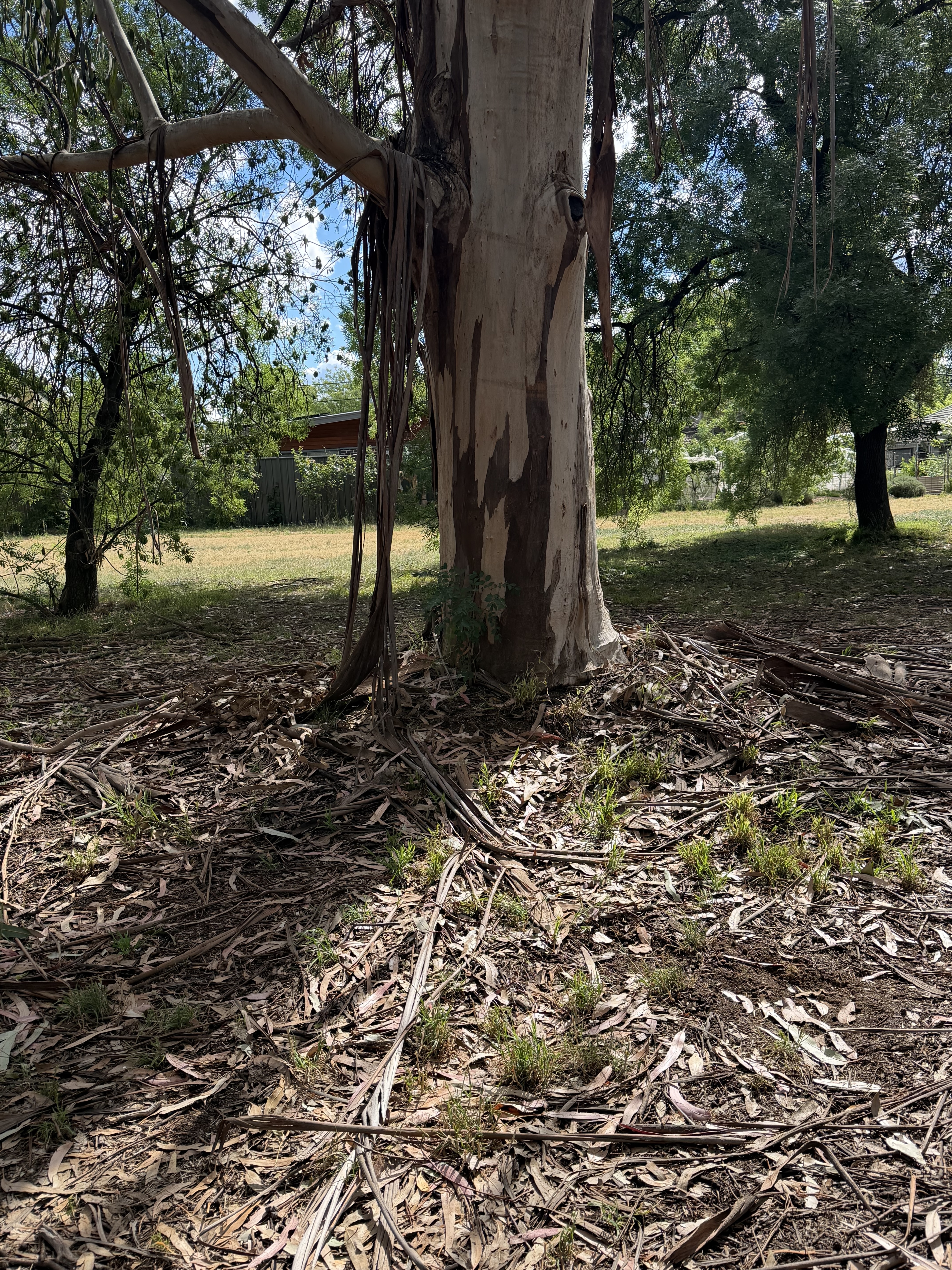
Leaf litter lies ankle deep, mixed with bark stripped clean from trunks. It is as if Mother Nature has sandblasted her children bare. How did young chicks in those swaying canopies survive wind gusts of 80 kilometres an hour? I’ve not heard a peep from them this morning.
The accompanying storms were short lived but the wind continues to rumble and roar like a road train. The little rain that came with it evaporated within hours, leaving the ground just as compacted and impenetrable as before. Any loose soil has been spun around and around like whirling dervishes in a trance. I am transfixed by the spectacle of dozens of whirly whirlies, small rotating whirlwinds forming across the denuded field.
My walk in town yesterday was miserable. The wind fired bullets of grit at my face and eyes. Its fury whipped up loose items on the ground and hurled them at unsuspecting passers-by. Women tacked their skirts as they leaned into the wind, slicing through the air. Children clung to their parents’ hands, wondering what might happen if they let go.
Back home, windows rattled and walls were buffeted. Further north, roofs and even lives were lost. I never felt any immediate danger, only awe at this force of nature completely out of our control. These past few days have been a reminder that nature is not something separate from us but an integral part of our daily lives. We need only to pay attention to it.
I discovered summer pudding many years ago at my mother-in-law’s place. It felt as if the dessert had been invented just for me. Cherries and berries are my favourite fruits and from the moment they come into season, my hands and lips are stained red and blue. I have been known to eat a kilo of cherries on a long car ride, with disastrous consequences to follow. Still, I can’t help myself. ‘Just two more,’ I tell myself, and then 2 kilometres later, ‘just another two and I’ll stop.’ These days I only buy 500 grams at a time. Self-control has never been my strong suit.
Summer pudding combines all my favourite fruits in a simple, almost humble dish. It originated in England, and I expected it to have a long, storied history. Surprisingly, the recipe dates back only to the late nineteenth century. In my mind, I had imagined a tradition going back hundreds of years. I pictured young girls wandering through fields, gathering wild berries for their mothers to turn into a cheap pudding. In reality, those girls probably ate the berries as fast as they picked them.
Nowadays, berries are expensive unless there happens to be a glut. Mulberries, raspberries and blackberries can be wildly expensive. Early season cherries are a luxury not many people can afford. Even strawberries, the most reliable and affordable of the berries, fluctuate in price. Making a summer pudding, at least without access to free fruit, ends up being more expensive than baking an elaborate cake. So much for my fantasy of it being a poor man’s pudding.
The trickiest part of making it is leaving it to set overnight. Patience is another virtue I lack. Every time I open the fridge, I can see the pudding with my cast iron teapot on top, pressing the bread down over the fruit. It will be ready by tomorrow afternoon, I remind myself. Less than twenty-four hours to go. And besides, I don’t even have clotted cream. Yet.
If this dessert sounds like heaven to you, here is a recipe. The quantities aren’t exact. Use whatever fruit you have, however much of it you can get your hands on. You could make a summer pudding entirely from raspberries, but I prefer a mixed variety.
Summer pudding
Stale sliced white bread to line the bowl 1kg mixed summer berries such as strawberries, cherries, blackberries, mulberries, raspberries ¼ cup caster sugar A splash of liqueur such as Kirsch if you like Clotted cream to serve
Cut the crusts off the bread. Wash the fruit and remove stalks, stones and pips. Cut the strawberries into pieces. Place all the fruit into a pot with the sugar and about ¼ cup of water. Cook for 2–4 minutes, until the sugar dissolves, the fruit softens and the juices run. Drain the juice. Brush the stale bread with the juice and line a bowl, juicy side outwards. Slightly overlap each slice so there are no gaps. Cover the bottom of the bowl too. Pour the fruit into the bowl with a little juice and cover the top with bread. Press the pudding down with a saucer and some heavy items on top. Refrigerate overnight or longer. Run a knife around the edge of the pudding and pour a little juice around the outside. Invert the bowl onto a plate and ease the pudding out. Serve with the remaining juice, clotted cream and extra fruit if desired.
Thank you dear Margaret for sharing this recipe and memories they evoke.
Post script
I bought clotted cream, invited a neighbour and a friend, and we attacked the pudding. It was delicious. The cream had to be scooped off the spoon, it was that thick. If you think the cream is unnecessary, you’d be mistaken. The pudding is quite sweet and needs the richness of the cream to balance the flavours. As scrumptious as it was, none of us could fit in seconds.
The first time I saw Lake George was almost 30 years ago. We were travelling to Canberra along the Federal Highway when the lake appeared to our left. It looked like an enormous expanse of water that accompanied us for what seemed like a long time. Later I would learn that the lake is 20 km long and 10 km wide. I thought all of Canberra’s drinking water must come from this enormous lake.
A few years later, we travelled the same route and I was looking out for the large lake. It wasn’t there. All I could see were cattle and sheep grazing where the lake should have been. There were even fences. It struck me that I couldn’t see any creeks that should have fed into a lake. Could I have imagined the expanse of water?
In time, I learnt that the lake regularly empties and fills. There are no creeks that feed into it, which makes it an unusual type of lake, a closed basin. What feeds it is rain and what drains it is evaporation. When it does have water, it is rarely deeper than 1.5 to 2 metres. This was not always the case. I have seen photos from the early 1960s when the Canberra sailing club held regattas on the lake. And in prehistoric times, the lake is estimated to have been 37 metres deep. With the current rate of climate change, Lake George will experience more severe fluctuations, and it may become a dry bed with only occasional filling episodes. So much for my fanciful idea that it could supply drinking water.
I have now lived in Canberra for close to two years. In that time, I have seen the lake fill and begin to drain again. There are cattle at the northern end now and I can see the fences appear again. Looking across the lake, I see a wind farm that one of our ex-politicians, Joe Hockey, described as ‘a blight on the landscape’. It makes me wonder whether he has ever seen an open cut mine. I quite like the look of the wind turbines in the distance.
Last winter, my boss and I had to drive to Sydney a couple of times. When we left Canberra it was still dark, and the sun had just begun to peep over the horizon as we came down towards Lake George. I was mesmerised. The black expanse of water slowly changed to navy, then cerulean. Golden threads shimmered where the sun’s rays bounced off the water. I was glad not to be the driver, so I could immerse myself in the liquid light of the lake.
Lachlan Macquarie named this expanse of water Lake George after King George III in 1820, as if it didn’t already have a name. To the Aboriginal tribes of the area, the lake was known as Weereewa or Ngungara. It has deep significance to the custodians of the land and waters as both a meeting place and a place for ceremonies. There is also strong evidence that there was a massacre at the site sometime in the early 1820s. King George III never set foot on Australian soil. It is time to recognise the custodians of this land and the lake, allowing them to reclaim it with their own language and rightful name. The lake is waiting for us to remember its true name.
Late to the arrival of Facebook, I only signed up because my daughter was overseas at the time. As a teacher, it was a decision I did not take lightly. I wanted to keep my anonymity. It was only when a dear friend suggested that I did not have to use my real name that I finally relented. I became Lotti McNiece. Lotti was the name of our mini poodle and McNiece was my husband’s surname. People who knew me could find me, others would have a hard time.
Years after Lotti died, I kept her name. People would walk up to me saying, ‘Aren’t you Lotti?’ and my standard reply was, ‘Well, yes and no…’ My husband had his own version of an alter ego. A Francophile, he studied the works of Louis Aragon and often used the name Louis when ordering at coffee carts. At home he became Louis Leoir, a struggling student in our daughter’s make believe class. And when we played our own version of Fawlty Towers, she became Polly and we imitated Sybil and Basil. Playing with names became a family tradition.
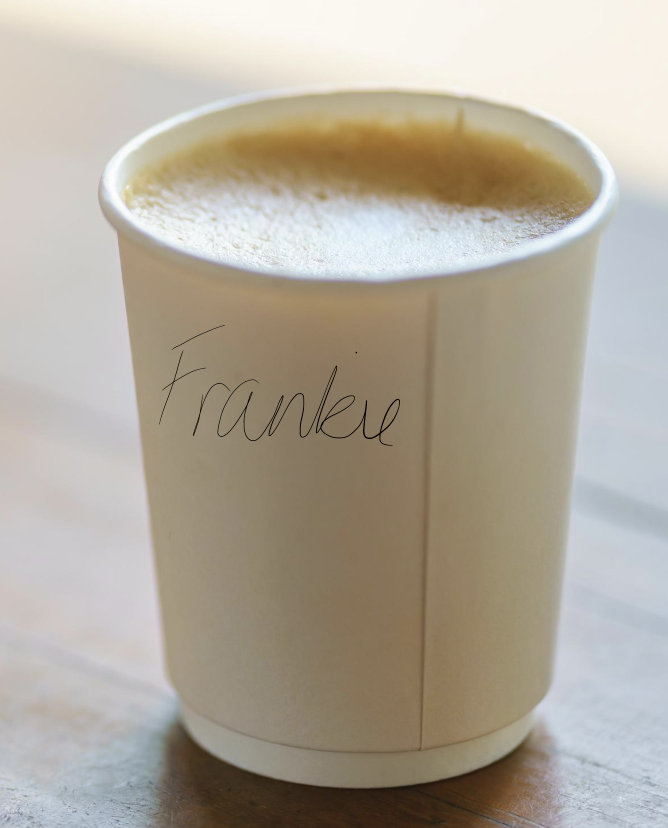
As a nod to my late husband, I use a variety of different names when ordering coffee. I seem to be fond of Frankie, Lotti, Zoe, Clara and Ella. At times I have even used Mark and Dan just to get a reaction. Alas, nothing can shock a barista. They probably think I am ordering coffee for someone else. Colleagues, on the other hand, giggle whenever I use a pseudonym as if they are witnessing some mischievous folly.
Most people I know are very attached to their names while I am, at best, ambivalent. As a child I was known by my middle name, Angela. This changed on the day I started school in Australia. As there was already an Angela in the class, my teacher insisted on calling me Viktoria. I hated it. It sounded so pompous. The moment I could find my voice, I began to call myself Vicki in an attempt to fit in. At home I had a nickname, so I learnt to respond to any of the four names I could be called. In my late twenties I reverted to Viktoria in an attempt to sound more mature. It is definitely a name to grow into. Over the years, some people have consistently called me Elizabeth, a misassociation of my name with the late queen of England instead of her great-great-grandmother, Queen Victoria. I respond well to Elizabeth.
While standing in line for coffee today, I watched a young man attempt to place his order. The woman behind the counter could not make out his name. She repeated several possibilities, none of them right. In the end, to keep the queue moving, he simultaneously nodded and shrugged when she said, ‘Josh?’ And so he became Josh for the duration of his brew. I leant over and confessed that I often use a pseudonym in these situations. It’s fun to try on different personas.
‘25 names in 25 days,’ he said with a twinkle in his eye. A conspiratorial moment shared between two strangers before I ordered my coffee.
There is an ancient rainforest at the bottom of a gully in Katoomba. To reach the forest floor of the Jamison Valley, I take a cable car that drops 200 metres at a 36 degree incline to attend a special session of the 2025 Blue Mountains Writers’ Festival. As we descend, the vertical sandstone cliff face looks almost close enough to touch. Three hundred million years ago, an expansive sea spread over this area. Over millennia, sediment and sand formed into hardened layers which we now recognise as sandstone. Each layer reveals its geological history through erosion, sedimentation or uplift. This cable car is my TARDIS. It is the closest I come to time travel.
The sandstone is ragged. Tiny ledges mark the layers, and wherever a square centimetre can be found, life takes root tenaciously. Small trees curl their roots around rock and somehow find enough nutrients to stay alive. I am in awe of the miracle of life I am privileged to witness.
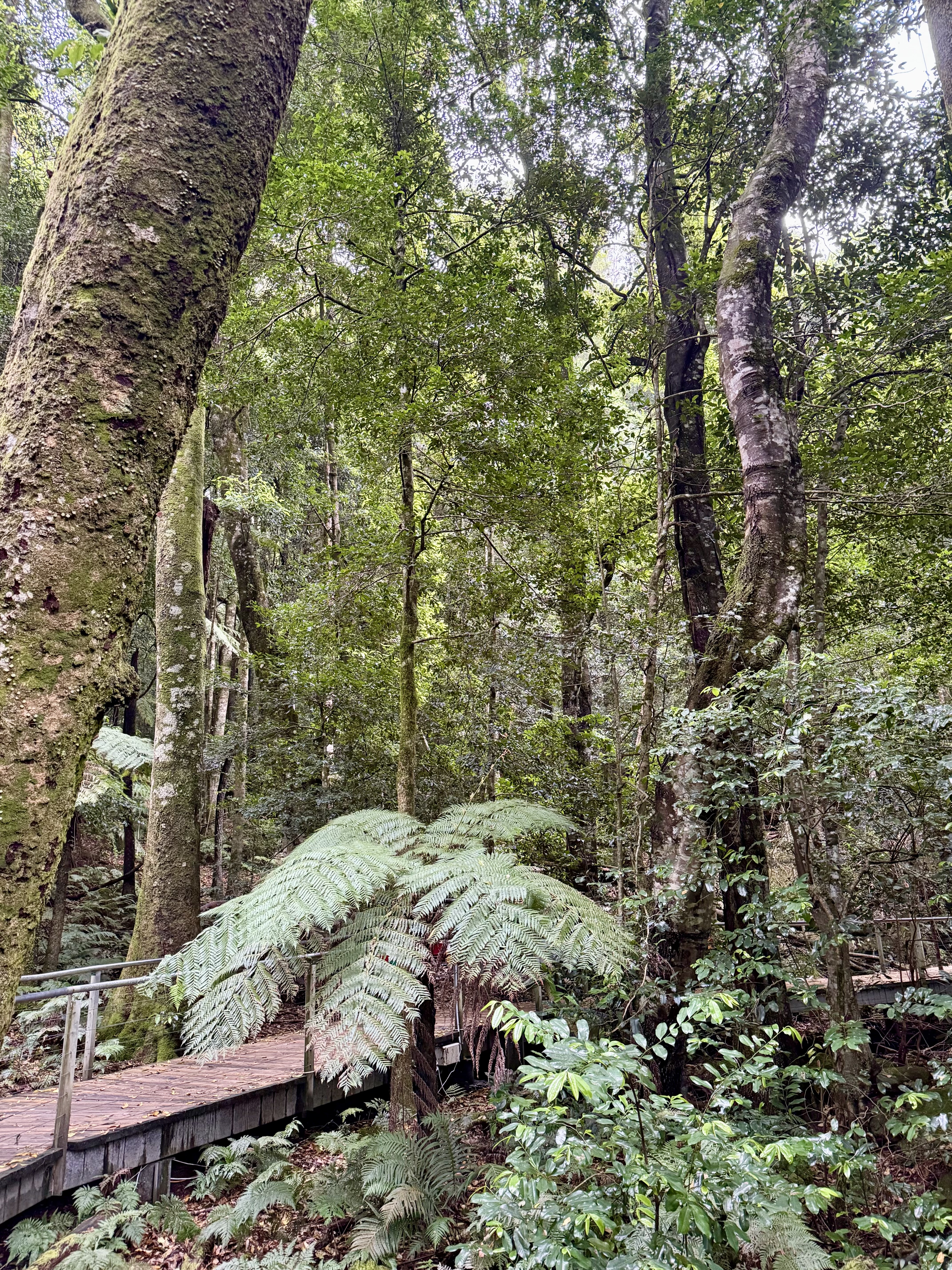
My TARDIS docks next to a wooden boardwalk that winds 2.4 kilometres beneath a rainforest canopy. This area is a privately operated tourist attraction that has managed, for the most part, to keep the rainforest pristine. Some added features feel kitsch, like scattered ‘dinosaur’ bones for children, but they are confined to one side of the boardwalk, so I simply look the other way.
I am enchanted by the ancient trees, vines and ferns that surround me. Some ferns are as tall as trees and about two hundred years old. Smaller ferns, unfurling their fronds, show tight spiral shaped leaves, an example of the Fibonacci sequence in nature. Mesmerised, I regard a delicate formation that follows this complex logarithmic pattern. I am not a mathematician, but I have a deep respect for how mathematics explains so much of the natural world. We seek patterns.
After a fifteen minute walk, I reach the Rainforest Room, a yurt like structure without walls that accommodates about one hundred and fifty people. Seats begin to fill. We are here at 7.45 on a Sunday morning to hear three writers talk about their books. Nature is the common element in their writing, though not all are happy to be labelled nature writers. I have come to hear Inga Simpson, whose work I admire. I don’t know the other two writers, Jessica White and Jane Rawson, but I know I will enjoy the session.
We sit in silence, looking out onto the rainforest. I am struck by the Coachwood trees, which have paintbrush wide white splotches. It looks as if someone has wiped their brushes on the trunks. Later I discover these marks are caused by lichen. They look stunning.
I recognise Sassafras, Turpentine and the Blue Mountain Gum among the trees. Then my ear attunes to songbirds tentatively striking up a melody. Within a minute, they are drowned out by the raucous sound of Sulphur Crested Cockatoos. I can’t help but smile at these juvenile delinquents who arrive with their boom boxes, ready to crash any party. Good luck hearing a song underneath all that squawking.
The event starts and I listen to Jane Rawson speak about her latest book Human/Nature, described as a lyrical work of creative nonfiction. I am drawn to her honesty and humour as she talks about establishing a life in the Huon Valley. Inga Simpson speaks about her latest book The Thinning, which I read some time ago. While it wasn’t my favourite of her works, it is interesting to listen to its reception within this group of readers. Jessica White talks about Silence Is My Habitat, her book of ecobiological essays. I am drawn to the title. Silence has always been my friend. I occasionally play music, which I love, but silence is what I long for most. I am listening to a kindred spirit, but her silence has been imposed by deafness, which she acquired at the age of four after pneumococcal meningitis. Her deafness has rendered the world silent, but it has given her the superpower of acute observation, especially of the natural world.
I love listening to these women in conversation. My soul is nourished by their words, their deep respect for one another and their reverence for nature. A tiny, oft ignored voice gently reminds me of a suppressed longing. I want to be a writer. First heard when I was six years old, I have held onto this dream tenaciously, much like the stunted trees clinging to the sandstone ledges. Their roots wrap around the rock the way my fingers furl over the keyboard, finding a letter here then there, forming words and sentences. It may not be much, but I hold on as if my life depended on it.



 From Quill to Quote