The period between Christmas and New Year is betwixt and between. On the threshold adjoining the old and the new, it is a time of transition and much uncertainty. It is a time for introspection and taking stock of the year past and making plans for the year to come. On one hand, we know it is an arbitrary marker of time, on the other we eagerly await a new ‘beginning’.
This period can be disorienting. We hardly know the day of the week as one day flows into the next. We are both restless and grateful for a chance to slow down. Family ties are strengthened or strained. Sometimes both at the same time. We nibble on leftovers, go to bed, rise at odd times and may have visitors staying for extended periods. Or we may be the visitors wondering whether we have overstayed our welcome. Time stretches, attenuates, and warps which gives this interminable interval such a nebulous almost dreamlike quality.
I too am hovering in this in liminal state. I am ready to move house, but that time hasn’t arrived. Shelves have been emptied and boxes are packed and I am in limbo. My spirit has left this house but not yet arrived at its next dwelling. It is what I imagine purgatory is like – neither here nor there. I am restless, in a state of flux, a fluid, fitful phase which objectively will be over before I know it. In the meantime, I feel as if I am stuck in eternal twilight, like a somnambulist caught in that transitional state between sleep and wakefulness.
100g of crystalised ginger (if your recipient likes a bit of a bite), if not, replace with 100g of more fruit or glace cherries or whatever you know your recipient likes
5 well beaten eggs
2 decent tablespoons of treacle
Zest of one lemon and two oranges (you can use the juice instead of water)
1¾ cups of plain flour
½ cup of self-raising flour
1 teaspoon of bicarb
2 teaspoons (or more) of mixed spice
200 g almonds (half to go into the cake and half to decorate)
A heaped cup or two of love and appreciation
Method:
Bring the person to mind for whom you are baking.
Use a large pot.
Chop the butter and heat with sugar, brandy, water or orange juice, mixed dried fruit, ginger, and mixed peel. After it comes to the boil, simmer and stir. Cook on gentle heat for at least 10min.
While mixture cools, preheat the oven to 150 Celsius. Grease or spray a 23cm round tin or use a square tin of roughly the same proportions. Line with baking paper and leave a generous amount extending above the tin. Chop about half of the almonds.
Once the mixture is cool, add eggs, treacle, lemon and orange zest. After stirring, sift in the flours, bicarb and mixed spice. Stir until all the flour is absorbed. Add the chopped almonds and stir. Add the heaped cupful of love and appreciation and keep stirring.
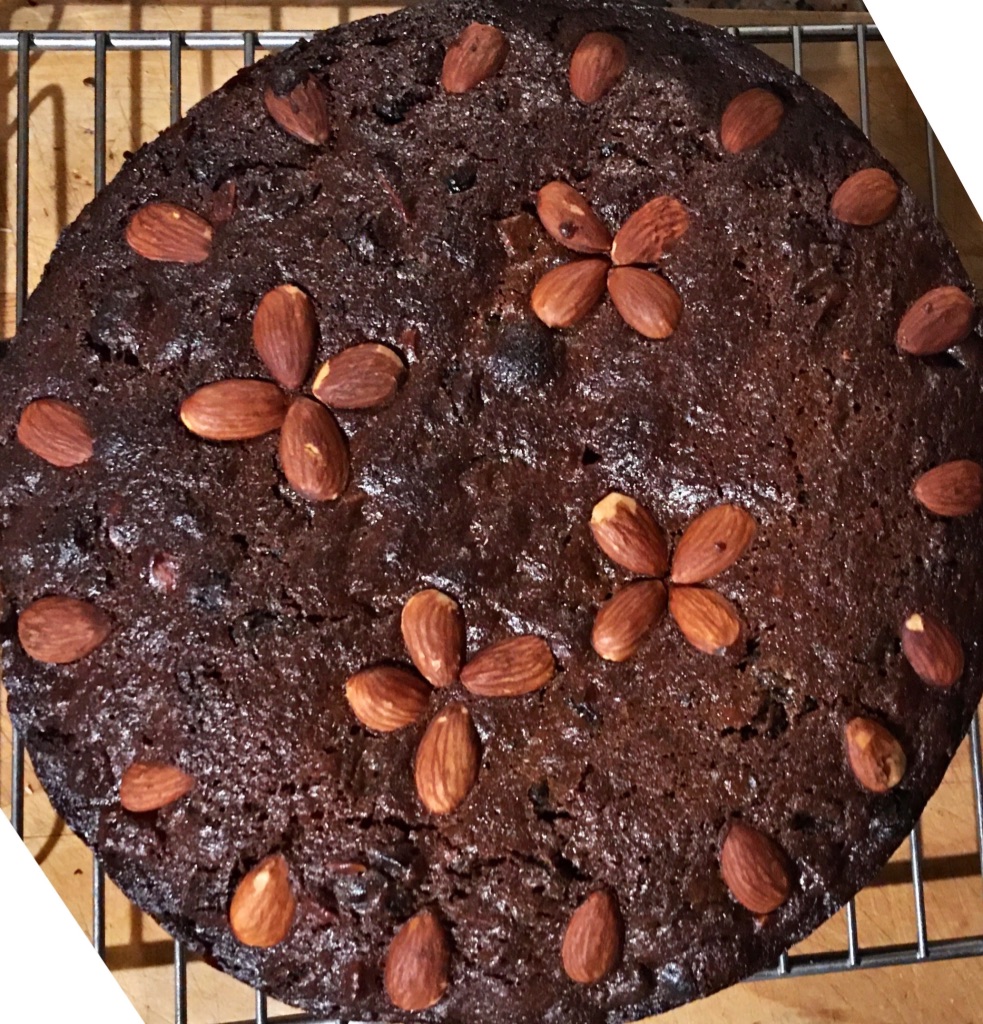
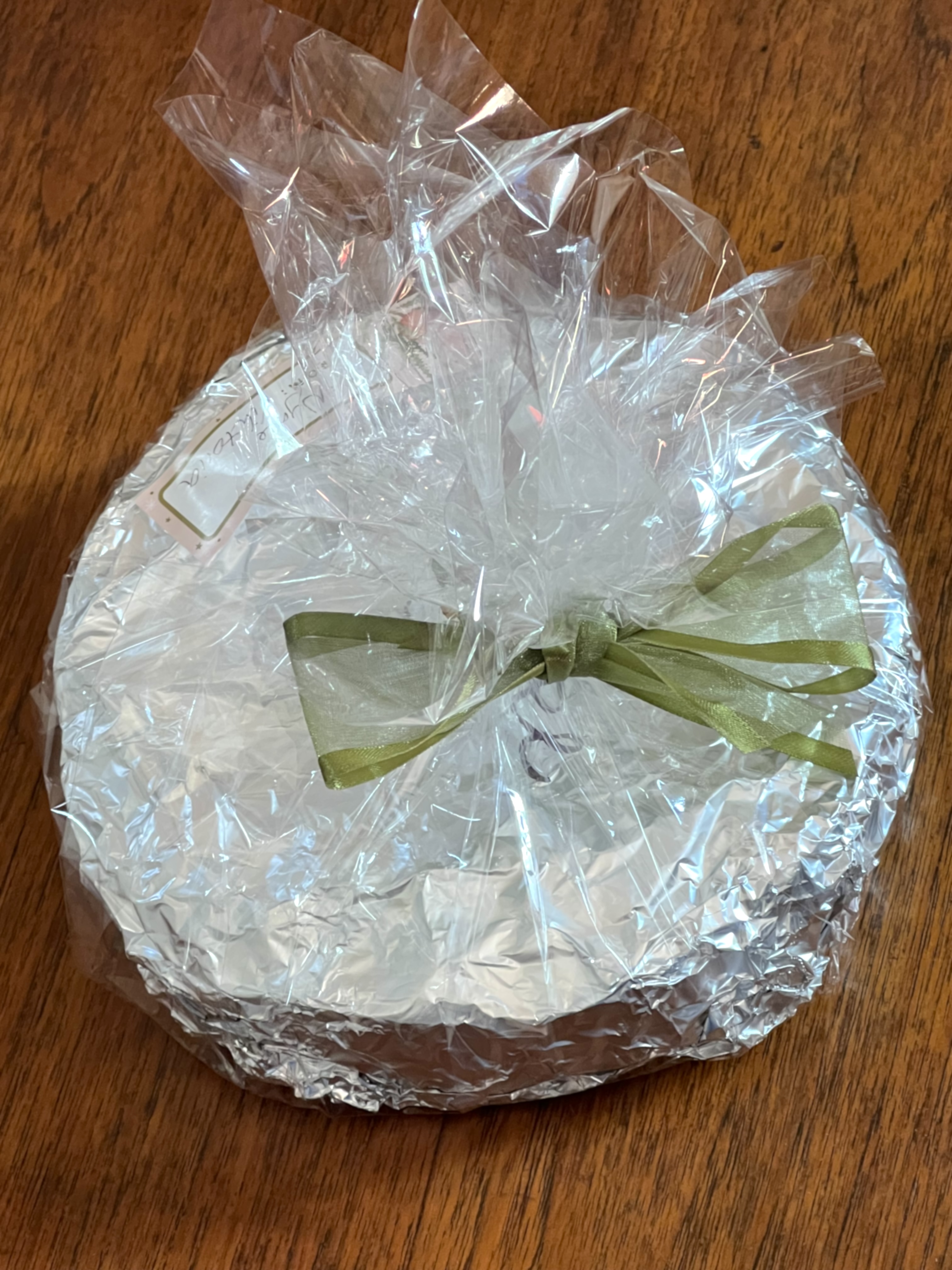
Spoon the mixture into the prepared tin. Make the top of the cake nice and flat and decorate with the remaining almonds. I usually make a flower pattern. Fold some brown paper into thirds and wrap it around the cake tin so it sits a good 5cm or so above the top of the tin. Tie with twine. Bake for 2 to 2.5hrs. Turn the cake after about an hour so it cooks evenly. Check with a skewer after 2hrs. Cool on a rack and wrap in foil. Write the person’s name on the foil and give thanks for their presence in your life.
My mother-in-law, Jean, introduced me to fruitcake. I had tried it before but could never quite understand what the fuss was about. The fruit cakes I had eaten up to that point were shop bought and mass produced. Pretty ordinary, I thought. And they were. When Jean began sending us fruit cakes several times a year, I began to appreciate a good fruit cake made with brandy, soaked fruits and nuts. She liked to experiment with various recipes, and I loved them all.
One day, Jean announced that she would no longer bake cakes. She was getting old and found the process increasingly difficult. I decided to step into the breach and began sending her the cakes she had taught me to make. In time, I perfected a fruit cake with chopped almonds that is just perfect. And so I carry on the family tradition of making and giving home-made cakes.
This year, I decided to bake fruit cakes for many of my friends. Over a period of about a month, I made 11 large cakes and more than 20 small, muffin-sized ones. The only restriction I placed on myself was that I wouldn’t post any. The cost of postage has become prohibitive over the years.
Making one cake after another took on a rhythm of soaking fruit, zesting oranges and lemons and watching the mixture froth when I added bicarb. I stirred in the flour and poured the mixture into baking tins which I then surrounded with brown paper and tied with twine. This helps to cook the cake evenly and stops the top from burning. Finally, it would go into the oven for a couple of hours during which I had time to start the next cake.
What I enjoyed most about this process was that I always had the person in mind for whom I was baking. I thought about each individual, their special qualities and the joy they brought to my life. It felt like a version of a Buddhist loving kindness meditation practice. I dedicated time to think about each person, added a little more of this, a bit less of that to suit their taste and wished them well for the coming year. I found it a lovely practice to think about each person, rather than bake all the cakes and allocate them randomly. This way, I could add a couple of magic ingredients to the mix – gratitude and love for recipients of each cake.
I’ve been watering my friends’ garden during an uncharacteristic heat wave. As my threshold for boredom is low, they have set up sprinkler systems to make the job easier. All I have to do is turn on the tap and return a while later to switch it off. In theory. It turns out that the sprinkler system is not very efficient around the vegetable garden. No matter how far I turn the tap to left, all I get is a piddle at the other end. So, I began watering that part of the garden with an old-fashioned watering can. It’s not surprising that this made me start paying more attention to the plants there.
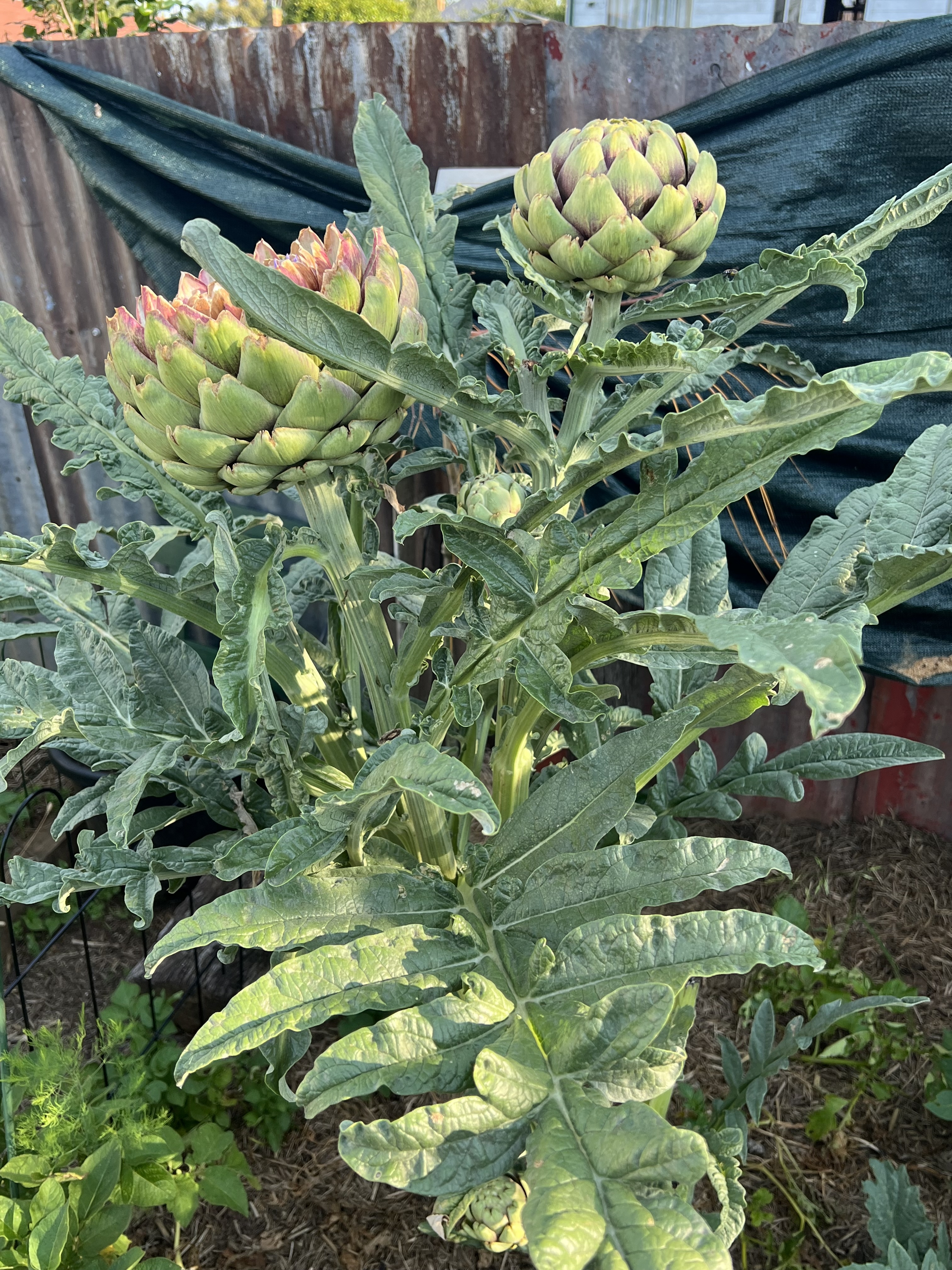
The most outlandish vegetable in that patch is the globe artichoke. It stands high and lofty, towering above the other plants and, if truth be told, it is quite unattractive. It reminds me of the weeds I have been battling in my own garden which makes me wonder how people discovered it was not only edible but a delicacy. While the ensuing internet search did not yield an answer to that question, I did learn some interesting facts about its history.
I wasn’t too far wrong when I compared it to the weeds in my garden. The artichoke belongs to the thistle family, and I’m growing plenty of those. The artichoke’s spiky flowers and thorny leaves attest to this lineage. I was surprised that it is one of the oldest vegetables we are aware of. Most likely, it originated from the wild cardoon found in Northern Africa, and was then imported to Sicily and Greece in the 5th century B.C.E. Both the Romans and Greeks regarded it not only a delicacy but also an aphrodisiac. Considering how little is ingested with each nibble of a leaf, I imagine it may take quite a while for this to take effect.
The artichoke finally made it to the rest of Europe in the 16th century when Catherine de Medici introduced it to France upon her marriage to King Henry II. Nowadays, it is difficult to imagine French cooking without artichokes, whether in tarts or artichokes à la barigoule. Artichokes are firmly embedded in French cuisine.
My favourite way of eating this peculiar vegetable is either dipping the cooked leaves into garlic butter or home-made mayonnaise before scraping off the minuscule bits of soft flesh with my teeth. Either way, it is a simple and satisfying if not particularly couth dish to devour. As the butter or mayo invariably drips from my chin, it is a dish best shared with close friends and preferably not in a classy restaurant.
Seven years ago, when I bought my house, it was under very unusual circumstances. Ruth, who sold me the house had only advertised it on Facebook. I turned up on her doorstep and decided to buy it on nothing more than the of strength feeling that this was the right place for me. I agreed to the price, we shook hands and began negotiating a long handover period. She trusted my word, I trusted hers and we kept in touch until three months later we could finally make it happen. We popped a bottle of bubbly and worked out moving days. There was no agent involved, just a couple of solicitors and banks. I’m sure we were both told that this was a crazy way to go about things, but we did it anyway and it worked out perfectly for us both.
This time around, I did get an agent involved mainly because he had worked closely with my late partner. I knew I could trust him implicitly. He too had his share of bad luck in the past few years – a stroke, which he survived, has left him with a lame leg and difficulty with movement. His once thriving business has suffered greatly from this setback. Yet his mind is as sharp as it ever was, and he is a good salesman. While I was close to becoming a nervous wreck in the process of the sale, he remained calm and optimistic and got on with the job.
When the eventual buyer came to look at the house, he was quietly optimistic. He answered her queries truthfully and when she requested to meet me after an inspection, he was happy to pass on the request and get out of the way. Gayle and I met and found that we communicated with ease and honesty. We had many things in common ranging from our love of books through to pens, inks and beautiful papers. There were other similarities too in our loves and our losses, in small, serendipitous moments that made one of us call out, ‘I was thinking about that just the other day,’ or simply, ‘me too!’ I knew she was the right person for this house while she felt the house calling for her. It had to be.
I have never forgotten Ruth’s generosity when I bought the house. She invited me to meet her friends, waited patiently for the sale of my house to go through and allowed me to store some of my belongings before we even signed contracts. It was time to pay it forward.
I invited Gayle to come up for a weekend so I could show her around Millthorpe and Orange, get a feel for the house and let her measure rooms and spaces. Unusual, yes, but also very sensible and welcoming to a new person in a village that is known for its inclusivity and friendliness.
Gayle arrived on Friday, and we took a stroll in the main street of the village. A couple of the local shopkeepers were sitting on a bench in front of their shops drinking bubbly. The moment we approached, we were offered a glass. We sat and chatted a while and met more people on our way back. Gayle was trying to remember the names of all the people she had met. Everyone had stopped to chat and welcomed her the way I knew they would.
The next night I had a couple of neighbours over for dinner. Over wine, cheese, and risotto we told stories and jokes, enjoyed each other’s company and parted with great fondness for the good people in the neighbourhood.
Today we visited the markets, bought Christmas presents and then took the dogs for a run. I showed her the closest large supermarket, hidden in a back street of Blayney, which only locals would ever know was there. Over the weekend, I showed her many little hidden gems that otherwise would take months to discover. Where to buy the best bread, how to get to the hardware store, the best cafés in town and the best op shops to find a bargain.
Why did I do this? I wanted to pay Ruth’s kindness forward and because I genuinely love this village and will shout its praises to anyone willing to listen.
I enjoyed having Gayle as a visitor to ‘our house’ and wish it were possible for more people to do business in such a civilised and caring manner. It was as important for my leave taking as it was for her arrival. I consider this handover as a rite of passage which will have ripple effects for us both for years to come.



 From Quill to Quote