
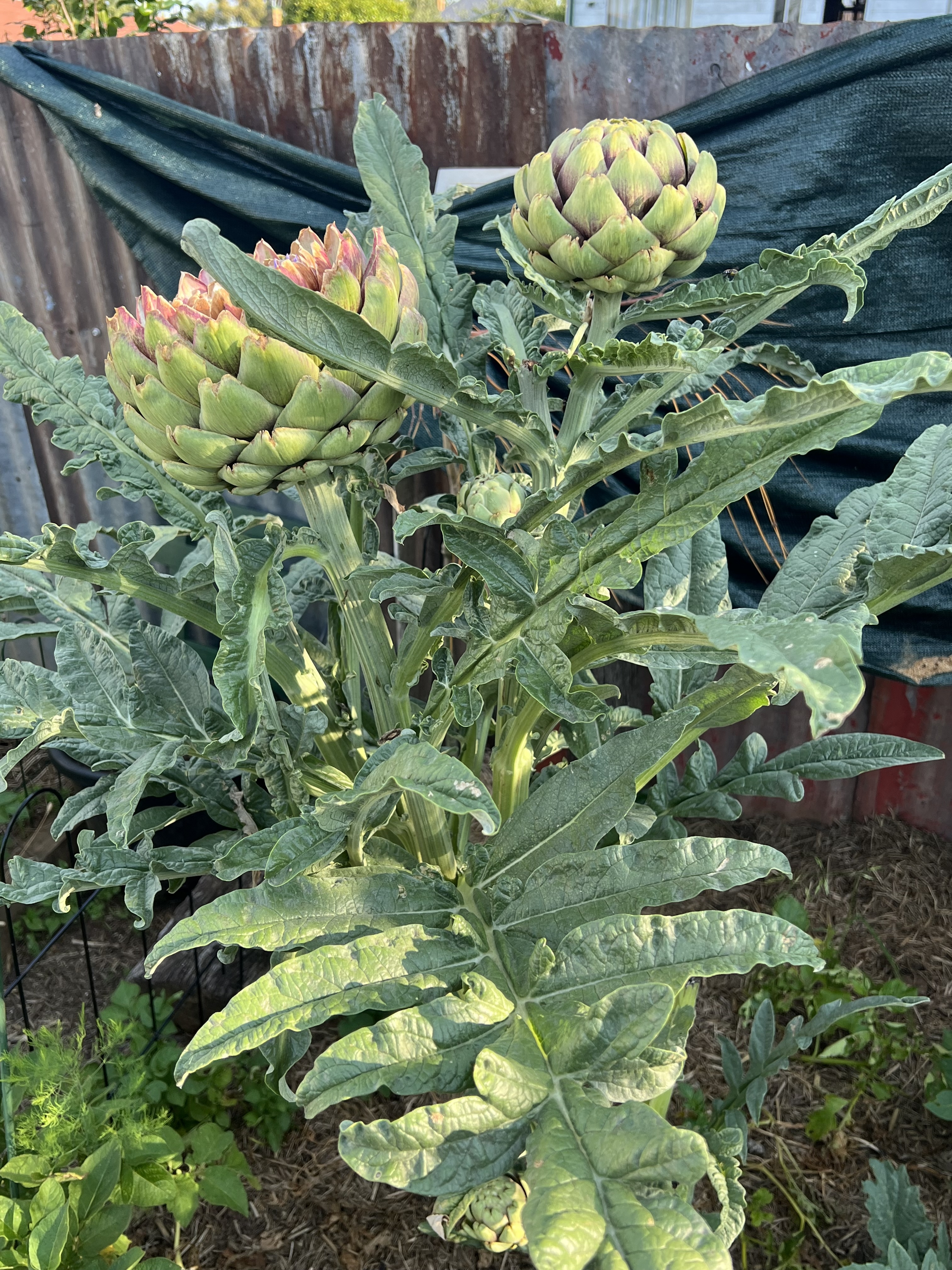
I’ve been watering my friends’ garden during an uncharacteristic heat wave. As my threshold for boredom is low, they have set up sprinkler systems to make the job easier. All I have to do is turn on the tap and return a while later to switch it off. In theory. It turns out that the sprinkler system is not very efficient around the vegetable garden. No matter how far I turn the tap to left, all I get is a piddle at the other end. So, I began watering that part of the garden with an old-fashioned watering can. It’s not surprising that this made me start paying more attention to the plants there.
The most outlandish vegetable in that patch is the globe artichoke. It stands high and lofty, towering above the other plants and, if truth be told, it is quite unattractive. It reminds me of the weeds I have been battling in my own garden which makes me wonder how people discovered it was not only edible but a delicacy. While the ensuing internet search did not yield an answer to that question, I did learn some interesting facts about its history.
I wasn’t too far wrong when I compared it to the weeds in my garden. The artichoke belongs to the thistle family, and I’m growing plenty of those. The artichoke’s spiky flowers and thorny leaves attest to this lineage. I was surprised that it is one of the oldest vegetables we are aware of. Most likely, it originated from the wild cardoon found in Northern Africa, and was then imported to Sicily and Greece in the 5th century B.C.E. Both the Romans and Greeks regarded it not only a delicacy but also an aphrodisiac. Considering how little is ingested with each nibble of a leaf, I imagine it may take quite a while for this to take effect.
The artichoke finally made it to the rest of Europe in the 16th century when Catherine de Medici introduced it to France upon her marriage to King Henry II. Nowadays, it is difficult to imagine French cooking without artichokes, whether in tarts or artichokes à la barigoule. Artichokes are firmly embedded in French cuisine.
My favourite way of eating this peculiar vegetable is either dipping the cooked leaves into garlic butter or home-made mayonnaise before scraping off the minuscule bits of soft flesh with my teeth. Either way, it is a simple and satisfying if not particularly couth dish to devour. As the butter or mayo invariably drips from my chin, it is a dish best shared with close friends and preferably not in a classy restaurant.
 From Quill to Quote