
Summer Pudding

Summer pudding

I discovered summer pudding many years ago at my mother-in-law’s place. It felt as if the dessert had been invented just for me. Cherries and berries are my favourite fruits and from the moment they come into season, my hands and lips are stained red and blue. I have been known to eat a kilo of cherries on a long car ride, with disastrous consequences to follow. Still, I can’t help myself. ‘Just two more,’ I tell myself, and then 2 kilometres later, ‘just another two and I’ll stop.’ These days I only buy 500 grams at a time. Self-control has never been my strong suit.

Summer pudding combines all my favourite fruits in a simple, almost humble dish. It originated in England, and I expected it to have a long, storied history. Surprisingly, the recipe dates back only to the late nineteenth century. In my mind, I had imagined a tradition going back hundreds of years. I pictured young girls wandering through fields, gathering wild berries for their mothers to turn into a cheap pudding. In reality, those girls probably ate the berries as fast as they picked them.

Nowadays, berries are expensive unless there happens to be a glut. Mulberries, raspberries and blackberries can be wildly expensive. Early season cherries are a luxury not many people can afford. Even strawberries, the most reliable and affordable of the berries, fluctuate in price. Making a summer pudding, at least without access to free fruit, ends up being more expensive than baking an elaborate cake. So much for my fantasy of it being a poor man’s pudding.

The trickiest part of making it is leaving it to set overnight. Patience is another virtue I lack. Every time I open the fridge, I can see the pudding with my cast iron teapot on top, pressing the bread down over the fruit. It will be ready by tomorrow afternoon, I remind myself. Less than twenty-four hours to go. And besides, I don’t even have clotted cream. Yet.

If this dessert sounds like heaven to you, here is a recipe. The quantities aren’t exact. Use whatever fruit you have, however much of it you can get your hands on. You could make a summer pudding entirely from raspberries, but I prefer a mixed variety.

Summer pudding

Stale sliced white bread to line the bowl
1kg mixed summer berries such as strawberries, cherries, blackberries, mulberries, raspberries
¼ cup caster sugar
A splash of liqueur such as Kirsch if you like
Clotted cream to serve

Cut the crusts off the bread.
Wash the fruit and remove stalks, stones and pips.
Cut the strawberries into pieces.
Place all the fruit into a pot with the sugar and about ¼ cup of water.
Cook for 2–4 minutes, until the sugar dissolves, the fruit softens and the juices run.
Drain the juice.
Brush the stale bread with the juice and line a bowl, juicy side outwards.
Slightly overlap each slice so there are no gaps.
Cover the bottom of the bowl too.
Pour the fruit into the bowl with a little juice and cover the top with bread.
Press the pudding down with a saucer and some heavy items on top.
Refrigerate overnight or longer.
Run a knife around the edge of the pudding and pour a little juice around the outside.
Invert the bowl onto a plate and ease the pudding out.
Serve with the remaining juice, clotted cream and extra fruit if desired.

Thank you dear Margaret for sharing this recipe and memories they evoke.

Post script

I bought clotted cream, invited a neighbour and a friend, and we attacked the pudding. It was delicious. The cream had to be scooped off the spoon, it was that thick. If you think the cream is unnecessary, you’d be mistaken. The pudding is quite sweet and needs the richness of the cream to balance the flavours. As scrumptious as it was, none of us could fit in seconds.
A High-End Wrap for a Low-Key Lunch

Packing a simple cheese sandwich should have been the easiest part of my day. At the Airbnb where I was staying, I had all the ingredients in a small bar fridge. Once assembled, I looked everywhere for a scrap of paper or cling wrap for my sandwich. Apart from toilet paper, there was nothing even vaguely suitable. While potentially amusing, I couldn’t face the toilet paper option. It reminded me too much of Barry Humphries eating a tin of pea soup out of an airsick bag on a flight to London. Funny but deeply disturbing.

I decided to opt for a more pedestrian alternative. While out for dinner, I went into a Lebanese corner shop which had a good selection of essentials. I walked down the aisle which sold every variety of dried pulses known to humankind and kept my eye out for cling wrap, foil or sandwich bags. I reached the back of the shop and was about to turn back empty handed, when I noticed both cling wrap and aluminium foil on the bottom shelf. Success! All I had to do was choose between them.

As I leant down, I noticed a much smaller packet of aluminium foil than the one I usually bought. I only wanted to wrap a sandwich, so I thought it’d be more economical to buy the smaller one. I was aghast when the cashier charged me $10. Highway robbery I thought, but dutifully paid the amount.

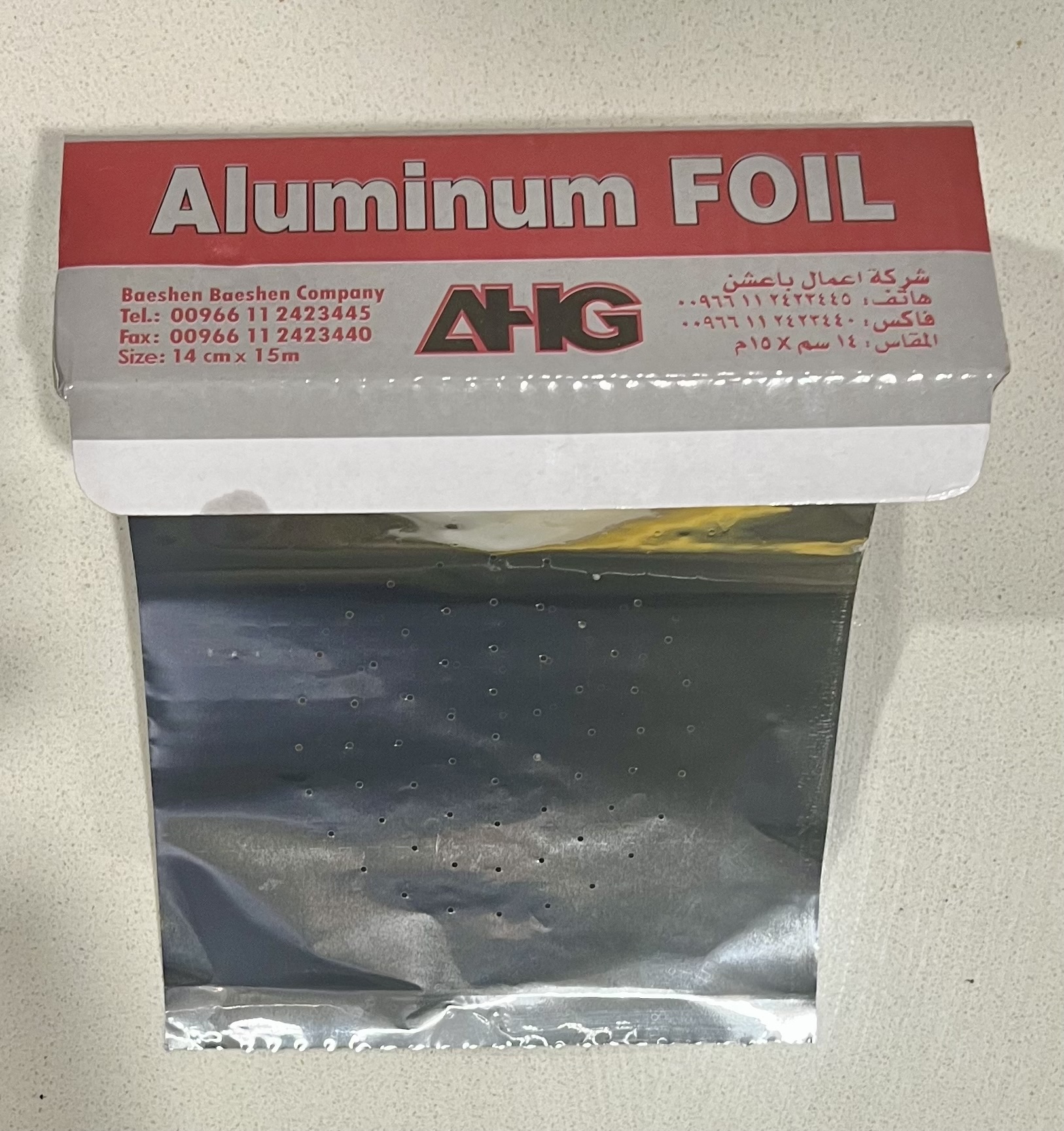
Back at the Airbnb, I made my sandwich for the next day. Opening the Aluminium foil, I was surprised to find it had perforated lines at regular intervals for easy separation. These were roughly the size of toilet paper squares. Perhaps, I should have stuck with my original choice of wrapping, I thought. It certainly would have been much cheaper. Then, I noticed small pin-pricked holes in concentric circles on each of the sheets. Moreover, the foil was quite thick, much thicker than the stuff I had at home. Clearly not meant for a sanga wrapper!

Suspicious, I began to Google the mysterious foil. Nothing on the box gave a clue as to its intended use. I wasn’t getting anywhere. Finally, it occurred to me to take a photo to see if Google lens could assist. And there it was:

‘Discover the ultimate hookah experience with the AHG Premium Shisha Foil Roll.’

I was about to wrap my sandwich in premium shisha foil!

Four sheets were ample for the job. Best of all, I could reuse the foil again and again. The stuff proved indestructible. Yet now that I’m back home, I find the cheaper foil much easier to use. And, as an added bonus, I don’t have to explain myself in the lunchroom the next day.

Christmas Cake Pt 2 – recipe

(Based on David Herbert’s fruitcake)

Ingredients:

250g block of unsalted butter

1 cup brown sugar (adjust to taste)

¾ cup of brandy

½ cup of water or orange juice

1 kg of mixed dried fruit

100g mixed peel

100g of crystalised ginger (if your recipient likes a bit of a bite), if not, replace with 100g of more fruit or glace cherries or whatever you know your recipient likes

5 well beaten eggs

2 decent tablespoons of treacle

Zest of one lemon and two oranges (you can use the juice instead of water)

1¾ cups of plain flour

½ cup of self-raising flour

1 teaspoon of bicarb

2 teaspoons (or more) of mixed spice

200 g almonds (half to go into the cake and half to decorate)

A heaped cup or two of love and appreciation

Method:

Bring the person to mind for whom you are baking.

Use a large pot.

Chop the butter and heat with sugar, brandy, water or orange juice, mixed dried fruit, ginger, and mixed peel. After it comes to the boil, simmer and stir. Cook on gentle heat for at least 10min.

While mixture cools, preheat the oven to 150 Celsius. Grease or spray a 23cm round tin or use a square tin of roughly the same proportions. Line with baking paper and leave a generous amount extending above the tin.  Chop about half of the almonds.

Once the mixture is cool, add eggs, treacle, lemon and orange zest. After stirring, sift in the flours, bicarb and mixed spice. Stir until all the flour is absorbed. Add the chopped almonds and stir. Add the heaped cupful of love and appreciation and keep stirring.

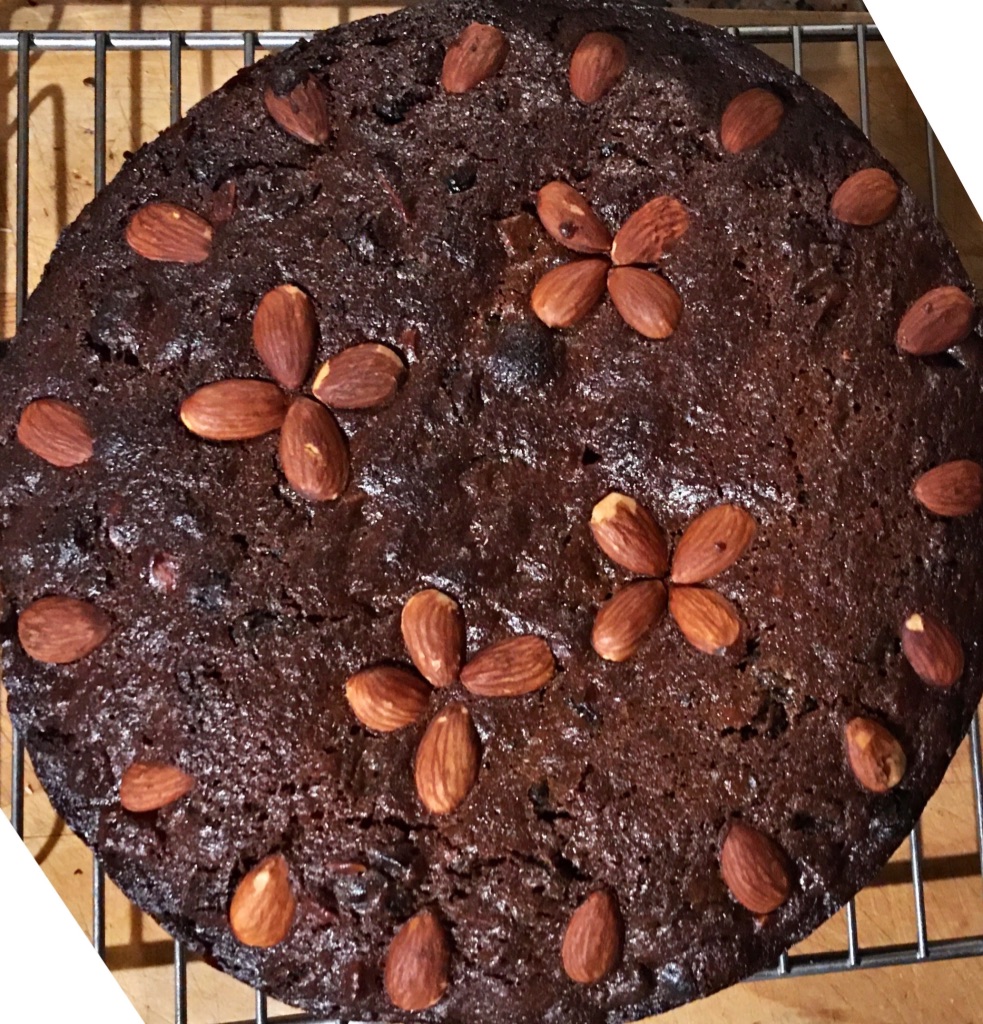
Spoon the mixture into the prepared tin. Make the top of the cake nice and flat and decorate with the remaining almonds. I usually make a flower pattern. Fold some brown paper into thirds and wrap it around the cake tin so it sits a good 5cm or so above the top of the tin. Tie with twine. Bake for 2 to 2.5hrs. Turn the cake after about an hour so it cooks evenly. Check with a skewer after 2hrs. Cool on a rack and wrap in foil. Write the person’s name on the foil and give thanks for their presence in your life.

A cup of tea

Coffee anyone? No problem at all! An espresso, cappuccino, laté or flat white is made to perfection even in the most modest country towns. We admire the young barista, usually male, with a top knot and a few tattoos to show his credentials. The coffee is pushed down with the finest tamper, milk is heated to 60-65degrees and poured with a flick of the wrist to create ornamental flourishes upon the crema.

Now let’s try ordering a cup of tea. If I’m lucky, the water poured over the teabag has actually boiled but if ordered as a takeaway, the milk is added before the tea has had time to brew. The result is tepid, watered-down, and stained milk.

If I sit down at a café and ask for tea, I am likely to get it in a thick coffee cup or a mug. Only tea drinkers seem to understand that the thickness of the cup affects the taste. Should a teapot make an entrance, the ubiquitous teabag still hangs limply within. It is a rare café that keeps tealeaves on its shelves.

Last week, I went out for breakfast with a friend. We chose a well-known establishment which serves excellent meals. As we ordered, I asked the young waitress to tell me how they made their tea. She explained the procedure in great detail without a hint of irony.

‘We boil the water, take a teabag out of the box, put it in the cup and pour the hot water over it,’ was her enthusiastic reply.

I was reminded of Basil Fawlty and the fresh orange juice. Chef had just opened a new bottle. I had to restrain myself from laughing or telling the young waitress not to worry about the tea and bring me a Screwdriver instead. Alas, the reference would have gone over her head.

I had often wondered why David Herbert included a recipe for a pot of tea in his Complete Perfect Recipes. I found it rather quaint. Perhaps he had similar experiences to mine and wanted to show how easy it is to make a decent cup of tea. For those who are curious, he starts the entry with the following words:

Throw out your teabags and return to the ritual of a real cuppa made from tea leaves!

Fill a kettle with fresh cold water and bring to the boil. When the water has almost reached the boil, pour a little into your teapot, swirl it around and pour it out. Add 2-3 teaspoons of tea leaves to the pot.

When the water is boiling, fill the teapot with boiling water. Put on the lid and leave to brew for 3-5 minutes.

David Herbert

And there we have it, a perfect cup of tea.

Christmas Pudding

Remember to soak in brandy and flambé!

I am the sole heir of a Christmas pudding recipe handed down through the generations. While Margaret was alive, she referred to it as her family’s secret recipe and I was the only person with whom she shared it. Over the years, I have faithfully followed the recipe and have delighted many friends both in Australia and overseas with this traditional Christmas treat.

I always think of recipes in terms of the person who shared it with me. Each time I make a dish, it is infused with love for, and memories of, the person who was kind enough to share their skill and knowledge with me. It is a true act of friendship to hand someone the gift of a great recipe. I hardly ever use commercially printed cookbooks, but I always return to the scraps of paper with scribbled recipes that friends have shared. Not only does it bring joy to think of people who have accompanied me at points in my life, it also brings joy to the people who are in my life now. A recipe is a gift of paying it forward.

I have never cared much for keeping secrets. Now that I am the sole guardian of Margaret’s Christmas Pudding recipe, I wonder about the felicity of the secret. Imagine if our forebears had kept recipes for bread or wine a secret. Would we have national cuisines if all recipes were fiercely guarded or just family feuds over the best dishes?

I don’t want to be the last in line to make this adaptation of a great Christmas pudding. The recipe is too good for that. My apologies darling Margaret but the secret is out.

                                                Christmas Pudding

6 oz breadcrumbs
2 oz flour
4 oz butter
½ lb sultanas
½ lb currants
4 oz raisins
2 oz glacé cherries
1 tsp nutmeg (freshly grated)
½ tsp mixed spice
½ lb brown sugar
2 eggs
¼ pint stout
½ cup grated carrots
1 tsp marmalade
½ cup warm milk
Juice and grated rind of 1 lemon
1 tsp bicarb

Mix butter and sugar until smooth. Mix all dry ingredients except spices and bicarb. Dissolve latter in warm milk, add lemon juice, rind and add beaten eggs and stout. Mix all ingredients together. Cover and leave. Stir again and if dry, add more milk and stout.

Cook for 5 hours in buttered pudding container with a tight lid, lined with grease proof paper. Serve hot.