
Music in the Margins

Dickson is an inner-north suburb of Canberra, well known for Asian restaurants and specialty grocers. The shopping precinct is also known for people sleeping rough, alcohol and drug problems as well as boarded up shop fronts. Coles and Woolworths are two retail giants competing against each other, but small shops struggle to make ends meet. It is a mixed bag.

In the centre of the shopping precinct is a plaza with a public library servicing the surrounding areas. At night, the covered entrance way provides shelter for the homeless. Vinnies does a night patrol in the area, providing food, jackets, sleeping bags, and offering non-judgmental social interaction. There are many who would like to clear out the poor and ‘improve’ the suburb. They speak of a clean-up as if it were a matter of getting some mops and brooms, sweeping away unwanted people.

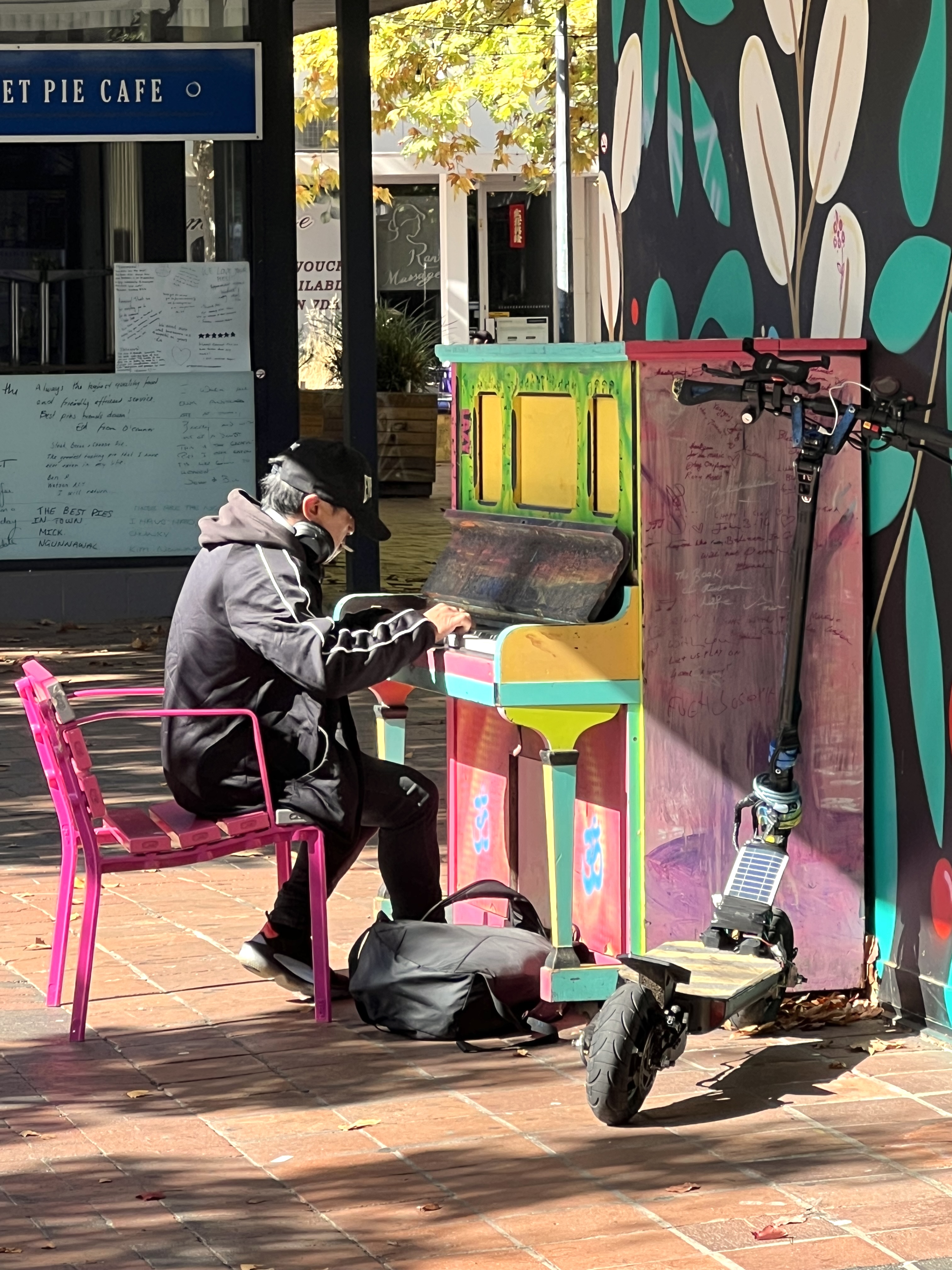
Yes, I can attest to the problems in the area, but I also see a richness and community spirit. While waiting for a prescription to be filled, I sat on a bench opposite a muralled wall where an upright piano stands under the eaves of a building. It is old and weather-beaten, but its keys are intact. Playable, even if most likely out of tune.

A man in his 40s, wearing a black backpack, sat down, rolled a cigarette and began to play. The music that flowed from his hands was enchanting. As it was a public holiday, there were very few people about. Yet those who were about to walk past, stopped, took videos or simply listened before continuing on their way. I stood up and commented on the soaring melodies to a woman with a pram. Her toddler was transfixed. Soon, someone else joined us and we were strangers no more. The pianist had brought us together to enjoy the moment, doing what he loved best, awakening within us the power of music.

At the end of a song, I approached to say thank you. He was rather bashful, telling me he was self-taught and had only been playing for two years. He could only play by ear, and as he hadn’t worked out how to use the black keys, he could only play in C major or A minor, the two scales that can be played solely on the white keys. He probably wasn’t aware of that. Nevertheless, he sounded accomplished, and his repertoire was extensive.

This man, rich in spirit but poor, had transformed my trip to the chemist into deep appreciation for the gifts that people can offer each other. He touched the hearts of everyone who walked past and allowed people to connect who would otherwise not strike up a conversation. All because someone had leaned an old piano against a wall in the mall.

I have seen the architect’s impression of a precinct, a master plan of hundreds of new apartments and clean, green public spaces. The language of conservation (zero waste) and Connecting with Country (green corridors) are present, appealing to our middle-class conscience.  No doubt the suburb will enjoy a process of gentrification and it will be prices rather than the broom that will eventually sweep the suburb clean of people like the piano man.
Music, Memory and Manners

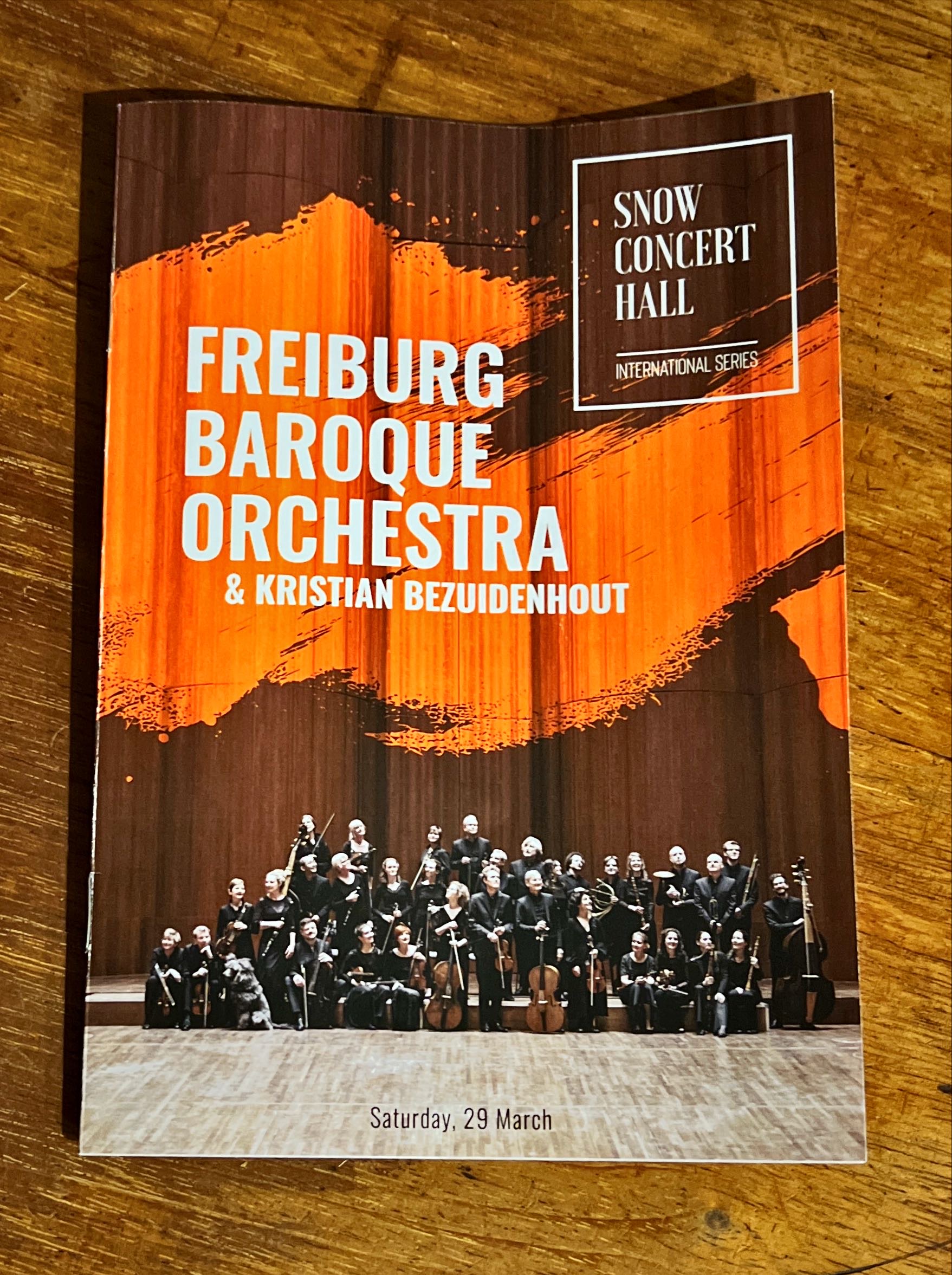
On the spur of the moment, I bought myself a ticket the Freiburg Baroque Orchestra. I have been in Canberra for just over a year and so far, have attended four concerts. Having access to more cultural events was one of my reasons for moving to the city. So why wasn’t I getting out more?

I am happy with my own company, but when it comes to going out, I still subscribe to the outdated notion that I need to go with a friend. What a ridiculous idea! Sure, it would be nice to talk about the concert, but during the recital we’d be sitting next to each other in silence. Would I enjoy the music more because I know the person sitting next to me? Of course not! So, I decided to drop this limiting belief and go anyway.

The concert consisted of a Bach symphony in G minor followed by the Mozart piano concerto ‘Jeunehomme’, with Kristian Bezuidenhout on Fortepiano. In Baroque music, I’m much more used to the sound of a Harpsichord, so it was interesting to listen to the Fortepiano which is more like the piano we know today but with a much softer, less sustained tone. Bezuidenhout’s playing was magical. Unfortunately, the man in front of me was tall and bobbed his head this way and that, making it hard for me to watch the action on stage. I felt sorry for the people behind me who must have watched his head go one way, mine the other, to get a glimpse.

There were two children behind me with their mother. I am guessing they were between 8 and 11 years old. Neither could wait for the interval to get some food. Poor kids! Afterwards, the boy, bored with the event, was hoping the concert would end after each piece. His sister was much quieter. It reminded me of taking my daughter to concerts when she was little, but she was much more engaged. Maybe that was because we started taking her from about the age of three and she was a compliant child. At that age, she sat on one of our laps, listened to the music for the first half and fell asleep after intermission. I wasn’t concerned about the children behind me – they only spoke between the pieces when people were clapping.

After the interval, the orchestra played the Violin Concerto No.5 in A major, ‘Turkish’. Gottfried von der Goltz was truly mesmerising on violin. I thought about my daughter, who also learned to play violin. I would have loved her to become a violinist but while she had the aptitude, she didn’t have the application. She pursued it for a couple of years at university but never quite seriously. At the time, I was a little disappointed. Now, I see that her interests have evolved and what she does pursue, she does with passion and full-hearted commitment. All these thoughts went through my mind as I listened. I also considered how lucky I am to have my daughter nearby. Had she become a violinist, she would most likely be overseas by now.

It is hard for a casual connoisseur to concentrate on only the music for over two hours. My mind went to many places during the evening. One place I wished my mind hadn’t turned to, was feeling annoyed with a man two rows in front of me. He not only arrived late but scrolled on his phone for the entire performance. No matter how much I told myself that I had no control over the situation, it kept annoying me. I tried to tilt my head so I couldn’t see the screen, but the phone kept lighting up. I felt sorry for the people sitting either side of him. I couldn’t understand why they didn’t ask him to put it away. It made me wonder why we seem to have traded manners, which are about the way we behave towards others, for the right of the individual to do as they please. Dear Lord, I’m beginning to sound self-righteous!

The end of the concert caught me by surprise. I must have drifted off a little. It had all been quite pleasant except for the mobile phone man. We streamed out of the concert hall, most people well past their sixties, judging by the number of grey heads. I felt like a youngster in comparison. Walking to the car I thought how easy and enjoyable the evening had been. From now on, I am fully embracing my independence.