Dakers Oval – Blayney

A small patch of mossy grass stands apart from weeds around a fenced oval. On the spur of the moment, I take off my sandals to feel the spongy softness under my soles. It has been a long time since I have taken off my shoes to walk in grass. In my own backyard there are bindis, thistles and countless other weeds that have invaded the lawn. But here, on this small patch, I stand and feel a spongy softness under my soles. I am reminded of times in my childhood when I would find a clearing in the woods and lie in a meadow of wildflowers, protected by tall trees and the birds of my youth. There were the chatty finches, the trill of blackbirds, monotone thrushes, and the incessant hammering of the woodpecker. I close my eyes and listen. Here there are magpies warbling to one another, repeating a melody that echoes across the field. They are accompanied by the incessant chirping of crickets, who provide a high-pitched drone above which the birds improvise their songs.

It is hard to believe I am standing no more than a hundred meters beside a large carpark and local supermarket. The dogs I am walking sniff the ground and roll with unbridled pleasure in a smell only they can identify. Their joy is palpable as they leap and chase each other around a field beyond the cricket pitch.

There are not many small places like this left where dogs are welcome. Ironically, it is more difficult to find open spaces for dogs in the country than in the city, where dog owners congregate in groups with their much-loved pooches in suburban parks. Still, I’m happy to have my own company without the intrusion of other peoples’ chatter.

Between the fences and the farms just beyond this small green space is where the Belubula river meanders, making its way to feed into Carcoar dam and flow on to Canowindra and eventually into the Kalari or Lachlan River, near Gooloogong. One of my dogs throws herself into a creek that feeds into this river, not for a swim but to wade and cool down. She heaves herself back up the bank, shakes and rolls in the dirt to dry off. For a moment I think of the back seat of the car, but I could never deny her the pleasure of a dip on a hot day.

Near the entrance to this precious piece of council land, I find discarded cans of ‘Mother’ and the plastic packaging of Arnotts Kingston biscuits. On previous walks I have seen young workers from the supermarket sit here to have their break, smoking, laughing, enjoying a little freedom. I’m saddened that they don’t look after this place, a place of refuge from stacking shelves or serving on checkouts. After all, they choose to come to here rather than the carpark where there are plenty of seats close by. Something must draw them towards this spot, surrounded by trees, birds and the burbling creek. Are they hoping that someone like me comes to pick up their rubbish or are they content to sit in their small, soiled nest?

I walk twenty meters to place the rubbish in the bin provided and decide not to let their actions befoul the pleasure of this scenic stroll. After all, it is a magnificent morning to be walking on this lush land.
Artichokes

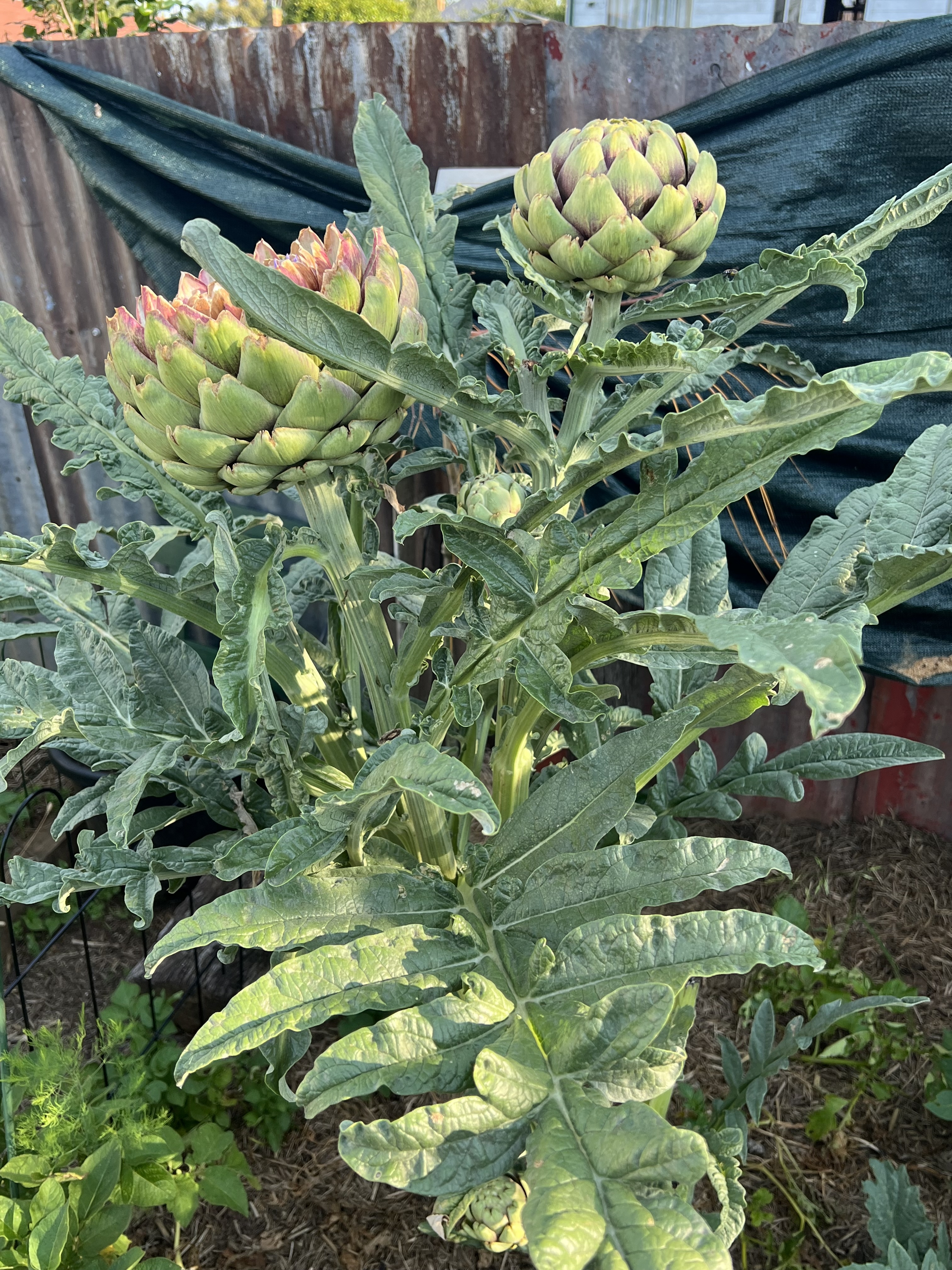
Artichoke plant

I’ve been watering my friends’ garden during an uncharacteristic heat wave. As my threshold for boredom is low, they have set up sprinkler systems to make the job easier. All I have to do is turn on the tap and return a while later to switch it off. In theory. It turns out that the sprinkler system is not very efficient around the vegetable garden. No matter how far I turn the tap to left, all I get is a piddle at the other end. So, I began watering that part of the garden with an old-fashioned watering can. It’s not surprising that this made me start paying more attention to the plants there.

The most outlandish vegetable in that patch is the globe artichoke. It stands high and lofty, towering above the other plants and, if truth be told, it is quite unattractive. It reminds me of the weeds I have been battling in my own garden which makes me wonder how people discovered it was not only edible but a delicacy. While the ensuing internet search did not yield an answer to that question, I did learn some interesting facts about its history.

I wasn’t too far wrong when I compared it to the weeds in my garden. The artichoke belongs to the thistle family, and I’m growing plenty of those. The artichoke’s spiky flowers and thorny leaves attest to this lineage. I was surprised that it is one of the oldest vegetables we are aware of. Most likely, it originated from the wild cardoon found in Northern Africa, and was then imported to Sicily and Greece in the 5th century B.C.E. Both the Romans and Greeks regarded it not only a delicacy but also an aphrodisiac. Considering how little is ingested with each nibble of a leaf, I imagine it may take quite a while for this to take effect.

The artichoke finally made it to the rest of Europe in the 16th century when Catherine de Medici introduced it to France upon her marriage to King Henry II. Nowadays, it is difficult to imagine French cooking without artichokes, whether in tarts or artichokes à la barigoule. Artichokes are firmly embedded in French cuisine.

My favourite way of eating this peculiar vegetable is either dipping the cooked leaves into garlic butter or home-made mayonnaise before scraping off the minuscule bits of soft flesh with my teeth. Either way, it is a simple and satisfying if not particularly couth dish to devour. As the butter or mayo invariably drips from my chin, it is a dish best shared with close friends and preferably not in a classy restaurant.

Bird Song

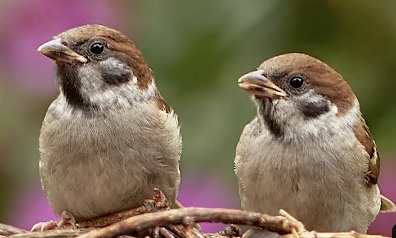
One morning while having breakfast, I tuned in to sparrows chirping. They like hiding in an overgrown hedge out the back providing them with ample shelter. It is never one sparrow that sings but a host of them. Their simple song, made up of only a few notes, is sung mainly by the male to attract females or fend off invaders. I can’t help but smile at their incessant bright chirruping. It isn’t very loud and provides a pleasant soundscape as I sip on my cup of tea.

Soon another sound gets my attention. The blackbird’s song is one of my favourites, mainly because it reminds me of my childhood. I even named a dog after this bird. While its song varies for each verse, it always seems to start on the same mellow note. Their phrases are short and often include ‘djuk djuk’ clucks. No other birds have the same slightly melancholic effect on me.

Scientists have found that listening to bird songs is conducive to mental health. It surprises me that we need this confirmed through research. This revelation reminds me of the recent discovery of ‘silent walking’. Those brave enough to try this new trend have reported a reduction in feeling distracted. Who would have thought. It turns out that being in touch with nature is calming.

I can now hear my three tenors warble at the font of the house. This is what I affectionately call the magpies that come to feed on the front veranda. Magpies often get a bad rap for being aggressive. In a small town like Millthorpe, they know all the people and can distinguish between those who treat them well and those who do not like their company. I am often rewarded for being kind to them with their mellifluous warbles as they sit on the railing, necks craned, beaks raised skyward.

Nature plays a vital role in our quality of life especially for those who live in cities. We are seeing an increased willingness to consider the health of urban environments through improving biodiversity. I’d like to see a greater variety of birds in the heart of Australian cities beyond pigeons, gulls, and ibises.

Of course, not all bird sounds have a positive effect on us. Some can be downright irritating. Take the Koel for example. To be subjected to the coo-eee call of a Koel rising in pitch and fervour is akin to torture. The kindest thing I can say about them is that I am grateful that they are migratory birds. I’d much rather listen to a flock of local sulphur crested cockies. Noisy as they are, I have a soft spot for these larrikins. They are mischievous, funny creatures who relish play and pleasure. I love the way they hang upside down from the gutter to look through my window or find novel ways to open my garbage bins to see what is hidden inside. Curious, cheeky and utterly uncontrollable, they are the epitome of the rebel without a cause. Cockatoos often wreak havoc, yet I can never be cross at them for long. Theirs may not my favourite bird call but they make me laugh like no other bird can.

There is so much to learn from pausing to listen to our natural environment. Tuning in to bird songs helps me get out of my head and pay attention to my surroundings. I focus wholeheartedly on listening rather than looking. It’s a skill many of us neglect.

Central West Sunset

Dusk at Millthorpe is enchanting. The western sky, dappled in mid-level cloud, plays with a palette of yellow, orange, pink and bruised plum. The colours layer on top of one other like an extravagant celebratory cake. The initial yellow and orange hues are followed by an intense pink reminding me of specimens in the Bathurst begonia garden. In part it is like pink tulle draped across the sky, lifting in intensity, and for a few glorious minutes, the sky lights up just as its embers are about to die out.

The soft duck egg blue above this showy palette is slowly transformed to lavender, plum, mauve, and violet before the sky changes yet again before my eyes. Blues now dominate the sky. Moving from azure to cerulean, delft and finally to navy before turning into an inky black sky, I gaze as if into the eyes of a lover. Slowly, stars emerge, first one then another, and before long hundreds fill the night sky. Away from the city lights, they illuminate the firmament and light the way, even on this moonless night.

I have long been fascinated by celestial bodies and as a child could name many of the constellations until my northern sky was replaced by the southern cross and new shapes for which I had no name.

I am intrigued by the Australian Indigenous way of viewing the stars. The images I look for are formed by lines connecting star to star while they look for images in the spaces between. This reminds me of those optical illusions where you see either a young or an old woman depending on your perspective, until you can see both images and move between them with ease. I’d like to learn more about Indigenous astronomy and move between the two skies with ease.

It is too cold to stay outside. The temperature drops fiercely once the sun withdraws. I shiver and take a last look at the night sky and still can’t tear myself away from the spectacle before me.

Gosling Creek Reserve

“The path reveals itself once you start walking.”
― Abhijit Naskar, Aşkanjali: The Sufi Sermon

The grass is long after all the rain. In parts of the reserve, it reaches past my shoulder. Rivulets of water course down the slopes to form boggy marshland and the creek runs fast and free to pool in a small pond. These are the things I forgot to mention when I invited my friend, Penny, for a walk with her two dogs. I have sensible walking boots; she wears flat slip-ons. Our dogs run wild while we jump across puddles or find grass tufts that take our weight as we cross the great wet expanse. Her shoes squelch and slide, but we make it across the worst of it with our balance intact.

Birds twitter in treetops and we hear a stream burbling not too far from us. As we approach a small bridge, the type you would find depicted in a Monet but without any of the charm, water rushes past us as if in a hurry to make it downstream. One of her dogs leaps in and lets the deluge wash over him. We can’t help but be swept along with his exuberance. After a while, he joins us on the path shaking the water off his loose skin, seemingly in both directions at once with a whip-flick motion that drenches us as he runs past. We laugh at his joie de vivre and watch the dogs bound through the high grass.

As we reach a well-trodden path around a pond, we hear a chorus of frogs in the tall reeds. Looking closer, we see a mother duck with five tiny ducklings drift towards the foliage for protection. The dogs haven’t noticed them. They are much more interested in a larger version waddling on the path ahead of us and make a half-hearted attempt to run after it. The duck launches itself into the pond and elegantly glides away. None of the dogs have an appetite for a serious chase, especially one that involves the effort of swimming. They are already running zigzag, following a new smell that has caught their attention.

On the other side of the pond is a park bench. We head towards it for a rest. The bench is dedicated to the memory of a girl called Mel, the same age as my daughter. She would have been 25 when she died. I think of her family and friends and the unspeakable loss they must continue to endure. My heart breaks for these nameless strangers. I wonder how this young woman died and why the seat was erected here. I can’t help but imagine various scenarios and fill the gaps with conjecture, but I will never know her true story.

We take a seat, but the dogs start barking and beseech us to keep moving. After a couple of minutes, we give in to their demands and begin our walk back. I decide that the asphalt track does have its merits, especially as we feel the first drops of rain, first on our arms and later, on our shoulders. Tree roots have cracked open the surface of the path and we tread carefully to avoid tripping on fissures and craters. At the same time, I’m glad nature is winning the battle here, and consider it likely that the trees will outlast the asphalt.

The path is suddenly steeper. We see hemlock growing up to two metres and it has invaded large tracts of the grassland. The plant is highly toxic and there is no antidote to hemlock poisoning. We call the dogs and make sure we don’t brush against it. This section of the reserve looks neglected, and we are aware that there may be snakes in the weedy vegetation. Best move on swiftly.

A galah flies across our path while a magpie struts in the next field, head bobbing forward and back until it sees our dogs. Begrudgingly, it flies to the nearest branch and keeps a wary eye on these bumbling, ground-sniffing predators. The birds, as ever, win against these domesticated, well-fed, and pampered dogs.

We reach a plateau where large fallen limbs of tress are neatly placed along the verge of the path. No doubt a storm has raged here not long ago. Some of the branches are horizontal while others lean precariously on the trunk of a tree. In time they will offer shelter to ground dwelling creatures and their sacrifice will not be in vain. Further, there are trees with protruding branches at crazy angles that remind me of some Halloween prank. They look almost human with one or two additional limbs waving in the wind. We marvel at their shapes and pick up our pace. We can feel the steady drops of rain on our faces now and head for the car.

The dogs have one final crazy dash across a field. They sprint in circles just as though they were running on an invisible racetrack. We call and they return, tongues to one side, panting and spent, content to go home. We laugh at their antics and know we must come again soon. At the carpark, we say our goodbyes and stomp to remove the mud from our shoes.

Four-leaf clovers

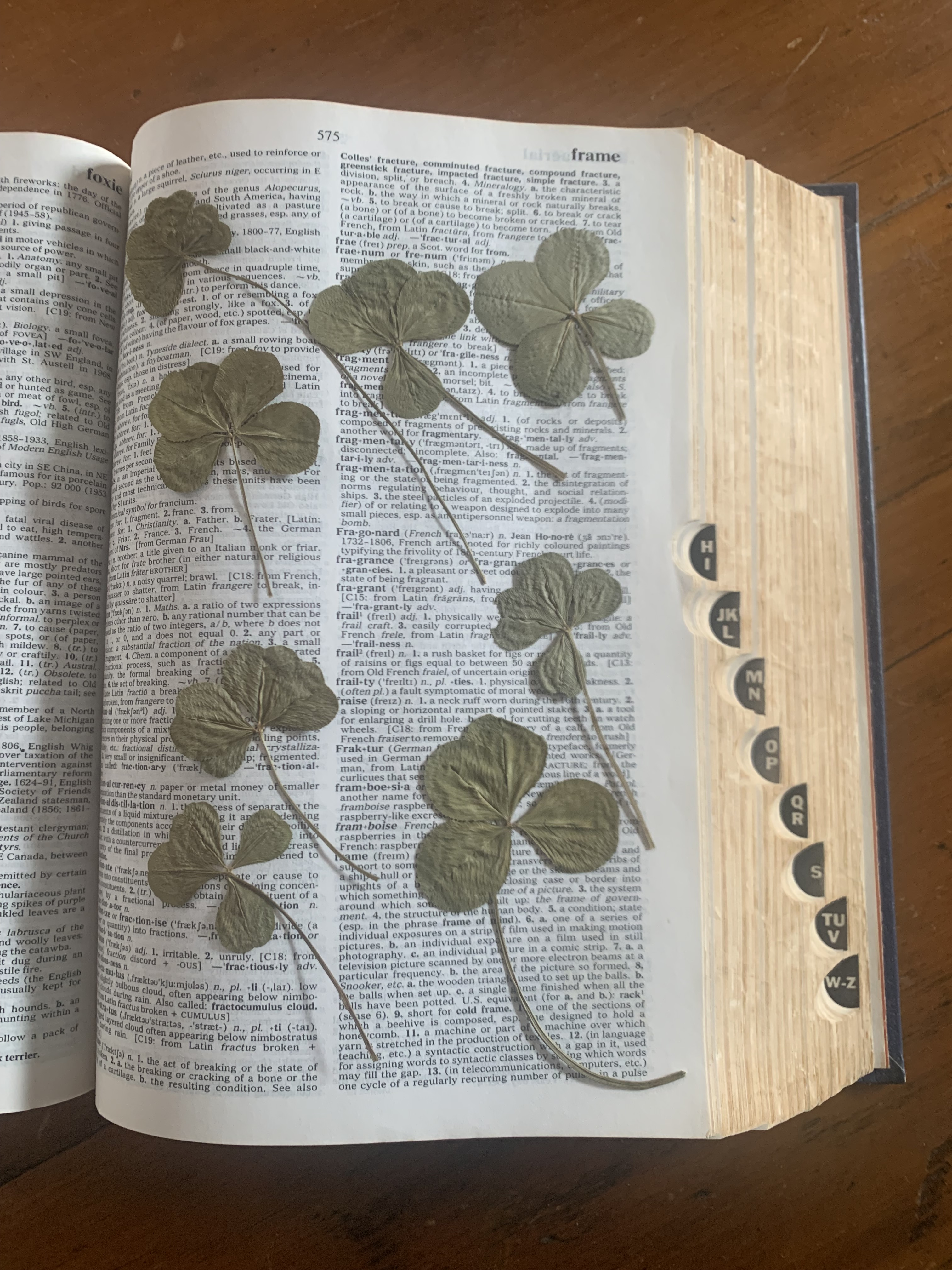
I found my first four leaf clover in a meadow as a nine-year-old child. It felt like a miracle. I picked the clover and put it in my pocket only to find it had shrivelled by the time I arrived home. The disappointment loomed larger than the original miracle. Still, if I could do it once, I knew I could do it again. I became obsessed with finding another one.

I learned that fragile leaves had to be pressed between paper, the quicker, the better. A book would work as would a bus ticket or even a lolly wrapper. At that time, I hadn’t yet acquired my habit of carrying a book everywhere I go, so relied on folded scraps of paper in my pockets.

I began to make a pact with fate – if I were to find a four-leaf clover, it would mean I wouldn’t get into trouble at home; I’d be allowed to go to the cinema on the weekend or the boy I liked would finally speak to me. However, finding the second four-leaf clover, eluded me for a quite a while but I wasn’t deterred. I spent many summer hours in fields looking at clover patches and at first all I saw was a sea of green. Slowly, patterns emerged and then, aberrations in the pattern. Not all of these resulted in finding four-leaf clovers, but I began to find them with increasing regularity.

My obsession hasn’t abated. In fact, my eyes have become so accustomed to spotting slight differences in clover patches that I often notice one as I walk past. It is my special superpower. Not very useful I must admit but I am often met with amazement when I bend down to pick one. Mostly I have an old receipt in my pocket so I can immediately press it, or at worst, I push it down onto my phone screen with my thumb, which works well enough until I get home.

My friends often receive a four-leaf clover in a card wishing them a happy New Year. I note this hasn’t stopped any of the calamities that have befallen us in the past few years. Still, it makes people happy, if only for a few short moments. It is a tangible symbol of my best wishes for their coming year.

As age creeps up and I keep pursuing my childish endeavours, my mind turns to pithy epitaphs I may consider. This one has held its attraction for a while now:

Finder of four-leaf clovers, maker of her own luck.

Spring

Spring has come suddenly. A week ago, temperatures were still in single digits and icy Antarctic winds blew across paddocks. This week, an azure sky greets us each morning and buds are shaking off their winter mantle, emerging from their deep sleep.

In a single day, leaves appear and apple blossoms beckon bees to their nectar. The first flies emerge and even they are a welcome sight. A young green backed crimson rosella who has come looking for seeds is quickly set right when she intrudes on an adult pair feeding. Stocky, crested pigeons arrive and there’s a stand-off between the birds. A dog barks and the pigeons take off with a characteristic whistling sound. This is created as air flutters between narrow feathers on its wing. A pied currawong lands and has a furtive look but is driven away by a pair of magpies. They feed, crane their necks towards the sky and warble in gratitude before leaving.

In the backyard, the lawn is overgrown. A languid blue tongue lizard emerges from the shadows seeking the sun. It could be mistaken for a garden ornament until something catches its eye. Suddenly it moves with diagonally opposite feet at unexpected speed. It is a reminder that snakes are also coming out of brumation and are looking for food, warmth and a mate.

After a wet winter, water lies in flooded ditches and the Eastern froglet can be heard from a distance. The deafening sound is easily confused with that of a cricket except that the chirp is at a slightly lower pitch. There must be dozens of these critters creating such a racket. Not even walking past with dogs disturbs the male frog’s amorous call.

Ornamental prunus blush pink along the nature strip, like bridesmaids at a wedding. They sway in the September wind, decidedly underdressed in blossoms without foliage. Other trees experiment with sending their first leaves to their stem tips. Is it time to let the next ones unfurl or is it better to wait? The silver birches err on the side of caution and hold tightly onto their buds. They aren’t ready yet to trust the change of season.

It seems the birches are right. As the afternoon progresses, the wind pulls across a blanket of grey clouds to cover the sky and temperatures drop back to single digits. Trees shiver and blossoms begin to lose their precious first petals. Tree branches knock against the windowpane as if asking to be let in from the cold. Spring may dither in these first few weeks of September but there’s no holding back its promise of abundant splendour.

Mushrooms

Chanterelles  or Eierschwammerl/ Pfiffferlinge © Nadya Kubik / shutterstock.com

‘See if you can find some mushrooms in the woods, when you come home from school’ my mother said before leaving for work. September was the best time for picking mushrooms and of all the chores, this one was my favourite. I took my dog, a bitser of a German Shepherd and, wicker basket in hand, we headed off. Going mushrooming was an adventure, a reason to go exploring the woods with my favoured companion.

I was nine years old and knew all the edible mushrooms of the Vienna Woods. I followed my nose and went deep into the forest where the dappled light shimmered across shadows and birds courted each other atop the canopy of beech trees. I listened for the cuckoo, the woodpecker, and the chirpy lark. They accompanied me in song and lifted my spirits as I meandered from the path in search for mushrooms at the base of ancient tree trunks.  

Looking for mushrooms was different to every other chore I had. It wasn’t time bound – I could justify being away for hours, unlike going to the shop to buy bread. To my dismay, my mother could calculate the time it took to walk there and back to the minute. Mushrooming, however, was an art, and art took its time. No one would accuse me of dawdling in the woods.

Deep in the forest, I felt at peace. Safe with the dog by my side, we looked out for one another. He never ran too far from my side. I was there to remove a thorn from his paw or find a cool stream for a drink, he was there to protect me. Sometimes, it was he who led me to the tastiest mushrooms. These afternoons were our precious time together.

While finding mushrooms for that night’s dinner should have been foremost on my mind, there were unexpected pleasures in the woods; a salamander that scuttled across the path and disappeared under leaves, a doe that looked deep into my eyes before trotting away. These encounters were pure rapture. I knew I belonged to this magical world and would always be welcomed home.

And then, there were the times when I found a meadow of wildflowers and I’d fill my basket before remembering the real reason for my ramble. Or, tired from my long walk, I’d lie down in a clearing and watch the clouds assemble into my favourite animals. All I had to remember was to be home before six and explain that mushrooms were particularly difficult to find that day. This was the latitude I was given when looking for mushrooms that would provide our evening meal.

Even so, I still had to find them. I could not go home empty handed for there would be no dinner on the table. I’d search carefully around promising trunks, moving leaves with a stick or bending down to explore a mound that could signal a troop of mushrooms. I was always delighted when my instincts proved right and I could pick three or four chanterelles before moving on.

On bountiful days, I’d return with enough mushrooms for a couple of meals. The sweet earthy smell in my basket scented the kitchen. For the next two nights, we would eat well. We’d have our fill of fried mushrooms and boiled potatoes and would not go to bed hungry.