Telstra Tower and Other Small Miracles

The other day I listened to Dr Ellen Langer speak about mindfulness as a way of being rather than a practice. She described the art of seeing the ordinary with fresh eyes, of really looking, really noticing. It struck me how easily the rhythm of daily life can lull us into living on autopilot.

Her talk reminded me of the Buddhist Monk, Thich Nhat Hanh’s definition of mindfulness, doing the ordinary things in life with a sense of purpose and attention, whether that be opening a door or turning on a tap. Each of these little acts can be done either mindlessly or mindfully. Doing it one way we are absent from our life while doing it mindfully we become alive to the present moment. And the present moment, as we know, is the only moment. Whatever happened 5 minutes ago is in past and whatever is coming is in the future. Life can only be lived in the small moments of now.

I have known this for many years but I am not very good at being grounded. My mind takes me hither and dither and I can be quite the scatterbrain. Where’s my phone? My wallet? Did I turn off the lights? Did I just lock myself out? These are daily micro-moments of panic I experience on repeat. My daughter just laughs and says she never gets past counting to 17 before my problem-of-the-moment is resolved!

This morning has been a scattered start. I’m still in my PJs deciding on shower, getting dressed, making to do lists, going to the shop and walking the dog. It really shouldn’t be this hard. Just start with the first logical step (have a shower) and keep going. It hasn’t helped that I am unwell and brain fog has settled in for the day. That’s when I stopped and looked out the window. No, not just looked out the window but really looked out the window. I saw the usual scene before me with fresh eyes. Trees swaying in the wind, leaves like windchimes. Thousands of hushed, eucalypt windchimes trembling on trees only a few metres from the glass pane. I was mesmerised by the bounty of their beauty and then looked further afield towards the horizon.

Erupting in a belly-laugh, I couldn’t believe my eyes! I have lived here for 20 months and have never seen it. Yet there it was, clear as the day before me. The largest structure in Canberra, a 195metre telecommunications tower known as Telstra Tower and it can be seen from my window! How often have I mindlessly looked out and never seen it? How can I miss an obscenely large structure like this? I shook my head in disbelief and couldn’t help but laugh at my selective blindness. Sadly, this is nothing new, many people know this about me but it still catches me completely unawares.

I now have a new landmark to celebrate when I look out the window and I wonder what other delights await me as I learn to look once more with fresh eyes. It’s both humbling and heartening to realise that wonder was there all along. As Thich Nhat Hanh says, “We all have the ability to look at things with fresh eyes and see them as if seeing them for the first time. If we have lost our freshness, all we have to do is practice breathing in and out to restore it.” (From A Handful of Quiet, Happiness in Four Pebbles.)

And so I breathe in and out and learn an old lesson anew. I laugh at how life patiently keeps offering me reminders and I resolve to open my eyes and look deeply as if for the very first or very last time.
Floating My Way into Calm

The first time I encountered a floatation tank was in Melbourne sometime in the 1990s. Back then, they were small pods which could either be closed completely or left ajar for those who suffered from claustrophobia. I didn’t know what to expect and found the experience relaxing but rather boring. It was also before I learnt to meditate.

On a whim, I decided to book a 60-minute floatation experience. I reasoned that if I fell asleep during an MRI, I would find floating in an enclosed tank relaxing. I booked into the nearest ‘Wellness Centre’ and a calm young woman met me at the front counter. The process was explained via a short video on an iPad; she then offered me a cup of tea and took me to the floatation room.

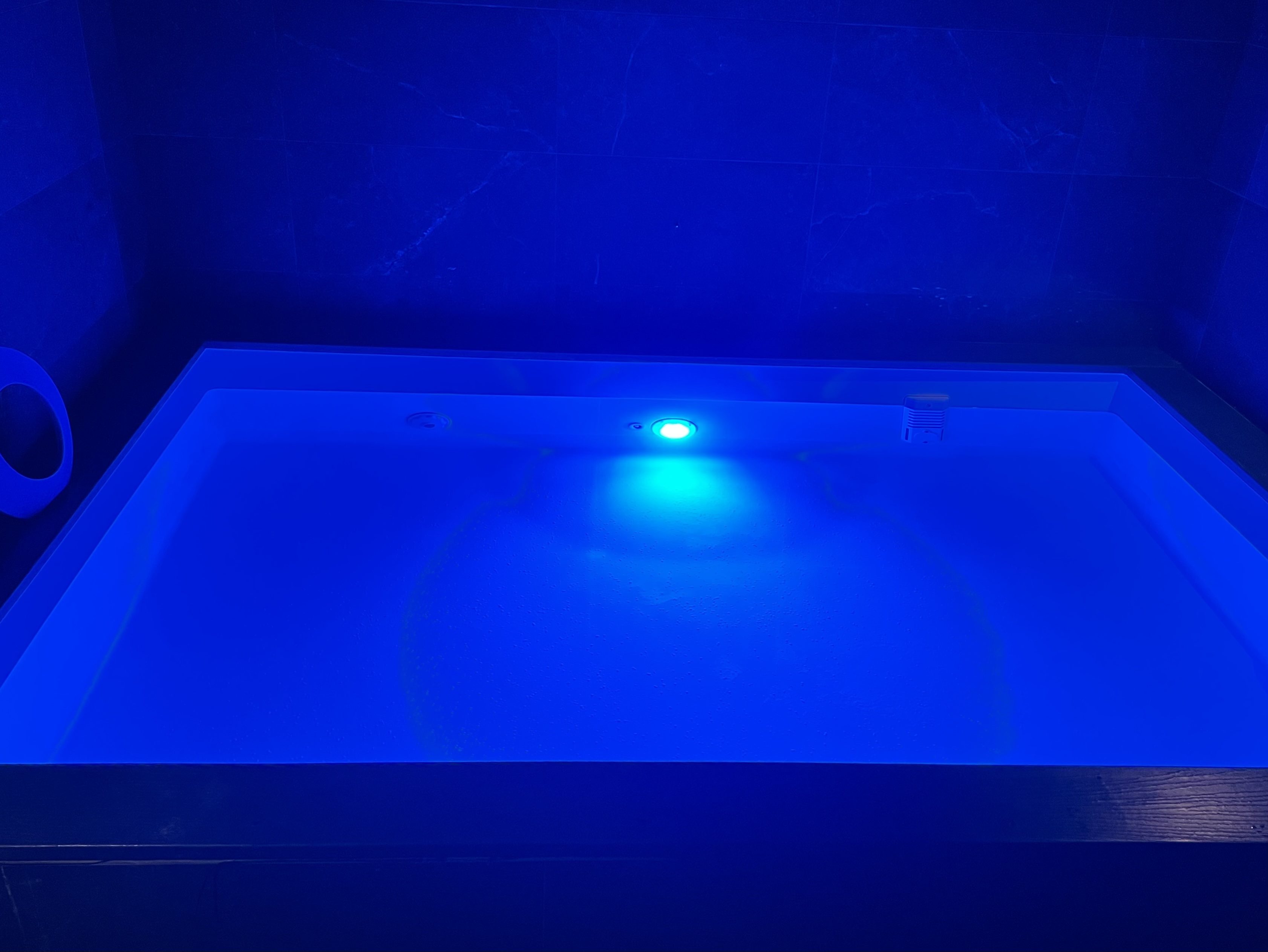
Instead of an enclosed tank, I found myself in a very spacious room with a shower on one side and a floatation pool taking up the length of the room. I was surrounded by blue light which I could turn off for complete sensory deprivation. Once showered, I stepped into the pool and immediately floated to the surface of the water. I chose not to have any music and turned off the light.

This may remind some people of solitary confinement and in a sense it was. I began a mindfulness of breathing meditation, where I counted each in and outbreath as one and then continued until I reached ten before starting at one again. I managed to focus for ten times ten breaths which roughly equates ten minutes before I lost track. I’m not sure how long I persevered with counting my breath before I fell into a deep sleep in zero-G.

Sensory deprivation is often used to reduce stress, relieve pain and help with concentration. When sensory input is minimised, it is easier to allow our parasympathetic nervous system to do its job and relax the body. It can lower the heart rate and produce a profound sense of calm. Sensory deprivation, especially when combined with high levels of magnesium sulfate (Epsom salts), can assist with muscle recovery and improved sleep quality. These are all sorely needed when we are always on the go, and my sore body sure appreciated the benefits.

A faint voice awakened me. I stirred, found the light switch and showered once more, washing the salt from my body. Heading to the lounge area, I encountered a number of slow moving, gently smiling people. After tea and a few quiet moments in the lounge, I opened the door and returned to the world outside; calm, rested, and savouring the silence within.

Ringing Bells and Deepening Breaths: A Practice in Presence

Breathing, such a simple act. An involuntary function of the body that stays with us from the moment we come into this world to the moment we leave it. So why is it so hard to for us to master?

Like many people I know, my breath is shallow unless I pay attention to it. When I consciously think about it, my breathing slows and moves to my belly. At the same time, my shoulders drop, and I feel calmer after just two or three rounds. I am not meditating, just paying attention while I go about my daily tasks. Yet I don’t remember to do this simple exercise often enough.

Today I heard Jonathan Fields talk about the importance of breathwork. He starts his mornings with taking some inbreaths and then exhaling just a little longer. As he repeats this, the breaths naturally get longer, and the exhalation is also lengthened. This has the effect of calming his mind and starting the day feeling at ease. I think this is a worthwhile routine to incorporate into my morning.

The scientific reason why this works is that stress puts the sympathetic nervous system in charge, which activates the ‘fight or flight’ response. On the other hand, when we breathe deeply, we engage the parasympathetic nervous system which slows the heart rate and makes us feel relaxed. As our breath is always available to us, we can use it to help us regulate emotions.

I was reminded of something I always do when I hear bells ring. I stop and breathe consciously until I can’t hear them anymore. In Eastern meditation practices, the bell is always a reminder to return to the breath. This practice was easy to incorporate into my daily life in Europe where church bells often chime on the quarter hour. When I was teaching in a small town in Switzerland, the bells were always there to help me come back to my breath during the day. It made me present to that moment with my students. I miss hearing them in Australia.

So today, I set a gentle sounding timer for each hour of the day, reminding myself to consciously breathe, drop my shoulders and to move my body. I spend too much time in front of my computer and am unaware of the tension I hold. Now, I have an external reminder to bring me back to the physicality of my body and my breath. As Thich Nhat Hanh said ever so simply, ‘breathing in I calm my body, breathing out I smile.’

Meditation upon my daughter

Sydney, 1996

I wrote this 26 years ago when my daughter, Ella was 9 weeks old. As her birthday approaches, I thought it a fitting tribute to her. It also is a fitting tribute to Thich Nhat Hanh, the revered Zen Buddhist monk, who passed away today, aged 95. I wrote this piece to read at the Lotus Bud Sangha in Sydney all those years ago.

There is nothing like having a little baby to look after to bring you back to the present. Her thoughts and actions are fixed in the present moment; this moment and this moment alone is all that matters. Show her a new object and she will delight in it, seeing it with a freshness we cannot conceive. Shot it to her the next day and the freshness remains – she is able to look at it as if for the first time, even the twentieth time. She delights in the small things in life. A breeze on her cheek can make her face light up and smile. It is a fleeting moment, but she enjoys it fully, unencumbered by ‘rational’ thought. She does not have to think ‘present moment, wonderful moment’ to meditate upon it. She does it automatically – without words, without thought coming between herself and the here and now.

She is not aware that she is a separate entity. The notion of ‘I’ and ‘me’ are alien to her. She is part of me and part of the rest of the world around her. She is part of space and knows no boundaries. Where she ‘stops’ and otherness ‘begins’ is something she will learn over a long period of time. At this moment, she truly ‘inter-is’. As she grows, she will have to learn other ways of seeing herself and the world. She will move from being a creature who fully feels connected with her surroundings to one who becomes increasingly egocentric. She will recognise familiar objects and no longer see them as if for the first time and she will develop a sense of a past and the knowledge of a future. Her ability to stay in the present will diminish accordingly. In the meantime, however, she is teaching me to look deeper at everything around me. As for my part, I hope someday to encourage her to see things with that same freshness she now takes for granted.

My daughter has taught me very quickly to be mindful of breath. In the past when I have tried the mindfulness of breathing meditation, I knew intellectually that breath equals life, but I never felt it the way I do now. My daughter was born limp and blue, her heartbeat the only sign of life. She was quickly suctioned and given oxygen. With that first breath her existence in the outside world started. Her life will go on as long as she keeps breathing. Is it any wonder that I regularly check her breath? I now see that meditating upon the breath is not simply a device to concentrate on something that is common to us all. Nor is it just a physiological phenomenon which can usefully be employed for relaxation. Meditating upon the breath is nothing short of meditating upon the sanctity of life itself. I now not only understand but feel why it is such a powerful meditation.

These past nine weeks have flown. Every day brings something brand new. While with adults we feel that there is a constant, that people ‘don’t change’ at least outwardly, with my daughter I realise that all of us grow and are forever changing. The baby I held in my arms three weeks ago isn’t the same baby I am holding now and yet clearly, she is! I am learning to enjoy paradox and I am learning to keep my mind open so that I can observe the world with the freshness she has brought into my life.