
Tides, Trees and Time

I have lived away from Sydney longer than I ever lived in that city, yet it keeps pulling me back like the tide along its shores. After living elsewhere for twenty five years, I can still find my way around the inner suburbs. I know the backstreets and shortcuts and have even kept up with the new motorways. In contrast, I often get lost in Melbourne, where I grew up. But it isn’t the streets, or their familiarity, that draw me back to Sydney.

This Christmas, I was greeted by flowering frangipanis in a friend’s garden. Their heady, tropical fragrance carried me back to past summers, to easy, carefree days spent on the beach at Nielsen Park or Bronte, inhabiting what seemed like endless summers. We would lie under the generous shade of Morton Bay fig trees, admiring the large, eel like buttress roots that extend several metres from the trunk. These trees are gigantic, with canopies that can reach up to fifty metres. They offer the best escape from summer heat in Sydney, and their large, often gnarled branches allow for endless adventures for children.

Blooming jacarandas are another Sydney hallmark. Every student at Sydney University knew that when the jacaranda bloomed in the Quadrangle, exam time had arrived. It was a favourite place for graduation photos, and I have one of my husband standing beneath the old tree. That tree collapsed in 2016, but it has since been replaced by new jacarandas to continue the tradition.

Southern Sydney suburbs are known for their jacaranda plantings. In the 1950s, Sister Irene Haxton, who worked at the Jacaranda Hospital in Woolooware, gave jacaranda seedlings to new mothers, who planted them in their gardens. Now there are suburbs where almost every garden hosts a magnificent jacaranda blooming in November. The purple flowers form thick carpets along driveways, a stunning sight, even if not always so welcome to the people who live there.

One of my all-time favourite flowers, which grows easily in Sydney, is the gardenia. Like the frangipani, its heavy, sweet perfume is intoxicating. I bury my nose into one of its creamy flowers and swoon, giddy with the pure pleasure of its scent. Unfortunately, gardenias do not cope well with frost, which precludes them from gracing my small garden in Canberra.

I used to return regularly to Sydney for cultural events, concerts and exhibitions, fleeting overnight visits that rarely allowed time to notice the flora I once took for granted. Now I tend to return to see friends, people who have been there through life’s highs and lows. Sydney is where I met my husband, where my daughter was born, and where many loyal friendships were formed.

I have no desire to move back to Sydney, with its stop start traffic and planes roaring overhead. I am much more at home in the slower pace of Canberra. I love its distinct seasons, with vibrant autumns and bracing winters that sharpen my senses. So, it isn’t that I miss Sydney as much as the memories that come alive whenever I visit. Each street, each smell, each tree reminds me of the path I have trodden, the life I have lived, and the friends who have shaped me. Sydney will always be those heady, fecund years of my thirties, when I sowed seeds of love and friendship. Now, in my sixties, I can return and enjoy its full florescence.

Woven Threads, Living Stories: A NAIDOC Reflection

My finished product

Happy NAIDOC Week! NAIDOC stands for National Aborigines and Islanders Day Observance Committee. As the name suggests, it was originally marked on a single day, and since 1975 has grown into a week-long celebration held each July.

This year marks the 50th anniversary of NAIDOC. It has its roots in protest movements seeking recognition and rights for Indigenous peoples and has since evolved into a celebration of culture, resilience and leadership. The theme for this year is “The Next Generation: Strength, Vision & Legacy.” As a teacher, this theme resonates deeply with me. We must ensure that the next generation is equipped with the knowledge, skills and tools to preserve and adapt their culture. I pay my respects to Elders past and present for the work they have done, and continue to do, in guiding and teaching the younger generations.

NAIDOC Week is also an opportunity for non-Indigenous members of the community to learn more about culture and Country. When I saw a weaving workshop advertised, I decided to go along and learn a little about this ancient craft. Ronnie Jordan ran the two-hour session at the Botanic Gardens with a couple of enthusiastic young people who clearly enjoyed sharing their cultural knowledge. I was humbled by their generosity.

Weaving is an example of complex technology, not only in the act of weaving itself, but also in the selection, processing and dyeing of materials such as grasses, reeds and even bark. Preparations like splitting, soaking and finding the right pigments are essential to how the final product takes shape. Weaving is used to make mats, baskets, bags, ropes, bowls, nets and fish traps. Weavers not only know how to create these items, but also how to repair them.

Both Indigenous men and women weave. They pass on knowledge through their hands, connecting with both people and Country. Each weaver develops their own distinctive style, which others recognise. It’s even possible to tell where an object comes from based on the plants used and the time of year it was harvested.

For our workshop, we used raffia that Ronnie had dyed using natural seeds, fruits and plants. We sat in a circle, began the process together, and continued at our own pace. I caught on reasonably quickly, perhaps because I knit and crochet, both of which rely on repeated patterns and maintaining even tension. As Ronnie walked around, she’d occasionally call out, “Exhale,” noticing that many of us were so focused we were holding our breath. After a while, the chatter died down and we settled into a meditative flow state.

The first time I saw Aboriginal women weaving was in Maningrida, in West Arnhem Land. They sat on the veranda of the local arts centre, their hands moving rhythmically as they wove baskets with intricate designs. It was mesmerising. I bought a small basket as a souvenir and carried it carefully all the way back to Sydney. I still regard it as one of the most beautiful objects in my home.

After two hours, our weaving was still very much in its infancy. We were encouraged to take some raffia home to continue. Not wanting to appear greedy, I took what I thought was a fair amount. It wasn’t nearly enough. Once home, I continued weaving late into the night until I ran out of coloured raffia. I had made a small mat, larger than a coaster, smaller than a placemat in about five hours. It gave me a new appreciation for handwoven baskets, and I now understand the price tags attached to them.

Lighthouse reflections

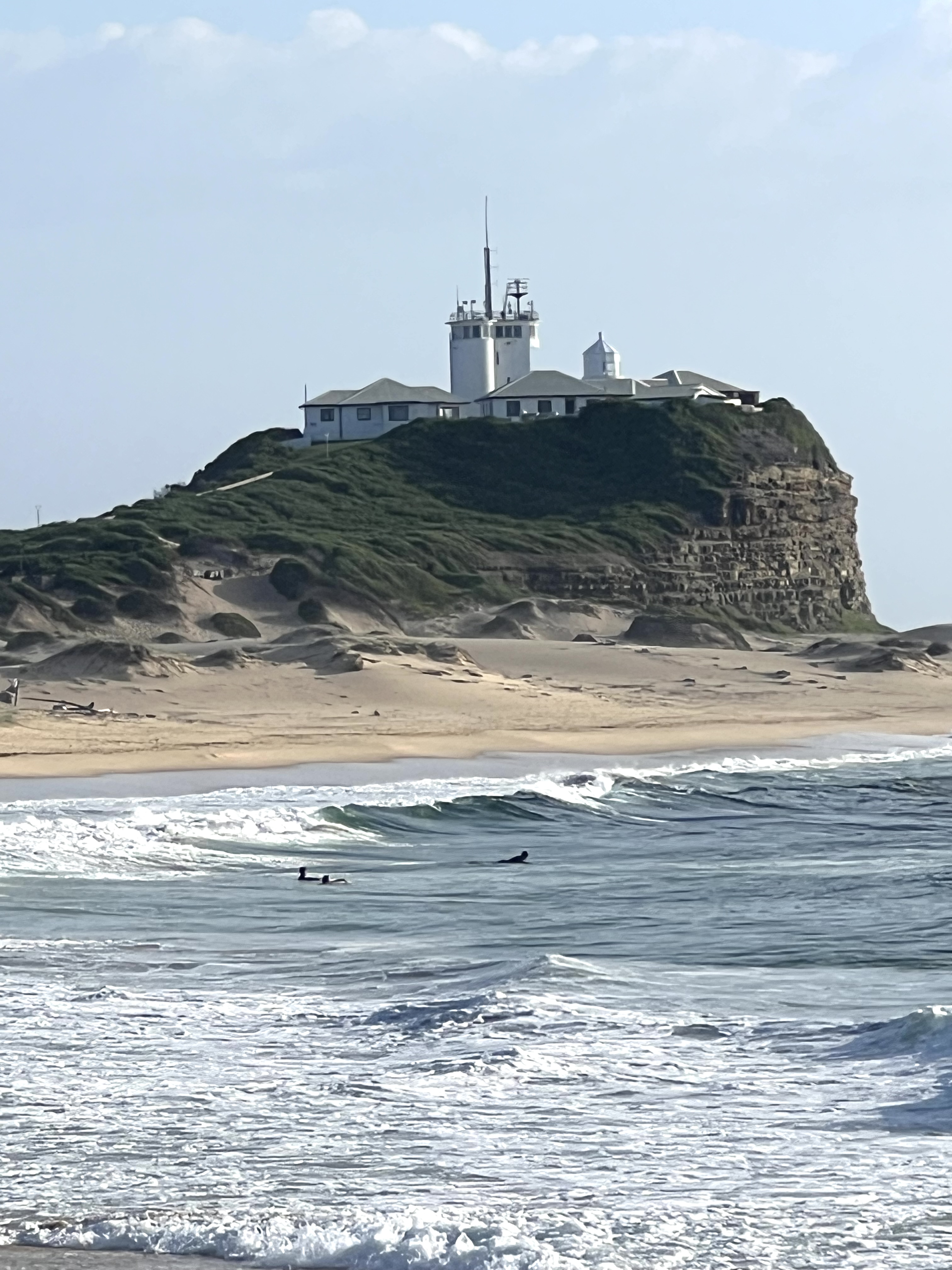
Some things are seriously worth waiting for. Like the Artist residency at Nobby’s beach, Newcastle. I was counting down the months, then the weeks until it was finally upon me. Five glorious days to spend on my memoir that has been sitting on a shelf for the past year, patiently waiting for me to come back and give my undivided attention.

There were eleven of us at the lighthouse. Some writers, some artists. Several had returned for the second time and were delighted to meet up with old friends. Two of us came from Canberra and, to my surprise, there was a large Melbourne contingent. One younger woman had grown up at the lighthouse as her father was the last signals operator before that job too became automated. We loved hearing stories about the people who lived there and the history of each of the rooms where we worked. For her, it was a chance to paint the lighthouse and its surrounds which had played such a significant part in her early life.

There is something magical about lighthouses. They are often metaphors for safe passage, guidance, and protection. They offer illumination for the dark nights of the soul and are a beacon of hope. In a port city like Newcastle, this lighthouse has the important function of guiding vessels into the harbour and up the Hunter River.

Before I arrived, the lighthouse became the beacon guiding me to cross the finish line of the year with a sense of achievement. It didn’t disappoint. I found it easy to get into flow and felt focused for hours on end. Many of us met at 12.30 for lunch in the common room, enjoyed each other’s company, and went back with a fresh burst of energy for the afternoon session. By the end of the week, I cut 21 000 words from my manuscript. I consider it a boon for my future readers. The engagement with the work has also rekindled my enthusiasm for the project.

The knowledge that Nobby’s lighthouse is one of the oldest operational lighthouses in the country made it feel like a workplace rather than some anachronistic holiday destination. I felt connected to both its current significance and its historical legacy.

Back in 1854, it first guided commercial shipping and 88 years later, it became important for military operations during WWII. The three small cottages erected on the site and these were used by defence staff during the war. An unexploded shell fired from a Japanese submarine damaged one of them.

Various lighthouse staff occupied the cottages after the war until the late 1990s. Lighthouse Arts, which is an initiative of the Hunter Writers’ Centre, now uses these cottages to hold exhibitions and offer artists and writers a space to create.

The area where the lighthouse is located is now known as Nobbys-Whibayganba headland. So finally, there is recognition of the Traditional Custodians, the Awabakal people and their deep cultural connection to the land, saltwater and the Dreaming.

I am grateful I could nurture my calling on this spiritually laden Country. It gave me much needed clarity and purpose. As such, I am already planning my next sojourn.

If you feel you would benefit from having a week to commit to your creative project, apply at https://hunterwriterscentre.org/2024/11/28/lighthouse-arts-residencies/  

We may even meet each other there.