
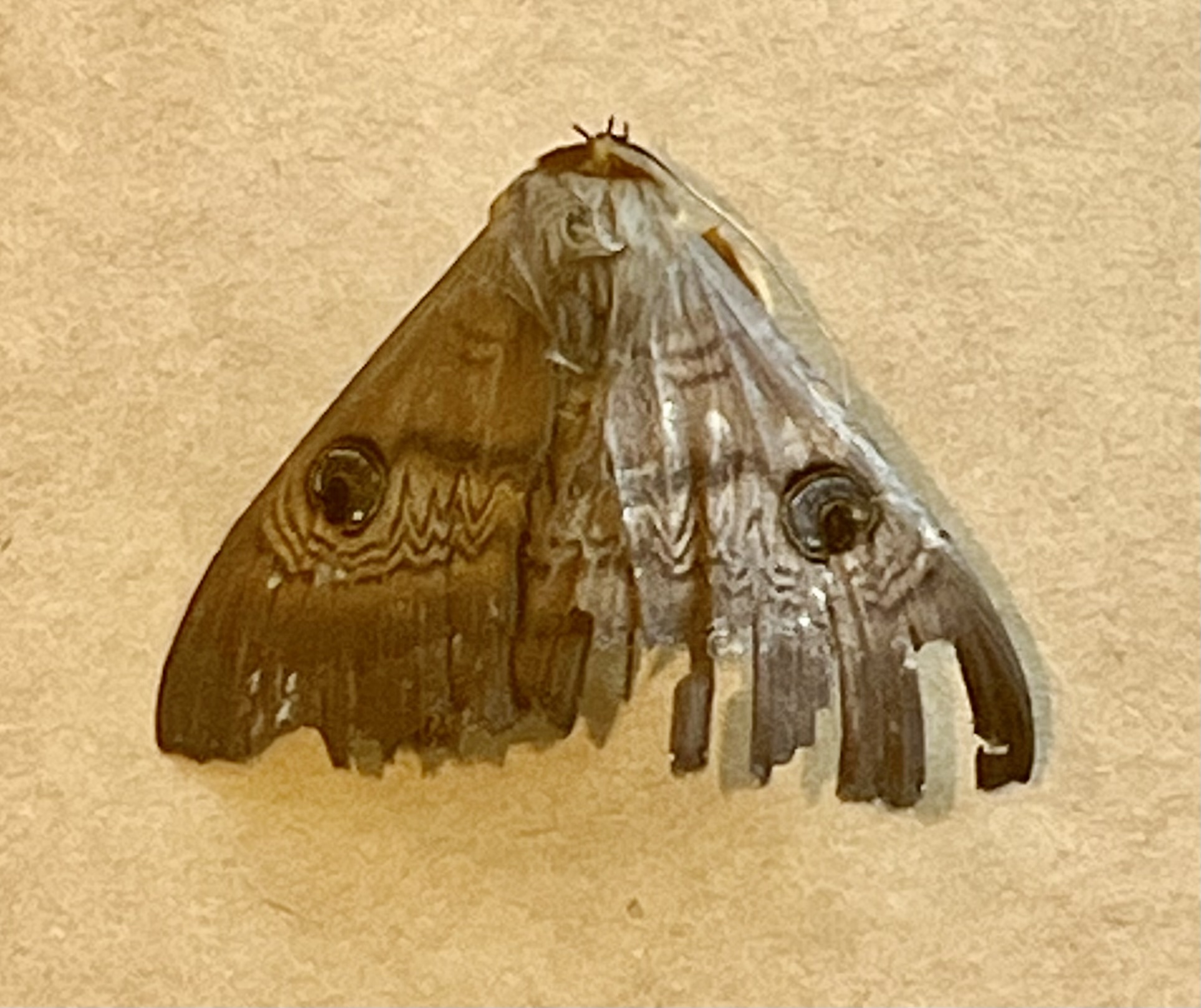
The other night, an enormous moth came into my study. Each of the dark brown wings had a blue ‘eye’, no doubt to intimidate a predator. I saw it settle on a window and watched awhile. I ought to get a large glass to capture and release it on the balcony, I thought. Then, momentarily distracted, I forgot all about the moth.
A week later, I found it dead on the table near the window. Even in death, it looked majestic. I felt guilty that I hadn’t remembered to release it and hoped it had a chance to mate and produce another generation of Southern Old Lady Moths. What an odd name for such a stunning moth!
Once I found out its name, I was curious to learn more. It is such a human trait. Naming something makes us feel more connected to it. So, I did a little research. Southern Old Lady Moths can be found where there are acacia trees, and we have plenty of them in the nature reserve across the road. Their caterpillars feast on wattle leaves and can grow up to 6cm. Their heads and feet are orange, just like the underside of the moth I found.
Once they emerge from their chrysalis, the moths are nocturnal. During the day they hibernate in small, out-of-the-way spaces, sometimes even in houses and garages. During these times, the moths remain perfectly still. This was what I was hoping for when I found the moth on the table, but I quickly realised this was not the case.
I felt responsible for its demise. I wished I had remembered to take it out when I first noticed it. Now, in death, I had the opportunity to observe it closely. I marvelled at its markings and its orange underside and head. Then, belatedly, I placed it in a pot plant on the balcony. Though I had forgotten it in life, I gave it a place in death. Here it will either provide food for a bird or turn to compost, completing its cycle of life.
 From Quill to Quote
poor thing..what a beautiful moth..a timely tale..
LikeLike
In our yard we have a large white cedar tree that harbours thousands of hairy caterpillars. They emerge around October and finish around March. I’m pleased to see the end of them. Your moths as opposed to our sound lovely.
LikeLiked by 1 person