Audiobooks

I do a lot of driving. Some of it for work, some to visit friends and family. I average about 28 000km a year or roughly 540km a week. This amounts to many hours in the car on my own. As I am out in the country, I don’t always have good reception.

I do enjoy silence, but I also like to use my time productively. When you’re out on the road as much as I am, there’s often not much time in the day to read. Listening to books gives me a chance to catch up on my reading list or to try new books I wouldn’t necessarily want to buy. The irony is that I often buy the books I have listened to because I want to go back and read them!

Some of the best audiobooks are the ones read by the authors themselves. It is such a pleasure to hear a book read in the way it was intended to sound. One of my favourites this year has been Chitra Ramaswamy’s Homelands which is a story of a friendship between her and a 95-year-old German Jewish refugee who arrived in Britain as part of the Kindertransport in 1939. It tells his story but also hers, examining their otherness, friendship, family and belonging.

Another book that had an impact on me was Syria’s Secret Library by Mike Thomson. In 2011, Syrian government forces attacked Daraya near Damascus and held it under siege, deliberately killing and starving its own citizens. Throughout the bombing and shootings, a group of dedicated men risked their lives to save books and established a secret library deep underground. These books could be borrowed and taken to the front, or read in the bunker where a young man took it upon himself to become the librarian. These men were fighters yet had a thirst for knowledge. So, they continued their education when educational institutions were no longer viable amidst the fighting. Listening to Mike Thomson read I was in awe of their dedication to the resistance and to their commitment to education.

I also like to listen to novels. On our way back from Adelaide, my daughter and I chanced upon A man called Ove by Fredrik Backman, a Swedish author. We thoroughly enjoyed listening to this story on our trip. I had never heard of Backman before and this lead me to listen to one of his other books, Anxious People, which I also loved.

Audiobooks have opened a new world of listening pleasure. Sometimes I listen to learn, other times I listen for pure enjoyment. Either way, it helps while away the hours on the road.

Soon I will be going to Melbourne to visit my sister. This is a round trip of roughly sixteen hours. I haven’t chosen my next book yet. Whatever it will be, I know I will enjoy those hours. In the meantime, your suggestions are always welcome!
A winter walk

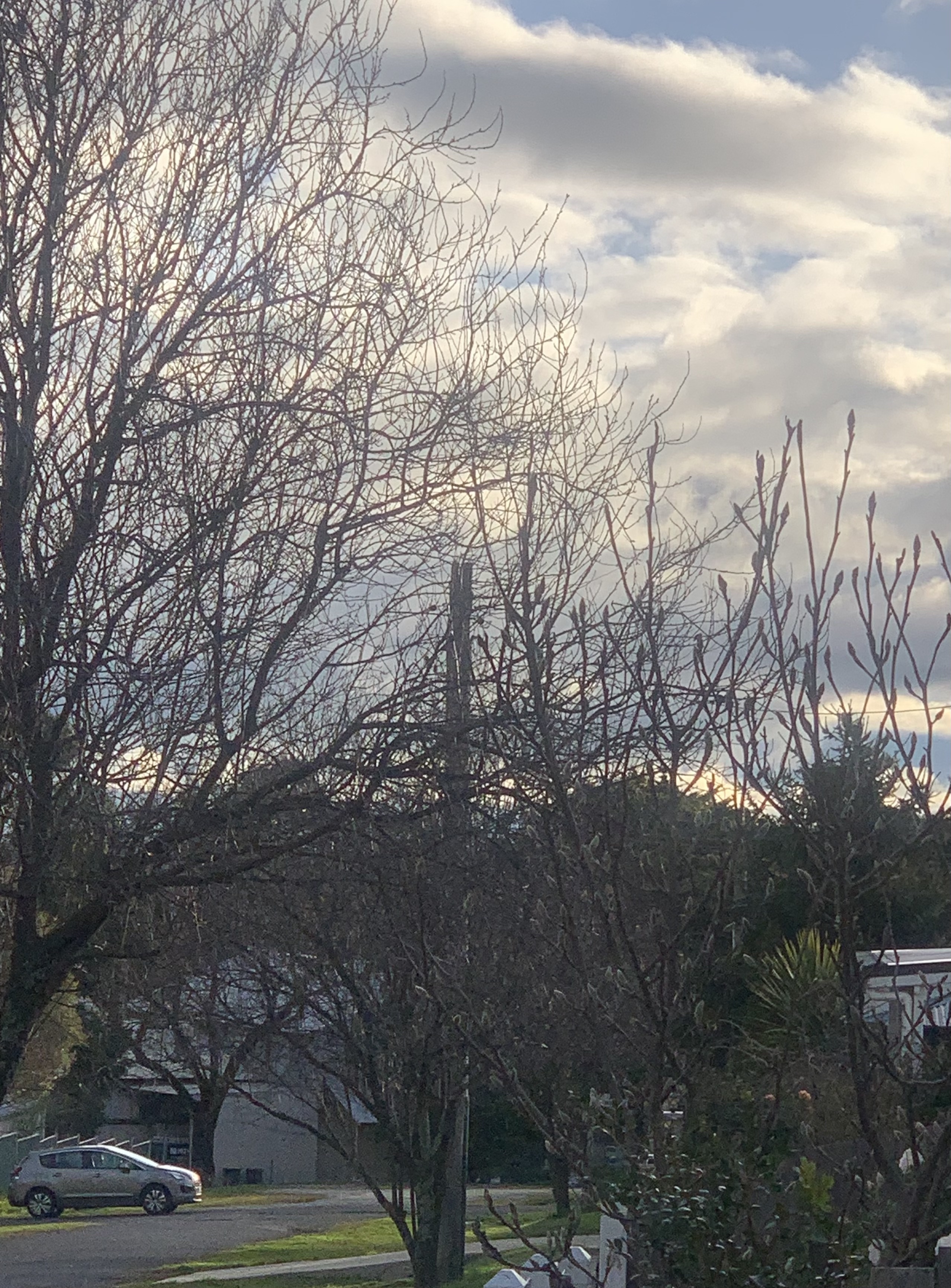
It is currently six degrees, windy and grey. Trees are shivering now that they have lost their leaves and even birds look untidy in their coat of ruffled feathers. It is anything but inviting out there. The dog needs a walk regardless.

I put on my walking boots, puffer jacket and scarf and head outside. The moment I turn the corner, the wind assaults me with a slap across my face. An involuntary sound escapes my lips. It is even less pleasant to be out than I imagined.

We walk along a well-worn route, down the footpathed side of the street where I can let the dog off the lead for a short block of freedom. Zoë runs ahead to say hello to the caged cockatoo who calls out to her, ‘Hello, puppy, hello, puppy!’ I reply with, ‘Hello, cocky.’ He rewards me with a bark to let me know that he has recognised the animal to be a dog. I marvel at his intelligence.

Further ahead, I stop for a moment at the corner store. Zoë gets excited at the prospect of a treat. Sure enough, the store manager comes out with a Schmacko. After a couple of high fives, Zoë is rewarded, and her eyes are aglow with devotion for this young man. She is playful and affectionate and jumps up at him. I cringe a little at her lack of manners and my neglect to train her.

We walk through the centre of the village and meet more dogs and people. Some of them are up for a friendly chat, others growl and snap. Our walk is slow as every blade of grass has a story to tell. Zoë reads the doggy news slowly and leaves her own messages at important junctures. Meanwhile, I hop on the spot and rub my hands together to stay warm. We make our way to the dog park, a handkerchief sized plot of land befitting nothing but a Chihuahua. Still, there is fresh news here too and Zoë learns all the local dog gossip as she keeps her ears and nose on the ground. My toes are beginning to protest at the pace of our walk.

Eventually we make our way back home. I can feel my pace quicken as we round the last corner, and I am once again assailed by an Arctic blast from the south. Zoë doesn’t register the cold but even she seems happy to arrive at our gate. Inside, we huddle in front of the heater.

I have a postcard on my desk which I picked up in Germany many years ago. It shows two windows, one looking out and the other looking in. Below are the following words:

There are people who stand in front of windows and longingly look inside believing that life happens there. While those inside stare out at the street believing it occurs there. Günther Kunert

On wintery days like today, I am content to live my life inside and look out.

Buying a fountain pen

I promised myself upon finishing writing my memoir, I would reward myself with something extravagant. Something that would last and be cherished, an item of beauty. I decided upon a fancy fountain pen to mark the occasion. It seemed a fitting purchase for someone who loves writing.

I finished the memoir six months ago now, but the time never felt right to spend money on an indulgence. Something more pressing always came up. Then, about two months ago, I took the plunge and began to research the pen that I would eventually buy. I looked at a number of luxury brands and chose a slightly lesser-known English company which offered a range of limited-edition bespoke pens. The one I eventually ordered had the advantage of offsetting some of the profit to a charity I was keen to support.

I couldn’t wait for the pen to arrive. As each pen is individually crafted, it took over six weeks to make and then I had to wait for the shipment from London. I was so excited to pick it up from the post office I wanted to unpack it there and then. But reason prevailed and I carefully unpacked my treasure at my desk. It came in a stunning black leather box, complete with a certificate of authentication, ink, and detailed instructions. When I removed the pen, the first thing I noticed was its weight. It felt very light and small in my hand. The body was made of resin, yet in parts it looked almost translucent. I felt a little disappointed, as I was expecting something akin to the sturdy Bakelite pens of the 1920s. Then I filled the pen and began to write. The 14c gold nib dragged across the paper and at times the ink didn’t keep up with my writing. I could hear it scratch along the paper and I knew the sound itself would be enough for me never to want to use it.

I swapped over to my trusty Lamy Studio fountain pen which I bought in Zürich about 15 years ago for about quarter of the price. It floated effortlessly across the page. I enjoy writing with it, and it has never let me down. Sure, it looks well-worn, and the patina of the bronze coating is clearly visible, but I love this pen. Why did I think I needed a replacement?

I think my motivation was that I wanted something new and shiny. Yet I love every old piece of furniture in the house with a unique story that can be traced through marks and stains. I still use the fifty-year-old pencil case my father made and every time I hold it in my hands, the worn leather fills my heart with gratitude for this object. Surely, my old Lamy is no different.

Once I realised that I was both disappointed with the new pen and with myself for not questioning my motivations, there was no other choice but to send it back and request a refund. I am not good at doing this. I was very factual and clear with my feedback and returned the item. I have lost some money on the postage, but I have gained a valuable insight about myself. This experience has taught me that I already have what I need, and that it is enough. More than enough.

Radical Gratefulness

Gratitude has become trendy with the positive psychology movement. You can always find something to be grateful for – be grateful for your breath, a pretty flower, a kind word. While I agree with the sentiment, I wonder whether the next generation who hear this mantra will grow up like I did, having to eat everything on my plate because I had to think of all those starving children in India. I am quite sure none of my Indian friends ever benefitted from the extra mouthful of cauliflower or cabbage I forced down my throat and it created a very skewed relationship with food for me which has lasted a lifetime. Waste not, want not…

Don’t get me wrong, gratefulness is a beautiful state and I do believe that we need embody it much more than we do. My gripe is the glib statements that often sound forced and obvious.  What I have been grappling with is what we do when things go wrong in our lives. How to be grateful when truly terrible things happen. This is what mean by radical gratefulness.

When I watched Peter die, struggling to take his last breaths, in those moments, I felt grateful. Not for the intense sunny morning that seemed so incongruous with what was happening, nor for the 20 or so years I had spent with him, but for those awful moments where I watched him suffer and that I could be there to share them with him. As my dear friend Janet said at her husband’s funeral, ‘Today is a beautiful, terrible day.’

Ten years later, I sat with Roger as he took his last breath and once more, I was grateful to have had the honour to sit with him in that beautiful, terrible moment. To bear witness to someone’s final moments is to be filled with deep sorrow, pain and beatitude. Radical gratefulness is the only way I can describe this. It is the experience of two opposing feelings in visceral communion through grace.

And so it was this week when I experienced a major setback. It was my fault – I missed a crucial date, and it has cost me dearly. My first reaction was to be annoyed, frustrated, and to be honest, gutted. But as time went on, I was able to find my way back to radical gratefulness. I didn’t accept the ‘it happened for a reason,’ ‘something better will come your way,’ comments, although I truly appreciated the love and empathy I received. No, I forced myself to look at the situation deeply, accept it fully, and be grateful for the lesson I have learned about my chronic inattention to detail. It simply matters, and I’ve stopped making excuses about being ‘the big picture thinker’.

I can now say with conviction that I am grateful for the mistakes I’ve made, for they have enabled me to learn and grow. As Alex Elle explains eloquently, ‘Gratitude practice isn’t about pacifying our painful or challenging times —i t’s about recognizing them and finding self-compassion as we do the work.’