
Listening to trees whisper, sigh and brustle as they sing their wind songs is one of the delights of walking in the country. The soughing of the wind through various trees often escapes our notice, but if we listen carefully, there’s much to be learnt about the trees we encounter.
A common feature in rural Australia, the Lombardy Poplar stands tall and erect. They make for graceful avenues and provide useful windbreaks for farmers. As they are deciduous, they look like sad sentries in winter but come spring, they emerge in full verdant glory with thousands of diamond shaped leaves. But it is their susurration that fascinates me. They sound like no other tree I know. Their flat petiole that attaches to the leaf creates a trembling, a shimmy-shamming sound that reminds me of unfolding crinkled tissue paper. I am sure I could recognise a copse of Poplars by simply listening to them.
My late partner once owned a country house in Manildra where he planted a row of poplars on his side of the road to match the ones on the other side. His neighbour scoffed at the extravagance of watering the trees, but he did it anyway. Their slender beauty would have captured his imagination. A lover of gardens, he appreciated a good view. As people drove past, they were enveloped by the poplars providing a change of scenery from the flat paddocks on either side. They were also heralding the houses on this lonely stretch of road. I can almost hear him instructing visitors, ‘Keep driving until you see the poplars, then turn right into the first driveway. Ours is the Federation house with all the roses along the fence.’
Lombardy Poplars have also been used to complement architectural features of well-known public buildings in Canberra. They were introduced there in the early 1900s, around the time that the house out at Manildra was built. They grace the forecourt of the National Library and can be found in many of the older parks around Lake Burley Griffin even though they are now considered a weed and prohibited under the ACT Pest and Plants and Animal Act 2005 due to their vigorous growth and propensity to invade waterways.
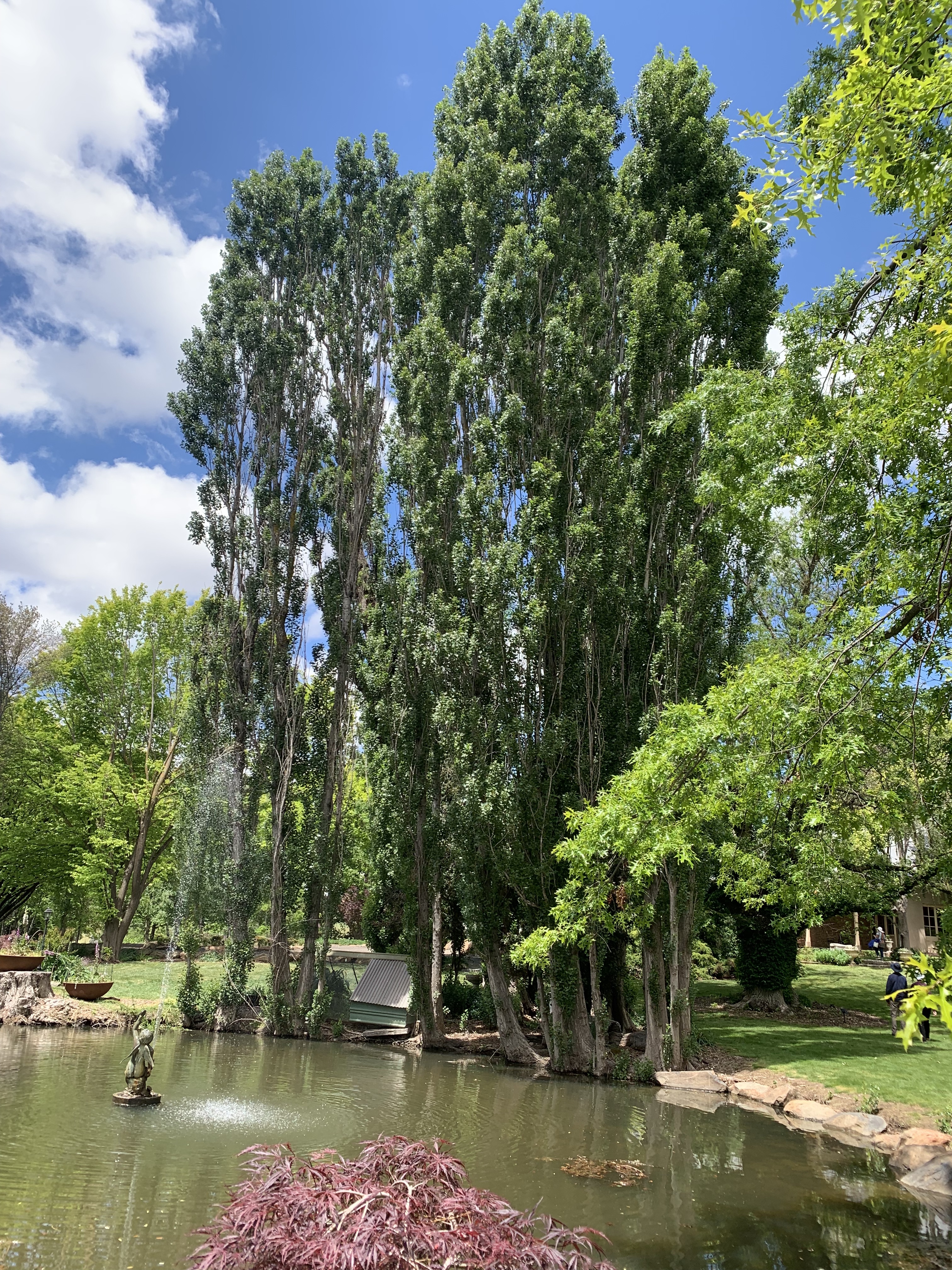
Last weekend Millthorpe hosted a Garden Ramble. It is a much-loved event which brings many visitors to the village. The gardens range from small backyards through to several acres of manicured parklands. Each is different, not only in size but also in aesthetic composition. Some favour the wild cottage garden effect while others are formal and majestic. It was at one of the oldest gardens that Poplars greeted me, sibilating in unison at my sight. Leaves waved like an old friend. These were ancient for Poplars, about forty metres tall, with roots that extended into the pond next to which they were originally planted. Their branches were in part straggly, but new growth was evident at the base of the trees.
Poplars, like church spires, reach to the heavens. I love them for their solemn beauty and wistful songs. Shimmering leaves in shamrock green remind me of the mother-of-pearl curtains of my youth refracting the sun’s rays. I am mesmerised by their wind-dance, their subtle choreography and siren song, drawing me ever closer into their embrace.
 From Quill to Quote