
The Old Lady’s Silent Farewell

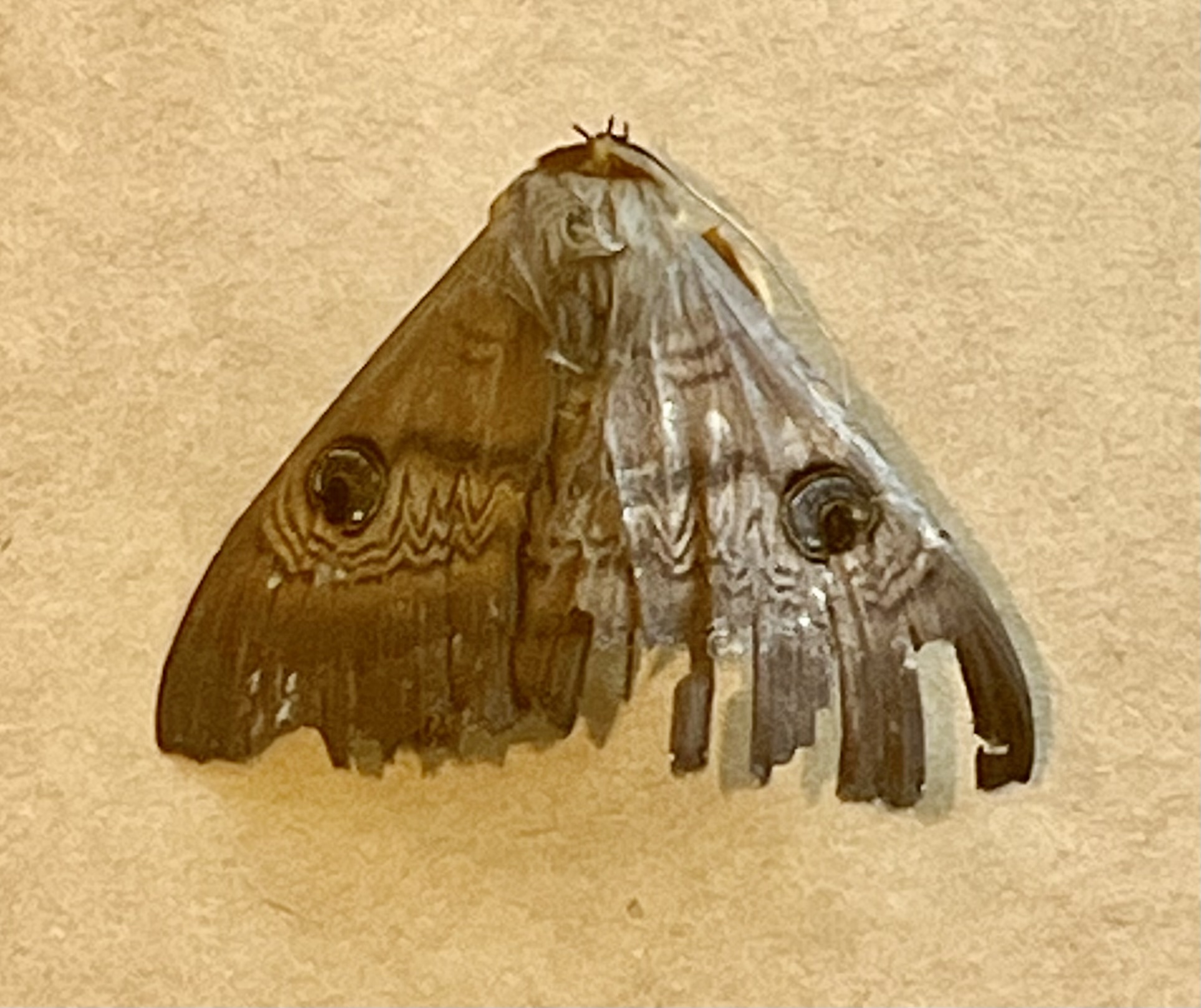
The other night, an enormous moth came into my study. Each of the dark brown wings had a blue ‘eye’, no doubt to intimidate a predator. I saw it settle on a window and watched awhile. I ought to get a large glass to capture and release it on the balcony, I thought. Then, momentarily distracted, I forgot all about the moth.

A week later, I found it dead on the table near the window. Even in death, it looked majestic. I felt guilty that I hadn’t remembered to release it and hoped it had a chance to mate and produce another generation of Southern Old Lady Moths. What an odd name for such a stunning moth!

Once I found out its name, I was curious to learn more. It is such a human trait. Naming something makes us feel more connected to it. So, I did a little research. Southern Old Lady Moths can be found where there are acacia trees, and we have plenty of them in the nature reserve across the road. Their caterpillars feast on wattle leaves and can grow up to 6cm. Their heads and feet are orange, just like the underside of the moth I found.

Once they emerge from their chrysalis, the moths are nocturnal. During the day they hibernate in small, out-of-the-way spaces, sometimes even in houses and garages. During these times, the moths remain perfectly still. This was what I was hoping for when I found the moth on the table, but I quickly realised this was not the case.

I felt responsible for its demise. I wished I had remembered to take it out when I first noticed it. Now, in death, I had the opportunity to observe it closely. I marvelled at its markings and its orange underside and head. Then, belatedly, I placed it in a pot plant on the balcony. Though I had forgotten it in life, I gave it a place in death. Here it will either provide food for a bird or turn to compost, completing its cycle of life.

Bee stings and childhood things

stock.adobe.com

My childhood memories of bumblebees are vivid. They were big, bright and booming creatures I encountered in meadows, underfoot and once in the backseat of a car. An early encounter with a bumblebee set the scene for melissophobia (fear of bees) that plagued me for decades.

I remember the occasion clearly. In the back seat of my uncle’s car, the window was wound down to let in some fresh air. A bumblebee flew in and was buzzing loudly at the back window, trapped. The bee looked so pretty with its striped and furry body, and I was fascinated. My mother’s voice boomed from the front seat.

‘Don’t touch!’

This was enough to make me want to do just that. I was a contrary child who could never follow orders, especially not those given by my parents.  So, I did exactly the opposite to what I was told. I reached out to touch the bee and was stung on my hand. I wailed in pain and tears flowed freely. I probably received a few  ‘I told you sos,’ and nothing could console me. I grew weary of these gentle giants that fly awkwardly from flower-to-flower pollinating as they go. I also developed a fear of all insects in flight

Bumblebees are considered a pest in Australia, and I have only ever encountered them in Tasmania. Like so many imported species, they compete with native species and they also compete with honeybees. An interesting fact about bumblebees is that they do not produce honey. Due to their size, they can damage flowers which makes them unusable for other pollinators that come along. 

I have only overcome my fear of bees in the last few years after learning more about their importance to the ecosystem. Somehow, understanding their vital role in our own survival has changed my attitude towards these creatures and my fear has subsided. I treat bees with respect and keep my distance, but I am no longer afraid. I appreciate all that they do and now watch in awe as they engage in their complex ritual dances to let other bees know where the best nectar can be found.