
Rescue, reclaim and write!

Whenever I move house, the first thing I set up is my desk. It has to be in the right position, preferably in front of a window. I love looking out when I am trying to think of the right word or phrase to express exactly what I am trying to say. Looking at a wall is stifling, no matter how many lovely post cards or pictures I have placed there.

I have had many desks in my life, starting with an ancient desk that my parents bought me when I was six or seven. I loved sitting there with an ancient Remington typewriter perched upon it. It made me feel important, like a real writer. At that desk, I typed my first stories and contemplated the idea of becoming an author. I couldn’t think of anything more magical than writing of lands far away, where anything was possible, and where readers could explore places unlike those they have ever encountered. I still have that dream. 

Since then, I have had pretty desks, utilitarian desks, large and small desks, old and more modern desks, desks that I have loved and ones I have loathed. My last one should have been perfect, except it was far too low for me to feel comfortable. No matter what I tried, it just didn’t feel right. I dreamt of a desk that was made just for me and had all the right dimensions.

Serendipitously, I met Thomas Fox at a local market. When I saw his woodwork, I knew he was the person who could design and make the desk I was after. He is an artisan with an eye for form and style. I wanted a desk with sensuous curves and a surface that would connect me to the age and beauty of the wood. I wanted a desk I could love, not just for its utility but for its inherent beauty, a desk to caress like a lover.

After months of refinement, we settled on a design. Thomas went to work on translating those ideas into something tangible and exquisitely elegant. Several months later, the desk arrived, ready to have its final polish and placement in my study. I took pleasure in hearing about the reclaimed wood he used, its provenance, and how the unique pieces of wood were rescued from iconic buildings around Bega. While its latest form as a desk is new, parts of it are over 150 years old. Each section of the desk has its own story, and its character has developed over the years from previous uses. It has come to me as a palimpsest, waiting for me to imprint meaning without erasing its history. I foresee a lasting, rich collaboration between us.
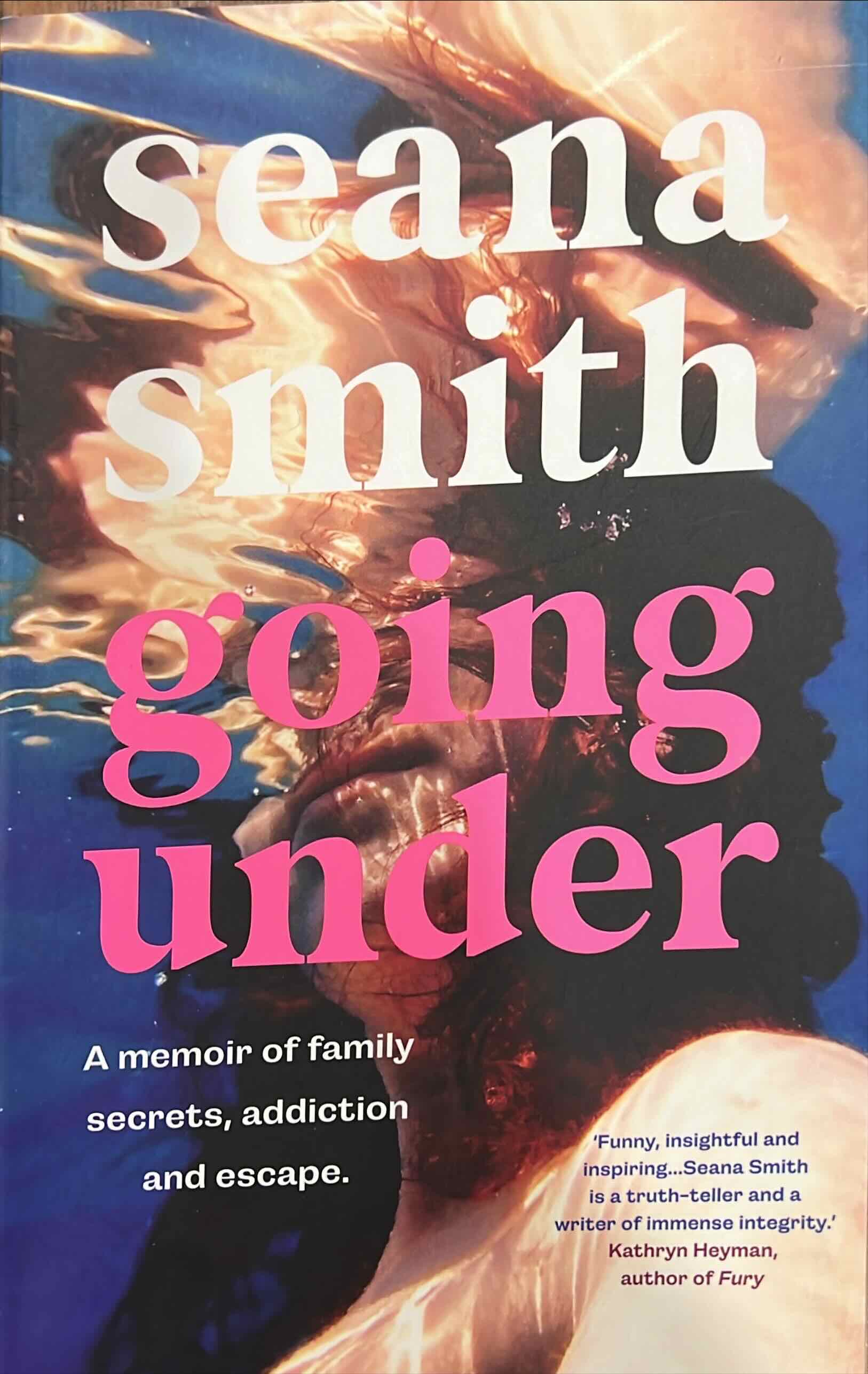
Going Under

Last Wednesday, I drove to Orange for my friend Seana Smith’s book launch.  Writing is a solitary occupation, but once the work is complete, it’s time to emerge and celebrate. Going Under was published only a few weeks ago. There is nothing more joyful than a beaming author holding up a copy of their book in print.

I met Seana through the Central West Writers, a group of people who met monthly in various locations. We were both members for several years, even if we didn’t attend regularly. When we came together, we listened to writers read sections of their work, offer a suggestion or two and cheer them on. When we saw their work come to fruition as a published article or book, it gave everyone encouragement to keep going. Writers’ groups can be a beacon of hope when we are stuck in the messy middle.

Seana’s book, Going Under, is a memoir which fearlessly chronicles her lifelong struggle with drinking. Like so many people I know, she has dealt with intergenerational alcoholism and trauma. These scars run deep, but we can effect healing when we face our demons.

Growing up in Scotland, drinking was part of the landscape. Moving around the world and finally settling in Australia didn’t change that. Nor did being successful in a variety of high-profile jobs. As an extrovert, Seana likes company, and having a glass in hand livens up a party. But drinking was much more than that for her. After much soul searching, Seana’s struggle with alcohol has finally come to an end. ‘My life will be better if I never drink again,’ came to her like a mantra that she could not ignore. And for over four years now, Seana has become a champion for sobriety.  

Going Under is published by Ventura Press. If your bookstore doesn’t have a copy, you can always place an order like I did. Or you can listen to the book in her wonderful braid Scots on Audible.

Whispers of an ancient land

The sun has slipped behind the rounded mountain at the rear of the cabin where I’m staying. Its rock face is in the shade for most of the day. I can tell from the height of the trees and the snow that lies in patches near the summit. Outside, it is 3 degrees, and we haven’t reached sunset yet.

I’m staying in an eco-cabin in the snowy mountains, a short distance from Jindabyne. Mobs of lazily grazing kangaroos straighten backs and ears before returning to their feed. We pose no threat. There are neat piles of square scat near the front door. A wombat’s calling card. Further up the mountain, wallabies hop leisurely across our path. Their pointy dark faces hold our gaze for a moment and before returning to forage in the scrub.

An echidna crosses the road in front of me. Breaking hard, I stop two metres before a ball of waddling spikes. Without a car behind me, I can wait for it to get across the deadly bitumen. I hope it stays on this side of the road. I have seen too much roadkill on this trip already. A sign announces emu corner. I turn to see two emus in the grassy paddock next to cattle and a ‘roo. This place is teaming with wildlife.

Snow gums are everywhere. These hardy trees have survived in subzero temperatures as well as blazing summer days. Most have a definite lean to them from the prevailing winds. Their smooth bark is ghostly white, with grey green or yellow vertical patterns. it peels in strips like sunburnt skin. Their lanceolate leaves droop, weeping and brooding.

There is a melancholy beauty to these twisted and stunted trees. I notice many dead trees walking in the alpine forests. Snow gum dieback is spreading throughout the region. Longicorn beetles are the culprits causing this mass destruction as they eat right through the tree from the outer to inner bark, leaving behind a graveyard of trees. These beetles are native and have never caused such destruction in the past. Could it be that successive droughts and higher than normal temperatures are creating the conditions for these beetles to reach plague proportions?  

Granite boulder outcrops mark the landscape. These stunning, smoothly rounded boulders of various sizes are clustered in paddocks and throughout the wooded areas. They are crystalised masses of magma brought to the surface over 400 million years ago. I am looking at an ancient landscape and I’m unable to process what it all means.

The Ngarigo and Walgal people know and understand this country deeply. It has been their spiritual home for millennia. The landscape holds within it the culture and knowledge which is inseparable from its traditional custodians. As an outsider looking in, I can feel the spiritual force of this place and am humbled by all that I don’t understand on a rational level. But I can feel its spirit and its message running through the contours. I see, but I’m unable to decipher. I am beholden to this ancient land, its stories, knowledge, and mystery.

Seville oranges

Towards the end of winter I went to look for Seville oranges at the farmers’ market. I asked every stall holder I came across, but had no luck. No one seems to plant Sevilles anymore. This reminded me of a road trip Roger and I went on five years ago.

Roger was known in the village as the marmalade man. Every winter he’d order a box of Seville oranges from a grocer he knew and then he’d spend the next week finely cutting and boiling the fruit. It was a ritual he loved. ‘I just let my mind wander,’ he’d say when I asked whether he was ever bored cutting oranges hour after hour. For him, it was a form of meditation. He made dozens of jars which he sold to loyal customers and there were always some left for family and friends.

One year, he wanted to do a trip down memory lane and take me out to the country he loved best. We headed for the Hay plains, stopping first at West Wyong and then Griffith, where he had worked many years ago. Griffith is orange country and some of the best fruit comes from its surrounding orchards. We stopped at at least six different farms asking for Seville oranges only to be told that they had pulled out the trees years ago. No one was buying them anymore.

These bitter oranges originated in Africa and were introduced to Europe by Genovese sailors in about the 10th century. Many believed these oranges were harbingers of happiness and, as such, the Moors planted them all over Spain. To this day, the city of Seville has over 14 000 of these bitter orange trees which make the best marmalade in the world. Sadly, there were none left in Griffith.

We returned from that trip with glorious memories, but no oranges. That year he made whisky marmalade using Navels. As Roger’s health deteriorated, I begged him to teach me the secret of making marmalade and the following year, when he sourced some of the elusive Sevilles, he relented.

‘Cut it on an angle like this,’ he’d admonish, or ‘that’s too thick’, but eventually he commended the efforts of his apprentice. Since his untimely death, I have continued the yearly marmalade tradition.

I went back to the farmers’ market a month ago and found a stall I hadn’t seen before. They only sold oranges and had a myriad varieties on offer. When I asked about Sevilles, the young woman said she’d ask the boss. A good sign, I thought.

‘The boss says they’re not quite ready to pick. Try again next week,’ she said. I was delighted. But the following week they still weren’t ready. After three more visits, the oranges finally arrived. In a mad bout of enthusiasm, I bought 3kg, which makes about 25 jars of marmalade.

The first batch was passable, but a poor imitation of Roger’s expertise. The next batch, however, was a perfect colour and consistency. I opened a jar for a taste test. Not bad, I thought. I fact, it is almost as good as his.