I have always loved the smell of bottled ink. It has a distinctive acrid smell that takes me back to learning to write in my first year at school. While today I find the smell nostalgic and comforting, the experience of forming letters on a page was torturous. Unlike children in Australia who learn to write using large, soft pencils, in Austria, we were expected to master the vagaries of the fountain pen at the age of six.
My memories of that time are shrouded in tears and ink blots on the page. Did I push too hard or was the pen leaky? Was the nib too thick or did I not hold the pen at the correct angle? Fountain pens can be tricky at the best of times. I don’t think I ever had ink free hands for the duration of my primary school years.
While quills have been used for centuries, the modern fountain pen was only invented in the early 1800s. It continued to evolve, with advances made by Lewis Waterman in America. His pens were able to be refilled and he invented a mechanism to allow ink to flow more freely. To this day, Waterman fountain pens are renowned for their style and reliability.
My pen clearly wasn’t a reliable one. My inky fingers no doubt made their way into my mouth as I turned pages. However, unlike with the forbidden book in Umberto Ecco’s Name of the Rose, there was no danger of any intellectual threat emerging from my scribbles. I was hardly going to be poisoned for my inattention by licking my blackened fingers. The only danger I faced was the wrath of my teacher for messy handwriting and blotting my copybook.
I am heartened that even King Charles has experienced the painful exposure to inferior pens even if he does own a Montblanc Solitaire among other prestigious pens. His outburst at Hillsborough Castle was beamed around the world. The newly crowned king was affronted by a leaky pen and let everyone know it. My own outbursts were met with a dressing down, a stern directive to stop moaning and to try harder. Not that any of this helped.
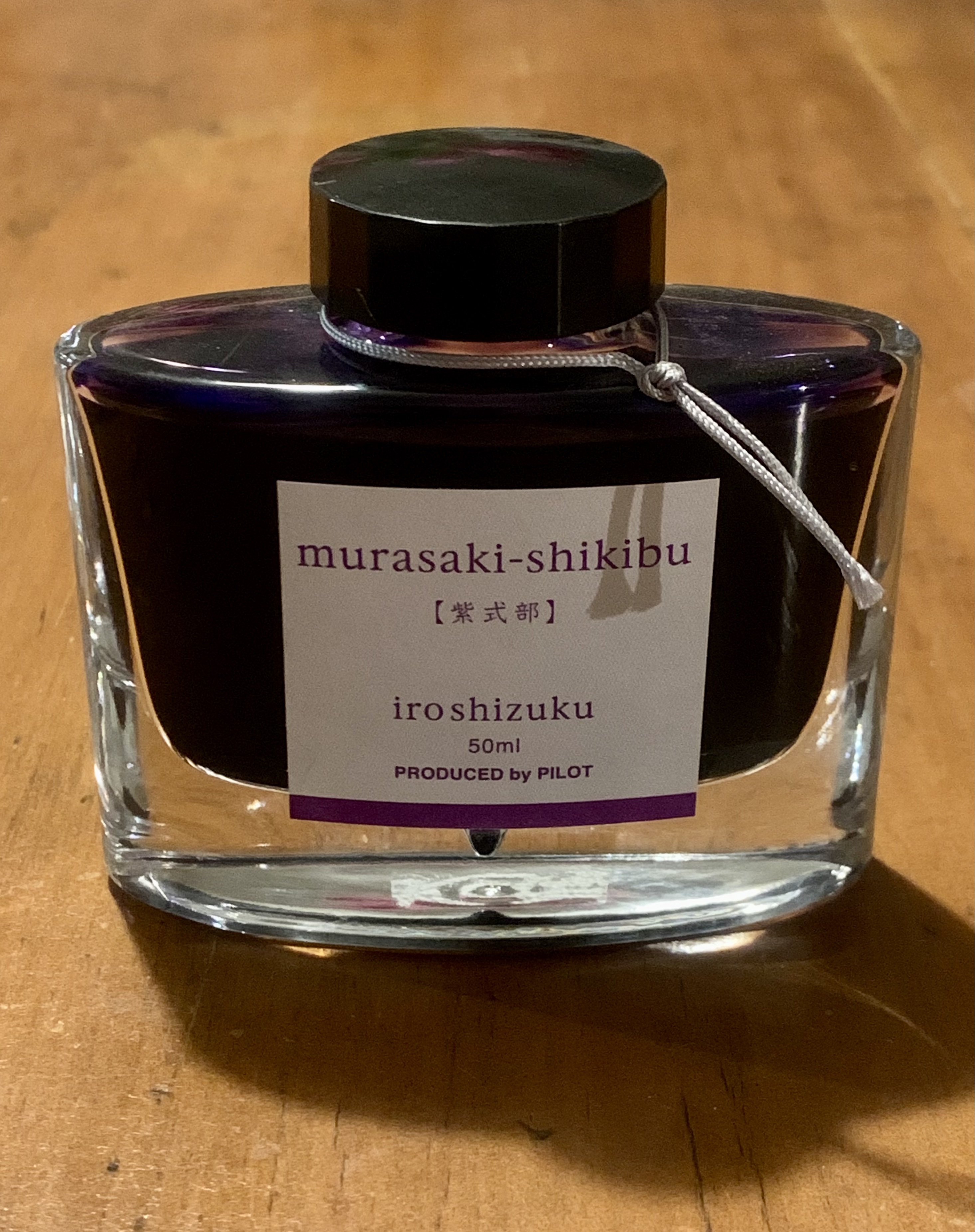
I don’t quite understand why I have persisted with fountain pens. Mine still leak and from time to time my blackened fingertips take me back to being a six-year-old. While I love all the wild ink colours that are available, I usually stick to black, just in case my signature needs to be validated or a page photocopied. Still, I love my Japanese murasaki-shikibu purple ink, named after the female Japanese writer who wrote the exquisite Tale of Genji in c.1010. This Japanese ink has a much more pungent smell than the inks I associate with my childhood. The shade of purple reminds me of my paternal uncle who would only write with a violet biro. Every time I use purple ink, it is a nod to my Hungarian uncle Lajos and his slight eccentricity which he maintained throughout his life. In a country where only blue or black were commonly available, it is hard to imagine where he sourced his pens.
I, on the other hand, am spoilt for choice. Besides the Pilot Japanese purple, my favourite Lamy colour is turquoise. In the Waterman range I adore absolute brown which is perfect for a nostalgic sepia look, harking back to the early twentieth century. For durability, however, I can’t go past Montblanc permanent black.
There is something almost subversive about writing with a fountain pen in the digital age where uniformity is prized over individuality. Colour is definitely not to be encouraged. But as always, I am happy to be counted among the renegades.
 From Quill to Quote
Ink had its curses in my primary school years but so glad I learned to write with it before Bic pens..( weren’t they Hungarian? )
LikeLiked by 1 person
Yes, learning to write with them as a young child is a curse but it never leaves you. Bic wasn’t Hungarian but Biro was. So the biro was named after him.
LikeLike
Oh what a lovely piece of writing. I have a ‘thing’ about pens. I prefer the ‘feel’ of some above others. And as for ink colours….
LikeLiked by 1 person
I know exactly what you mean. The feel of a pen is all important. It doesn’t matter how expensive a pen is, if it doesn’t feel right, it isn’t meant for you.
LikeLike