Bottled Ink

I have always loved the smell of bottled ink. It has a distinctive acrid smell that takes me back to learning to write in my first year at school. While today I find the smell nostalgic and comforting, the experience of forming letters on a page was torturous. Unlike children in Australia who learn to write using large, soft pencils, in Austria, we were expected to master the vagaries of the fountain pen at the age of six.

My memories of that time are shrouded in tears and ink blots on the page. Did I push too hard or was the pen leaky? Was the nib too thick or did I not hold the pen at the correct angle? Fountain pens can be tricky at the best of times. I don’t think I ever had ink free hands for the duration of my primary school years.

While quills have been used for centuries, the modern fountain pen was only invented in the early 1800s. It continued to evolve, with advances made by Lewis Waterman in America. His pens were able to be refilled and he invented a mechanism to allow ink to flow more freely. To this day, Waterman fountain pens are renowned for their style and reliability.

My pen clearly wasn’t a reliable one. My inky fingers no doubt made their way into my mouth as I turned pages. However, unlike with the forbidden book in Umberto Ecco’s Name of the Rose, there was no danger of any intellectual threat emerging from my scribbles. I was hardly going to be poisoned for my inattention by licking my blackened fingers. The only danger I faced was the wrath of my teacher for messy handwriting and blotting my copybook.

I am heartened that even King Charles has experienced the painful exposure to inferior pens even if he does own a Montblanc Solitaire among other prestigious pens. His outburst at Hillsborough Castle was beamed around the world. The newly crowned king was affronted by a leaky pen and let everyone know it. My own outbursts were met with a dressing down, a stern directive to stop moaning and to try harder. Not that any of this helped.

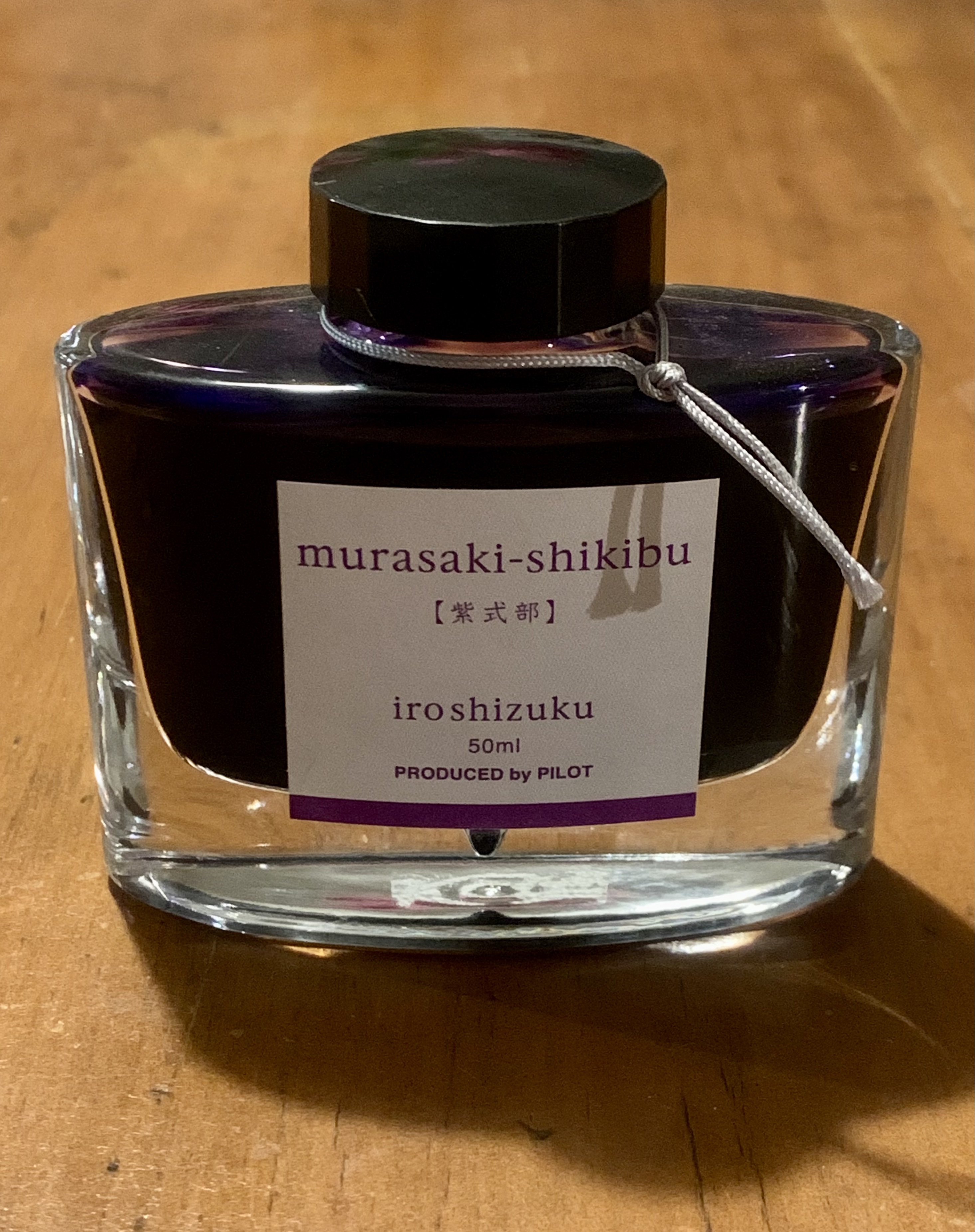
I don’t quite understand why I have persisted with fountain pens. Mine still leak and from time to time my blackened fingertips take me back to being a six-year-old. While I love all the wild ink colours that are available, I usually stick to black, just in case my signature needs to be validated or a page photocopied. Still, I love my Japanese murasaki-shikibu purple ink, named after the female Japanese writer who wrote the exquisite Tale of Genji in c.1010. This Japanese ink has a much more pungent smell than the inks I associate with my childhood. The shade of purple reminds me of my paternal uncle who would only write with a violet biro. Every time I use purple ink, it is a nod to my Hungarian uncle Lajos and his slight eccentricity which he maintained throughout his life. In a country where only blue or black were commonly available, it is hard to imagine where he sourced his pens.

I, on the other hand, am spoilt for choice. Besides the Pilot Japanese purple, my favourite Lamy colour is turquoise. In the Waterman range I adore absolute brown which is perfect for a nostalgic sepia look, harking back to the early twentieth century. For durability, however, I can’t go past Montblanc permanent black.

There is something almost subversive about writing with a fountain pen in the digital age where uniformity is prized over individuality. Colour is definitely not to be encouraged. But as always, I am happy to be counted among the renegades.

Cut flowers

Since my house has been on the market, I have bought flowers every week before the next inspection. It makes the dining room table look cheerful and inviting, adding colour and a touch of whimsy. I always choose brightly coloured ranunculus in a riot of hues. There is nothing serious about these flowers, and like gerberas, they make me smile each time I glance at them.

The flowers are grown by a local hobby farmer who brings half a dozen bunches to the local coffee shop each Friday. Her smile is every bit as bright as her flowers. The last time I saw her at the shop, she insisted I take a freshly picked bunch, so that the joy they bring lasts a day or two longer. I thanked her and paid my twenty dollars, an extravagance to some, but I love their impact on my house and mood.

As international flights have enabled cut flowers to be flown around the world so that orchids could be enjoyed mid-winter in Canada or Norway, it feels so much more intimate to buy freshly picked seasonal flowers.

In my twenties, as a student living on a small allowance in Berlin, I bought flowers each week to conjure up the sun in the eternal twilight months of winter. This small weekly ritual helped to soften loneliness and feeling lost in a new city. It brought hope of new life to come in spring, when the clouds would clear, and days lengthen.

Today, I am buoyed by the same message of hope. This period of my life will pass – clouds will part to reveal whatever comes next. I don’t need to know the details yet; all I need to do is to invite grace. And if flowers are to bring me hope and joy, they are worthy of a special place at my table.

Courage to share his story

Photo: Andreas F. Borchert

He approached us after casting his vote. A stranger who needed to share his story, to explain himself and his actions. A stranger who trusted that two women supporting an Aboriginal Voice would listen as he gave voice to his own story. 

He began to tell us of his Irish mother, a woman he loved dearly. She always claimed he was ‘fey’, alluding to his intuition and ability to sense things from beyond. He showed a keen interest in his Irish roots and had wanted to take his mother back, but this was not to be. After she died, he decided to make the trip on his own.

He sought out the places that were dear to his mother and met long lost family. The more time he spent on his mother’s Country, the more he felt the place holding him, welcoming a lost son. This feeling finally overcame him when he entered a small church in the village where his mother was born. As he stood at the baptismal font where she and generations of her family had been baptised, he succumbed to a flood of tears, held back for the longest time.

A gentle hand touched his shoulder. It was the parish priest.

Welcome home, son,’ he said, and our traveller felt he had truly arrived.

It was a moment akin to transcendence, a knowing that this was where his roots were, no matter where he would live out the rest of his life.

I too have experienced this sense of homecoming. A homecoming to a place that I can no longer call home, but a place where I feel the pull of my roots stronger than any other place I know. It is a feeling of merging and becoming one with the land, the trees and the birds that roost within them. I expand to take in all that is and experience both rapture and rupture between me and what lies beyond. Words cannot capture what happens in these moments, they will always stay ineffable.

Like my stranger, after experiencing what the Irish call ‘Thin Places’, where the veil between heaven and earth momentarily falls away to reveal the transcendent, I have but an inkling of Aboriginal people’s connection to Country. But like the man I met ever so briefly, I know where I stand and why I have chosen to take that stand.

Preoccupied

I’ve been too much in my own head to pay much notice to the world around me. I’m anxious about the sale of my house, the upcoming move, and the demands of my job. My nervous energy has no place to go now. I have done everything I can to display the house in the best light. It is fresh, clean and utterly appealing. I am spring loaded and restless. My energy needs to dissipate, so I take the dog for long walks around the village.

Recently, I’ve barely been able to keep in touch with friends and have not contacted family overseas. I know I should pick up the phone, but I am too distracted. When friends call, all I can talk about is what is happening in my life. At present, I am not a good listener. I am much too preoccupied.

An old friend called me this morning to see how I was travelling. I must have spoken for at least ten minutes about all my petty concerns before he said that he too was finding it difficult to concentrate. He mentioned his apprehension regarding the unfolding situation in Israel. I had no idea what he was talking about but, with a sense of foreboding, made a mental note to follow it up once the conversation ended.

I checked the ABC website and noted what had occurred while my own thoughts were spinning out of control. I read with increasing dread about the aftermath which will surely follow the Hamas strike. Regardless of the side you are on in this conflict, no good can come out of this unforeseen attack. Innocent people have paid and will continue to pay the price for this offensive. Opinions will be hardened, and the two sides will not be able to negotiate a viable settlement for years to come. There is a very real possibility that war could erupt, drawing in players from surrounding countries.

I am dismayed. I think about two incredible fathers I recently read about. One is Palestinian, the other is Israeli and both have lost young daughters due to the violence caused by this long-running conflict. Bassam Aramin and Rami Elhanan choose to build bridges rather than burn them down. They advocate dialogue instead of gunfire. Over the years, their grief has led to an unlikely friendship through which they are able to put their differences aside and show the world that reconciliation is possible on a personal level. As Rami put it, “instead of sharing the land that God gave us, we will share the graves underneath.” If two enemy ex-soldiers who can find their way to friendship through shared grief, what is holding us back from reaching out?

Maybe like me, the rest of us are too preoccupied with our own small problems to see beyond securing our own backyard. But the time has come to reach over fences and begin a genuine dialogue. Let’s engage in this radical act: listen to understand and allow for space to pause before responding.

Every new start is difficult

I sat on the floor with my back against the windowpane, feeling the warmth of the sun wash over me. It was mid-morning, and all was quiet. Two dogs were sprawled out dozing in front of me. I closed my eyes and joined them for a delicious short nap.

When I woke some minutes later, I gazed around sleepily, enjoying the strange sensation of having nothing to do. I was dog sitting in my townhouse in Canberra where my daughter currently lives. It will eventually become my place of residence, but for now, I am a visitor. Unlike back home, there is nothing that beckons to be done.

I began thinking about what life will be like living there. The nature reserve across the road is inviting as is the café which is a short stroll. What else? Sure, I could list the many attractions of living in a city again – the galleries, bookshops, markets, and events I could attend, but it all seemed rather undefined. While these are pleasant outings, they won’t define my life.

These concerns took me back to my first few months in Sydney. I was twenty-eight, hardly knew a soul in the city and was looking for work. I moved into a share-house with a young couple and spent days looking over the rooftops of Glebe. Frangipanis were blooming and scented the streets. Everything was verdant, fresh, and perfumed, a complete change to the European Plane trees of Melbourne. I spent hours sitting in my room, reading, and looking out onto an as yet undiscovered city.

Waiting for the phone to ring after applying for jobs meant I couldn’t leave the house. Mobile phones may already have been invented, but they were only accessible to well to do business types. I had only ever seen them in movies. Our phone was still the corded variety stationed in the hallway and I prayed for it to ring.  Lonely and bored, my days stretched out ahead without purpose. I was lost. These feelings were completely at odds with the life I had led in Melbourne. There, I had been busy studying, involved in university life and I had friends that reached back to my childhood. What had I done? As I sat on the floor feeling sorry for myself, a thought came upon me. Up until then, I had always been busy. Too busy in fact. I finally had a moment to stop and evaluate where I wanted my life to go. Given time, I would make new friends, get involved in the community and be busy again. I would look back on this time of inactivity and marvel at the opportunity it had afforded me. And as it turned out, that is exactly what happened. Within a year I had a group of friends, a job and social commitments galore. I longed for the days when I had nothing to do but look out the window…

My move to Canberra will follow a similar trajectory. Every new start is difficult. It will take time to find my tribe. This time, I have a job lined up which will make it all the easier. Within a year I will be bumping into friends, going out to dinner or concerts and I will reminisce over the time when I had nothing to do but sit with back against the windowpane and feel the warmth of the sun.